Tile Top Dining Tables: A Comprehensive Buyer’s Guide


Most homeowners who start shopping for a dining table think they're choosing a shape, a finish, and a chair style. Then real life enters the conversation. Someone sets down a warm serving dish. A child drags a plate instead of lifting it. Coffee rings sit for an hour during a long Saturday breakfast. Suddenly the table isn't just décor. It's a work surface, a gathering place, and a test of patience.
That’s where tile top dining tables deserve a fresh look. Not as a nostalgic throwback, and not as a novelty, but as a thoughtful answer for people who want beauty with backbone. A well-made tile top table has presence. It also gives you a surface that feels composed under daily use, especially in homes where the dining room does real work.
For the investment homeowner, that mix matters. You want a forever table that looks intentional, feels substantial, and doesn't ask you to panic every time dinner gets lively.
Beyond Wood An Introduction to the Tile Top Table
A lot of buyers come in comparing wood, stone, and glass. Wood feels warm. Stone feels dramatic. Glass can keep a room visually light. If you've looked at glass topped dining room tables, you’ve probably noticed how much the top material changes the personality of the entire room.
Tile sits in a different lane.
It brings pattern, texture, and craftsmanship to the center of the house, while also handling the kind of everyday friction that makes some homeowners nervous with other surfaces. You can live with a tile top table more casually. That doesn’t mean careless. It means confident.
Why tile feels different in daily life
A tile top has visual rhythm. Even a simple layout creates subtle breaks of color, glaze, and line. In a quiet dining room, that can keep a large table from feeling flat or heavy. In a busy kitchen-dining space, it adds character without demanding constant attention.
It also changes how people use the room. Homeowners often worry about preserving a beautiful dining table so carefully that they stop enjoying it. Tile top dining tables tend to relax that tension. You still get a polished, finished look, but the surface reads as resilient.
A forever table should invite use, not anxiety.
Who tends to love tile top dining tables
These tables often appeal to homeowners who want more than one design benefit at once:
- A practical surface: They want something that handles shared meals, homework, serving pieces, and everyday messes with less fuss.
- A distinctive focal point: They’re tired of tables that disappear into the room and want a piece with more personality.
- A custom look: They like mixing materials, such as tile with painted wood, oak, maple, or metal.
- Long-term value: They'd rather buy one well-considered piece than replace a trend-driven table later.
The biggest misconception is that tile limits your style. In practice, it often opens more possibilities. A tiled surface can feel old-world, modern, rustic, refined, or architectural and understated depending on the tile itself, the grout color, and the base beneath it.
The Enduring Allure and History of Tiled Tables
Tile top dining tables have been around far longer than is commonly realized. Their roots trace back to ancient Persia around 500 to 300 BCE, where artisans created intricate mosaic designs on durable surfaces. That tradition later evolved through the Italian Renaissance, when glazed ceramic tabletops became status symbols in wealthy villas. During the Industrial Revolution, tiled tables became more accessible to everyday households, and today they continue to blend craftsmanship with durability, with high-quality tiles lasting over 50 years with proper care according to this history of tile tabletops.
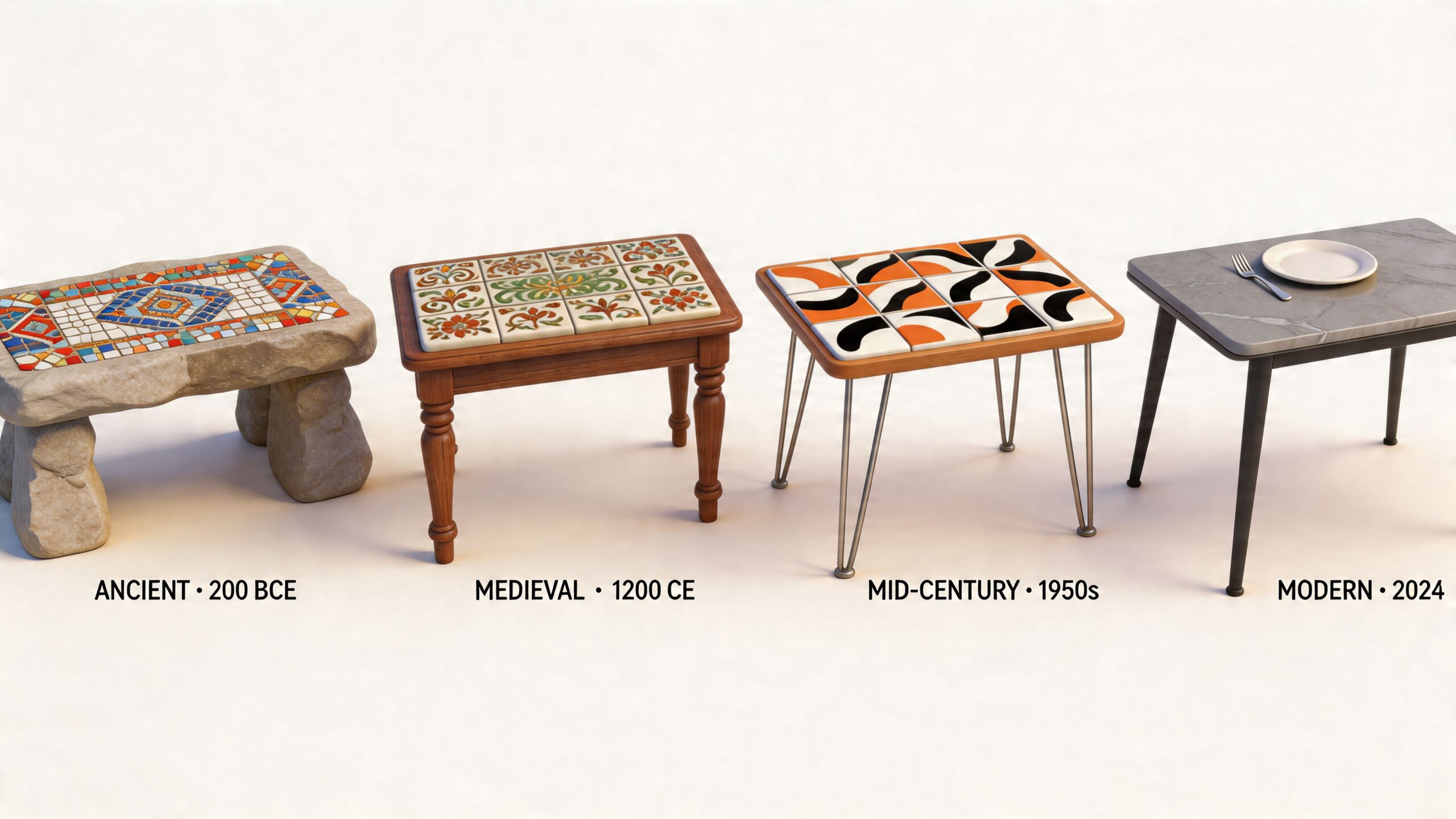
What makes that history useful today isn’t just the age of the idea. It’s the reason the idea survived. Tile solved two human needs at once. People wanted surfaces that could handle use, and they wanted furniture that said something about taste.
Why the look still works now
Good furniture survives when it keeps adapting. Tile has done that well.
In one room, a hand-finished ceramic top can feel warm and collected, especially with a solid-wood base and upholstered chairs. In another, a cleaner porcelain top with a restrained pattern can look refined and modern. The material carries history, but it doesn’t trap you in a period style.
That’s why tile top dining tables fit so many interiors:
- Traditional homes: Tile brings an artisanal note that pairs naturally with carved wood, painted finishes, and classic upholstery.
- Mediterranean and European-inspired spaces: It reinforces the architectural language already present in the room.
- Modern interiors: Simpler tile layouts offer texture without clutter.
- Collected family homes: Tile helps a dining space feel layered rather than showroom-perfect.
Character comes from variation
Wood has grain. Leather has patina. Tile has surface movement.
That movement might come from a glaze, a pattern, a matte finish, or the slight visual shifts that happen from tile to tile. Those details matter because a dining table is usually one of the largest uninterrupted surfaces in the room. If that surface is too flat, it can feel generic. Tile gives it narrative.
The best tile top tables don't look decorated. They look composed.
A homeowner often gets confused here and assumes “pattern” means “busy.” It doesn’t have to. A restrained tile selection can be quieter than a dramatic wood grain or a heavily veined stone. The lines between tiles can organize a large tabletop and make it feel balanced.
Why heritage matters for a forever purchase
People use the word heirloom too casually in furniture. A piece earns that label when it combines staying power with emotional presence. Tile top dining tables do that especially well because they carry both craft and memory. Family meals, holiday platters, board games, birthday candles, and ordinary weeknight dinners all happen on a surface that already feels storied.
That’s part of the appeal. You’re not buying a table that tries to imitate permanence. You’re buying into a tradition that has valued durable beauty for centuries.
Understanding Construction Quality and Materials
A tile top dining table is only as good as what sits underneath the tile. Buyers often focus on the visible surface first, which is understandable, but construction is what determines whether a table feels solid after years of actual use.
The strongest pieces use a composite build. The tile is mortared onto a rigid substrate, often supported by a wood or metal structure. That layered approach allows the top to distribute weight more effectively. According to the construction details summarized in this tile top table product reference, a tile top table can support dynamic loads up to 1,000 lbs, and proper construction can keep sagging to less than 1mm over a 5-year span.
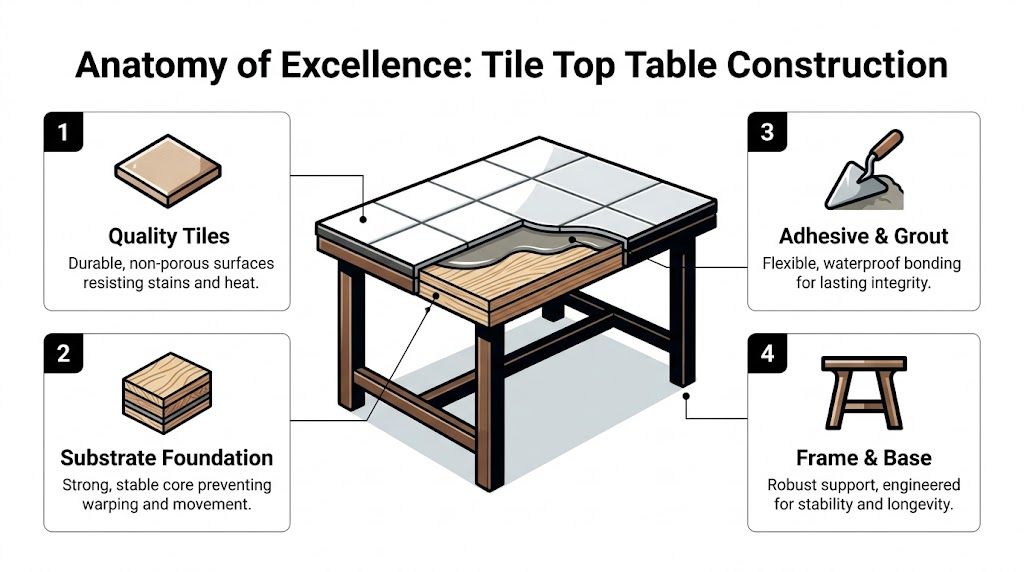
That tells you something important. A good tile top table isn't fragile surface treatment. It's engineered furniture.
The four parts that matter most
When you're evaluating construction, look at the table as a system:
Tile surface
This is the visible wear layer. It determines the table’s look, touch, and resistance to staining, scratching, and heat.Substrate foundation
This hidden layer keeps the top stable. If the foundation moves too much, the tile and grout will eventually show it.Mortar and grout
These hold the field together. They need to be appropriate for furniture use, not treated like an afterthought.Frame and base
The structure beneath the top carries the load and affects how steady the table feels when people lean, serve, or gather around it.
If you want a deeper look at what separates sturdy furniture from disappointing furniture, this guide to choosing the best table construction for family life is a useful companion.
Ceramic and porcelain aren't the same
Many buyers often pause here. Both ceramic and porcelain belong to the tile family, so they can seem interchangeable. They aren't.
High-quality porcelain is fired to create a denser, less porous surface. That affects how it behaves over time. According to the technical details in this porcelain dining table reference, porcelain has water absorption under 0.5%, while ceramic typically falls in the 3% to 7% range. The same reference notes a Mohs hardness rating of 7 to 8 for porcelain and the ability to withstand temperature changes up to 200°C without cracking.
For an indoor dining table, that translates into a few practical differences. Porcelain is usually the stronger choice when you want a denser, more stain-resistant, scratch-resistant surface. Ceramic can still be beautiful and appropriate, especially when the look of the tile is the priority, but it often asks for a bit more attentiveness.
Ceramic vs. Porcelain Tile A Comparison for Your Dining Table
| Feature | Ceramic Tile | Porcelain Tile |
|---|---|---|
| Surface density | Less dense | Denser |
| Water absorption | 3% to 7% | Under 0.5% |
| Scratch resistance | Good for many homes | Stronger resistance for daily wear |
| Temperature performance | Useful indoors | Can handle temperature changes up to 200°C without cracking |
| Best fit | Decorative warmth and classic character | Higher-performance, lower-porosity durability |
What stability feels like in person
Construction quality is easier to understand when you think beyond specifications.
A well-built tile top table feels calm. You set down a heavy serving bowl, and the top doesn’t telegraph stress. You lean your forearms on the edge, and the table stays planted. Chairs slide in and out around it without the whole structure feeling fussy or overworked.
Practical rule: If a tile top table feels shaky in a showroom, time won't improve it.
Because tile is mounted over a structural core, the table can also be lighter than many people expect compared with a solid stone slab. That can make placement and long-term ownership easier, especially in homes where rooms evolve over time.
Details worth checking before you buy
A buyer doesn't need to become an engineer, but a few questions reveal a lot:
- Ask about the substrate: A rigid, stable base matters as much as the tile itself.
- Inspect grout lines: Even joints look better and help protect the table from moisture issues.
- Check the frame material: Solid wood and well-finished metal both have roles, but the frame should feel substantial and well integrated.
- Look at edge treatment: The transition from tile to border should feel intentional, not patched together.
- Test for wobble: Stability is part of craftsmanship.
The best tile top dining tables reward close inspection. The surface may draw you in first, but the hidden structure is what earns your trust.
Designing Your Perfect Custom Dining Set in Columbus
Custom furniture gets talked about as if it’s only about color choices. In reality, the most satisfying custom dining sets begin with proportion. Before anyone chooses tile pattern, grout tone, or leg style, the table has to fit the room and the way the household lives.
That’s especially true for tile top dining tables, because the surface has such a strong visual voice. A custom piece should feel settled in the room, not squeezed into it or floating awkwardly with too little scale.

Start with shape before finish
A round tile top can soften a square breakfast area and make conversation feel easier. A rectangular top often works better in long rooms or open-concept spaces where the table needs to anchor a larger footprint. A square table can feel architectural and intimate at the same time.
The point isn't to chase a rule. It's to decide how you want the room to behave.
Ask yourself:
- How many people gather most often? Daily use matters more than holiday maximums.
- Do you serve family-style meals? Shared platters ask for generous surface area.
- Is the room formal, casual, or mixed-use? The answer shapes both size and edge profile.
- Do you want the table to blend or lead? Tile can do either, depending on selection.
Why tile is such a strong custom canvas
A tile surface gives you more room to create nuance than many buyers expect. You're not merely choosing “a top.” You're composing a layered piece.
Those choices often include:
- Tile color and finish: Matte, softly reflective, patterned, tonal, or clean and minimal.
- Layout: Grid, mosaic-inspired arrangement, larger-format simplicity, or a more artisanal composition.
- Grout tone: A close match gives a quieter field. Contrast makes the geometry more visible.
- Border treatment: Wood edging can warm the table. A sleeker frame can make it feel more contemporary.
- Base design: Pedestal, trestle, four-leg, or mixed-material support all change the feeling of the piece.
Custom dining sets become far more personal than off-the-floor furniture. A homeowner who loves solid wood furniture Ohio homes are known for may pair tile with a substantial wood base for warmth and weight. Someone drawn to a cleaner look may choose a simpler frame that lets the tile read almost like architecture.
Build around daily confidence
A custom table should do more than look good on a screen. It should solve real household needs.
The construction method behind many tile top tables supports that confidence. As noted in the earlier construction reference, these tables use a rigid substrate with mortared tile and can support dynamic loads up to 1,000 lbs, while also being 20% to 30% lighter than solid stone and maintaining less than 1mm of sagging over a 5-year span in proper builds. For a homeowner, that means a custom piece can feel substantial without becoming impractical.
That matters if you’re furnishing a renovation, planning around children, or choosing one table meant to carry decades of daily use.
A custom dining table shouldn't force you to choose between personality and peace of mind.
How to approach customization without getting overwhelmed
Many shoppers frequently freeze. They have too many choices and no sequence for making them. The easiest path is to choose from the ground up.
First decide the room's mood
Do you want the finished dining area to feel relaxed and European, refined and modern, or rooted in traditional craftsmanship? That answer narrows tile finish, wood tone, and chair style quickly.
Then choose the anchor material
Sometimes the tile is the star. Sometimes the base is. In homes with strong millwork or other wood furniture, a quieter tile may be the right move. In a simpler room, the tabletop can carry more visual interest.
Finish with seating and texture
A tile top has a tactile coolness. Upholstered chairs, woven seats, or hand-finished wood chairs balance that beautifully. This is often where homeowners can introduce softness and make the dining area feel complete.
If you're beginning that process, getting started with custom order furniture offers a practical way to think through your options before you make final decisions.
Why this matters in Columbus homes
Columbus homes span many styles. You’ll find newer open-concept builds, classic brick homes, renovated mid-century spaces, and houses where the dining room has to work hard every single day. Tile top dining tables adapt well to that variety because they can lean formal or informal without losing their sense of permanence.
They also pair naturally with the values many local buyers care about: custom dining sets, thoughtfully made pieces, and the kind of craftsmanship associated with solid wood furniture Ohio buyers seek out when they want lasting quality. In some interiors, they even sit comfortably alongside Amish-made furniture because both share an appreciation for material honesty and lived-in longevity.
Protecting Your Investment A Guide to Maintenance and Care
One reason homeowners hesitate with tile top dining tables is simple. They understand how to care for wood. They’re less certain about tile and grout. The good news is that tile itself is usually the easy part. The area that deserves the most attention is the grout.
According to the care guidance summarized in this mission tile furniture reference, indoor ceramic tile table grout should be resealed every 1 to 3 years to help prevent moisture penetration and staining. The same reference notes that tiles can often withstand 500°F, while standard grout can be damaged by temperatures over 200°F. That’s why trivets are still a smart habit, even on a durable tiled surface.

Daily care is refreshingly simple
For ordinary upkeep, think gentle and consistent.
- Wipe spills promptly: This matters most at the grout lines.
- Use a soft cloth: A damp microfiber cloth handles most daily cleaning.
- Choose mild cleaners: Harsh chemicals can wear down finishes and sealers over time.
- Dry the surface after cleaning: Especially around grout joints and edges.
If you’ve cared for a kitchen table before, none of this will feel difficult. The difference is that tile usually asks for less worry about rings and routine messes.
Grout is the maintenance priority
People often assume the tile needs constant special treatment. Usually, grout needs the attention.
Grout lines are slightly more vulnerable to moisture, discoloration, and gradual wear. That doesn’t make tile top dining tables high-maintenance. It means they benefit from a maintenance rhythm. Resealing on schedule protects the look of the table and helps preserve the integrity of the surface as a whole.
Care note: Protect the grout, and you protect the table.
For households in climates with seasonal humidity changes, regular inspection is wise. If grout starts looking dry, dull, or more absorbent than usual, it may be time to reseal.
Best habits that preserve the table longer
Some habits are easy to adopt and pay off over the long run:
- Use trivets under very hot cookware.
- Avoid abrasive scrubbers on decorative or glazed tile surfaces.
- Clean crumbs from grout lines rather than grinding them in with pressure.
- Use placemats if your household has frequent, energetic daily meals.
- Check edge joints occasionally, especially on older tables.
If you want broader advice on preserving a hardworking dining surface, this guide to protecting your kitchen table offers helpful principles that apply beyond tile alone.
What to do if the table starts looking tired
A tiled table rarely needs dramatic intervention to recover its appearance. Most often, it needs a careful cleaning, fresh grout sealer, and a reset of everyday habits. If the wood base or frame is part of the design, maintain that material according to its finish as well.
The main thing is not to confuse durability with invincibility. Tile is forgiving. Good maintenance keeps it elegant.
Value Financing and White-Glove Delivery
A forever table is rarely the lowest initial price in the room. It’s often the better long-term decision. That distinction matters for homeowners who care about quality but also want to buy responsibly.
With tile top dining tables, the value conversation starts with lifespan and use. You’re choosing a surface known for durability, then pairing it with construction that’s meant to stay steady under regular household life. That tends to shift the decision away from short-term bargain thinking and toward cost over years of ownership.
What value really means in furniture
Value isn't about finding the least expensive table. It’s about buying a piece that still feels right, functions well, and looks composed years from now.
That’s why the purchase experience matters too. Good design decisions can prevent expensive mistakes. Strong delivery service can prevent damage before the table even reaches the dining room. Clear pricing policies can remove a lot of buyer hesitation.
For homeowners shopping a furniture store Columbus Ohio market with many choices, it helps to compare not just products, but the entire ownership experience.
Four services that change the purchase experience
Some benefits matter before the sale. Others matter after the receipt.
- Custom Order Program: The ability to choose finishes, fabrics, and configurations through 3D visualizers helps buyers make fewer compromises and land on a table that belongs in the home.
- In-Store Design Studio: Complimentary Design Consultations give structure to decisions that can otherwise feel abstract, especially when coordinating a dining set with flooring, cabinetry, or nearby upholstery.
- Low Price Guarantee: A 110% refund of the difference if a lower local authorized dealer price is found within the stated period gives buyers reassurance that they're investing wisely.
- Clearance Gallery: Savings of up to 70% on select floor samples, overstocks, and closeouts can make premium furniture more attainable.
Financing can make the timing work
Many homeowners don't struggle with whether a quality table is worth it. They struggle with when to make the investment. Renovations, moves, and whole-home furnishing projects stack decisions on top of each other.
Flexible financing through Synchrony HOME can make the timing easier. It gives buyers a way to move forward with a better piece now instead of settling for a placeholder and replacing it later.
Delivery is part of the value, not an add-on
Dining tables are deceptively difficult to deliver well. The top has to arrive clean, stable, and undamaged. The base has to be assembled correctly. The finished piece has to sit level in the room where it will be placed.
That’s why white-glove delivery service matters. Proper in-home placement, assembly, inspection, and packaging removal save the buyer from the usual friction of furniture delivery. With a tile top, careful handling is especially important because a beautiful surface still deserves a careful landing.
Smooth delivery protects both the furniture and the experience of buying it.
For many homeowners, that’s the final piece of the value equation. A strong product matters. So does a process that respects the investment.
Frequently Asked Questions About Tile Top Dining Tables
Can a damaged tile be replaced
Sometimes, yes. It depends on how the table was built, how the tile field was set, and whether matching replacement tile is available. A custom or artisan tile may be harder to match later, which is one reason many careful buyers ask for a few extra tiles at the time of purchase when possible.
Are tile top dining tables good for families with children
Yes, often very good. Families usually appreciate the easy-clean nature of the surface and the lower stress around everyday messes. The main caution is to teach children not to strike the edge with heavy objects and to keep up with grout care over time.
How do tile top tables compare with solid wood in everyday use
They offer a different kind of peace of mind. Solid wood brings warmth, grain, and the kind of aging many people love. Tile brings more resistance to common dining-room mess and heat exposure. The better choice depends on whether you prioritize tactile wood character or a harder, more casually livable top surface.
Do they work in formal dining rooms or only casual spaces
They work in both. The style depends on the tile, grout, edge treatment, and base. A hand-finished tile with a substantial wood frame can feel refined and traditional. A sleeker porcelain layout can feel crisp and architectural in a more formal room.
Will a tile top feel too busy visually
Not if it’s chosen well. Many buyers think tile always means strong pattern. In reality, some tile tops are quite quiet. Tone-on-tone selections and subtle grout choices can make the surface feel textured rather than busy.
Do tile top dining tables pair well with Amish-made furniture
Often, yes. The connection is usually in the craftsmanship. A tile top can pair beautifully with the clean lines, joinery, and honest material expression associated with Amish-made furniture, especially when the base is solid wood and the palette is restrained.
What interior styles suit them best
They’re more versatile than people expect. They can feel right in traditional, Mediterranean, collected transitional, rustic, and even modern interiors. The key is coordination. The tile doesn’t have to dictate the room. It just has to belong to it.
Is it worth seeing one in person before buying
Absolutely. Tile is tactile. The sheen, texture, grout scale, and interaction with the base are much easier to judge in person than online. This is one category where touching the materials and seeing the table at room scale often changes the decision.
If you're ready to explore a forever dining table in person, Vinson Fine Furniture at Easton Town Center offers the kind of hands-on experience serious homeowners value. You can work with the In-Store Design Studio during a complimentary consultation, explore the Custom Order Program with 3D visualizers for fabrics, finishes, and configurations, and compare options for custom dining sets, solid wood furniture Ohio shoppers seek out, and even Amish-made furniture. For value-minded buyers, the Low Price Guarantee includes a 110% refund of the difference, and the Clearance Gallery offers savings of up to 70% on select pieces. Flexible financing through Synchrony HOME and White-Glove In-Home Delivery make the process feel as considered as the furniture itself.