Gray Dining Table and Chairs: An Investment Guide


A lot of homeowners reach the same point at the same time. The walls are painted. The floors are finished. The kitchen feels close. But the dining area still feels unresolved, as if it’s waiting for the one piece that will make the room feel grown up, welcoming, and complete.
That’s usually when the debate starts. Do you buy something trendy and hope it still feels right in a few years, or do you choose a dining set that can carry everyday breakfasts, holiday meals, homework sessions, and long conversations without looking dated by the next remodel?
Gray often answers that question better than people expect. A well-made gray dining table and chairs set can feel current without chasing fashion. It can soften a bright room, bring balance to warmer wood floors, and give you a neutral base that still has personality. Above all, it can support a home that needs to do more than one thing well.
The Modern Homeowner’s Guide to Timeless Dining
A dining room rarely serves just one purpose anymore. On Monday, it may hold takeout containers and laptops. By Wednesday, it becomes the landing place for school papers and design samples. On the weekend, it turns into the room where everyone stays a little longer after dessert.
That shift helps explain why buyers are paying closer attention to quality and flexibility. The global dining table market was valued at USD 8.22 billion in 2024 and is projected to reach USD 13.71 billion by 2032, with a projected 6.75% CAGR, according to Fortune Business Insights on the dining table market. The same report connects that growth to demand for multifunctional dining spaces and high-quality, customizable furniture, which helps explain why neutral, adaptable finishes such as gray keep gaining ground.
Gray works in this setting because it solves several design problems at once. It feels refined, but it doesn’t shout. It brings a modern edge, but it can still sit comfortably beside traditional millwork, vintage lighting, or a farmhouse floor plan. That’s a rare combination.
Consider two common homeowners. One is renovating a newer home near Easton and wants a dining set that won’t feel cold against white walls and black windows. The other is updating an older Columbus home with warmer trim and wants something lighter than espresso but less fragile-looking than a pale natural finish. Gray can serve both homes, because it sits in the middle. It adds depth without heaviness.
A timeless dining room usually isn’t built around a loud statement. It’s built around a dependable foundation that lets the room evolve.
That’s the appeal of gray dining table and chairs. The color gives you room to change art, rugs, lighting, and even chair upholstery over time, while the table itself still feels intentional. For an investment homeowner, that kind of flexibility matters just as much as style.
Understanding the Enduring Appeal of Gray
Gray has lasted because it does more than coordinate. It shapes the mood of a room.
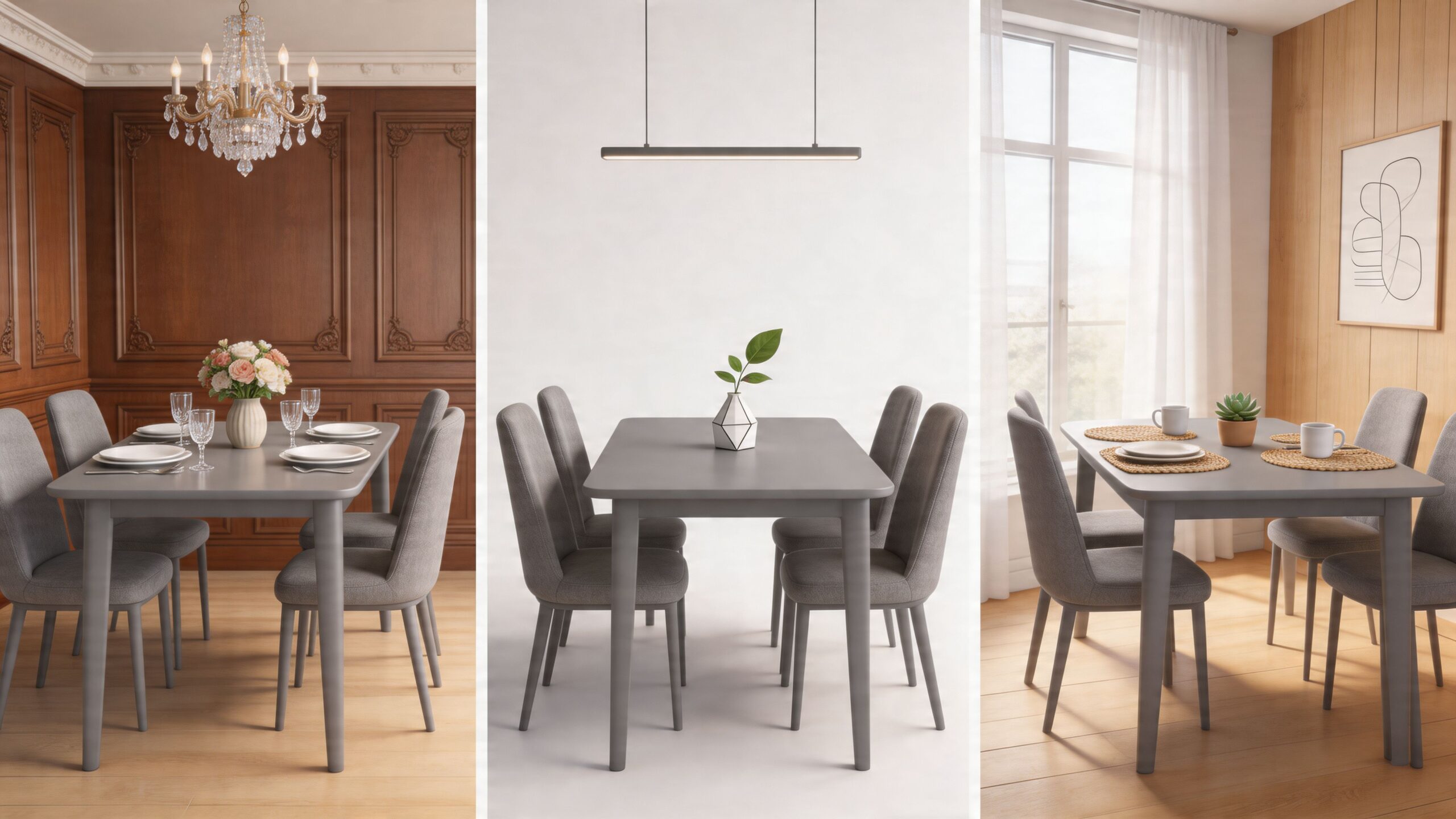
Gray is favored for its elegant ambiance and calming psychological effects, which can help diners feel more at ease, according to Chita Living’s discussion of gray dining chairs. That same source describes gray as a true design chameleon, able to integrate into nearly any interior style. That description fits what designers see in real homes every day.
Gray creates calm without looking flat
People sometimes worry that gray will make a dining room feel dull. Usually, the opposite happens when the finish is chosen well. Gray mutes visual noise. It lets the shape of the table, the grain of the wood, the texture of the fabric, and the glow of the light fixture do more of the talking.
In a busy household, that quietness matters. If your kitchen already has movement from countertops, hardware, tile, and open shelving, a gray dining set can act as a visual pause. The room feels settled.
That doesn’t mean every gray is the same. The confusion starts when homeowners shop as if gray were one color.
Cool gray and warm gray behave differently
A cool gray usually carries a blue or charcoal cast. It tends to work well with:
- Crisp architectural finishes like black window frames, white walls, and polished nickel
- Modern silhouettes such as slim legs, clean-lined side chairs, and minimal pendant lighting
- High-contrast palettes with black, ivory, and deeper navy accents
A warm gray leans toward taupe, mushroom, or weathered wood. It often works better with:
- Traditional or transitional homes that already have cream trim or warmer flooring
- Textural rooms with linen, woven shades, antique brass, or aged leather
- Layered neutrals like oatmeal, camel, clay, and soft olive
Practical rule: Hold your gray finish next to your floor before you fall in love with it under showroom lighting. Undertone conflict is what usually makes a “beautiful” table feel wrong at home.
Gray supports change over time
A dining room shouldn’t trap you into one decorating decision. That’s one reason gray outlasts more specific finishes. If you start with upholstered host chairs in ivory today, you can switch to top-grain leather later. If your room currently leans farmhouse, a change in lighting and art can move it toward modern classic without replacing the table.
That flexibility gives gray real staying power. A walnut table makes a stronger wood statement. A painted white table makes a stronger finish statement. Gray sits in the sweet spot between those two. It still has presence, but it leaves room for the rest of the room to grow.
Why gray feels current without feeling temporary
Trend colors usually demand attention. Gray doesn’t. It behaves more like a framework.
That’s why gray dining table and chairs show up in very different interiors and still feel at home:
| Style | How gray works in the room |
|---|---|
| Modern | Sharpens clean lines and pairs well with black, glass, and metal |
| Farmhouse | Softens rustic wood and keeps the room from feeling overly themed |
| Transitional | Bridges classic upholstery and updated lighting with ease |
| Traditional | Lightens the look of a formal room without losing elegance |
When homeowners choose gray well, they aren’t picking a compromise color. They’re choosing a finish that can age gracefully with the house.
Choosing Your Foundation Solid Wood and Finishes
The color may catch your eye first, but the material determines whether the piece will still feel solid years from now. For an heirloom-minded buyer, the most important question isn’t “What shade of gray do I like?” It’s “What is this table made of?”
A gray finish can be beautiful on many surfaces. That doesn’t make all surfaces equal. Solid wood ages differently, repairs differently, and moves through the seasons differently than veneer-heavy or composite construction. If you want a dining set that earns its place over time, the foundation matters.

Why solid wood changes the ownership experience
Many heirloom-quality gray dining sets are made with solid rubberwood, which has a Janka hardness rating of 1,070 lbf, nearly three times that of pine, according to New Classic Furniture’s Gia gray dining collection details. The same product information notes that rubberwood’s dense, interlocking grain helps resist warping and supports strong stability in high-traffic households.
That kind of detail matters more than most shoppers realize. A dining table gets pushed, leaned on, wiped down, bumped by chairs, and loaded with serving pieces. Wood that resists movement and stress gives the whole set a more grounded feel.
If you’re exploring solid wood dining tables, pay attention to how the base and legs are built, not just the tabletop finish. A handsome top can distract from weaker construction underneath.
Solid wood comparison for your dining table
| Wood Type | Hardness (Janka) | Grain Pattern | Best For |
|---|---|---|---|
| Rubberwood | 1,070 lbf | Dense, interlocking grain | Everyday family use, stable leg and apron construction |
| Acacia | 1,750 lbf | Varied, often pronounced grain | Busy homes that need a harder, more durable surface |
| Pine | 380 lbf | Softer, simpler grain | Lighter-duty use and more casual, less investment-focused settings |
What those hardness numbers mean in daily life
Janka hardness can sound technical, but the takeaway is simple. Harder woods generally stand up better to routine wear. They’re not immune to dents or scratches, but they begin with a stronger defense against them.
Rubberwood often surprises shoppers because it doesn’t always carry the prestige of oak or walnut in casual conversation. Yet in dining furniture, it can be a smart structural choice. Its density and grain pattern give table legs and frames dependable strength, which is exactly where you want steadiness.
Acacia, when used in dining sets, brings a different advantage. It’s harder and often more expressive in grain, which can make a gray stain look richer and more layered. That combination appeals to homeowners who want a neutral finish without a flat, painted appearance.
If you’re buying for a family home, judge the table with your hand as much as your eye. Press on the corners. Sit in the chair and shift your weight. A sturdy set feels composed, not delicate.
Choosing the right gray finish
Gray finishes aren’t only about color. They also change how the furniture feels and how wear will show over time.
A few common finish directions behave differently:
- Open-grain stained gray feels more organic. You see and feel more of the wood character. It suits homes that want warmth and texture.
- Smoother painted gray creates a more refined aesthetic. It can read cleaner and more architectural, especially with simple chair silhouettes.
- Lacquered gray gives a sleeker surface appearance. It fits more contemporary spaces and reflects more light.
- Lightly distressed gray can be forgiving in active households because small marks blend more naturally into the finish story.
The right choice depends on your lifestyle as much as your taste. A perfectly smooth finish may be ideal in a formal dining room used selectively. A hand-finished, lower-sheen surface often makes more sense in a room that handles weekday dinners and school projects.
Questions worth asking before you order
Many disappointments happen because buyers choose with their eyes only. Ask better questions, and the quality difference becomes easier to spot.
- What is solid wood and what is not? Ask which parts are solid wood, including legs, aprons, and chair frames.
- How does the gray finish show grain? Some grays look painted from a distance but reveal beautiful texture up close.
- Can this finish be touched up or refreshed? Repairability matters over a long ownership cycle.
- What will this look like in daylight and lamplight? Gray can shift dramatically through the day.
For investment homeowners, the table isn’t just the dining room’s centerpiece. It’s the room’s working surface, visual anchor, and long-term commitment. That’s why the foundation deserves more attention than the color card.
Finding the Perfect Fit Size and Shape for Your Space
A beautiful table that blocks traffic or crowds the room won’t feel luxurious for long. Fit is what separates a smart purchase from a frustrating one.
Most measuring mistakes happen because people only measure the table footprint. They forget the chairs, the pull-back space, and the walking path around the set. A dining room needs breathing room or it quickly starts to feel cramped.
Start with the room, not the product page
Measure the length and width of the room first. Then mark doors, windows, vents, and any nearby island or walkway that affects movement. If the dining area is open to another space, treat the traffic path as part of the plan.
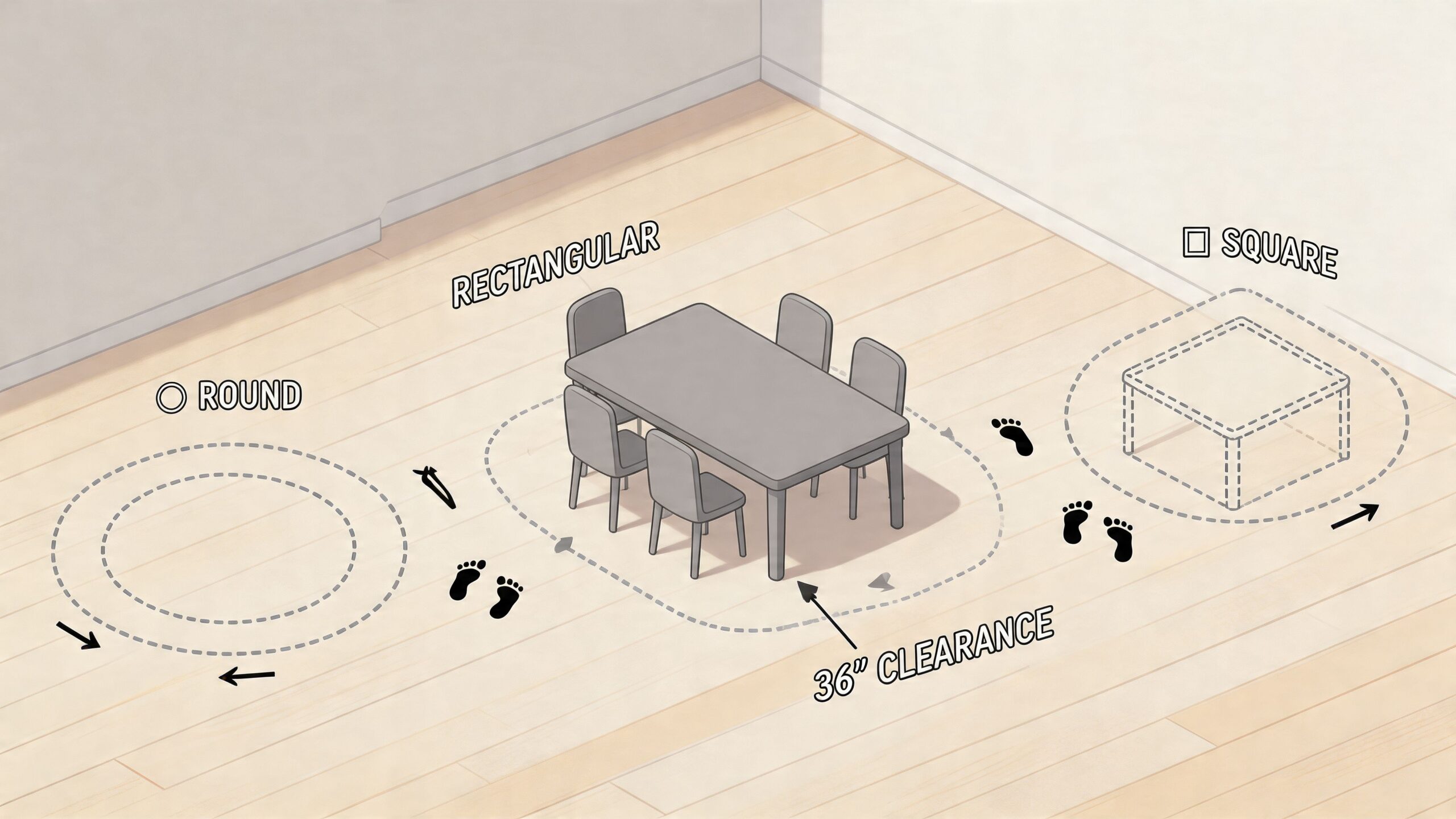
A good working rule is to aim for 36 inches of clearance behind each chair. That gives enough room for someone to sit down and for another person to pass without constant negotiation. In tighter homes, you may have to make careful compromises, but that benchmark helps you shop with discipline.
For many households, a taped outline on the floor tells the truth faster than any sketch. Use painter’s tape to map the table shape and chair pull-back zone. Walk around it. Pretend someone is serving dinner while another person opens a nearby cabinet.
Match the shape to how you live
A table shape changes conversation, flow, and seating flexibility.
- Rectangular tables work well in longer rooms and for larger gatherings. They create a strong architectural line and often suit open-concept homes.
- Round tables soften a room and encourage face-to-face conversation. They can be especially useful in square rooms or breakfast areas.
- Oval tables offer some of the sociability of a round table with the reach of a rectangle.
- Square tables can feel intimate, but they need the right proportions and enough room around them.
If you host often but don’t want a large table dominating the room every day, extension capability becomes valuable. The best expandable tables feel intentional both closed and open. They should never look like two different personalities stitched together.
Counter height needs its own evaluation
Counter-height gray sets can be an excellent fit in casual dining spaces, especially where the room blends into the kitchen. They create a more relaxed, refined look and can make everyday meals feel slightly more social.
Some counter-height gray dining sets use solid acacia wood, which has a Janka hardness of 1,750 lbf and is 45% harder than red oak, with strong dimensional stability in changing climates, according to Living Spaces product details for the Strine grey counter set. That durability can be appealing in busy Central Ohio homes where the set sees daily use.
If you're sorting through proportions and layouts, a practical guide to dining table shapes and seating arrangements can help you pressure-test your plan before you commit.
The right table size should make the room feel easier to use, not merely fuller.
The Art of Coordination Chairs Decor and Fabrics
Many homeowners often hesitate. They’ve chosen a gray table they love, then stall on the chairs because they don’t want the room to feel cold, mismatched, or too formulaic.
That hesitation is justified. A 2025 Houzz report found that 42% of dining room search queries involve “gray table color matching,” according to the cited summary at Macy’s gray dining room sets page. Gray’s undertones can create confusion, especially when a cool gray table is paired with warm beige upholstery, or a taupe-gray finish is set beside a blue-gray rug.
Start with undertone before style
Most coordination mistakes are really undertone mistakes.
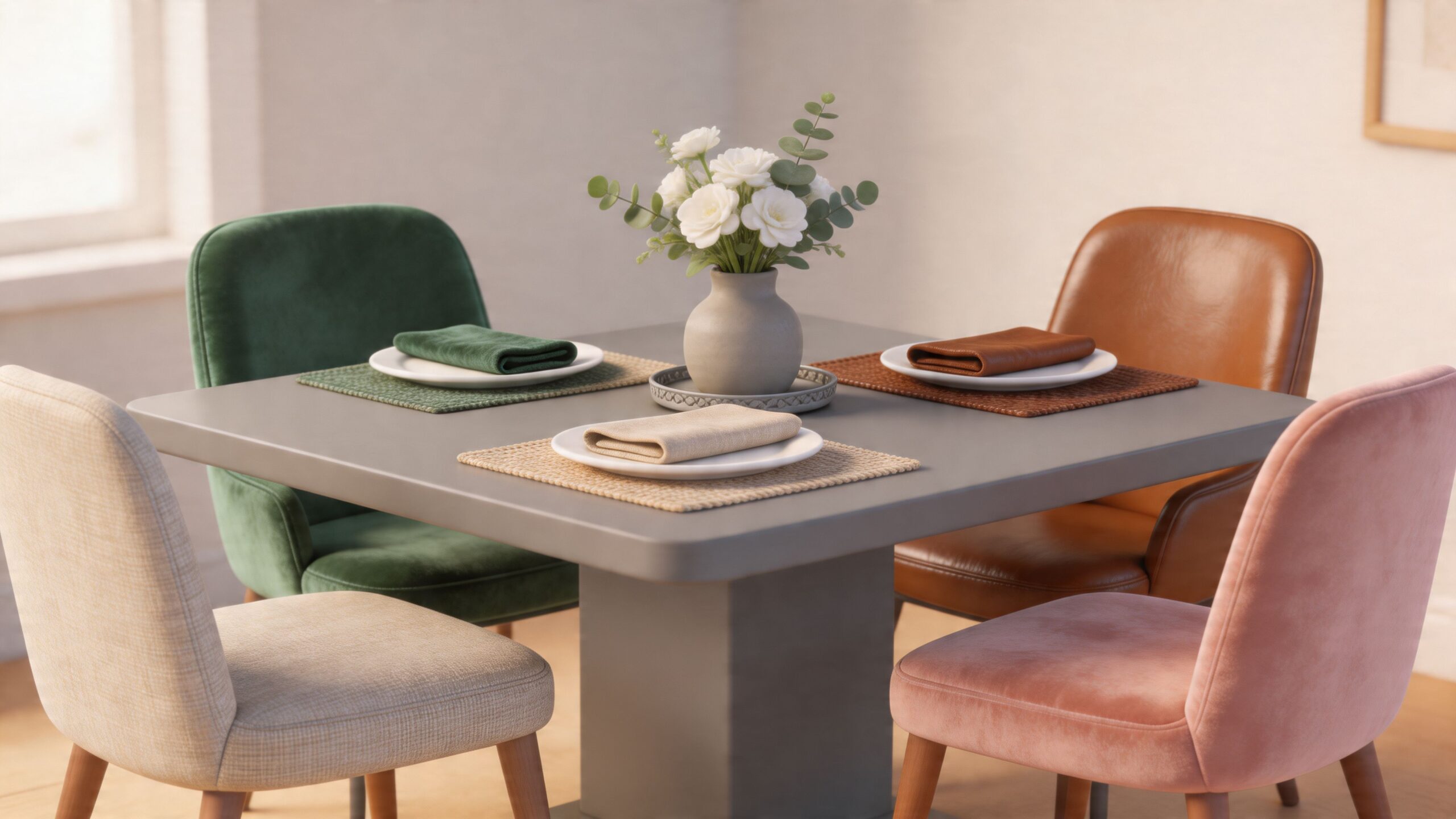
A cool gray table often pairs better with fabrics and finishes that feel crisp or clean. Think charcoal, ivory, slate blue, black, or nickel tones. A warm gray table usually prefers softer company, such as greige linen, camel leather, muted olive, aged brass, or warmer oak accents.
If a room feels “off” and you can’t explain why, the issue often isn’t scale or quality. It’s temperature. The colors are pulling in different directions.
Three chair strategies that work with gray
You don’t need to buy a fully matching set to create harmony. In fact, many investment homeowners prefer a more collected look.
One finish, varied texture
Keep the chairs in the same tonal family as the table, but change the material. A gray wood table with upholstered side chairs in a soft performance fabric can feel layered and calm. This works well in transitional homes where you want comfort without visual clutter.
Contrast with intention
Pair the gray table with darker wood, black frames, or leather seating. This approach gives the room structure and can keep gray from reading too soft. It’s especially useful in modern and industrial-leaning spaces.
Use host chairs as the accent
Keep side chairs simpler, then add two more expressive end chairs. That may mean a curved upholstered armchair, a richer leather, or a bolder fabric pattern. The room still feels cohesive because the gray table acts as the anchor.
A gray table doesn’t need matching gray chairs. It needs chairs that respect its undertone and balance its visual weight.
Fabric choices change the mood fast
Chair upholstery is where homeowners can express personality without sacrificing flexibility. If the table is the anchor, the seat fabric is the mood setter.
Consider how different upholstery directions influence the room:
- Performance fabric suits family dining because it feels approachable and refined at the same time.
- Top-grain leather adds depth and age-worthy character, especially in warmer gray settings.
- Textured woven neutrals create softness and are excellent when the table has a smoother finish.
- Velvet or high-pile textures can make the room feel more formal or decorative, which may be beautiful but less practical for some households.
If you want to make better upholstery decisions, it helps to understand upholstery materials beyond simple color names. Texture, hand feel, cleanability, and visual weight all affect whether a chair still feels right years later.
Decor pairings that keep gray from feeling sterile
Gray’s neutrality is useful, but a room still needs warmth and rhythm. A few thoughtful pairings solve that quickly.
| Element | Good companion for gray dining table and chairs |
|---|---|
| Rug | Cream pattern, muted blue, soft taupe, or earthy geometric |
| Lighting | Aged brass, matte black, or mixed-metal chandelier |
| Centerpiece | Greenery, ceramic vessels, or low seasonal florals |
| Wall art | Warm neutrals, abstract charcoal, landscape tones, or soft color blocks |
The easiest way to make gray feel rich is to combine it with natural materials. Wood bowls, linen drapery, leather, wool, and ceramic surfaces all help the room feel layered instead of flat.
Protecting Your Investment Long-Term Care and Maintenance
A solid dining set earns marks from real life. The goal isn’t to keep it untouched. The goal is to help it age well.
Gray finishes need a little intention because they can reveal buildup, scratches, or dryness differently depending on sheen and undertone. A pale, smooth gray may show crumbs and surface haze sooner than a deeper open-grain gray. A distressed finish may hide minor wear better, but it still deserves proper care.
Daily habits that preserve the finish
A consistent routine usually matters more than specialty products.
- Wipe after meals: Use a soft cloth after everyday use so residue doesn’t sit on the finish.
- Catch spills quickly: Liquids left under plates, placemats, or serving bowls can create avoidable trouble.
- Use a barrier under heat and moisture: Trivets, coasters, and felt protectors prevent small issues from becoming visible ones.
- Lift, don’t drag: Serving pieces, decor, and even chairs can scratch more than people realize.
If your set has a lower-sheen, textured gray finish, wipe with the grain so residue doesn’t settle into character lines. If it has a smoother painted or lacquered surface, use a clean cloth that won’t leave lint or streaks.
Seasonal care matters in Ohio homes
Wood responds to its environment. In Central Ohio, indoor air can shift across the seasons, especially in homes with forced-air heating or strong summer humidity. That doesn’t mean a quality table is fragile. It means steady indoor conditions help it perform better over time.
Keep the table away from direct, intense sunlight when possible, especially if one side of the room gets repeated afternoon exposure. Use window treatments if the room runs bright. Sunlight can change how a gray finish reads and may age one area faster than another.
Wood furniture lasts best in homes that stay reasonably consistent. Sudden swings in heat, dryness, and moisture are harder on the piece than daily use.
Know the finish before you treat a flaw
Not every scratch should be handled the same way. A distressed or hand-rubbed finish may allow for subtle touch-up blending. A smooth painted finish often needs a more exact approach to avoid making the repair more visible than the mark itself.
That’s why care advice should match the material and finish you own. A practical guide to how to care for wood furniture is helpful because it encourages finish-aware maintenance instead of one-size-fits-all cleaning habits.
Long-term value comes from two things working together. Buy well, then care for the piece as if you expect to keep it.
Begin Your Design Journey at Easton Town Center
Reading about construction, finish, and scale helps. Sitting at the table changes everything.
The moment most investment homeowners gain clarity is when they stop comparing tiny screen images and start interacting with the furniture itself. They pull out a chair. They run a hand across a gray finish to see whether it feels dry, waxy, smooth, or open-grained. They notice whether the seat invites a lingering dinner or signals that the room was styled more for photos than for living.
That’s why the showroom experience still matters, especially for gray dining table and chairs. Gray is nuanced. One finish may look warm and architectural in daylight, while another reads cooler and more formal under ambient lighting. Seeing those differences in person removes a lot of uncertainty.
For homeowners searching for a trusted furniture store in Columbus, Ohio, Easton Town Center offers the kind of in-person comparison that makes long-term decisions easier. It’s where finish, comfort, and craftsmanship become tangible.
What a thoughtful buying process looks like
A strong design process usually begins with your room, not the retailer’s inventory. Bring photos. Bring floor plans. Bring measurements and samples if you have them. A useful consultation looks at the dining room as part of the whole home.
The most helpful guidance usually focuses on questions such as:
- How formal is this room really? A home may have a dining room, but the way your family uses it should drive the choice.
- What finish undertone already exists? Floors, cabinets, trim, and nearby countertops all affect which gray will feel right.
- What kind of seating comfort do you want? Some people host long dinners and need supportive upholstery. Others want a cleaner all-wood profile.
- Will the room need to flex? Extension leaves, host chairs, and wipeable fabrics can matter more than expected.
A showroom with an in-store design studio can make these decisions less abstract because you can compare finishes, fabrics, and configurations together instead of guessing across several websites.
Customization is where heirloom quality becomes personal
An heirloom-quality table should fit your life, not force your life to fit the table. That’s where a robust custom order program matters.
The best custom process lets you shape the piece across multiple dimensions:
| Custom decision | Why it matters |
|---|---|
| Table size and shape | Ensures the room functions well for daily life and gatherings |
| Finish selection | Lets you tune the undertone to your floors, lighting, and adjacent rooms |
| Chair silhouette | Changes the room’s personality from tailored to relaxed to formal |
| Fabric or leather | Balances comfort, maintenance, and personal style |
| Configuration | Helps the set fit how your family actually sits and hosts |
Digital visualizers are especially useful here. They help you see combinations before production, which is far more reliable than trying to imagine a swatch beside a finish chip in isolation.
Value matters, even in a premium purchase
Investment-minded buying isn’t the same as overspending. It means looking closely at what you get for the money and how long that value lasts.
A good buying experience should include transparent pricing, confidence in quality, and practical options if you’re furnishing more than one room at once. That’s where details like a Low Price Guarantee with a 110% refund of the difference, Clearance Gallery savings up to 70%, Flexible Financing through Synchrony HOME, and White-Glove In-Home Delivery become meaningful. They help remove friction from a major purchase without reducing the conversation to bargain hunting.
For some buyers, the best path is a fully customized dining set. For others, a floor sample or seasonal closeout offers immediate value while still delivering premium construction. The important part is having both routes available.
The final step should feel easy
Once the design is settled, delivery should protect the investment you just made. White-glove service matters because dining sets are heavy, precise, and vulnerable to damage if handled casually. Proper inspection, placement, assembly, and packaging removal make the last step feel as considered as the first.
That full experience matters. An heirloom piece shouldn’t arrive with the feeling of a rushed transaction. It should enter the home with the same care that went into selecting it.
Gray remains one of the smartest foundations for a dining room because it combines flexibility, poise, and longevity. But the right gray set isn’t just found. It’s chosen carefully, fitted properly, and finished in a way that supports the life of the home.
If you’re ready to see what heirloom-quality gray dining table and chairs look like in person, visit Vinson Fine Furniture at Easton Town Center. Their team offers complimentary design consultations, an in-store Design Studio, a Custom Order Program with 3D visualizers, a Low Price Guarantee with a 110% refund of the difference, a Clearance Gallery with savings up to 70%, flexible financing through Synchrony HOME, and White-Glove In-Home Delivery. For Columbus homeowners who want lasting value and personal expression, it’s a smart next stop.