Design Your Perfect Home Office Furniture Layout

If you're working from a dining table, a guest room corner, or a desk that looked right online but never felt right in daily use, the problem usually isn't motivation. It's layout. A strong home office furniture layout gives your work a real place to happen, with enough room to think, move, store what matters, and look polished on a call.
That matters more now because home offices aren't temporary anymore. They've become part of how a home performs. For an investment homeowner, that changes the standard. The question isn't how to fit a desk into a room. It's how to create a workspace that protects comfort, supports focus, and still feels worthy of the rest of the house.
Foundations for a Functional Home Office Layout
A good layout starts before you shop. Most layout mistakes happen when people choose furniture first and try to solve the room afterward. The result is familiar: a desk that blocks a vent, a chair that clips the wall, or shelving that looks balanced but leaves no comfortable place to work.
Professional guidance recommends a minimum workstation envelope of about 60 inches wide by 84 inches deep for comfortable movement, with a desk that starts at 48 inches wide and 28 to 30 inches high, plus about 30 inches behind a floating desk for access, according to Houzz's home office measurement guide. Those numbers are useful because they shift the conversation from style to fit.
Measure the room like a designer
Start with the room empty, or as empty as you can get it. Measure the full width and depth, then mark every fixed element that affects placement:
- Door swing: Include the full arc, not just the door opening.
- Windows: Note sill height and where natural light lands during the workday.
- Outlets and data points: These often decide where your desk can function cleanly.
- Floor vents and returns: Never bury them under case goods.
- Baseboards and trim: Deep trim can change how tightly furniture fits.
- Radiators or wall registers: These create no-go zones for desks and storage.
Draw the room on paper or in a simple floor-planning app. Then sketch likely circulation paths. You should be able to enter the room, sit down, stand up, and reach storage without a collision course.
Practical rule: If you have to turn sideways to get into your chair, the room isn't too small. The layout is too tight.
Map function before furniture
List what the room has to support. Focused computer work is different from paper-heavy admin, design work, reading, or regular video calls. A layout for deep concentration usually wants fewer visual distractions. A layout for frequent calls may need a stronger backdrop and better control of light.
This is also where expert planning saves money. A complimentary design consultation can catch the small mistakes that turn into expensive returns, especially in rooms with awkward windows, alcoves, or shared uses. If you want inspiration before you visit a showroom, these home office furniture ideas are a useful starting point for thinking through shape, scale, and storage.
Desk Placement Ergonomics and Flow
The desk is the anchor of the room. A 2020 Statista report found that 27% of U.S. consumers prioritized a desk when furnishing a home office, which reflects how often every other layout decision is built around that single piece, as summarized in Statista's home office furniture coverage.
That matches what works in practice. Get the desk placement right, and the room starts to solve itself. Get it wrong, and no chair, lamp, or bookshelf will fully fix the feeling.

Three placements that usually work
Facing the entry
This is often the most confident arrangement. You sit with a view of the room, which helps many people feel settled and in command of their workday. It also creates a more intentional backdrop for video calls, because what appears behind you can be designed instead of tolerated.
The trade-off is space. A floating desk needs room around it, and in smaller rooms that can quickly feel wasteful if the proportions aren't carefully managed.
Against a wall
This is the most efficient option, and for many people it's the best one. It preserves open floor area, simplifies cable management, and can sharpen focus because the visual field stays controlled. In narrower rooms, this approach often makes the office feel calmer.
The downside is that wall placement can invite bad ergonomics if the desk is undersized or if upper shelving crowds the monitor zone.
Centered in the room
This works best in a larger office where the desk is meant to carry visual weight. A solid-wood executive desk looks right when it has breathing room. It also creates a natural distinction between the primary work area and secondary storage along the perimeter.
But don't choose this arrangement only because it looks impressive. If it compromises movement or forces your storage too far away, it becomes decorative at the expense of function.
Prioritize health over symmetry
A desk should sit where your body can work well, not where the room looks most mathematically balanced. That means your monitor height, chair position, arm support, and leg room matter more than whether the desk is centered perfectly between two windows.
The most attractive layout often isn't the most comfortable one. The longer you work from home, the more that difference matters.
Material and construction also play a vital role here. A solid wood desk holds up to years of movement, weight, and daily contact in a way lighter temporary furniture often doesn't. For buyers looking at long-term use, it is one of the clearest places to invest in craftsmanship, including the kind of hand-finished and Amish-made furniture many homeowners in Central Ohio seek out when they want permanence rather than a stopgap.
Chair selection belongs in the same decision, not after it. A desk and chair need to be tested together. The seat height, arm profile, and desk apron all affect comfort. If you're comparing proportions and silhouettes, this selection of writing desks and office chairs shows how different combinations can change both posture and visual weight in the room.
What fails most often
Poor desk placement usually shows up in predictable ways:
- Window glare: Natural light is valuable, but direct glare on a screen gets old fast.
- Door conflict: If the door opens into the back of your chair, the layout never feels settled.
- Overscaled desks: A large desk can make a room feel important, but it can also strangle circulation.
- Background neglect: If you're on calls often, the space behind you is part of the layout, not an afterthought.
Smart Storage and Shelving Strategies
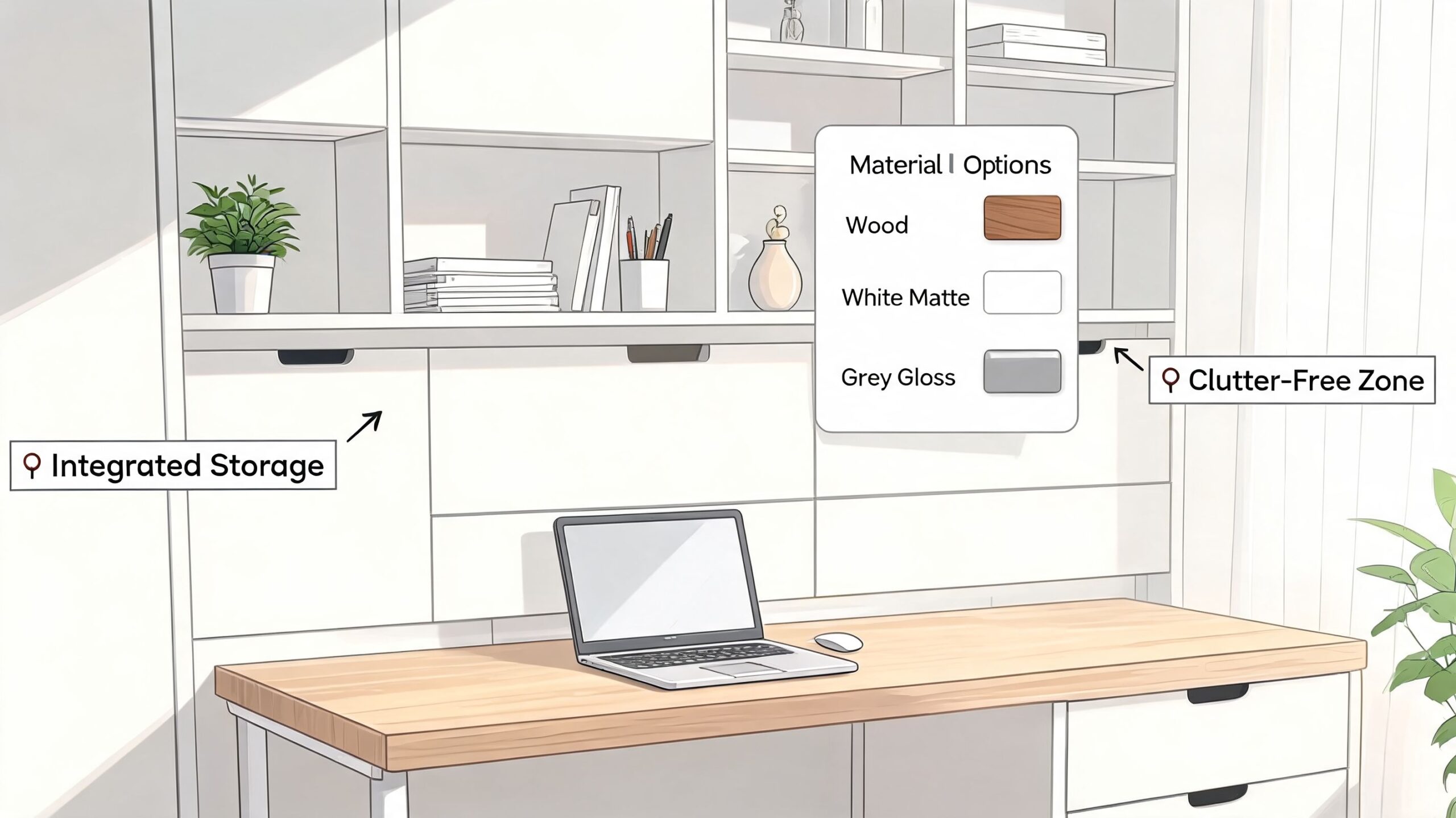
Clutter usually isn't a storage problem alone. It's a zoning problem. When everything lives at the desk, the work surface becomes a catch-all for papers, chargers, reference materials, and devices that don't need to be there.
The strongest home office furniture layout separates the space into working zones. Ergonomic guidance summarized by Ideal Home's home office layout advice notes that layouts often work better when the primary work zone is separated from secondary storage such as printers and file cabinets, even if that uses a slightly larger footprint.
Build a storage hierarchy
Not everything deserves prime real estate. Sort office items by frequency of use.
- Daily-use items: Pens, notebooks, chargers, current files, and task lighting should stay within easy reach.
- Weekly-use items: Reference binders, a printer, and supplies can sit nearby but off the main desk.
- Archive items: Tax files, extra paper, and long-term storage belong in closed cabinetry, a credenza, or taller case pieces.
This approach keeps the desktop open for actual work. It also reduces the constant twisting and reaching that can make a room look efficient on paper but feel tiring in practice.
Use height without making the room top-heavy
Tall bookcases and wall-mounted shelves are useful, but they need restraint. If every vertical surface is filled, the office starts to feel busy and mentally loud. A good rule is to let one wall do most of the storage work while another wall stays visually quieter.
Closed storage usually looks cleaner than open storage in a workroom. Open shelves are best reserved for books, framed art, and a small number of objects you want visible. They're less successful for mixed office supplies unless you're disciplined enough to keep them edited.
A clear desk doesn't happen by accident. It happens when the room gives every necessary item a better home than the work surface.
Custom sizing matters here. A credenza that's too deep crowds circulation. A hutch that's too tall can dominate the desk. A shelving unit that stops awkwardly short of the ceiling can make even expensive furniture feel unresolved. If you're working through those clutter decisions, this guide on how to solve clutter issues once and for all is a practical reference for matching storage type to actual habits.
Match storage to the room's architecture
The cleanest offices respect the room they're in. In a traditional room, paneled bookcases or a substantial wood credenza can feel grounded and appropriate. In a lighter, more contemporary space, slimmer shelving and lower closed storage often preserve the airiness better.
The goal isn't to cram every function into one footprint. It's to let the desk remain the center of work, while storage offers unobtrusive support.
Layout Templates for Common Room Sizes
Many individuals do not start with a purpose-built office. A Nulab survey summarized by Loctek Motion found that only 28.6% of remote workers use a dedicated home office, while many work from a master bedroom (28.5%) or living room (19.9%). That's why a practical home office furniture layout has to work in real homes, not just ideal floor plans.
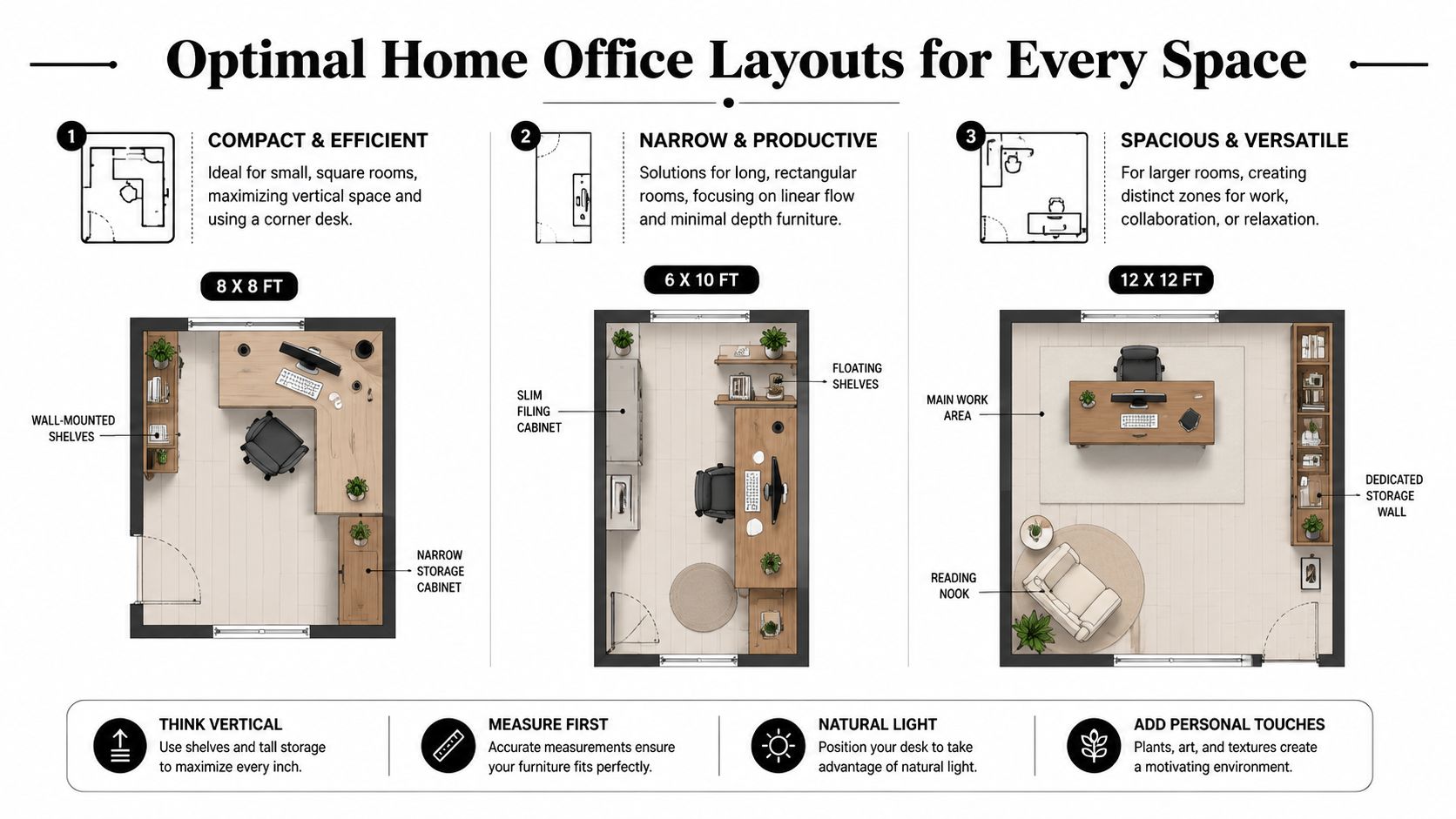
Three room shapes and what they need
Square spare bedroom
This is the most forgiving layout. It usually supports a standard desk, a comfortable chair, and a secondary storage wall without strain. If the room has a centered window, place the desk to control light rather than forcing symmetry. One wall can hold shelving or a credenza, while another stays open enough to keep the room from feeling packed.
Long, narrow room
These rooms need discipline. Avoid deep furniture on both long walls. A straight desk with modest depth often works better than a bulky executive form here. Keep storage slimmer and more vertical so the walkway stays clear.
Awkward corner or shared living area
Furniture often needs to gracefully perform double duty. A writing desk, secretary desk, or compact storage piece often performs better than an oversized workstation. In living spaces, the office should visually close down when work concludes. That means cleaner lines, stronger concealed storage, and fewer exposed peripherals.
Comparison table for planning
| Room Size (Approx.) | Ideal Desk Type | Minimum Desk Width | Chair Clearance (Behind Desk) |
|---|---|---|---|
| Small | Writing desk or corner desk | 48 inches | 30 inches |
| Medium | Standard single-user desk | 48 inches | 30 inches |
| Large | Executive desk or floating desk | 48 inches | 30 inches |
The minimum desk width and clearance above align with the professional guidance cited earlier from Houzz. Larger rooms may comfortably take a wider desk, but wider isn't automatically better. The right size is the one that preserves circulation and leaves room for storage, seating, and visual calm.
Shared-use layouts that hold up
For small-space and multi-use rooms, the smartest solution is often the least bulky one.
- Bedroom office: Place the desk where it doesn't compete with the bed as the room's main visual mass.
- Living room office: Use a refined desk and closed storage so the work zone reads like furniture, not equipment.
- Two-person office: Create clearly separate work zones instead of pushing two chairs into one oversized desk wall.
A lot of homeowners need furniture that solves those constraints without making the room feel temporary. That's where scaled pieces, flexible storage, and careful depth matter more than trend-driven shapes. If your office is competing with guest space, bedroom space, or family space, these ideas for the best furniture for small spaces can help narrow the options.
Finishing Touches Lighting and Technology
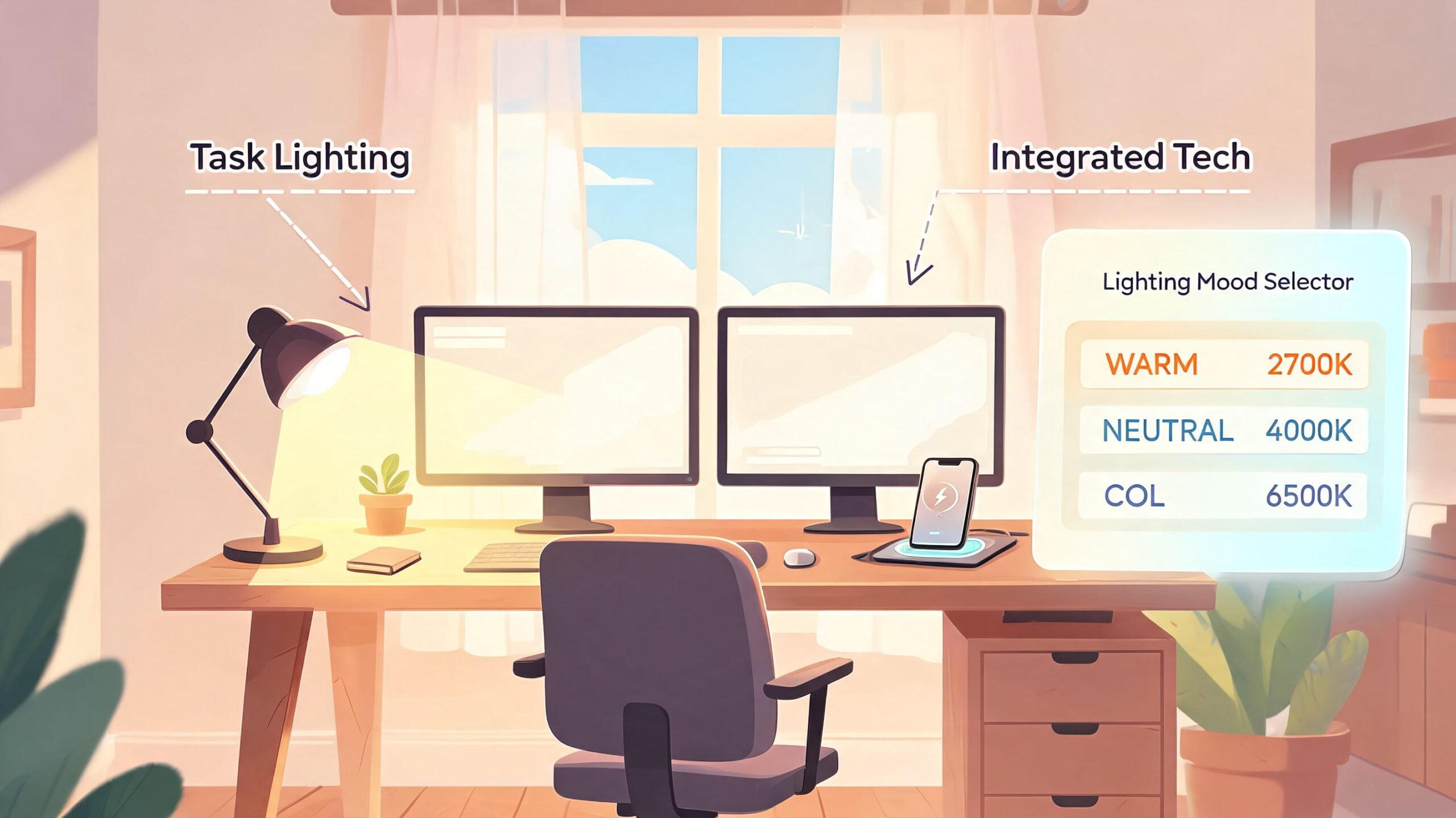
Once the furniture is placed, the room still isn't finished. Lighting and technology determine whether it feels polished and easy to use, or merely furnished. In a hybrid routine, that difference shows up every day.
As noted in a Houzz summary referencing Owl Labs' 2024 hybrid work findings, workers continue to value dedicated setups that support productivity and high-quality video calls, which means layout decisions now need to account for camera framing and acoustics, not just furniture position, in this discussion of home office corner use.
Layer the light
A finished office usually needs three kinds of light working together.
- Ambient light: This is the room's general illumination. It should make the whole space usable without feeling harsh.
- Task light: A desk lamp or directional light supports reading, writing, and screen-adjacent work.
- Accent light: A picture light, shelf light, or soft lamp adds depth and helps the room feel residential rather than corporate.
For video calls, flat overhead light rarely helps. More flattering setups place light in front of you or slightly off to the side so your face is visible without glare.
Handle cables before they spread
Technology clutter can undo a beautiful room fast. A thoughtful home office furniture layout gives wires a route and equipment a destination. Printers, docking stations, routers, and charging hubs all need a place that doesn't steal the desk.
A credenza or cabinet can hide the visual noise if you plan for access. Leave room for power strips, ventilation, and the simple reality that cords need slack. The cleaner the technology layer, the calmer the room looks.
Keep the camera view in mind while you style. The part of the office other people see is part of the design brief now.
Soft materials help here too. Drapery, rugs, upholstered seating, and even books on shelves can soften the room acoustically, which improves call quality and makes the office feel less sharp overall.
Bring Your Vision to Life at Vinson Fine Furniture
A well-planned office rarely comes from guessing. It comes from testing scale, material, and function together, then making choices you won't want to replace in a few years. That's especially true when the office needs to feel integrated with the rest of the house instead of looking like a temporary work station.
For homeowners shopping a furniture store in Columbus Ohio, the advantage of an in-person process is simple. You can sit in the chair, open the drawers, compare wood finishes in real light, and judge whether a desk has the presence or restraint your room needs. That's difficult to do from thumbnails alone.
Use design help where it matters most
Layout problems are often subtle. A desk may fit the wall but not the chair path. A bookcase may match the desk but overpower the room. A beautiful office chair may fail once it tucks under the desk apron.
The practical solution is to bring your room measurements, photos, and priorities into a design setting where those pieces can be considered together. At the Easton Town Center showroom, homeowners can work through those decisions with the in-store design studio and complimentary consultation process, then explore custom made office furniture if standard sizing doesn't solve the room well.
Customize for the long term
The right office often isn't sitting on a floor exactly as you need it. Custom ordering lets you adjust what affects daily use:
- Finishes: Match existing millwork, flooring, or the tone of nearby rooms.
- Configurations: Choose the footprint that fits the room instead of forcing the room to accept the footprint.
- Materials: Select solid-wood construction, upholstery, or leather options that suit your comfort and maintenance preferences.
- Visualizers: Use 3D tools to preview combinations before the piece is built.
That matters for buyers who care about lasting quality, including those looking for solid wood furniture Ohio homeowners can keep through remodels, moves, and changing work routines. It also matters for anyone who values Amish-made furniture for its durability, craft tradition, and steady visual presence in a home office.
Keep value and logistics in view
A serious furniture purchase should also be practical. The buying process is easier when pricing, delivery, and timing are clear.
Vinson Fine Furniture offers several points worth considering in that decision:
- Low Price Guarantee: A local authorized dealer price match policy with a 110% refund of the difference.
- Clearance Gallery: Savings of up to 70% on selected floor samples, overstocks, and closeouts.
- Flexible Financing: Synchrony HOME options for buyers who want to spread out the investment.
- White-Glove In-Home Delivery: Placement, assembly, and packaging removal done for you.
Those services matter because a home office isn't only about what you buy. It's also about whether the process feels orderly from first sketch to final placement. If your project includes other rooms as well, many homeowners planning an office are often also thinking ahead to guest room, bedroom, or media upgrades. For some Easton visitors, that broader trip also includes comparing premium sleep options at the same destination, especially if they're already researching the best mattresses Easton Town Center shoppers can test in person.
The right office should work hard, age well, and still look intentional years from now. That's the standard worth planning for.
If you're ready to turn a makeshift setup into a lasting workspace, visit Vinson Fine Furniture at Easton Town Center and bring your room measurements, photos, and wish list. A complimentary design consultation, custom-order options, value-minded clearance pieces, flexible financing, and white-glove delivery can make the process far more precise and far less stressful.