A Guide to a Custom Built Bookshelf in Columbus, Ohio


A familiar Columbus problem starts with a wall that looks simple on paper and impossible in real life. There's the alcove beside the fireplace, the upstairs landing under a sloped ceiling, or the family room wall where a freestanding case always looks temporary. Homeowners buy one shelf, then another, then baskets to disguise the overflow. The room still feels unsettled.
That frustration usually isn't about books. It's about fit, proportion, and permanence. A generic shelf rarely reaches the ceiling cleanly, clears the baseboard gracefully, or carries the visual weight of the room. It stores things, but it doesn't finish the architecture.
A custom built bookshelf answers a different question. Instead of asking what can be squeezed into the space, it asks what the space should become over the next decade and beyond. For homeowners who want a long-term upgrade, that's the shift that matters most.
For inspiration on styling shelves after the build is complete, these shelf decorating ideas for any room help translate a built-in from storage piece to finished design feature.
Table of Contents
- From Empty Wall to Heirloom Feature
- Beyond the Box Store The Value of a True Built-In
- Designing Your Vision Key Elements of Customization
- Budgeting for a Lifetime Piece Understanding Cost and Timeline
- The Vinson Design Studio Experience From Consultation to Installation
- More Than Just Books Inspiration for Your Built-In
- Caring for Solid Hardwood and FAQs for Ohio Homeowners
From Empty Wall to Heirloom Feature
A custom built bookshelf usually begins with a room that almost works.
When storage stops solving the problem
In many homes, the first attempt is practical. A freestanding unit gets placed against the wall. Another gets added later because the first one isn't wide enough. A gap remains at the top, cords collect at the bottom, and the trim never lines up. The room starts to feel pieced together, even when the home itself is beautifully finished.
That's especially common in houses with details that mass-market furniture can't accommodate. A wall may lean slightly out of square. Ceiling lines may shift. Baseboards may project farther than expected. In older homes and carefully customized newer homes alike, these little realities matter.
A built-in doesn't just hold objects. It resolves awkward architecture and gives the eye a place to rest.
The difference becomes visible the moment the casework looks like it was always meant to be there. The vertical lines feel intentional. The crown or top line relates to the room. The wood carries depth and warmth instead of a flat, disposable look.
Why a built-in changes the room
A well-designed custom built bookshelf behaves more like architecture than furniture. It can frame a window, turn an empty recess into useful storage, or create a library effect without making the room feel heavy. That permanence is what gives the piece its heirloom quality.
For many families, value is daily ease:
- Children's rooms gain order with shelves sized for books, keepsakes, and bins that don't overwhelm the floor.
- Living rooms feel calmer because devices, games, albums, and objects all have a deliberate home.
- Transitions in a house improve when a blank passage wall becomes a feature instead of a dead zone.
The emotional shift matters too. A room with a true built-in feels finished. It doesn't ask for one more workaround or one more weekend project. It serves its purpose with grace.
Beyond the Box Store The Value of a True Built-In
A box-store shelf solves a short-term storage problem. A true built-in solves a design problem, a structural problem, and often a resale problem at the same time.
Fit that furniture can't fake
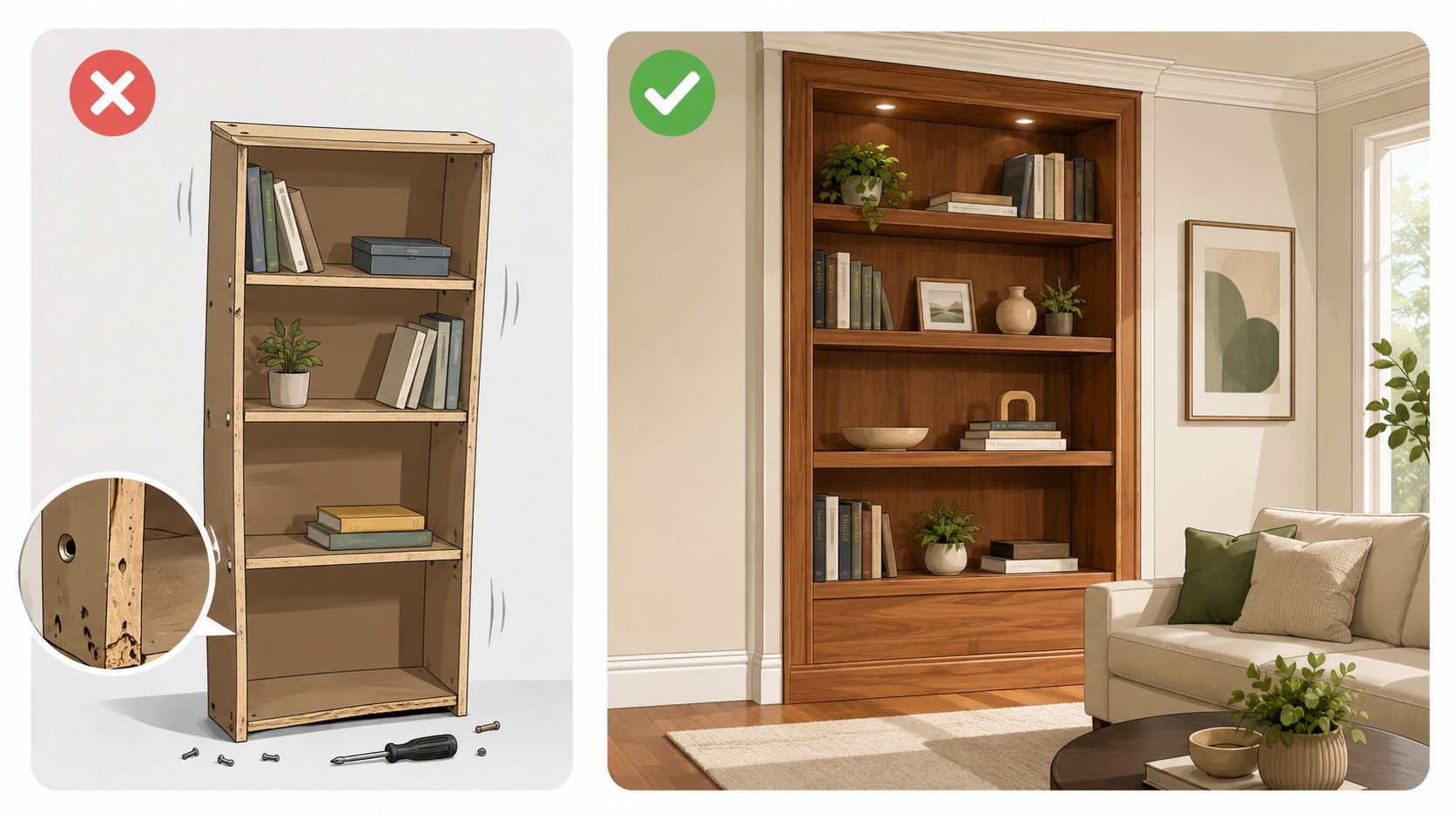
The clearest advantage is fit. A built-in can be scribed and adjusted piece by piece to follow an irregular wall, a sloped ceiling, or a non-square corner cleanly, which is exactly where standard furniture fails most obviously, as shown in this slanted-wall bookshelf example.
That matters more than many homeowners expect. In a photograph, a small gap at the ceiling may seem minor. In a finished room, that same gap makes the entire installation feel temporary. The eye notices when something doesn't belong.
For homes where the bookshelf needs to share a wall with a screen or concealed components, principles used in sophisticated entertainment storage can help shape a cleaner, more integrated layout.
Why material standards matter
Material choice decides whether a bookshelf matures gracefully or degrades early. That's why a solid-hardwood standard matters. A case built from solid cherry, oak, maple, or walnut carries real weight, a richer grain pattern, and the kind of repairability that supports long ownership.
By contrast, lower-grade sheet goods and compressed materials often telegraph their limitations quickly. Edges wear. Fasteners loosen. Surfaces lose their crispness. Once that process starts, the piece tends to look older than the house around it.
A useful comparison looks like this:
| Feature | Solid hardwood built-in | Lower-grade prefabricated shelving |
|---|---|---|
| Fit to room | Made to actual dimensions | Adapted to standard sizes |
| Visual depth | Natural grain and substantial presence | Flatter appearance |
| Long-term repairability | Can often be refinished or repaired | Often replaced rather than repaired |
| Architectural integration | Reads as part of the home | Reads as added furniture |
For homeowners exploring custom furniture projects more broadly, custom furniture made simple outlines how a personalized approach differs from buying something off the floor.
A built-in belongs to the architecture
There's also a quiet design truth that experienced homeowners recognize. The best rooms don't feel filled. They feel resolved. A custom built bookshelf can align with window casings, echo nearby millwork, and hold visual balance across the wall in a way standalone pieces rarely achieve.
That's why the value goes beyond storage. A true built-in gives the home a finished layer of craftsmanship. It feels anchored, composed, and lasting.
Designing Your Vision Key Elements of Customization
The most successful custom built bookshelf starts with three decisions. Wood species, structure, and finish. When those are chosen well, the room gains both beauty and discipline.
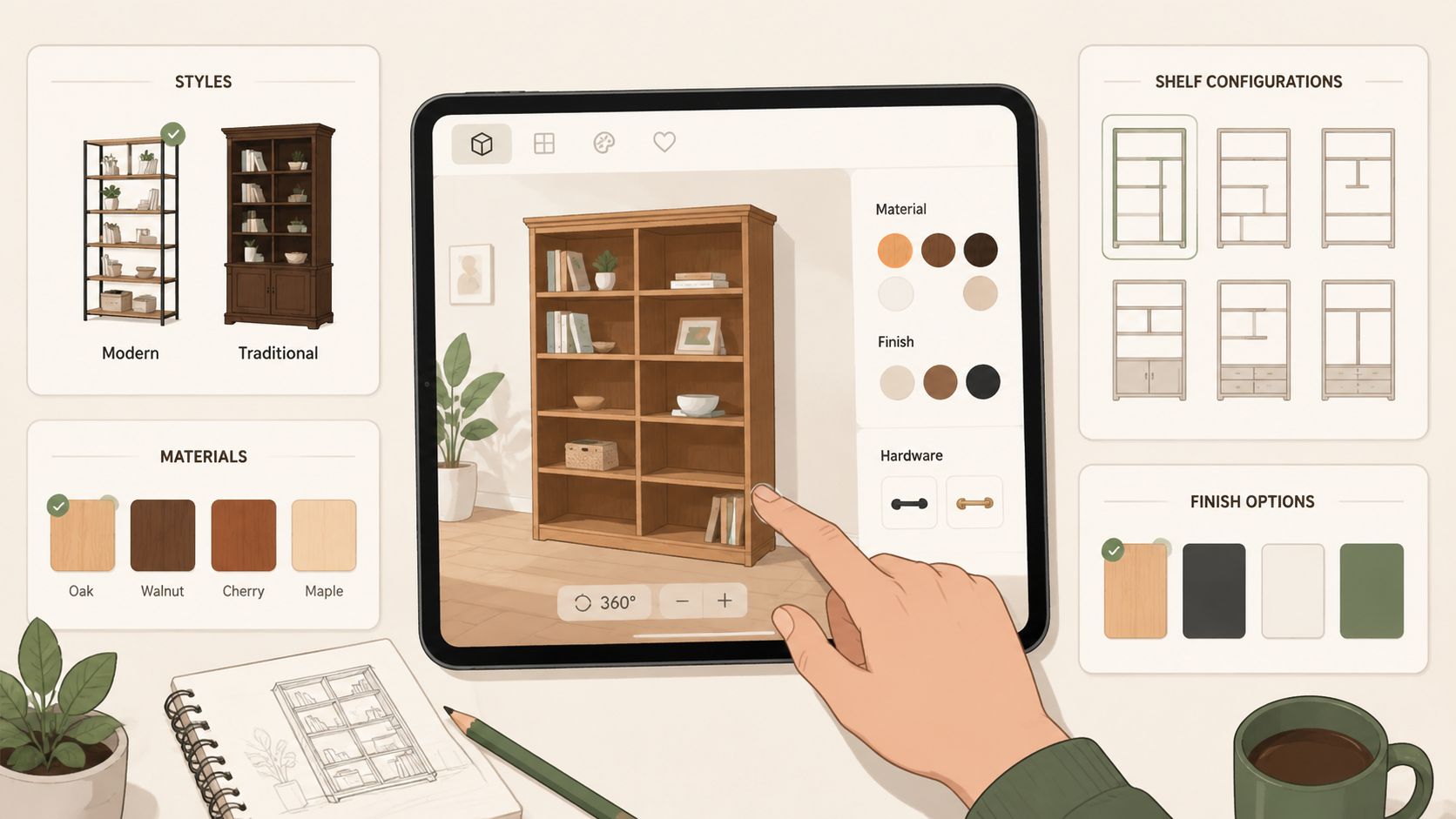
Choosing the right hardwood
Each hardwood brings a different mood to the room.
- Cherry offers warmth and an elegant, refined character. It suits traditional interiors beautifully, but it can also soften a clean-lined modern space.
- Oak has a more pronounced grain and a grounded, architectural feel. It works especially well when a homeowner wants the wood to read clearly from across the room.
- Maple feels smoother and more understated in grain. It's often the right choice when the goal is a lighter, bespoke look.
- Walnut adds depth and richness. In a study, dining room, or moody family room, it creates a subtly luxurious presence.
The tactile experience matters too. Solid wood has weight in the hand and visual depth in changing light. It doesn't look printed on. It looks grown, milled, finished, and meant to age.
The structural details clients rarely see
Behind the visible beauty, structural discipline determines whether shelves stay handsome under real use. One practical rule from builder guidance is to break a wide run into smaller bays with a fixed center divider, because shorter spans resist visible sag better than one long uninterrupted shelf, as shown in this bookshelf design example for reducing shelf deflection.
That principle often clears up a common point of confusion. Some homeowners assume thicker shelves are the only answer. Often, better layout is the answer. A divider changes the span, and the span changes how the shelf performs.
High-end built-ins also rely on sound construction standards. Professional builders commonly use 3/4-inch solid wood for the main structure, a 1/4-inch plywood back for racking resistance, and direct anchoring into wall studs to keep the cabinet square and secure, according to this custom bookshelf construction guide.
Practical rule: Beautiful joinery and handsome wood still need disciplined engineering behind them. Proportion and support are part of the design, not an afterthought.
Finish proportion and final character
Once the structure is right, the details bring the piece into harmony with the home.
A design team usually considers several questions at this stage:
Should the bookshelf blend or contrast?
A close finish match creates continuity. A darker or lighter species can turn the bookshelf into a stronger focal point.How open should the design feel?
Narrow uprights and lighter finishes often feel airy. Deeper wood tones and thicker framing feel more library-like.What belongs on the lower section?
Open shelving keeps the look light. Doors or drawers hide the practical items that never look elegant on display.
For homeowners refining these choices, getting started with a custom order offers a useful way to think through finish, scale, and room compatibility before anything is built.
A good custom built bookshelf never looks overdesigned. It looks inevitable, as if the room had been waiting for it all along.
Budgeting for a Lifetime Piece Understanding Cost and Timeline
Cost questions deserve a direct answer. A custom built bookshelf is a meaningful home investment, and the price reflects both skilled labor and the specificity of the work.
What the national cost range actually means
According to 2025 HomeAdvisor data on custom built bookshelf cost, the national average cost is $3,080, with a typical range of $1,399 to $4,888. The same data notes that high-end solid hardwood installations can range from $400 to $1,200 per linear foot, and the average return on investment ranges from 50% to 70%.
Those numbers make more sense when viewed as a construction project rather than a simple furniture purchase. A built-in requires measuring, fitting, leveling, finishing, and anchoring. In many homes, it also requires adapting to walls that aren't perfectly straight or corners that aren't perfectly square.
What changes the final investment
Three factors usually move the budget more than anything else:
| Cost driver | Why it matters |
|---|---|
| Size of the installation | A longer wall or taller run requires more material and more labor |
| Wood species and finish level | Premium hardwoods and more detailed finishing raise the investment |
| Complexity of the room | Slopes, irregular corners, and integrated storage add fitting time |
A simple straight wall is one thing. A reading nook under a stair line or a media wall with concealed storage is another. The second project asks more from the maker and the installer.
There's also a value side to the equation. Homeowners who are already thinking in terms of long-term ownership often compare a built-in not to a temporary shelf, but to other permanent upgrades. In that context, a custom bookshelf becomes easier to judge fairly.
How to think about timeline
Timeline depends on design complexity, material selection, production scheduling, finishing, and installation coordination. That's why a responsible timeline conversation starts after dimensions and details are established, not before.
A helpful way to think about it is this:
- Design takes patience because the right proportions and interior layout need to be settled first.
- Craftsmanship takes time because solid wood must be milled, assembled, finished, and prepared correctly.
- Installation takes planning because the final fit is what makes the project look architectural instead of added-on.
For value-minded buyers, this is also where policy matters. A store offering a clear pricing commitment can remove some uncertainty from the process. A Low Price Guarantee with a 110% refund of the difference and a Clearance Gallery with savings up to 70% can be relevant for other rooms in the home, even when the bookshelf itself is custom and made to order.
The Vinson Design Studio Experience From Consultation to Installation
A custom bookshelf project often starts the same way. A homeowner stands in front of an empty wall with a rough idea, a few saved photos, and a long list of practical questions. How deep should the shelves be? Should cabinets run to the floor? Will the piece feel too heavy in the room, or too small once it is installed?
That uncertainty is normal. Good design work removes it by turning a broad wish into a series of clear decisions.
The first conversation
The process begins with the room, the wall, and the life around it. A designer asks how the space functions day to day, what needs to be stored, what deserves display space, and how the new built-in should relate to nearby flooring, trim, and furniture.
That first meeting often brings relief. Clients do not need to arrive with every answer. They need a starting point.
For homeowners who want guidance early, a complimentary interior design consultation creates a practical place to review measurements, discuss priorities, and sort through finishes without guessing from a phone screen. Seeing wood tones and proportions in person helps people judge scale the way they would judge paint on a wall. Small samples and digital images can suggest a direction, but they rarely tell the whole story.
Turning preferences into a real plan
Once the goals are clear, the project becomes much easier to understand because each decision builds on the one before it. Purpose comes first. Then dimensions. Then wood species, finish, storage layout, and the visual rhythm of open and closed sections.
That sequence matters. Choosing stain before settling shelf widths is a little like choosing drapery fabric before measuring the windows. The order affects the result.
A thoughtful design conversation usually covers questions like these:
- What belongs on open shelving? Books, framed photos, art, and collected objects all need different spacing.
- What should stay hidden? Cabinets can hold media equipment, games, paperwork, or seasonal items that would create visual clutter on open shelves.
- How should the piece meet the architecture? Crown detail, base treatment, and panel proportions help the bookshelf feel connected to the home rather than being placed against a wall.
- How should the rest of the room relate to it? A built-in becomes part of a larger composition, not an isolated object.
That last point is often where the project gains depth. Homeowners may also be selecting dining, bedroom, or seating pieces in solid wood so the room feels cohesive rather than pieced together over time. Vinson Fine Furniture helps clients review those related choices as part of a coordinated design process, with finish options and visual planning that make it easier to see how the room will live as a whole.
The strongest custom projects do not begin with a product. They begin with a conversation precise enough to shape the product well.
Delivery installation and final placement
Installation is the moment when planning becomes visible. Joinery, finish, and proportion matter, but so does the care taken in the last few hours of the project.
Vinson Fine Furniture supports Central Ohio homeowners with showroom guidance, custom-order coordination, and white-glove delivery. The piece is inspected, brought in carefully, and placed with attention to the room itself. That level of care protects floors, walls, and the furniture, but it also protects the design intent. A built-in should read as though it belongs to the house.
Clients often notice the difference right away. Doors sit correctly. Lines look balanced. The unit feels settled, substantial, and finished from the first day.
That is the core value of a well-run custom process. It replaces uncertainty with clarity, and it turns an empty wall into something that feels considered, permanent, and worth living with for many years.
More Than Just Books Inspiration for Your Built-In
A custom built bookshelf earns its keep when it solves more than one problem. Storage is only the beginning. The best installations define space, reduce visual noise, and give a room a stronger center of gravity.
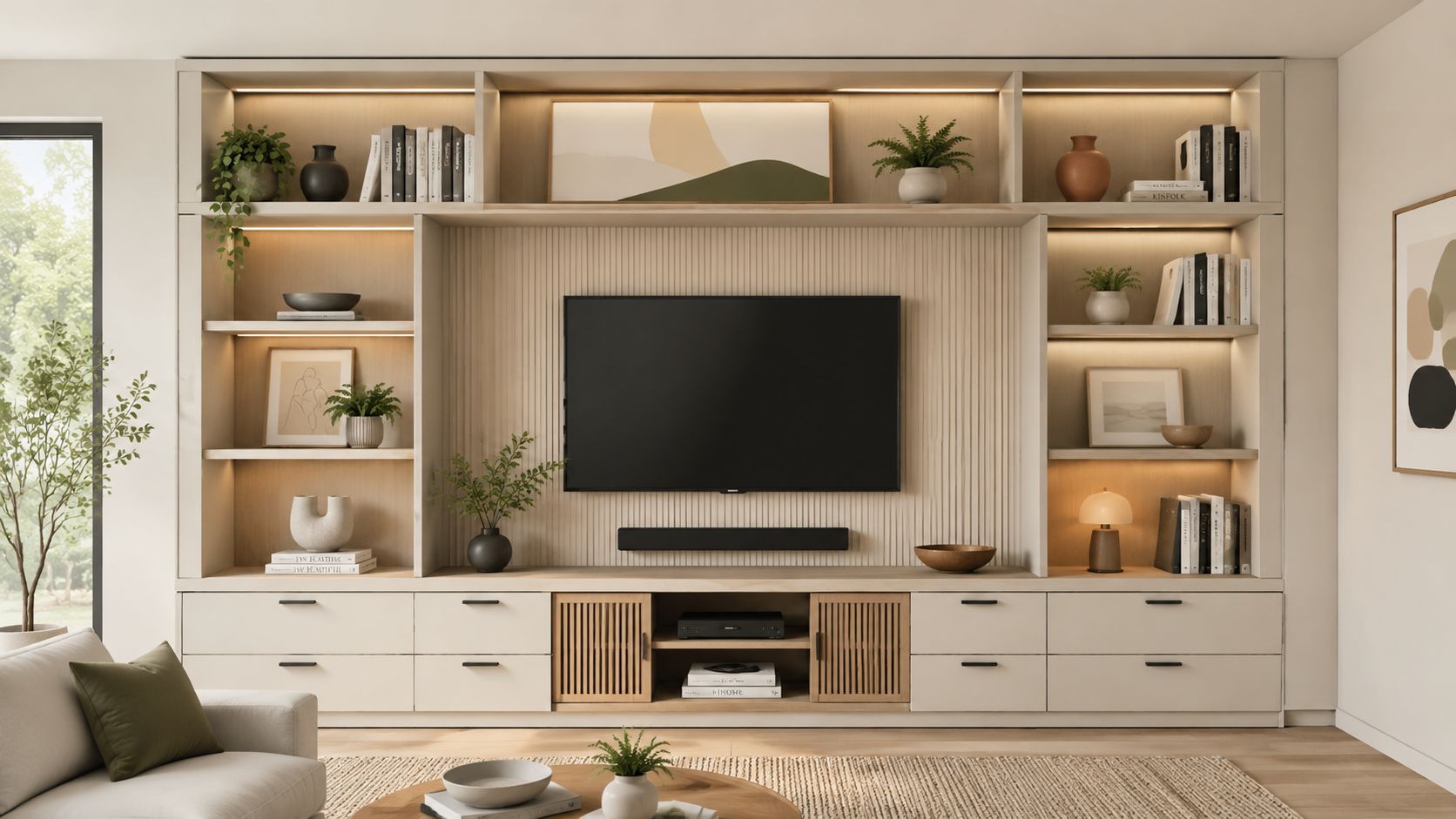
A media wall with order built in
A family room often benefits from built-ins even when the household owns fewer books than games, devices, albums, and framed photographs. Open shelves can soften the presence of a screen, while closed lower cabinetry keeps practical clutter from taking over the room.
This kind of composition works especially well when the room already includes premium seating. A custom-built wall of wood shelving can balance the softer forms of custom leather sectionals Columbus shoppers often choose for comfort, especially when those sectionals include power reclining or motion features.
A well-planned media built-in can hold:
- Display shelving for art, ceramics, and collected objects
- Concealed storage for remotes, charging accessories, and games
- A visual frame that helps the television sit more gracefully in the room
Dining rooms entries and open-plan spaces
Built-ins can also bring unusual elegance to rooms that aren't usually associated with bookshelves.
In a dining room, a lower cabinet with upper shelving can function like a refined server wall. It holds platters, glassware, linens, and serving pieces while giving the room a more substantial, composed backdrop. For households investing in Amish-made dining sets, that continuity in craftsmanship can make the whole room feel more intentional.
In an entry, a built-in can become a first impression piece. A narrow profile with generous height adds storage without crowding circulation. The result feels gracious rather than makeshift.
In open-concept homes, the bookshelf can even act as a soft room divider. It doesn't shut one zone off from another. It gives each area clearer identity.
A built-in is often most successful when it gives a room definition, not just storage.
This is why the category reaches well beyond libraries. Whether the room includes Smith Brothers furniture Easton clients admire for comfort or Mavin bedroom furniture selected for solid-wood warmth, a built-in can help the architecture hold everything together.
Caring for Solid Hardwood and FAQs for Ohio Homeowners
A custom built bookshelf rewards steady, simple care. Solid wood doesn't ask for fuss. It asks for respect, consistency, and a home environment that supports its natural character.
Simple care habits that protect solid wood
The first principle is gentle cleaning. Dust with a soft cloth and avoid harsh products that can leave buildup or dull the finish. Moisture should always be controlled rather than allowed to linger on the surface.
For seasonal guidance, wood furniture care recommendations offer practical direction on routine maintenance.
A few habits make the biggest difference:
- Dust regularly so grit doesn't act like an abrasive on finished surfaces.
- Wipe spills promptly because standing moisture is never a friend to wood.
- Keep indoor conditions stable since solid hardwood responds to swings in humidity.
- Use shelves thoughtfully by distributing heavier items with balance instead of crowding one span.
Ohio homeowners often ask about lower-level installations too. For spaces where storage planning intersects with finished basements, Trademaster's basement design ideas can help frame the broader layout conversation before custom millwork decisions are made.
Frequently asked questions
Where is the showroom located?
The showroom is located at Easton Town Center, a convenient destination for homeowners throughout Columbus and Central Ohio who want to compare materials and discuss room plans in person.
Can a finish coordinate with existing solid wood furniture?
Often, yes. A good design consultation usually begins by comparing species, undertones, grain character, and the sheen level of the existing furniture rather than chasing a rough visual match from memory.
What if the wall has a slope or isn't square?
That's one of the strongest reasons to choose a custom built bookshelf. Irregular walls are exactly where built-ins justify themselves, because the installation can be fitted to the room instead of forcing the room to accept a standard rectangle.
How long does a custom order take for delivery in Central Ohio?
The answer depends on design complexity, production scheduling, finish selection, and installation planning. A precise timeline is usually given once the specifications are settled.
Can a built-in work with other furniture updates in the same project?
Yes. Many homeowners coordinate a bookshelf with adjacent seating, dining, or bedroom plans so the home feels coherent rather than assembled in stages. That's especially helpful when selecting solid wood case goods, top-grain leather seating, swivel chairs, rockers, or gliders for neighboring spaces.
A custom built bookshelf is rarely an impulse purchase. It's a considered one. That's a good thing. The best results come when a homeowner takes the time to understand material, proportion, and process, then chooses a piece that will still feel right many years from now.
For homeowners ready to turn an awkward wall into a lasting architectural feature, Vinson Fine Furniture offers an approachable next step. A visit to the Easton Town Center showroom allows families to explore solid hardwoods, discuss customization, and use the in-store design process to shape a bookshelf and surrounding room with greater clarity.