Custom Made Office Furniture: A Columbus Buyer’s Guide

Your home office often starts with good intentions. A laptop on the dining table. A chair borrowed from another room. A stack of papers moved from counter to counter whenever company comes over.
After a while, that temporary setup starts shaping your day in all the wrong ways. You work around the furniture instead of letting the furniture support your work. That's usually the moment Columbus homeowners start looking at custom made office furniture differently. It stops feeling like an indulgence and starts feeling like a practical upgrade for focus, comfort, and the way the room fits the rest of the house.
From Makeshift Corner to Command Center
A lot of homeowners reach the same point in a similar way. The dining chair feels too hard by midafternoon. The desk is really a console table with no storage. Cords trail across the floor, and video calls happen with a hallway in the background because there isn't a proper place to work.

That shift from improvised to intentional is happening in homes everywhere. The custom furniture market, including office pieces, is projected to reach USD 66.49 billion by 2033 with a 9.4% annual growth rate, reflecting rising demand for personalized and ergonomic workspaces tied to hybrid and remote work trends, according to Coherent Market Insights on the custom furniture market.
For a Columbus homeowner, the issue usually isn't just productivity. It's harmony. You want the office to function like a workplace without making your guest room, loft, or family room feel cold and commercial. That's where custom work changes the experience. A desk can fit the exact wall. Storage can conceal printers and papers. Wood tone, hardware, and chair upholstery can relate to the rest of your home instead of fighting it.
What changes when the room is planned for real life
A well-designed office usually solves several problems at once:
- Better posture support with a desk and chair selected for the way you work
- Cleaner visual lines through integrated storage and cable control
- Improved concentration because the room has a clear purpose
- Stronger home value appeal because the space feels finished rather than improvised
A home office should work as hard as you do, but it should still look like it belongs in your home.
If you're starting to think beyond a folding table and task lamp, this guide to home office furniture that fits the way people actually live and work is a useful next step.
The Enduring Value of Custom Versus Ready-Made
Ready-made furniture has one obvious strength. It's fast. You can choose it, order it, and often have it in your home quickly. For some situations, that convenience matters.
But convenience and fit aren't the same thing. Custom made office furniture is closer to a bespoke suit than an off-the-rack jacket. The difference isn't only appearance. It's how the piece sits in the room, how it supports your body, and how little compromise you have to accept.
Where ready-made furniture usually asks you to compromise
A standard desk might be too shallow for dual monitors. Or too wide for the alcove where you need it. The finish may clash with your flooring. The drawers may open into a walkway. None of those problems sound dramatic on paper, but together they create daily friction.
Custom furniture starts with the room and the user. That changes the questions:
| Decision area | Ready-made approach | Custom approach |
|---|---|---|
| Room fit | You adapt to preset dimensions | The piece is built around your space |
| Style | Limited finish and hardware choices | Materials and details can align with your home |
| Work habits | Generic storage and surface layout | Layout supports your tools, files, and routines |
| Longevity | Often designed for broad-market turnover | Often chosen for lasting use and repairability |
Why many buyers stay with custom once they try it
Consumer behavior strongly favors personalization. 62% of consumers prefer customized designs, 54% are willing to pay a premium, and repeat custom orders have risen 29%, according to Business Research Insights on the custom furniture market.
Those numbers make sense when you think about daily use. A custom desk isn't just furniture you admire from across the room. It's something you touch every day. You notice the drawer glide, the edge profile under your forearms, the way the chair seat feels after hours of focused work.
A useful buying rule: If you'll use a piece almost every day, comfort and construction matter more than trend appeal.
There's also the cost question, and that's where people often get stuck. Custom doesn't always mean choosing the most elaborate option. It means choosing intentionally. Some homeowners invest in a statement desk and keep the rest of the room simple. Others start with a smaller custom footprint and add matching storage later. If you want to understand how that process works without turning it into a design puzzle, this overview of making custom furniture simpler lays it out clearly.
Value also includes how you buy. A thoughtful furniture purchase should come with pricing confidence, not guesswork. That's why policies such as a Low Price Guarantee with a 110% refund of the difference and a Clearance Gallery with savings up to 70% matter. They give homeowners ways to pursue long-term quality while staying disciplined about budget.
Designing Your Perfect Home Office Workspace
The room should support the way you think. That sounds lofty, but it usually comes down to simple choices. Where your light falls. Whether papers have a place to disappear. How far you have to reach for what you use every day.

A dedicated office and a shared-use nook need different solutions, but the planning logic is similar. Start with function first. Then refine the look.
Begin with your work pattern
Before you choose a desk shape or wood finish, ask a few practical questions:
- Do you spread out or work compactly. A laptop-only setup needs a different surface than a paper-heavy workflow.
- Do you take frequent video calls. Background, lighting, and sightlines matter.
- Do you need hidden storage. Some people work better when every tool is visible. Others need visual calm.
- Does the room serve another purpose. A guest room office needs furniture that looks composed even when work is done.
A good layout supports movement. You should be able to pull out the chair, open drawers, and walk through the room without feeling boxed in. That sounds basic, but it's one of the most common places homeowners misjudge scale.
Match the office to the rest of the home
The best home office doesn't feel imported from a corporate suite. It feels related to the rest of the house. In a Columbus home, that might mean a solid-wood desk with a warm hand-finished surface, a bookcase that echoes your dining furniture, or a leather chair that feels appropriate in a den.
Here's a simple planning framework:
Anchor the room with the main work surface
Pick the wall or window placement that supports your daily routine first.Add storage where clutter naturally forms
Don't place filing where it seems symmetrical. Place it where papers land.Soften the room
Rugs, art, and a reading chair keep the office from feeling too rigid.Check visual balance
If one side of the room has height, give the other side enough weight to feel intentional.
If you're unsure whether to prioritize storage, surface area, or seating comfort, choose the feature that removes the biggest daily annoyance first.
Many homeowners benefit from talking these choices through in person. The In-Store Design Studio at Easton Town Center offers complimentary design consultations that help translate rough ideas into a workable room plan. If you want inspiration before visiting, this gallery of home office furniture ideas for different room types and styles is a practical place to start.
Exploring Your Limitless Customization Options
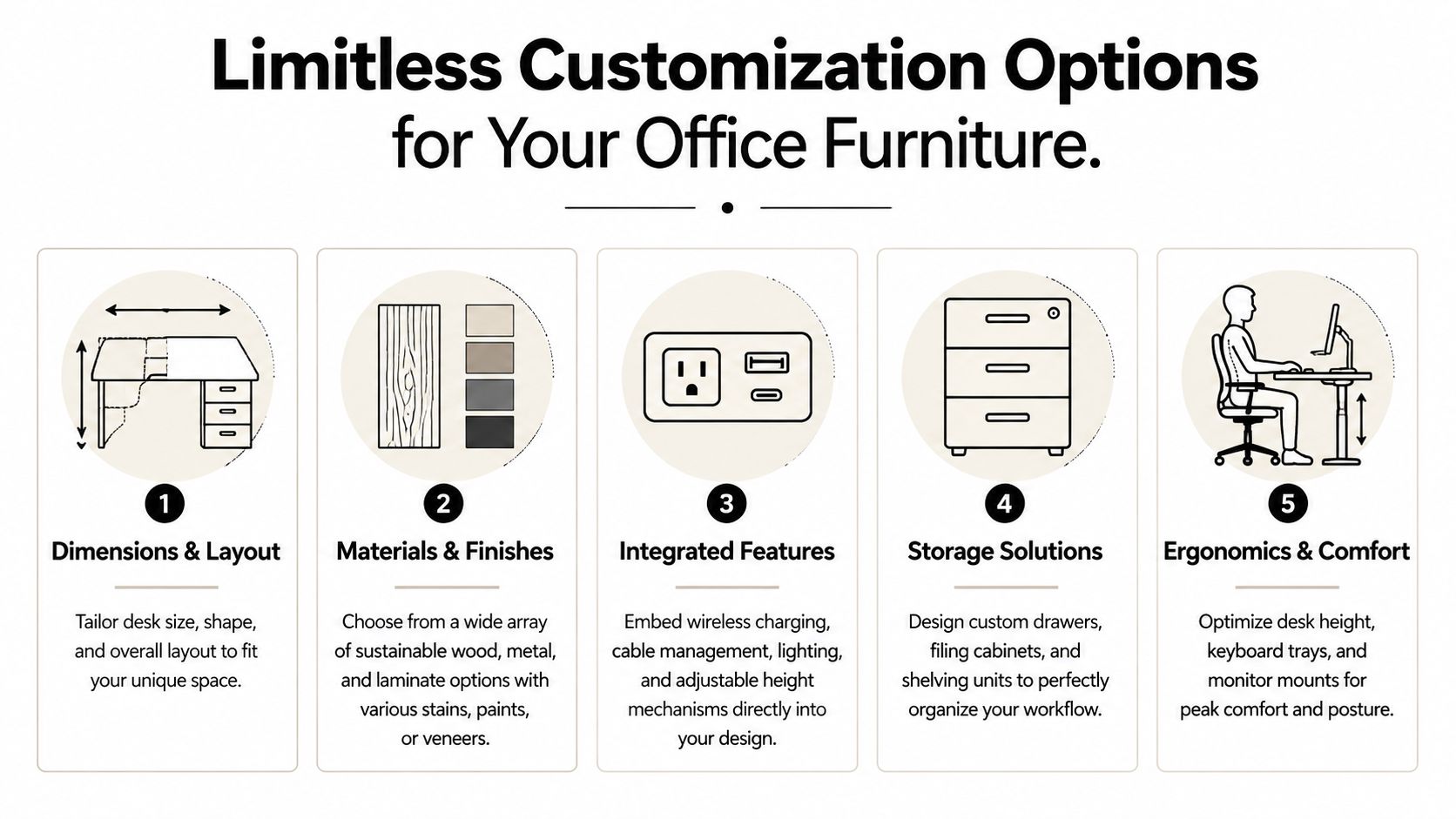
“Custom” can sound vague until you break it into decisions you can make. In practice, custom made office furniture means shaping the piece around your room, your routine, and the materials you want to live with for years.
The choices that matter most
Through a custom order program, homeowners usually work through several layers of decision-making.
Dimensions and layout
This is the foundation. You can adjust width, depth, return configuration, drawer placement, and overall footprint so the piece fits the room instead of crowding it.Wood species and finish
Solid wood changes both the appearance and the personality of the room. Some homeowners prefer a lighter, cleaner look. Others want depth, grain variation, and a richer stain that feels traditional.Hardware and detailing
Drawer pulls, leg shapes, edge profiles, and panel styles have a quiet but powerful effect. These details often decide whether a desk feels modern, transitional, or classic.Work surface features
Built-in cable management, keyboard access, modesty panels, and storage sequencing can all be adapted to how you use your desk.Seating comfort
Upholstery, leather type, seat feel, arm style, and scale all matter if the office includes a desk chair or lounge seating for reading and calls.
Why construction standards matter
Style gets attention first. Construction determines whether the piece still feels good years later. Heirloom-quality furniture follows standards such as ANSI/BIFMA for structural integrity, and that matters for solid-wood office furniture because wood naturally expands and contracts with seasonal conditions. Proper construction helps prevent issues such as joint separation and drawer problems, as outlined in this document on furniture construction standards and material specification.
The same source notes that leather specification matters too. In seating, top-grain leather grade directly affects durability and stain resistance, which is one reason a chair that looks similar at first glance can perform very differently over time.
A simple way to evaluate customization choices
Use this checklist when comparing options:
| Custom choice | What to ask |
|---|---|
| Size | Does it fit the wall and still allow comfortable movement? |
| Material | Will this surface age gracefully in my home? |
| Storage | Do drawers and shelves match how I actually work? |
| Seating | Can I sit comfortably for long stretches? |
| Finish | Does it complement nearby floors, trim, and lighting? |
Some homeowners want a clean-lined desk with discreet storage. Others want a full library feel with a return, bookcases, and a reading chair. Both are valid. The right answer depends on how the room serves you.
One option homeowners often consider is Vinson Fine Furniture, which offers a Custom Order Program with choices in fabrics, finishes, and configurations, along with 3D visualizers and in-store consultation support.
The Vinson Design and Ordering Process Demystified
Custom ordering feels intimidating when people imagine a long series of technical decisions. In reality, the process works best when it's collaborative. You bring the room, the goals, and the style preferences. The design team helps translate that into a piece you can approve with confidence.

Step one through step four
Start with the consultation
Bring room photos, rough measurements, and a sense of how you work. If you have inspiration images, even better. The point isn't to arrive with a finished plan. It's to give the design conversation something real to build from.Narrow the furniture direction Size, silhouette, wood finish, storage needs, and seating style get clearer. If the room needs more than a desk, the discussion can also include bookcases, filing, accent seating, or multi-use pieces.
Review the visualization
Digital tools make a major difference here. Advanced 3D visualizers have reduced post-delivery modification requests by 30 to 40 percent by helping customers preview the exact piece before production, according to Kansas City Office Design's overview of office furniture design specification.Finalize and place the order
Once dimensions, finish, and features are approved, the order moves into production. Financing can also be discussed at this point through Synchrony HOME for homeowners who want to spread out the investment.
What you want from this stage is clarity. If you can see the piece, confirm the finish, and understand the layout, you're much less likely to second-guess the order later.
For first-time buyers, the easiest way to understand the flow is to review the custom order starting process and what happens at each stage. It takes much of the mystery out of custom work and helps you prepare for a more productive showroom visit.
Understanding Timelines, Investment, and Delivery
One reason people delay custom furniture is uncertainty. They aren't always worried about the idea of waiting. They're worried about not knowing what the wait means, what affects the price, and what happens when the piece finally arrives.
Why custom takes longer
Mass-produced furniture often ships faster because the design decisions are already finished. With custom work, materials are selected, dimensions are confirmed, and the piece is built with a specific home in mind. That takes time.
For quality custom pieces, average lead times are typically 12 to 16 weeks, while mass-produced furniture may ship in weeks, according to Benhar Office Interiors on custom office furniture lead times. For homeowners, the practical takeaway is simple. Ask for honest timing early, then plan your project around it.
What shapes the investment
The final price usually reflects a mix of factors:
- Material choice such as solid wood, metal, or upholstery grade
- Complexity including custom dimensions, returns, shelving, or built-ins
- Craftsmanship level in joinery, finishing, and detailing
- Delivery service especially if in-home placement and assembly are included
A longer lead time doesn't automatically mean inconvenience. Sometimes it means better sourcing, more careful finishing, and fewer compromises.
Why delivery matters more than people think
Good furniture can be damaged by rushed handling at the very end. White-glove service protects the investment by adding careful placement, assembly, inspection, and cleanup inside the home. It's particularly valuable for larger desks, solid-wood cases, and multi-piece office installations.
If you've never used it before, this explanation of white-glove delivery service and what it includes in the home helps clarify why many homeowners prefer it for major furniture purchases.
Frequently Asked Questions for Columbus Homeowners
Can custom made office furniture work in a small room
Yes. In smaller rooms, custom is often more useful because standard furniture sizes can waste precious space. A shallower desk, better drawer placement, or a wall-scaled bookcase can make a compact office feel more open and much more usable.
Is custom only for very formal home offices
Not at all. Custom can be formal, relaxed, modern, or traditional. A built-to-order workspace can live in a dedicated office, a bedroom corner, a loft, or a shared family room as long as the scale and materials are chosen thoughtfully.
How do I know if solid wood is worth it
Solid wood is usually worth serious consideration if you care about longevity, repairability, and character over time. It tends to matter most on the pieces you use and see every day, especially the desk itself or a major storage cabinet.
Can I try comfort in person before choosing
Yes, and that's one of the strongest reasons to visit a showroom at Easton Town Center. Photos can help with style, but they can't replace a sit-test. Seat depth, arm height, desk proportion, and finish tone all read more accurately in person.
How does the Low Price Guarantee fit with custom orders
The practical value of a pricing policy is confidence. If you're making a major furniture investment, you want to know you're not paying more than necessary for comparable authorized local pricing. That kind of protection helps custom feel more grounded and less risky.
What if I'm furnishing more than just the office
That's often the smartest time to get design help. When the office is part of a larger move or renovation, coordinating wood finishes, upholstery, and room function across the home creates a calmer result than choosing each room in isolation.
If you're ready to move from a temporary setup to a workspace that feels integrated, durable, and personal, Vinson Fine Furniture offers a place to start with an Easton Town Center showroom, complimentary design consultations, a Custom Order Program, flexible financing through Synchrony HOME, a Low Price Guarantee, Clearance Gallery savings, and white-glove in-home delivery.