Home Office Furniture for Sale: A Columbus Buyer’s Guide

A large share of homeowners didn't set out to create a serious office at home. It often started with a laptop on the dining table, a spare chair pulled from another room, and a stack of papers migrating from one corner to the next. That arrangement can work for a week or two. It rarely works well for years.
A permanent home office asks more from furniture. It has to support posture, concentration, storage, and the visual character of the home all at once. When shoppers begin looking at home office furniture for sale, the smartest shift is mental before it's practical. The question isn't limited to what fits the room. It's what will support daily work without looking temporary or wearing out too soon.
Table of Contents
- Your Home Office Is Now a Permanent Fixture
- First Define Your Space and Your Work Style
- The Ergonomic Imperative Investing In Your Health
- Quality You Can Feel A Guide to Enduring Materials
- Beyond the Desk Essential Storage and Cohesive Style
- The Vinson Experience Your Partner in Design and Value
Your Home Office Is Now a Permanent Fixture
The strongest home offices no longer feel like emergency setups. They feel intentional. That change reflects how people live and work now, and the market has followed. The global home office furniture market is projected to grow from USD 25.3 billion in 2024 to USD 45.3 billion by 2034, according to this home office furniture market projection.
That projection matters because it confirms what many homeowners already feel. The home office isn't a passing adjustment. It's a durable part of the modern house, and furniture choices need to carry more weight than a quick online purchase usually allows.
A client comparing desks often focuses first on style or price. A designer starts elsewhere. The better questions are these: Will this desk still work if the room changes? Will the chair still feel supportive after a full day? Will the storage keep the room calm instead of cluttered?
A thoughtful office should support work hours and disappear gracefully into the home after the workday ends.
That's why the category now includes far more than a writing desk and a task chair. Buyers are looking for pieces with presence, comfort, and longevity. For homeowners refining a dedicated workspace, ideas for creating an inspiring home office often begin with one simple decision. Stop treating the room like temporary overflow, and start treating it like a permanent interior.
First Define Your Space and Your Work Style
Buying better furniture before defining the room usually leads to expensive compromises. The desk looks right in a showroom photo, but the chair can't roll back comfortably. The storage cabinet fits the wall, but blocks an outlet. The room has furniture in it, yet it still doesn't function.
A useful plan starts with how the space is used. Someone who reviews paper files, takes video calls, and uses two monitors needs a different setup than someone who writes for a few hours and closes a laptop after a few hours. Good selection begins with honest habits, not wishful ones.
Start with movement, not furniture
The first measurement shouldn't be the wall. It should be the working zone.
For comfort, a desk should have a minimum depth of around 70 cm, with 80 cm better for comfort, and there should be at least 80 to 90 cm of clear space behind the chair for movement, as explained in this home office size guide. That rear clearance is the detail many shoppers miss. They measure the desk footprint, but not the space required to sit, turn, stand, and move naturally.
A room can technically hold a desk and still feel wrong every day. That usually happens when circulation wasn't part of the plan.
Practical rule: Measure the room as a path of movement first, then place furniture inside that path.
Build a brief for the room
Before shopping, it helps to write down the office requirements in plain language:
- Daily tasks: Does the user mostly type, sketch, read, print, or meet on camera?
- Technology needs: Will the setup hold one screen, multiple monitors, speakers, or a docking station?
- Privacy level: Does the room need to hide work at day's end, or can materials stay visible?
- Lighting conditions: Is there natural light on the screen side, behind the chair, or directly in front of the user?
- Power access: Are outlets in the right location for lamps, monitors, and charging without visible cord clutter?
These details shape the furniture more than trend language ever will.
Match the room to the person
A compact office for occasional admin work can feel elegant with a smaller desk, concealed storage, and a chair that blends into the home. A full-time workspace usually needs more surface area, better task seating, and storage that supports routine rather than hiding it.
Shoppers furnishing tighter footprints often benefit from studying home office furniture for small spaces, especially when the office shares square footage with a guest room or living area. In those rooms, depth, chair clearance, and visual lightness matter as much as width.
The goal isn't to fill the room. It's to make the room work.
The Ergonomic Imperative Investing In Your Health
Style can invite a buyer to notice a piece. Ergonomics decides whether that piece earns a place in a daily routine. In a home office, the desk and chair aren't decorative accessories. They're tools used for hours at a time.
Musculoskeletal disorders remain a major category of work-related injuries, and factors such as chair height and desk depth materially affect daily fatigue, according to this ergonomics overview for office furniture. That's why a workspace that merely looks polished can still perform poorly if the body has to compensate for it all day.
What an ergonomic chair should actually do
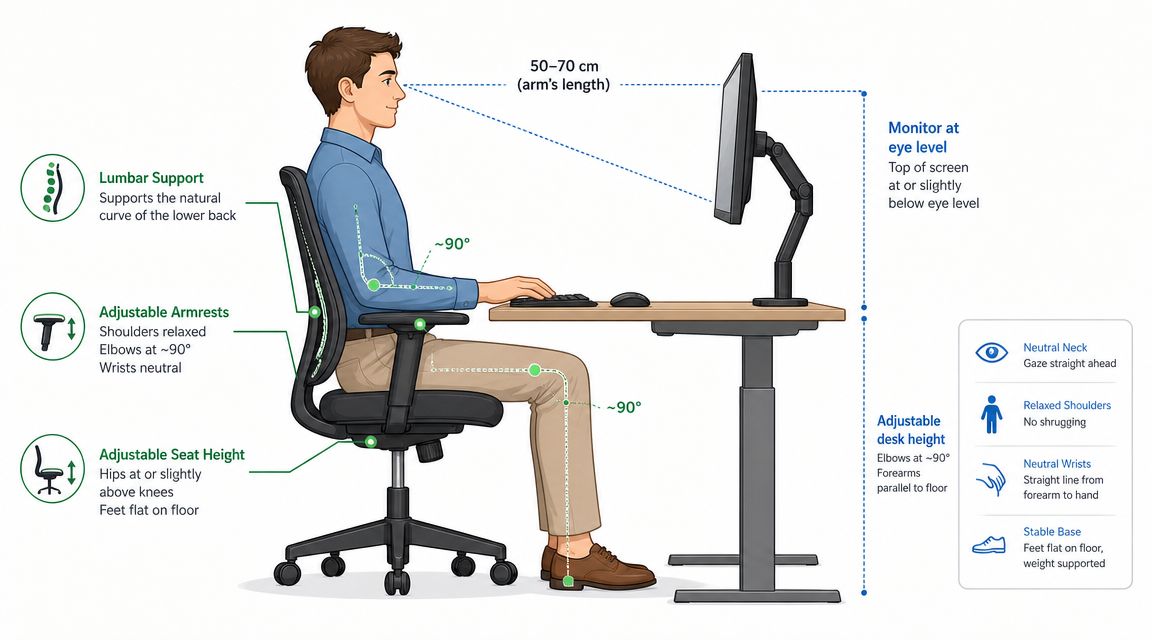
Many chairs are described as ergonomic when they only swivel and roll. A supportive chair does more. It allows the body to settle into a neutral posture instead of holding tension.
The most important features to assess include:
- Seat height adjustment: Feet should rest comfortably while knees remain in a natural position.
- Back support: The chair should support the lower back without forcing the spine forward.
- Arm positioning: Armrests should help the shoulders relax rather than lift or hunch.
- Seat proportion: The seat should support the legs without pressing awkwardly behind the knees.
- Movement: The chair should allow small posture shifts during the day instead of locking the body in one rigid position.
A chair can look refined and still fail every one of those tests.
Why the sit test matters
No spec sheet can tell a shopper how a seat feels after several minutes of real use. Cushion density, back angle, arm placement, and seat contour all register differently in person than they do on a screen. That's especially important for anyone spending long stretches at a desk.
The body notices bad seating long before the eye does.
That's why showroom testing matters so much for home office furniture for sale. A buyer should sit, lean back, type, roll away from the desk, and return again. A chair that feels acceptable for thirty seconds can feel tiresome by midday.
For shoppers considering task seating and desk pairings, writing desks and desk chairs offer a useful starting point because proportion matters just as much as appearance.
Desks should support posture, not just equipment
A desk needs to do more than hold a computer. It should allow the screen, keyboard, arms, and chair to work together. If the desk is too shallow, the monitor ends up too close. If it's too high or too low relative to the chair, shoulders and wrists begin compensating.
Sit-stand desks can be a strong option for some households, particularly when the user shifts tasks throughout the day. Traditional desks can work beautifully too, provided the proportions are correct and the chair is adjustable enough to complete the setup.
The common mistake is treating the desk and chair as separate purchases. They function as one ergonomic system. If one element is wrong, the other usually can't rescue it.
Quality You Can Feel A Guide to Enduring Materials
Most furniture disappoints long before it fully breaks. Drawers begin sticking. Surfaces show wear too quickly. Edges chip. The piece still occupies the room, but it no longer feels good to use. That's the hidden cost of buying on looks alone.
Material choice changes that outcome. It affects how the desk ages, whether a finish can be refreshed, how much weight the piece can handle, and whether the office still feels composed years later.
The lifecycle question most shoppers skip
Many buying guides focus on upfront price. They don't spend enough time on what happens after years of daily use. As noted in this discussion of lifecycle value in office furniture, solid wood furniture often carries a lower total cost of ownership because of its durability and repairability, while flat-pack pieces often require replacement sooner.
That difference matters in a home office because desks, filing pieces, and bookcases are touched constantly. Hands rest on them, chairs bump into them, cables tug behind them, and equipment sits on them every day. A beautiful finish needs substance underneath it.
Furniture Material Comparison What Your Money Really Buys
| Attribute | Solid Wood | Wood Veneer | Laminate/Particleboard |
|---|---|---|---|
| Everyday durability | Strong and substantial for long-term use | Can perform well, depending on core construction | More vulnerable to wear at edges and joints |
| Repairability | Often can be refinished or repaired | Limited repair options, depending on damage | Usually difficult to repair cleanly |
| Visual character | Natural variation and depth | Attractive surface appearance | More uniform, often less depth and warmth |
| Aging over time | Often develops character | Can age well if protected | More likely to show fatigue as surfaces wear |
| Long-term value | Supports investment buying | Mid-range option for certain rooms | Often chosen for short-term needs |
A table like this doesn't mean every office needs the same answer. It does mean buyers should decide with the full lifecycle in mind.
Craftsmanship shows up in quiet ways
Quality is often most obvious in the details a shopper can feel but not always name at first touch. A solid desk tends to feel grounded. Drawer action feels smoother. Edges feel cleaner in the hand. The finish has more depth. The piece doesn't wobble when weight shifts across the surface.
For anyone comparing construction methods, a guide to choosing the right hardwood for longevity and style can help decode what different woods contribute to performance and appearance. That's especially useful for buyers interested in solid wood furniture Ohio homeowners often seek for long-term rooms, and for those drawn to Amish-made furniture because craftsmanship is part of the value.
Higher quality doesn't only look better on delivery day. It stays more satisfying to live with.
Beyond the Desk Essential Storage and Cohesive Style
A well-designed office isn't just a desk against a wall. It's a working environment with rhythm. Papers need a place. Chargers need a place. Reference books, printers, baskets, and personal objects all need a place too. Without that supporting layer, even a beautiful desk ends up buried under daily life.
Storage should reduce visual noise
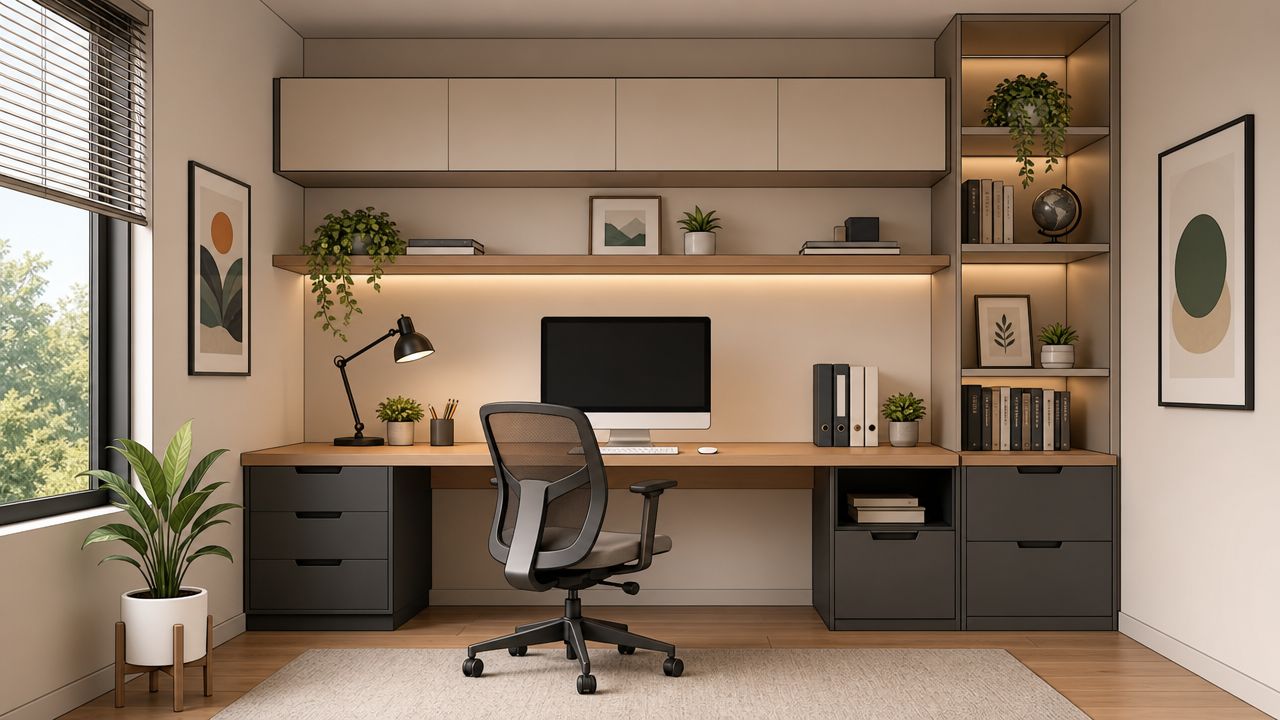
The best storage pieces do two jobs. They organize work, and they calm the room.
A few useful examples:
- A credenza behind the desk: Helpful when the office doubles as a meeting space or video-call backdrop.
- A bookcase with a mix of open and closed sections: Good for balancing display and concealment.
- A file cabinet in a matching finish: Useful when paperwork is part of everyday workflow and shouldn't drift into shared living areas.
- A cabinet with doors: Ideal for technology, office supplies, or items that create visual clutter.
The guiding principle is simple. Storage should support the work without making the room feel corporate.
Let the office belong to the home
A home office should relate to the rest of the interior. If the home leans warm and refined, the office shouldn't feel cold and utilitarian. If the house includes natural wood tones and layered textures, the office should continue that language.
That's where coordinated collections and custom finish choices become valuable. Matching or complementary pieces create continuity, especially in visible rooms near living areas. Shoppers exploring home office furniture collections often find it easier to build that cohesion when desks, storage, and seating share a common design vocabulary.
This is also the point where camera background matters. Many offices now function as professional backdrops. A clean bookcase, a handsome cabinet, or a balanced wall composition often shapes the room as much as the desk itself.
The Vinson Experience Your Partner in Design and Value
You have the measurements in hand. You know where the windows fall, where the door swings, and which corner catches the best afternoon light. Now comes the part that is hard to judge from a product page alone. How a desk feels when you rest your forearms on it for an hour. How a chair supports you at the end of a long workday, not just in the first five minutes. How a wood finish changes beside your flooring, wall color, and the fabrics already living in your home.
That is why a serious home office deserves an in-person decision.
Online browsing can help narrow options, but a long-term workspace is a physical experience. The purchase affects posture, focus, storage habits, and the visual calm of the room every single day. A good showroom visit turns abstract choices into clear answers.

Customization That Fits the Way Work Really Happens
Customization solves practical problems first.
The right finish can tie the office to nearby rooms, especially if the space is visible from a hallway, living room, or guest area. A different desk scale can preserve circulation in a compact room. A chair upholstery choice can soften a technical silhouette so it feels appropriate in a home, not borrowed from a corporate suite. Tailoring furniture works much like tailoring clothing. The material matters, but the fit determines whether you will still be pleased with it years later.
Vinson Fine Furniture offers a Custom Order Program with choices in fabrics, finishes, and configurations, along with digital visualizers that help buyers preview combinations before ordering. For a homeowner building a workspace meant to last, that process often leads to a room that feels resolved, balanced, and personal.
Design Guidance That Prevents Expensive Mistakes
A beautiful office can still feel wrong if the proportions are off.
A desk that is too deep can crowd the walkway and make the room feel smaller every day. A chair with a heavy frame can visually dominate a modest space. A finish that looked quiet on a screen can clash with flooring or trim once it arrives at home. These are not dramatic errors, but they are costly and difficult to ignore once the furniture is in place.
In-person design guidance helps catch those problems before an order is placed. The In-Store Design Studio and Complimentary Design Consultations give shoppers a clear way to sort through scale, finish, function, and layout. Bringing photos, measurements, and a short description of your work habits makes that conversation far more productive.
Useful preparation includes:
- Room dimensions: Wall lengths, window placement, and door swing
- Daily needs: Monitor count, storage needs, writing space, printer location
- Style references: Existing finishes, metal tones, upholstery colors
- Priority order: Ergonomics first, storage first, or visual integration first
For homeowners near Easton Town Center, the showroom offers something especially valuable. Confidence. A finish sample suggests a direction. A full-scale display confirms whether the choice belongs in your home.
Value Without Sacrificing Standards
Good value is measured over years of use.
A lower price can look appealing at first, but replacement costs, daily discomfort, and visual disappointment have a way of making the original bargain feel expensive. A well-built desk, a supportive chair, and storage that fits properly from the start usually serve the room longer and more gracefully. That is the difference between buying furniture and making an investment in how you live and work.
Shoppers trying to balance budget and quality often benefit from seeing made-to-order pieces alongside floor samples or closeout options that still meet the design standard of the room. The comparison is easier in person because construction, finish quality, and comfort become obvious very quickly.
A Purchase Process That Feels Complete
The process does not end at checkout.
Delivery, placement, assembly, and packaging removal shape the final result just as much as the selection itself, especially with larger desks, bookcases, and storage pieces that need to fit precisely within the room. White-glove service protects the furniture, protects the home, and saves the buyer from treating a design investment like a weekend moving project.
Vinson supports larger purchases with financing options and white-glove in-home delivery that includes placement, assembly, and packaging removal. For clients furnishing a home office as a long-term investment in well-being and productivity, that level of care matters. It keeps the experience thoughtful from the first showroom conversation to the first day of real work in the completed room.
If you want to compare materials by hand, test comfort in person, and make choices with the kind of certainty that usually only comes from professional guidance, Vinson Fine Furniture at Easton Town Center offers a setting where that decision can be made carefully and well.