How to Hire a Home Interior Design Company: A Columbus Guide


An empty room usually creates two reactions at once. Excitement comes first. Then the questions arrive. What belongs here, what should stay from the old house, what should be custom, and how can the whole home feel finished instead of pieced together over time?
That's why hiring a home interior design company has become less of a luxury decision and more of a planning decision. Homeowners aren't only buying sofas, beds, and dining tables anymore. They're trying to create rooms that function well, wear well, and feel coherent from one space to the next. An integrated design studio inside a furniture showroom can simplify that process in a way a fragmented approach often can't.
Table of Contents
- Setting the Stage for Your Design Journey
- Defining Your Vision and Preparing for Consultation
- Evaluating Design Services in Central Ohio
- Navigating Budgets and Timelines
- The Collaborative Customization Process
- Finalizing Your Home with White-Glove Service
- Frequently Asked Design Questions
Setting the Stage for Your Design Journey
A new build, a major renovation, or even one unfinished main room can leave a house feeling unsettled. The layout may be technically complete, but the home still doesn't support daily life the way it should. Seating feels undersized, traffic flow feels awkward, and finishes compete instead of working together.
That gap is exactly where a strong home interior design company earns its place. Professional design support brings order to decisions that homeowners often try to solve one item at a time. The room stops being a list of purchases and becomes a complete environment.

Why design support is becoming a practical service
The demand behind this shift is visible in the broader market. The global interior design market was valued at USD 137.93 billion in 2024 and is projected to reach USD 175.74 billion by 2030, according to Grand View Research's interior design market report. That growth reflects a simple reality. People want coordinated spaces and design-led selection, not just standalone products.
For homeowners in Columbus, that matters because the problem usually isn't access to furniture. It's decision overload. Too many finishes. Too many silhouettes. Too many measurements that look fine on paper and feel wrong in the room.
Practical rule: Good design work reduces expensive hesitation. It gives each purchase a role before money is spent.
A thoughtful starting point is learning where to begin with home design planning. That early clarity often prevents the most common mistake, which is buying a few attractive pieces first and trying to build a cohesive room around them later.
Why an integrated studio model changes the experience
The traditional path can be fragmented. One professional handles planning. Another source handles furniture. A separate team manages delivery and installation. Each handoff creates room for confusion, delay, and diluted accountability.
An integrated in-store design studio solves that differently. Space planning, finish selection, product customization, ordering, and delivery coordination stay connected. That doesn't just make the project more convenient. It usually makes it more coherent.
For a homeowner furnishing a primary bedroom, great room, and dining area at the same time, cohesion is rarely accidental. It comes from working through the whole picture with one process instead of assembling it through separate channels.
Defining Your Vision and Preparing for Consultation
The most productive design consultations start before the appointment. A designer can solve many problems, but can't solve uncertainty the homeowner hasn't articulated yet. Even a rough sense of priorities makes the first meeting sharper and more useful.
Preparation doesn't require a finished vision board or design vocabulary. It requires honesty about how the room needs to work, what already exists, and what absolutely isn't working today.

Build a useful brief before the first meeting
The strongest client brief is practical, not poetic. It should answer questions like these:
- How the room is used: Is the living room for formal entertaining, everyday family use, reading, television, or several of those at once?
- Who uses it most: Adults only, children, guests, pets, or multiple generations.
- What must stay: Existing art, heirloom pieces, a dining table, or a rug that sets the palette.
- What doesn't work now: Poor lighting, awkward circulation, insufficient storage, uncomfortable seating, or scale problems.
- What level of upkeep feels realistic: Some homes can support delicate fabrics and lighter finishes. Others need performance materials and forgiving surfaces.
A homeowner who says “traditional but cleaner,” “comfortable but personalized,” or “warm wood without heaviness” gives a designer something to interpret. A homeowner who only says “something nice” usually gets a slower process because the designer has to diagnose the brief during the meeting.
A pre-consultation checklist that saves time
Before scheduling a complimentary design consultation, it helps to gather five things:
Room measurements
Include wall lengths, ceiling height, windows, doors, and anything fixed such as vents or fireplaces.Photos from every angle
Wide shots are more useful than close-ups. A designer needs to understand sightlines and circulation.An inventory of existing pieces
Note what's staying, what's moving elsewhere, and what may need to be recovered or refinished.Inspiration with reasons
Save images, but label them. Is it the arm shape, the scale, the wood tone, the calmness, or the layering that appeals?A decision list
Identify the priorities in order. For example, seating comfort may matter more than making a bold statement, or storage may matter more than a larger cocktail table.
A consultation becomes much more valuable when the homeowner arrives with constraints, preferences, and priorities. Designers work faster when the brief is clear.
A style assessment can also help sharpen language around preference. Some homeowners know exactly what they like when they see it but struggle to describe it. A guided design quiz often gives structure to that instinct and turns scattered tastes into a consistent direction.
One more point matters here. Bring the dislikes. Knowing that a homeowner doesn't want a room to feel formal, sparse, fussy, or dark can save just as much time as knowing what they do want.
Evaluating Design Services in Central Ohio
Not every design service solves the same problem. Some homeowners need detailed room planning and furniture sourcing. Others need a single consultation to confirm layout and scale. The mistake is assuming all design offerings are interchangeable because the final deliverable sounds similar.
The stronger way to evaluate a home interior design company is to look at process quality, not just image quality. A beautiful room photograph doesn't automatically reveal whether the project was handled clearly, efficiently, or with budget discipline.
What to look for beyond a pretty portfolio
A good portfolio should show more than taste. It should suggest consistency in scale, proportion, material judgment, and restraint. The best rooms often feel resolved, not crowded.
Look for signs that the company can manage the practical side of design:
- Measured planning: Rooms look correctly scaled, not overfilled or underfurnished.
- Material judgment: Wood tones, fabrics, and finishes work together rather than competing.
- Range within a signature: The company should adapt to the client while still showing discernment.
- Evidence of livability: Seating arrangements, table spacing, and storage choices should support real use.
The process matters just as much. Effective design firms use a structured sequence that includes needs analysis, dimensional planning, finish specification, and client approval through digital visualizers or mockups, as described in this design operations guide. That kind of documented process protects both quality and profitability, but from the homeowner's side it does something even more important. It reduces preventable mistakes.
Comparing interior design service models
A homeowner exploring furniture stores with design services should understand how the service model affects the experience.
| Service Model | Best For | Typical Cost Structure | Process |
|---|---|---|---|
| Full-service independent designer | Renovations, large furnishing projects, multi-room coordination | Usually a professional design fee structure tied to scope, time, or project format | Broad project management, planning, selections, sourcing, and coordination across multiple vendors |
| Consultation-only | Homeowners who want expert direction but will execute themselves | Usually limited to a consultation or defined planning package | Advice, layout input, and selection guidance with homeowner-led purchasing and implementation |
| Integrated in-store design studio | Homeowners furnishing rooms and wanting planning plus product coordination in one place | Often centered on product purchase with design support included or closely tied to the showroom process | Space planning, finish selection, customization, ordering, and delivery coordination within a connected workflow |
Questions worth asking in a consultation
Some questions reveal more than a portfolio ever will.
- How is the room plan developed before products are selected?
- What happens if a piece is the right style but the wrong scale?
- How are custom finishes, fabrics, or configurations approved before ordering?
- Who coordinates delivery, placement, and installation details?
- How does the team prevent a project from becoming a collection of isolated decisions?
The clearest sign of professionalism is often not style. It's a repeatable process that makes style easier to execute.
For Central Ohio homeowners, the practical choice often comes down to how many handoffs they want in the process. More handoffs usually mean more room for mismatched assumptions. A connected studio model often fits best when the project centers on furnishing the home well, not managing a broad construction team.
Navigating Budgets and Timelines
Budget conversations tend to go wrong when everyone talks only about price. The better conversation is about value over time. A lower upfront number can still be the more expensive decision if the piece wears poorly, doesn't fit the room, or creates extra delivery and replacement costs later.
That's why a disciplined home interior design company discusses ownership, not just purchase. Homeowners usually feel more confident when the quote reflects what the project includes.
Budget for ownership, not just purchase
Budget transparency matters because homeowners need to compare quotes on equal terms. As noted in this Houzz profile example and related cost discussion, the practical issue often isn't style alone. It's understanding total cost across layout, sourcing, delivery, and installation.
A useful budget review should separate these decisions:
- Where to invest: The pieces used daily, such as dining seating, primary bedroom furniture, and main living upholstery.
- Where to save: Accent items, secondary rooms, or immediate placeholders for later phases.
- Where custom matters: Odd room dimensions, specific finish matching, or comfort requirements that standard retail sizing can't solve.
- Where timing affects cost: In-stock goods satisfy immediate needs. Custom orders support precision and long-term satisfaction.
A room that looks expensive but functions poorly isn't value. A room that fits, performs, and stays relevant for years usually is.
Where value programs actually help
Showroom policy and service structure can make the budget feel more manageable. For homeowners balancing quality with discipline, a few features matter more than flashy promotions:
- Low Price Guarantee: A guarantee that refunds 110% of the difference if a lower local authorized price is found within the stated window gives buyers a clearer sense of pricing protection.
- Clearance opportunities: A clearance gallery with savings of up to 70% can be useful for immediate needs, guest rooms, second homes, or one-off statement pieces.
- Flexible financing: Financing can help align a larger furnishing plan with household cash flow rather than forcing compromises on every major item.
For custom work versus in-stock goods, timing should be discussed plainly. In-stock furniture supports a faster finish. Custom furniture takes longer but removes more guesswork around fit, finish, and proportion.
Budget lens: The right question isn't “What costs less today?” It's “What solves the room well enough that it won't need to be corrected later?”
Homeowners looking for practical ideas before committing to a full project can start with guidance on decorating on a budget without losing the room's integrity.
The Collaborative Customization Process
This is the stage where a room moves from abstract preference to concrete decisions. The process should feel collaborative, but it also needs structure. Without that structure, customization becomes a maze of swatches and second-guessing.
The strongest design process narrows choices in a deliberate order. First comes function. Then scale. Then materials. Then the refinements that give the room its character.
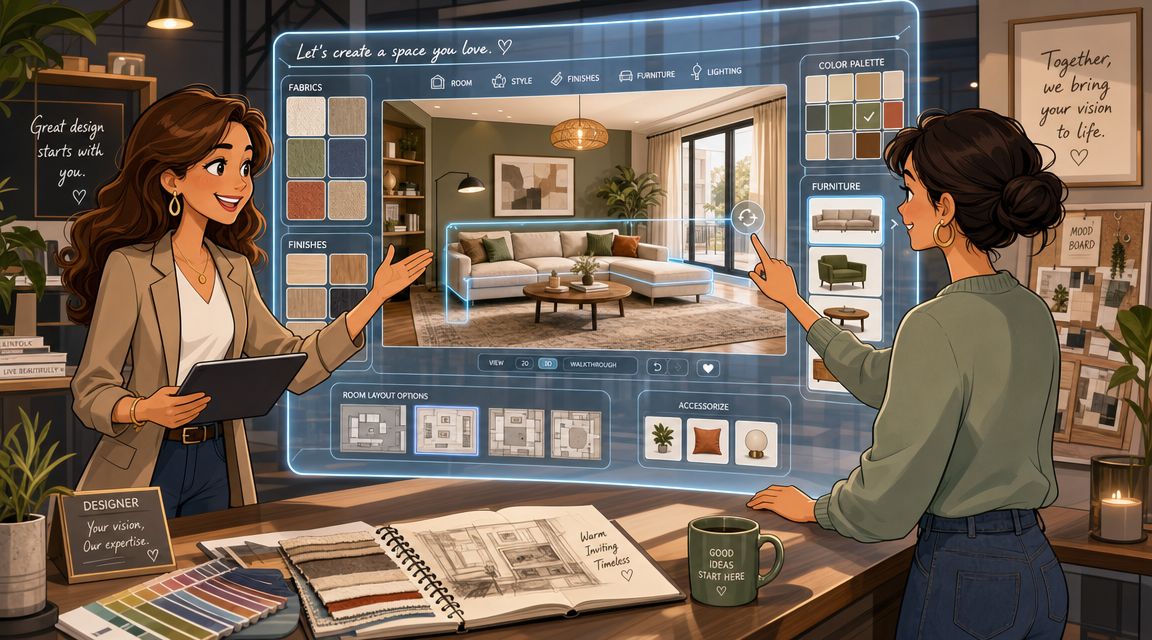
How the room starts taking shape
A well-run customization process usually begins with space planning. The designer studies the room's dimensions, entry points, focal walls, and circulation paths. Only after that does upholstery scale, dining proportion, or bedroom casegood placement become clear.
From there, the conversation turns tactile. Fabric hand matters. Leather character matters. Finish depth matters. The visual result is only part of the story. The room also has to feel right in daily use.
A connected studio process often includes:
- Needs analysis: How the room functions day to day.
- Dimensional planning: What fits without crowding the space.
- Finish and fabric selection: Wood tones, textiles, performance needs, and visual balance.
- Client approval: Reviewing the final direction through samples, layouts, or digital visualizers before ordering.
That sequence works because each decision supports the next one. It prevents the common mistake of choosing a fabric or table shape in isolation and discovering later that the whole room has drifted off course.
Where customization earns its keep
Customization is most valuable when standard options force compromise. A dining room may need a specific table length, a narrower depth, or a finish that relates to existing millwork. A sectional may need a precise configuration to preserve circulation without sacrificing seat depth. A bed may need the right wood tone to anchor a calm primary bedroom instead of overpowering it.
That's where getting started with custom order furniture becomes useful. The process typically allows homeowners to choose fabrics, finishes, and configurations through a visual approval step before production begins.
One showroom-based option in Central Ohio is Vinson Fine Furniture, which offers an in-store design studio, a Custom Order Program, and digital visualizers that help clients review fabrics, finishes, and configurations before final approval. In practical terms, that means the homeowner can handle planning and furniture selection in one connected environment rather than splitting the process across separate providers.
For shoppers looking for custom dining sets, solid wood furniture Ohio options, or Amish-made furniture, this model is especially effective. The room can be solved as a whole instead of ordering a beautiful table first and hoping the surrounding pieces catch up later.
Customization works best when it serves the room. It works poorly when it becomes customization for its own sake.
In Easton Town Center, that integrated model also gives homeowners a reason to shop in person. Scale, comfort, finish depth, and mattress feel are hard to judge from a screen. For anyone comparing options at a Furniture store Columbus Ohio location or searching for the Best mattresses Easton Town Center, the sit-test and sample review still matter.
Finalizing Your Home with White-Glove Service
The final stage of a design project affects the finished result more than many homeowners expect. A well-planned room can still feel chaotic if the delivery process is careless, incomplete, or left to the homeowner to manage piece by piece.
Why delivery is part of the design result
White-glove service matters because furniture rarely arrives as a single simple drop-off. Rooms often involve multiple items, protective packaging, assembly steps, placement decisions, and last-minute adjustments to make the arrangement work.
A true white-glove delivery service typically includes inspection before arrival, careful in-home placement, assembly, and packaging removal. That changes the experience significantly. The homeowner doesn't end the project surrounded by cartons, hardware, and guesswork about where everything should go.
The design process should end with the room ready to use. That's the true standard. Not curbside delivery. Not boxed furniture in a hallway. A finished room.
For homeowners furnishing a whole-home project or even a major single room, this final layer often determines whether the process felt smooth from beginning to end.
Frequently Asked Design Questions
Should every room be designed at once
Not always. A phased plan often works better than rushing every space at the same time. The key is to create an overall direction first, then prioritize rooms by use. Main living spaces, the primary bedroom, and dining areas usually deserve attention before decorative secondary rooms.
A strong designer should still think beyond the first room. Even if purchasing happens in phases, the home should feel connected when complete.
When is custom furniture worth it
Custom is worth serious consideration when fit, finish, or function can't be solved well with standard sizing. Dining rooms, awkward family rooms, and primary bedrooms often benefit most. If the room has unusual dimensions, a specific wood tone requirement, or heavy daily use, custom usually earns its place.
If the need is immediate or the room is temporary, in-stock options may be the better decision. The right answer depends on permanence, not prestige.
Can a designer help make a home feel calmer and easier to live in
Yes, and this question deserves more attention than it usually gets. The design industry is beginning to address neurodiverse clients more directly, including emerging conversations around inclusive design highlighted in this Business of Home coverage. The strongest designer isn't always the one with the most trend-forward portfolio. Often it's the one who can reduce friction through layout, lighting, acoustics, and storage.
That can matter for ADHD, autism, sensory sensitivity, aging-in-place, or for a household that wants less visual and mental clutter. Calmer circulation, better task lighting, softer acoustics, and more predictable storage zones can make a room feel better without making it look clinical.
Good design should support daily life, not just photograph well.
A thoughtful home deserves furniture, planning, and delivery that work together. Homeowners who want to explore a more connected approach can start with Vinson Fine Furniture, then visit the Easton Town Center showroom to sit, compare materials, review customization options, and shape a room with the support of an in-store design studio.