Best Online Home Design Services: A 2026 Buyer’s Guide

A homeowner opens six tabs, saves thirty inspiration images, and still can't answer the question that matters most. What should go in the room, and what's worth paying for?
That tension explains why the best online home design services have become so popular. They promise speed, visual clarity, and a way to turn scattered ideas into something more coherent. The category is growing quickly. The global online interior design services market is valued at USD 7.8 billion in 2024 and is projected to reach USD 22.4 billion by 2033, a projected 12.4% CAGR from 2025 to 2033, according to Data Horizzon Research's online interior design market analysis.
For an investment homeowner, though, convenience is only part of the equation. A room that looks good in a rendering can still fail in daily life. The scale can be off. The finish can read differently in natural light. The seat depth can feel wrong. The wood can lack the weight and integrity expected from a long-term purchase.
That's where discernment matters. Digital tools can be useful. They can also create false confidence. A sharper buying process starts by knowing what these services do well, where they fall short, and how to move from online inspiration to decisions rooted in material quality. A helpful starting point is learning how to use online furniture photos to make smarter buying decisions, especially when the goal isn't a quick refresh but a home built around lasting pieces.
The Digital Decorator Dilemma
The problem usually doesn't start with a lack of ideas. It starts with too many.
A homeowner may know the broad direction. Warmer woods, better seating, a dining set that feels substantial, a sectional that can handle real use. Then the feed fills up with polished rooms, conflicting advice, and photorealistic mockups that make every option look resolved. The room appears close to finished, but the buying decisions remain murky.
When online help earns its place
Online design services answer a real need. They help homeowners organize inspiration, test layouts, and get unstuck. For someone staring at an awkward living room or an open-concept main floor, even a simple floor plan or mood board can create momentum.
They're also easier to access than traditional design help. Some options are free. Others start at approachable price points. That accessibility is a major reason the category keeps expanding and why homeowners now treat virtual design as a normal part of the furnishing process rather than a niche service.
A polished rendering solves visual confusion. It doesn't automatically solve comfort, durability, or construction quality.
Why discernment matters more than ever
The best online home design services work well when the homeowner needs direction. They're less reliable when the homeowner needs final confidence.
That distinction matters most in rooms anchored by investment pieces. A dining table isn't just a silhouette on a screen. A leather sectional isn't just a color block in a floor plan. Once the purchase moves into bench-made seating, top-grain leather, power motion, or solid cherry, oak, maple, or walnut, the margin for error gets expensive.
A smart buyer uses online design to narrow choices, not to outsource judgment. The screen can help establish style. The final decision still has to survive real light, real proportions, and real use.
Understanding the Online Design Landscape
Not all digital design services do the same job. Some are light-touch planning tools. Some are guided e-design packages. Others are built around premium consultation. Knowing the difference prevents disappointment later.

Three common service models
DIY visual planning gives the homeowner direct control. These tools are best for rough layouts, spacing experiments, and testing whether a sectional, dining table, or accent chair grouping will physically fit.
Guided e-design usually includes a questionnaire, inspiration review, space measurements, and a deliverable package. That package often includes mood boards, product suggestions, floor plans, and sometimes a rendered room view.
High-touch virtual consultation is narrower and more premium. It tends to focus on direct access to a design professional, often for strategic advice, material guidance, or design review rather than a full furnishing roadmap.
What homeowners usually receive
Most online design packages revolve around a few core outputs:
- Mood boards that establish style direction, palette, and product language
- Floor plans that help with placement and traffic flow
- Renderings that make scale and composition easier to visualize
- Shopping lists that convert the concept into actual products
- Revision rounds that refine the room after feedback
The visual side has become much stronger. According to this overview of cloud-based 3D interior design platforms, leading platforms now serve over 200 million users globally and use AI-assisted decoration algorithms to create advanced renderings without local software installation. That explains why so many rooms online now look nearly camera-ready.
Where the technology helps and where it doesn't
Good renderings are useful for proportion, balance, and early decision-making. They're especially helpful when a homeowner wants to compare a tighter seating layout against a more open one, or decide whether a rectangular dining table will crowd a passage.
Still, a strong rendering can hide material uncertainty. Leather tone shifts under different light. Wood finish depth reads differently in person. Fabric texture rarely translates perfectly through a screen. That's why homeowners who rely heavily on digital planning should also study how to avoid color mismatch when ordering online.
For readers tracking broader style direction, expert insights on 2026 design can be useful as inspiration. The best use of trend content, though, is to inform selection, not drive it. Enduring rooms usually come from sound scale, honest materials, and measured customization rather than quick trend adoption.
Comparing Top Online Home Design Services
The strongest way to evaluate the best online home design services isn't by hype. It's by fit. Some services are useful for a homeowner who needs a budget-conscious starting point. Others suit a client who wants fast visual options. A different group serves buyers looking for premium access and a narrower, more consultative experience.
Here's a practical comparison based only on verified public information.
Online Home Design Services at a Glance
| Service | Starting Price | Typical Turnaround | Key Deliverables | Best For |
|---|---|---|---|---|
| IKEA Interior Design Service | Free | Varies by appointment and project | Planning appointment, layout discussion, shopping list, ordering support, optional assembly support via TaskRabbit | Homeowners who want a simple, accessible starting point tied to a retail buying path |
| Havenly | $99 per room | Varies by package and scope | 1:1 designer sessions, 3D renderings, custom floor plan | Budget-conscious homeowners who want guided structure |
| Decorilla | Not stated in verified data | Varies by project | Multiple concept previews and proposals, sourcing help, paint color guidance, detailed 3D visual, money-back guarantee if no proposal is selected | Homeowners who want options before committing to a direction |
| The Expert | $400 to over $3,000 | Length depends on consultation format | Focused video consultations ranging from 25 to 115 minutes, direct designer access, real-time product editing | Clients seeking premium-level advice and direct expert access |
| Collov | Not stated in verified data, with a minimum project budget of $1,000 | Varies by package and scope | E-design support, direct purchasing from partner brands without markup | Homeowners who want design and shopping in one flow |
What the comparison really means
The free end of the market appeals because it removes friction. In 2023, IKEA launched its interior design service with a free online or in-store planning appointment that helps homeowners discuss layouts, create shopping lists, and coordinate ordering, according to Apartment Therapy's review of online interior design services. That's useful for early-stage planning, particularly when the goal is speed and simplicity.
Havenly stands out because it lowers the barrier to entry while still providing a more structured design process. The same Apartment Therapy coverage notes a $99 per room starting point that includes 1:1 sessions with a designer, 3D renderings, and a custom floor plan. That's a meaningful bridge between DIY experimentation and full-service design help.
Practical rule: The right online service isn't the one with the longest feature list. It's the one that matches the homeowner's project scope, budget discipline, and decision style.
At the premium end, The Expert serves a different need. Its consultation model is less about low-cost room packaging and more about direct access. Verified pricing ranges from $400 to over $3,000, with focused sessions lasting 25 to 115 minutes. That can be valuable when a homeowner already has a strong point of view and wants highly targeted advice rather than a bundled shopping plan.
Decorilla's differentiator is risk reduction. A homeowner receives multiple concept previews and proposals before choosing a direction. If none of those proposals is selected, the customer gets a refund. That structure works well for buyers who know what they don't want but haven't landed on what they do want.
Collov fits a more commerce-driven process. Verified information notes partnerships with over 200 home brands and a minimum project budget of $1,000, positioning it for buyers who want direct purchasing built into the design experience.
The benchmark that matters most
A useful benchmark from Havenly's 2026 analysis of online interior design services identifies Havenly as the dominant service for project-fit alignment, using a “best fit” approach based on project constraints and user-defined budget parameters. That idea is more important than any single brand ranking.
The most successful online design outcomes usually come from a strong match between the service model and the homeowner's actual project. A buyer furnishing a full living room with custom leather seating, swivel chairs, and a solid-wood dining set needs a different process than someone choosing wall color and a rug.
Homeowners who want a more grounded process before spending serious money should also understand the furniture buying journey from first research to final decision. Most mistakes happen when buyers confuse a helpful visual plan with a finished purchase strategy.
The Limits of Virtual Design and What It Misses
Online design can answer many visual questions. It can't answer all physical ones.

A rendering can suggest that a leather sectional fits the room. It can't tell a homeowner whether the seat pitch supports long evenings, whether the arm height feels natural, or whether the motion mechanism operates with the quiet, controlled feel expected in a premium piece. The same goes for dining. A digital view can show shape and footprint. It can't communicate the density of solid maple, the character of walnut grain, or the confidence that comes from a well-built top.
What screens flatten
Material decisions suffer most online.
Top-grain leather has depth, softness, and variation that flat photography rarely captures. Solid cherry and solid oak carry visual warmth, but they also carry physical weight. The edge profile, the joinery, and the finish all shape whether a piece feels heirloom-grade or merely decorative.
That limitation matters because durability now sits at the center of many purchase decisions. Food52's discussion of online interior design services notes that 68% of homeowners prioritize durability over trendiness in emerging 2024 to 2025 data. Yet the same discussion points out that top-ranked guides often fail to show homeowners how to connect digital mood boards with in-store evaluation of custom solid-wood or top-grain leather pieces.
If durability is the priority, then touch, sit, weight, and finish become decision tools, not optional extras.
What investment homeowners still need
A homeowner buying for the long term should test more than appearance:
- Seat comfort: Sit depth, back support, arm scale, and motion feel
- Wood integrity: The heft and grain character of solid cherry, oak, maple, or walnut
- Finish realism: How stain, leather, and fabric respond to daylight and lamp light
- Room fit: Whether the piece works once real door swings, walk paths, and sightlines are considered
Measurements matter here, too. Even the best design recommendations break down if the furniture can't move through the home or fit the room the way the plan assumed. That's why a practical next step is reviewing how to measure furniture before buying.
The central limitation of virtual design isn't that it's bad. It's that it's incomplete. For investment-grade purchases, a screen can start the process. It shouldn't finish it.
The Vinson Advantage In-Store Design and Customization
For homeowners in Columbus and around Easton Town Center, the strongest answer to the limits of online-only design is a high-touch showroom process that treats furniture as a long-term investment instead of a quick transaction.
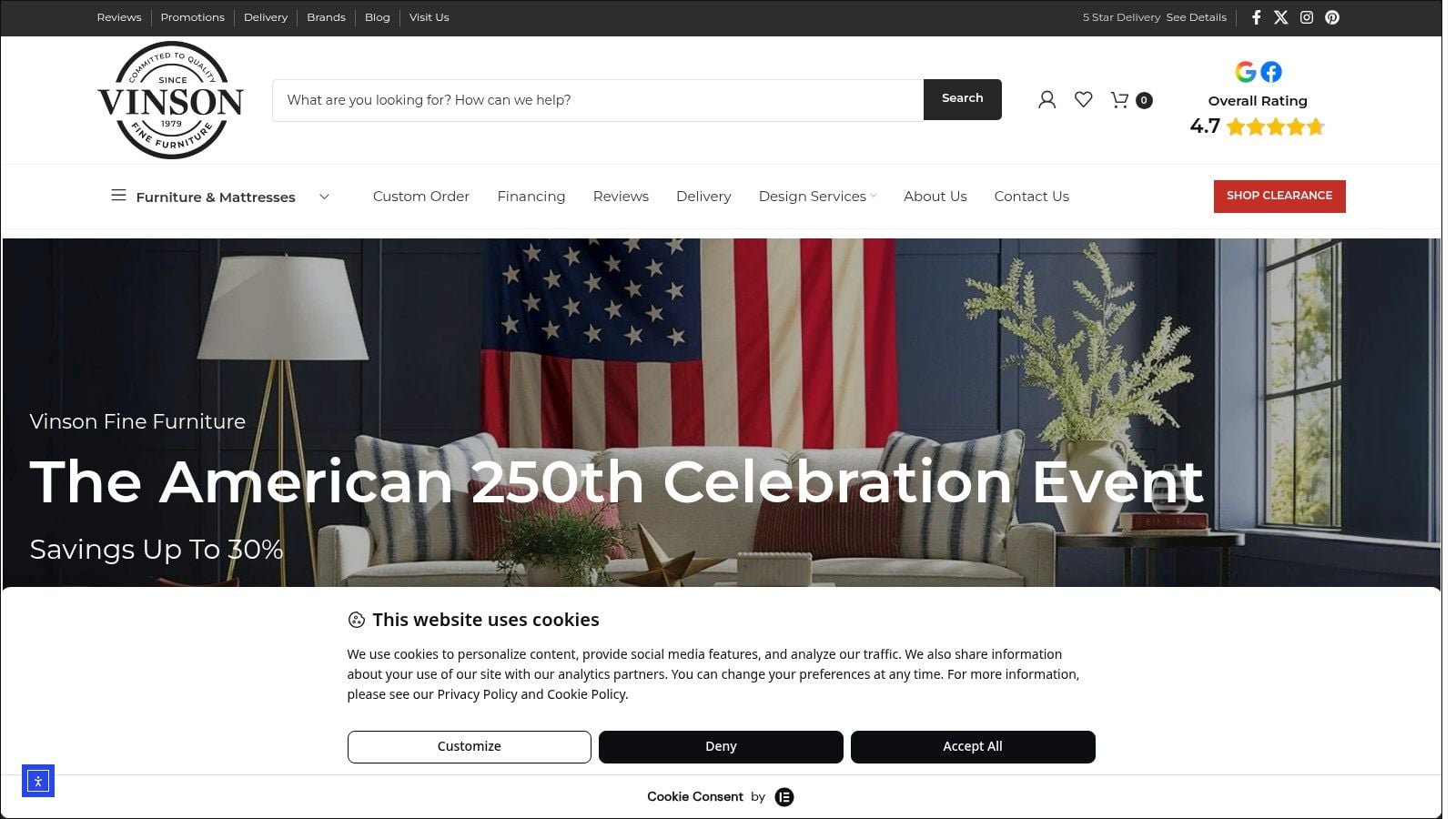
Vinson Fine Furniture is a family-owned business, formerly known as Kitchen Tables & More, with a showroom at 4070 Morse Rd, Columbus, OH 43230 in the Easton Town Center area, as listed in this Yelp business profile for Vinson Fine Furniture. That local presence matters because the best furnishing decisions often happen when digital ideas meet physical reality.
A design studio built for real decisions
The in-store design studio gives homeowners something online services often can't. It puts scale, material, comfort, and customization into the same conversation. Complimentary design consultations help translate saved images and loose preferences into a room plan anchored by pieces that can effectively carry daily life.
The process now demands more discipline. Instead of approving a room because the rendering looks balanced, the homeowner can compare arm styles, seat depths, wood tones, and silhouettes in person. The room stops being a concept board and becomes a livable plan.
For buyers seeking that kind of guidance, furniture stores with design services offer a more complete path than online-only curation.
Why solid hardwood changes the conversation
Vinson's hardwood standard is clear. The store focuses on solid hardwood furniture and does not promote engineered wood, MDF, or particle board. That distinction matters for investment homeowners who care about longevity, refinishing potential, and structural integrity over time.
In practical terms, solid cherry, oak, maple, and walnut age with more grace than disposable case goods. They carry depth in the grain, integrity in the structure, and a presence that's immediately obvious when a drawer is opened or a tabletop is touched. Amish-made dining sets and bedroom collections are especially strong in this category because the craftsmanship emphasizes durability and proportion rather than shortcut construction.
That's why terms like Solid wood furniture Ohio, Amish-made dining sets, and Mavin bedroom furniture aren't just search phrases. They describe a category of product that behaves differently in the home and over the years.
Customization that goes beyond surface choices
A strong custom program should help a homeowner tailor a piece without losing the discipline of good design. Vinson's custom order program does that through brands such as Smith Brothers of Berne, Canadel, and Mavin, with digital visualizers that help narrow options before the final in-person review.
A few examples show why this matters:
- Smith Brothers furniture Easton: Custom leather sectionals, reclining seating, swivel chairs, rockers, and gliders can be shaped around room scale, comfort preference, and motion needs.
- Canadel dining: Homeowners can work through table size, base style, wood species, and finish to land on a dining set that feels perfectly suited rather than generic.
- Mavin bedroom furniture: Solid-wood bedroom pieces offer a path to coordinated storage and sleeping spaces built around hardwood integrity and customization.
A good custom process doesn't overwhelm the buyer with options. It narrows choices until the room feels specific, coherent, and built to last.
Motion seating and leather that justify the upgrade
This is another category where online shopping often underperforms. Premium motion furniture isn't just about whether a footrest opens. It's about whether the mechanism moves smoothly, whether the proportions stay elegant, and whether the chair still looks refined when not in use.
The same goes for leather. Top-grain and performance leathers carry a tactile richness that photos struggle to translate. The buttery hand, natural variation, and drape over a well-engineered frame all become obvious during a sit-test. For homeowners searching for Custom leather sectionals Columbus, those details are often what separate a short-term compromise from a piece worth living with for years.
Value that respects the investment
Investment buying still requires discipline. Vinson's value structure addresses that without lowering standards.
- Low Price Guarantee: If a lower price is found at a local authorized dealer within the stated period, the store refunds 110% of the difference.
- Clearance Gallery: Savings can reach up to 70% on floor samples, overstocks, and seasonal closeouts.
- White-Glove Delivery: Multi-point inspection, careful placement, assembly, and packaging removal reduce friction at the end of the process.
Custom work also requires patience. A typical custom order for high-quality, American-made Amish furniture takes about 8 to 16 weeks from start to finish, according to Vinson's custom sectional design information. That timeline reflects bench-made construction. For a homeowner buying with a long view, that's usually a sign of substance, not delay.
Creating Your Perfect Home with a Hybrid Approach
The most effective strategy isn't online versus in person. It's a deliberate mix of both.
Online tools are excellent for early exploration. They help a homeowner collect references, compare layouts, refine palette direction, and understand what style language keeps appearing across saved images. That's useful work. It reduces guesswork before any serious purchase begins.
The final stage should become more tactile and selective. Once the room direction is clear, the homeowner benefits from testing the seat, studying the wood grain, comparing finishes under real light, and confirming scale with a professional design eye. That's where a room shifts from visually promising to materially convincing.
A better sequence for investment homeowners
- Start digitally: Build mood boards, save room images, and explore layout ideas.
- Edit hard: Identify what keeps repeating. Wood tone, arm style, table shape, leather color, motion needs.
- Measure carefully: Confirm the room, entry path, and major dimensions.
- Move in person: Test comfort, compare materials, and review custom options before committing.
- Buy for longevity: Favor solid hardwood, bench-made construction, top-grain leather, and designs that still make sense years from now.
That hybrid method respects both convenience and quality. It uses the best online home design services for what they do well, then relies on in-person expertise for the decisions that carry the most financial and practical weight.
Homeowners who are ready to move from inspiration to confident buying can visit Vinson Fine Furniture, located in the Easton Town Center area of Columbus. The showroom's complimentary design consultations, in-store design studio, custom programs with Smith Brothers of Berne, Canadel, and Mavin, solid hardwood focus, white-glove delivery, low price guarantee, and clearance savings create a stronger path than screen-only shopping for anyone furnishing a home with long-term value in mind.