Console Table Designs: Style & Sizing Tips

The console table by the front door is doing too much and too little at the same time. It catches the mail, the keys, the sunglasses, and the random paperclip magnet from last week, but it still feels unfinished because the piece itself never got chosen with care.
That's usually where console table designs start to matter. A good console table isn't just a narrow ledge, it's a calm landing spot for daily life, and the right one changes how an entryway, hallway, or sofa wall feels the moment someone walks past it.
Why Console Table Designs Still Earn Their Place
A tired entryway can make an entire home feel rushed. Mail piles up, keys drift, and the first surface people see becomes a dumping ground instead of a useful transition space. A well-chosen console table solves that by giving the room a defined edge, a place where the day can land without taking over the path.

The form itself has serious history. Console tables trace back to 17th-century France and Italy, where they appeared as wall-mounted decorative pieces for aristocratic interiors, often shaped like a half-moon or crescent and supported by a curved bracket called a console. During the reign of Louis XIV (1643–1715), the style moved through royal courts and palaces, and early versions were often made in pairs with matching mirrors and gilded detail, a far cry from the practical landing strips people use today. That long arc matters because it explains why the shape still feels elegant even when it's doing everyday work. Origins of the console table
From ornament to daily utility
The modern category didn't stay decorative. One industry forecast places the console table market at USD 5.44 billion in 2026, rising to USD 7.96 billion by 2033 at a 5.6% CAGR. The historical shift toward function accelerated in the late 18th century and again in the mid-20th century, when designers leaned into simpler lines and practical use in hallways, living rooms, and smaller homes. Market forecast and design evolution
Practical rule: if a table sits where people already walk, its profile has to serve circulation first and display second.
That's why console tables are treated as shallow-load furniture. For most homes, the right depth preserves room to pass while still giving enough surface for a lamp, tray, or basket. In a Columbus house, that balance is the difference between a piece that looks sharp for a week and one that stays useful for years.
The Major Console Table Styles Worth Knowing
The easiest way to shop console table designs is to read the silhouette first, then the material. Shape tells the story before finish ever does, and it usually tells the truth about how the piece will sit in the room.
Traditional, modern, rustic, and mid-century
Traditional console tables lean into carved edges, turned details, and warm wood tones. They suit homes with trim, paneled walls, formal mirrors, or older architecture that already has visual weight. These pieces often feel composed and familiar, especially when the surface is balanced with a lamp and a framed print.
Modern consoles strip away ornament. Expect cleaner geometry, slimmer legs, smooth fronts, and a quieter profile that disappears into a hallway until it's needed. This style works well when the room already has strong lines, minimalist lighting, or a more open floor plan.
Rustic pieces show grain, texture, and sometimes visible character marks in the wood. They bring a softer, lived-in feel to homes that use stone, textured rugs, or relaxed seating. The look works best when the rest of the room can absorb a little visual roughness without feeling crowded.
Mid-century designs usually bring tapered legs, rounded edges, and an organic shape that feels lighter than it is. The style fits well in homes where the architecture is simple but not severe, especially when the owner wants something with vintage spirit without full traditional ornament.
A smart approach is to match the console to the architecture already in the home, not to a trend board. In many Columbus homes, that means choosing a profile that respects the trim, flooring, and sightlines already in place. For shoppers comparing proportions and surface details, a helpful internal primer is the sofa table explanation, since the same visual logic often carries over.
Good showroom habit: bring a photo of the wall, not just the room. A console table is judged by what surrounds it.
Custom makers can also bend a style in useful ways. A cleaner modern frame can still feel warmer with the right wood finish, and a traditional form can be softened with less ornate hardware or a simpler edge. That kind of flexibility is where a custom order program becomes practical rather than extravagant.
Solid Hardwood and the Materials That Make a Console Last
The material choice decides whether a console feels sturdy in the hand or merely decorative from across the room. For an investment homeowner, that's the core question, because a console table in a hallway or entryway gets touched, bumped, and used every day.
What solid hardwood changes
Vinson's standard is solid hardwood, and for console tables that means the discussion stays focused on cherry, oak, maple, and walnut. These woods carry weight, hold joinery well, and can be refinished later, which is part of why Amish-made furniture has such a durable reputation. Bench-made construction and mortise-and-tenon joinery matter here because the piece has to remain stable under repeated use, not just look good in a staged room. Choosing the right hardwood for longevity and style
| Material | Feel and Weight | Durability | Refinishing Potential |
|---|---|---|---|
| Solid Hardwood | Substantial, dense, and calm in the hand | Built for long-term use with strong joinery | Can often be refreshed and refinished |
| Engineered Wood | Lighter and less substantial | More limited for repeated daily use | Generally far less forgiving |
Solid hardwood also makes sense when the table has to sit flush to a wall, support a lamp without wobble, or survive as a daily drop zone. A lighter material can work visually, but the physical experience changes as soon as someone sets a bag on it or leans over to grab keys.
How complementary materials fit
Metal accents can sharpen a profile, especially on a modern or mid-century piece. Glass tops create visual lightness, while stone adds visual heft and a cooler tactile feel, but those surfaces make the strongest sense when the base is already stable and the home can handle a little more maintenance. In a busy household, the best combination is the one that supports use without turning the console into a delicate object people are afraid to touch.
Worth remembering: the best-looking console is the one that still feels composed after a normal weekday, not just after the styling is finished.
Sizing Console Tables for Hallways, Entryways, and Behind the Sofa
Sizing is where most console table mistakes happen. A piece can look elegant in a showroom and still fail at home if it pinches the walkway, hides an outlet, or floats awkwardly under a mirror that's too high.
Start with depth, then check clearance
The first measurement to trust is depth. Common guidance places console tables around 10 to 18 inches deep, with 28 to 34 inches of height and 30 to 72 inches of length for residential use. For typical hallways, independent guides recommend roughly 12 to 16 inches deep, and 10 to 14 inches deep behind a sofa, while keeping at least 36 inches of clear walkway and placing the console flush to the wall or pulled off by only 1/2 to 1 inch to avoid visual misalignment and snag points. Sizing tips for console tables Console table design guide
Measure the room the way the piece will actually live in it
- Check baseboards first: A deep baseboard can change how a console sits against the wall.
- Find outlet height: Lamps, chargers, and catchalls are easier when cords don't fight the table.
- Look at nearby art: A console under a mirror or framed piece needs visual breathing room.
- Bring hallway dimensions: Tight passages need a different profile than a wide foyer.
- Measure sofa height too: Behind-sofa placement should respect the back rail, not compete with it.
For shoppers who want a clean showroom conversation, the furniture measuring guide helps organize those numbers before the visit. That matters because the right dimensions turn a nice-looking piece into a usable one.
A console that fits well should feel almost inevitable. People should pass it without thinking about it, and then notice it only because it makes the room more organized.
Styling and Accessorizing a Console Table with Intention
Most styling advice starts with the same formula, mirror, lamp, vase, done. That can work, but it doesn't help much in a real home where the console also handles keys, sunglasses, charging cords, and the stuff that arrives in someone's hands.
Anchor, height, layering, function
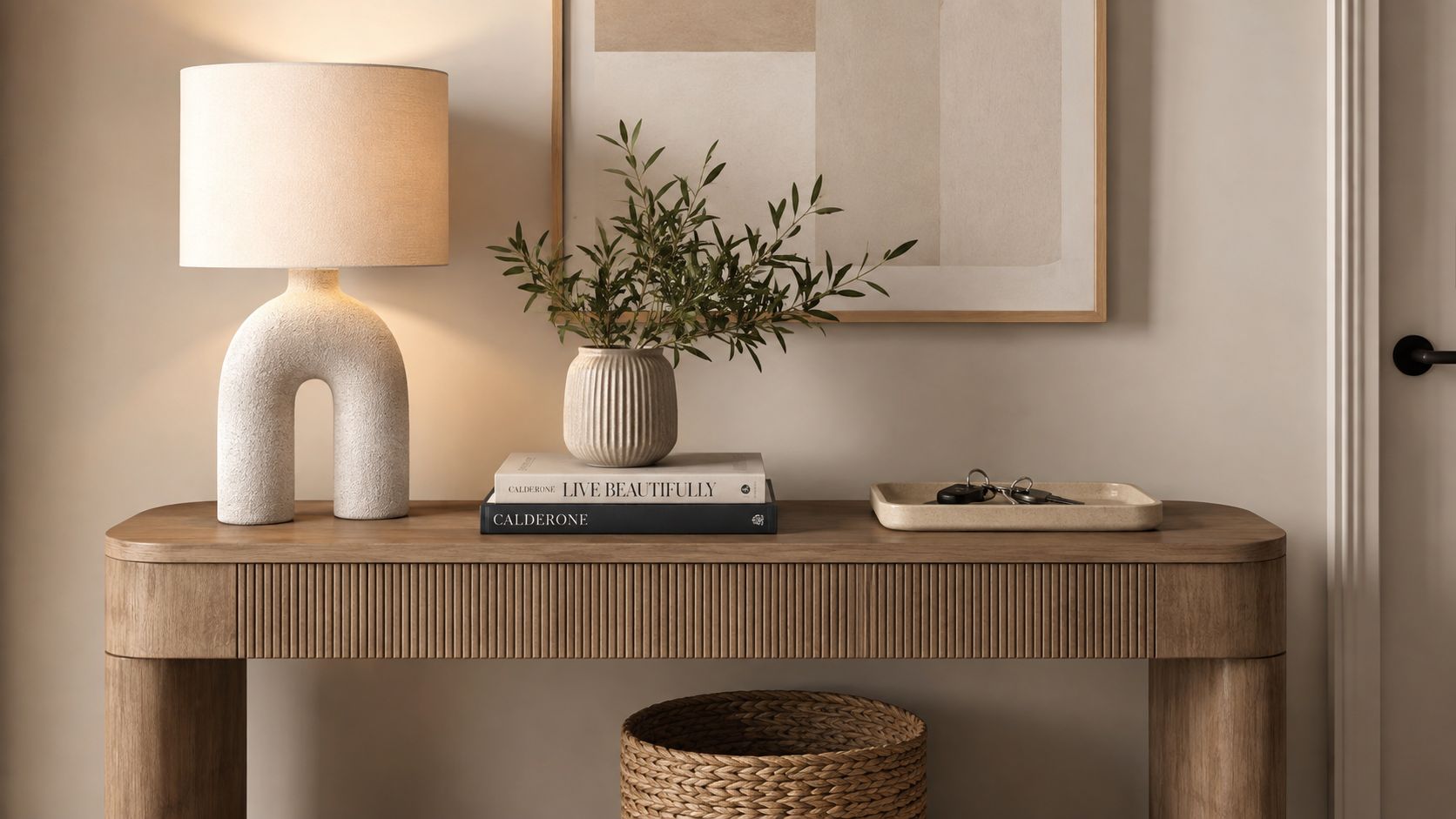
Start with an anchor, usually a mirror or artwork, because the wall needs a visual center. Add height with a lamp or tall vase so the table doesn't look flat. Then layer in books, bowls, or sculptural pieces to give the surface depth without making it crowded. Finally, keep function visible with a tray or catchall so daily items have one home instead of many.
That is also where practical household habits should shape the setup. A shallow tray can disguise a charging station, a woven basket underneath can hide mail, and a simple dish can keep remotes and keys from scattering across the top. Seasonal changes work best when the core arrangement stays stable and only one or two objects rotate with the calendar.
For readers who like to see styling ideas in photographic form, interior design photo ideas can be a useful reference point for how composition, scale, and restraint work in finished rooms. The point isn't to copy a photo exactly. It's to notice how the strongest arrangements leave some empty space on the surface.
The same logic applies to the area below the table. A basket can hold pet leashes, reusable bags, or the small things that otherwise drift into the entryway, and that hidden storage is often what makes the console feel composed instead of busy. For another useful styling framework, the coffee table styling guide shows how balance and restraint carry across furniture categories.
Customization Options Through the Vinson Design Studio
Customization is not only for large dining rooms or upholstered seating. A console table can benefit from the same thinking, especially when the goal is to fit a specific wall, coordinate with nearby wood tones, or match the way a home gets used.
What can change and why it matters
The Custom Order Program gives homeowners control over finishes, fabrics where upholstery is involved in related pieces, and digital preview tools that help confirm the look before anything is built. For console-adjacent planning, that flexibility matters because a table often lives beside seating, a mirror, or nearby storage, which means the finish has to cooperate with the rest of the room instead of standing apart from it. The custom order process makes that path more approachable by showing how the selections work before the order is placed.
Brands like Canadel, Mavin, and Smith Brothers fit different needs in a home where a console table is part of a larger furnishing plan. Canadel works well for dining-adjacent custom builds, Mavin supports solid-wood bedroom coordination, and Smith Brothers is useful when the nearby seating needs coordinated upholstery. That's where the In-Store Design Studio and complimentary design consultations matter, because they let the pieces be evaluated together instead of as isolated purchases.
Best practice: bring one finish sample from the room if possible. A console table often looks different beside oak flooring than it does beside painted trim.
For the homeowner who thinks customization is a luxury add-on, the better frame is fit. A table that matches the room, the circulation path, and the daily routine is usually the one that stays in the house longest.
Caring for a Console Table and Bringing the Right Questions to Easton
Solid hardwood asks for simple care, not complicated maintenance. Dusting regularly, controlling humidity, using felt pads, and wiping spills quickly all help the piece age gracefully, especially on a table that sits near a door or seating area. Wax or oil finishes need occasional attention, but the routine is still straightforward when the construction is built around longevity.

The value shows up over time. Amish-made construction, solid hardwood, and careful joinery give a console table the kind of durability that makes it worth maintaining instead of replacing. That's the investment logic behind the category.
Before a visit to Easton Town Center, bring room dimensions, a few photos, and any fabric or finish swatches that already live in the home. During a complimentary design consultation, ask how the piece sits against the wall, what the finish will do beside existing wood, and whether the scale leaves enough walkway in daily use. The Low Price Guarantee and Clearance Gallery can also extend the value of a custom order when a shopper is comparing options with a clear budget in mind.
Vinson Fine Furniture offers solid hardwood console tables, custom finish guidance, and complimentary design consultations at Easton Town Center for homeowners who want the piece to fit the room and the routine. Visit Vinson Fine Furniture to explore the console table category, compare materials in person, and bring your room measurements in for a sit-test and design conversation that's built around long-term use.