Interior Design Consultation Price: A Columbus, OH Guide

Interior design consultation fees typically range from $150 to $500 for an initial meeting or $100 to $200 per hour in the U.S. A key aspect is understanding which pricing model fits the project, because the right structure often matters more than the starting number.
A homeowner in Columbus often reaches this point at the same moment. The house is finally purchased, the rooms are full of possibility, and the questions start piling up. Should the family commit to a paid consultation, move straight into full-service design, or look for a more integrated way to make smart furniture decisions?
That uncertainty is understandable. A consultation can be a wise investment, but only when the homeowner knows what the fee includes, what it doesn't include, and whether it leads to a much larger commitment. For an investment-minded buyer who cares about heirloom quality, solid hardwood, top-grain leather, and pieces that will still feel right years from now, pricing needs to be clear before any order is placed.
A helpful starting point is to learn where to begin with home design planning. Once the pricing language becomes familiar, the decision gets much easier.
Table of Contents
- The True Cost of Creating a Home You Love
- Decoding Interior Design Pricing Models
- Factors That Influence Your Final Design Cost
- The Vinson Advantage A Complimentary Showroom Consultation
- Investing in Quality Your Design Consultation Payoff
- Key Questions to Ask Your Designer and Red Flags to Avoid
- Begin Your Design Journey with Confidence
The True Cost of Creating a Home You Love
A homeowner might start with a simple goal. A solid cherry dining table for family gatherings. A custom leather sectional that fits the room. A bedroom set with the quiet confidence of Amish-made craftsmanship. Then the next question arrives. What is the interior design consultation price, and is it worth paying before a single piece is ordered?
The answer depends on what kind of help the homeowner needs. A widely cited benchmark puts initial consultation fees at $150 to $500, with hourly consulting rates often at $100 to $200 per hour in the U.S. according to Pacaso's interior designer cost guide. That range is broad enough to confuse almost anyone who's furnishing a home for the first time.
The confusion usually comes from treating the consultation like a simple appointment fee. It rarely works that way. A consultation can be a brief style discussion, a room-measuring visit, a sourcing strategy session, or the first step into a much deeper design engagement.
A design fee only makes sense when the homeowner can clearly connect it to decisions, deliverables, and long-term value.
For an investment homeowner, the true cost isn't just the consultation charge itself. It's also the cost of ordering the wrong scale, the wrong finish, the wrong seating depth, or a material that looks good for six months and disappoints after that. One wrong purchase can undo the savings from skipping professional guidance.
A practical example
Consider a family moving into a new home near Columbus. They need a dining set, bedroom furniture, and a sectional for the main living space. Without guidance, they may choose pieces one at a time, based on isolated showroom impressions or online dimensions that don't tell the full story.
With professional guidance, the family can evaluate flow, finish harmony, seating proportions, customization choices, and how each room connects to the next. That's where consultation value shows up. Not in abstract style advice, but in fewer costly missteps and better long-term decisions.
Decoding Interior Design Pricing Models
The phrase interior design consultation price sounds singular, but the market doesn't work that way. What a homeowner encounters is a menu of billing structures. Each one shifts the risk, the predictability, and the scope.
Why the same project can be priced in different ways
Some designers bill by the hour. Others prefer a flat project fee. Some tie their compensation to the broader purchase or project scope. A few package work by room so the homeowner can tackle the house in stages.
The difference matters because the homeowner isn't only buying advice. The homeowner is paying for decisions, communication, sourcing, revisions, and often coordination behind the scenes. Industry analysis notes that junior to mid-tier designers typically charge $50 to $200 per hour for advisory sessions, while an extensive full-service consultation often begins at a fixed rate of $5,000 to $12,000 because flat fees absorb sourcing and coordination work that hourly billing can undercount, as outlined in this consultation fee analysis.
That explains why two quotes for what sounds like “design help” can land in completely different places.
Comparing Interior Design Pricing Models
| Pricing Model | How It Works | Best For | Potential Downside |
|---|---|---|---|
| Hourly | The client pays for time spent on meetings, planning, sourcing, and revisions | Smaller questions, limited-scope advice, one-room troubleshooting | The total can feel unpredictable if decisions expand |
| Flat fee | One price covers an agreed scope of work | Homeowners who want budget clarity and a defined process | Scope changes can lead to add-ons or misunderstandings |
| Percentage-based | Fee is tied to the overall project or furnishing spend | Larger furnishing plans or renovation-level work | It can be harder for the client to estimate the final fee upfront |
| Per room | Each room is priced as its own assignment | Phased furnishing plans and staged budgeting | It can create inconsistency if rooms are designed too independently |
A simple way to think about it:
- Hourly pricing works like hiring an advisor by the clock.
- Flat-fee pricing works like buying a complete design package.
- Percentage-based pricing works like engaging a partner whose role grows with the project.
- Per-room pricing works like furnishing the home in chapters.
Practical rule: The best model is usually the one that matches the homeowner's decision style. Some people want flexibility. Others want a defined total before they start.
For a homeowner furnishing with solid maple, oak, cherry, or walnut pieces, and layering in custom upholstery or motion seating, pricing transparency matters even more. Customization tends to create more decisions, not fewer. That's one reason many buyers explore professional design services before they commit to product selections.
Factors That Influence Your Final Design Cost
The pricing model sets the structure. The actual project details drive the final number.
What changes the number
Experience is one factor. A designer with a refined process, stronger sourcing access, and the ability to solve layout problems quickly may charge more. That doesn't automatically make the fee high or low in value. It means the homeowner is paying for judgment, not just time.
Scope is the next major factor. A quick styling consult is very different from a whole-home furnishing plan that includes room flow, finish coordination, upholstery selection, and custom order decisions. In-person work can also cost more than virtual help because it often includes site visits, measurements, travel, and deeper hands-on evaluation.
Deliverables also shape the fee. A homeowner should ask whether the consultation includes any of the following:
- Space planning with real furniture layout guidance
- Material direction such as leather, fabric, and wood finish selection
- Customization support for options like dimensions, cushion feel, or table shape
- Visual tools such as room renderings or digital visualizers
- Purchasing guidance on what to buy now and what can wait
For homeowners balancing upgrades across multiple rooms, even adjacent categories can affect planning. Someone comparing furnishing costs with renovation work may benefit from practical reading on budget kitchen renovation ideas, especially when trying to sequence spending between cabinetry, finishes, and new furniture.
Why the consultation fee is only one line item
A consultation fee often feels large at the beginning because it's visible and immediate. The broader project budget is usually where the substantial spending resides. Historical pricing data shows that the average U.S. interior design project cost was $7,808 in 2022, with small projects at $200 and high-end work above $60,000, based on Angi data cited in Thumbtack's interior designer cost page.
That context helps. The consultation is usually not the main budget event. It's the first decision inside a much larger furnishing or design plan.
A homeowner furnishing a new build or recently purchased house should look at the consultation in relation to everything that follows: dining, bedroom, seating, delivery, customization, and installation. That broader lens often makes it easier to plan how to furnish a new home in a way that feels coordinated instead of reactive.
The Vinson Advantage A Complimentary Showroom Consultation
Some homeowners don't need a separate paid design relationship. They need informed guidance connected directly to the furniture decisions they're already making.

What a showroom consultation includes
In that setting, the consultation isn't an abstract conversation. It's attached to real materials, measurable dimensions, and actual customization options. A homeowner can evaluate the weight of solid hardwood, compare finish tones across cherry, oak, maple, and walnut, and sit in sectionals, swivel chairs, rockers, gliders, and recliners to test proportion and comfort.
This approach becomes especially useful when a household wants guidance on custom ordering. The process may include fabric coordination, top-grain leather selection, dining dimensions, bedroom scale, and digital visualizers for brands such as Smith Brothers, Canadel, and Mavin. Those details help a homeowner move beyond “pretty in the showroom” and toward “right for the home.”
A complimentary consultation can also simplify hard choices:
- Dining decisions such as table size, extension format, and finish pairing
- Bedroom planning built around solid-wood case goods and long-term durability
- Sectional configuration including power motion, reclining seats, and corner flow
- Accent seating like swivel chairs and gliders that improve movement through a room
Why integration changes the value equation
The value of a showroom consultation is that the homeowner isn't paying separately for advice that then has to be translated elsewhere. The planning, material review, and product selection happen in one place, with one set of decisions.
That integrated model is particularly strong for a buyer who wants heirloom-quality furnishings instead of disposable pieces. It connects design guidance to bench-made construction, custom options, and white-glove delivery rather than leaving the homeowner with a concept board and a long sourcing list.
One option for homeowners who want that format is a complimentary interior design consultation connected to the showroom experience. It can also help to complete a design quiz beforehand so the meeting starts with clearer priorities and room goals.
The smartest consultation is often the one that helps the homeowner choose well, not simply the one that produces the lowest standalone fee.
Investing in Quality Your Design Consultation Payoff
A consultation earns its keep when it protects the homeowner from short-term thinking. That payoff becomes obvious the moment the conversation shifts from general style to tangible quality.

How to use a consultation well
A strong consultation begins with priorities. Not trends. Not impulse purchases. Priorities.
A homeowner gets the most from the meeting by bringing a short, useful brief:
- List the rooms that matter first. A family may need the dining room and great room solved before the guest room.
- Name the daily realities. Children, pets, frequent guests, formal entertaining, reading, napping, and TV viewing all affect material and seating choices.
- Identify what must last. Dining sets, bedroom furniture, and primary seating usually deserve the highest standards.
- Clarify what can be customized. Finishes, fabrics, leather, dimensions, and motion features should be discussed early, not after the room plan is set.
- Bring measurements and photos. Good design advice becomes much sharper when the room is visible.
What investment-grade guidance looks like in person
The payoff is most obvious when the homeowner can physically compare options. A solid-maple dresser feels different from lighter, less durable construction. A top-grain leather sectional has a different hand and visual depth than lower-tier upholstery. A well-made dining table in walnut or oak carries a presence that photographs rarely capture.
That's where names like Smith Brothers, Canadel, and Mavin become useful reference points. They represent categories that matter to investment homeowners: custom leather seating, solid-wood dining, and substantial bedroom furniture designed for long use. The consultation helps match those categories to the room, the household, and the finish palette.
A productive session should also include the less glamorous details that protect the purchase:
- Seat depth and height so comfort isn't guessed
- Wood species and finish tone so adjoining rooms feel coherent
- Motion features so reclining and power mechanisms fit the room properly
- Traffic flow so the furniture doesn't overpower the architecture
For homeowners comparing makers and materials, it helps to review high-quality furniture brands before the visit. That kind of preparation makes the consultation more decisive and far more useful.
Key Questions to Ask Your Designer and Red Flags to Avoid
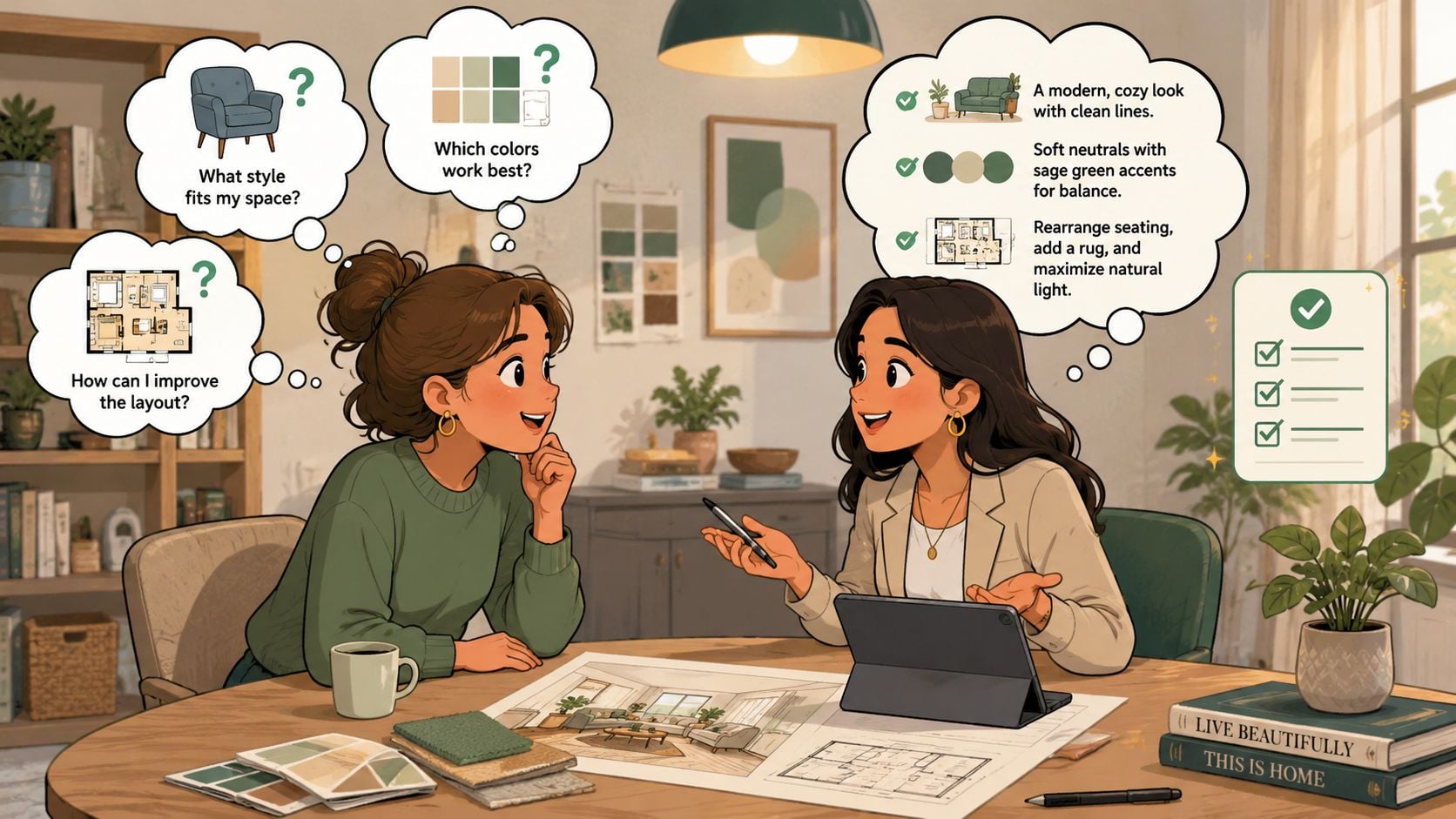
A homeowner doesn't need design training to ask smart questions. Clear questions often reveal more than a polished portfolio.
Questions that create clarity
One of the most important questions is whether the consultation fee stands alone or serves as the first step into a broader project. That distinction matters because paid consultations can range from $50 to $500 per hour, while full-service projects may start at $5,000+, making fee application and budget transparency essential, as explained in this overview of consultation cost structure.
A homeowner should ask:
- What exactly is included in the consultation? Is it advice only, or does it include layout guidance, sourcing, finish selection, or follow-up notes?
- How are purchases handled? Will the designer specify and order furnishings, or is the homeowner expected to source items independently?
- Does any consultation fee apply to future purchases? This question often determines whether the meeting is a planning session or the start of a larger engagement.
- How are custom orders managed? The homeowner should know who tracks details like finishes, fabrics, dimensions, and vendor communication.
- What happens if something arrives damaged or incorrect? A clear service process matters just as much as a beautiful presentation.
Clear pricing should answer three things without hesitation: what's included, what costs extra, and who handles the details after the order is placed.
Red flags worth noticing early
The warning signs are usually straightforward.
- Pressure without clarity. If a homeowner is pushed to commit before scope and process are explained, caution is warranted.
- Vague deliverables. A consultation shouldn't feel like paying for a pleasant conversation with no useful output.
- Poor fit in style or quality. A homeowner seeking solid hardwood, Amish-made dining sets, or custom leather sectionals should work with someone comfortable in that category.
- No discussion of budget guardrails. Serious guidance respects financial boundaries instead of sidestepping them.
- No path for problem resolution. Questions about lead times, damage, or service should have direct answers.
A trustworthy process usually feels calm, specific, and collaborative. It also respects value-minded shoppers by being transparent about purchase opportunities such as a Low Price Guarantee and a Clearance Gallery, rather than treating price questions as unwelcome.
Begin Your Design Journey with Confidence
The interior design consultation price matters, but the first number on the page rarely tells the whole story. What matters more is whether the homeowner receives useful guidance, clear scope, and decisions that hold up over time.
For many households, the best value won't come from chasing the lowest fee. It will come from aligning design help with the actual furnishing process, especially when the goal is to buy less often and buy better. That's a different mindset. It favors solid wood furniture in Ohio, Amish-made dining sets, custom leather sectionals in Columbus, and bedroom pieces built with the weight and integrity of lasting craftsmanship.
A thoughtful consultation should leave the homeowner with more than inspiration. It should create direction. The right scale. The right wood tone. The right leather. The right motion features. The right sequence for furnishing the home well.
At Easton Town Center, that kind of decision-making becomes easier because the materials, the comfort test, and the customization conversation can happen in one visit. For the investment homeowner, that is often where confidence begins.
A homeowner ready to compare solid cherry, oak, maple, or walnut in person, explore Smith Brothers furniture in Easton, review Canadel and Mavin custom options, or test the feel of premium motion seating can start with Vinson Fine Furniture. The showroom offers an in-person path to evaluate heirloom-quality furniture, customization choices, clearance savings, and design guidance in a setting built for thoughtful decisions.