Best Leather Sectional Couch: Your 2026 Guide

You're probably looking at a room that needs to do a lot. It has to welcome guests, hold up to movie nights, give everyone a comfortable place to land, and still look polished on an ordinary Tuesday afternoon. That's why the search for the best leather sectional couch gets complicated so quickly. One sofa can look beautiful online, another can sound impressive in a product description, and neither tells you what matters most once it's in your home for years.
A leather sectional is one of the few furniture purchases that can feel like both a design choice and a long-term household decision. The leather you touch, the way the seat supports your legs, the solidity of the arm when you lean on it, and the quiet strength inside the frame all matter. If any one of those pieces is wrong, the sectional won't age gracefully.
For many Columbus homeowners, the confusion starts with language. Full-grain. Top-grain. Genuine. Semi-aniline. Kiln-dried hardwood. Modular. Those terms get thrown around as if they all mean roughly the same thing. They don't. And once you understand them, your shopping process gets much simpler.
Your Guide to Choosing the Perfect Leather Sectional
The easiest way to understand leather is to think about solid wood furniture. Oak, maple, and walnut are all wood, but they don't perform the same way, wear the same way, or age the same way. Leather works much the same way. Two sectionals can both be called leather, yet one is built for decades and the other is built for a much shorter chapter.

A good starting point is to separate surface beauty from lasting value. A sectional may look rich and polished in a photo, but the essential questions are these:
- What leather grade is on the seating areas
- What frame is holding that leather up
- How will it fit your room and daily routine
- Can you tailor it instead of settling for a close-enough shape
If you want a practical primer before you visit a showroom, this guide on what you should know before buying a sectional is worth reviewing.
Start with the life you actually live
A retired couple furnishing a formal sitting room needs something different from a family with a dog, two children, and a favorite corner seat that gets used every evening. One home might benefit from the natural character of a more expressive leather. Another might need a finish that handles daily wear with less fuss.
Practical rule: Don't choose your sectional by color first. Choose it by lifespan, maintenance tolerance, and the way your household uses the room.
That mindset keeps you from overpaying for a look that doesn't fit your habits, or underbuying when you really want a piece that can stay with your home for years.
Decoding Leather Grains and Grades
The leather itself is where most shoppers either make a smart investment or get distracted by marketing language. The name on the tag matters, but the feel matters too. Real quality leather has depth. It doesn't feel plasticky, stiff, or overly uniform.
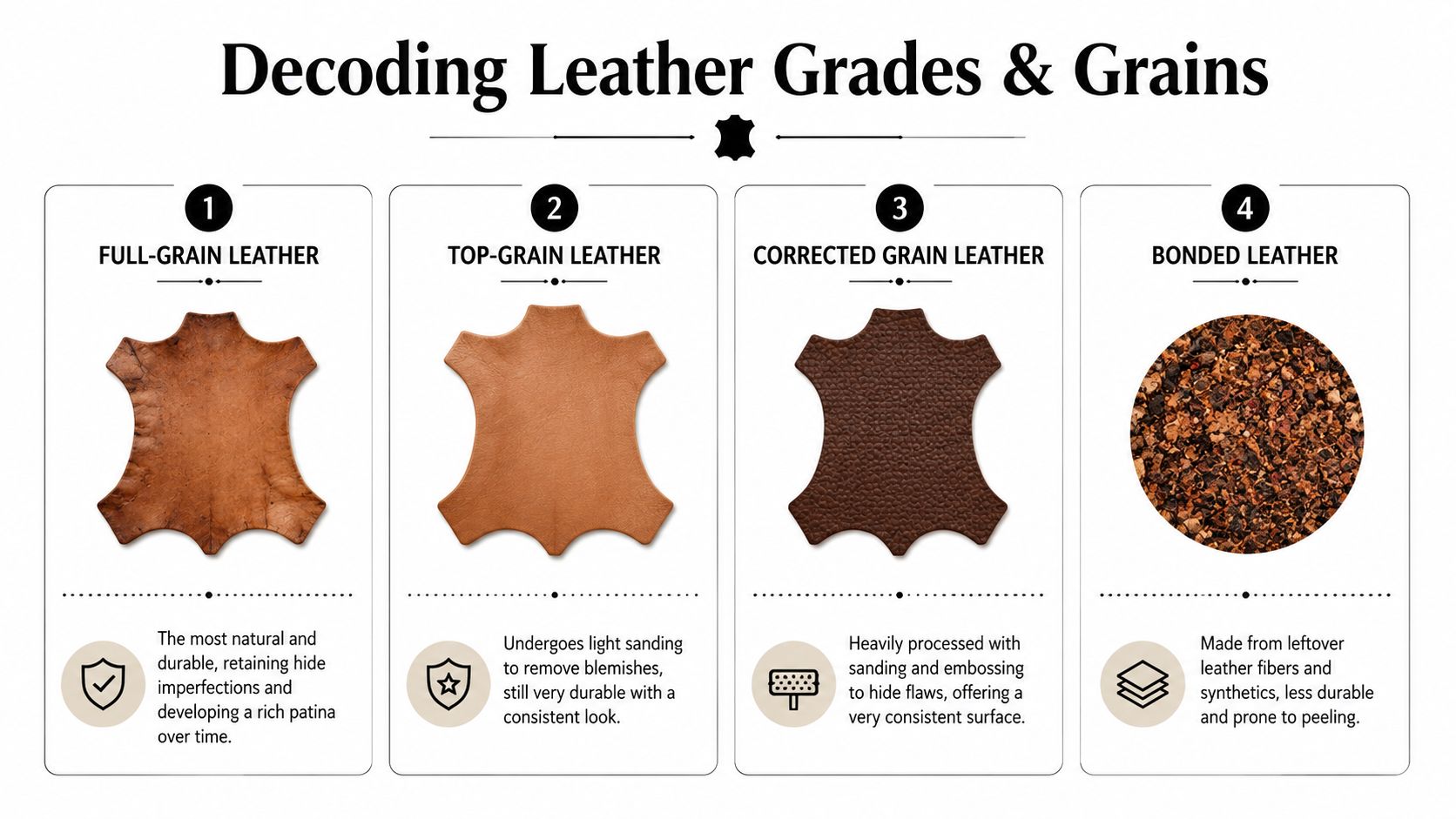
The four grades that matter
Here's the short version, laid out plainly:
| Leather type | What it feels like | How it tends to age | Best fit |
|---|---|---|---|
| Full-grain | Natural texture, visible character | Develops rich patina over time | Buyers focused on heirloom quality |
| Top-grain | Smoother, more refined surface | Long-lasting with a more consistent look | Families and everyday living spaces |
| Corrected-grain | Uniform appearance, more processed feel | Moderate durability | Buyers prioritizing visual consistency |
| Bonded leather | Often smooth at first, less substantial feel | More limited durability | Short-term or budget-led purchase |
According to this leather sectional longevity guide, full-grain leather sectionals can exceed 100 years when properly maintained, while top-grain leather offers a lifespan of 15+ years and a strong balance of durability and affordability.
That single comparison changes how you read a price tag. A full-grain sectional isn't just “more expensive.” It belongs to a different category of purchase.
Full-grain versus top-grain
Full-grain keeps more of the hide's natural surface. You'll often see subtle markings, tonal variation, and a more organic hand. Many investment homeowners love that because the leather gains character rather than looking worn out.
Top-grain is slightly more refined. It usually feels smoother and looks more uniform across cushions and arms. For many homes, especially active family rooms, it hits a sweet spot between elegance and practicality.
If you want a deeper explanation of one of the most common upholstery choices, this page on top-grain leather sofas gives a helpful overview.
The best leather sectional couch for one household isn't always the most expensive leather. It's the leather that matches how long you plan to keep it and how much maintenance you're willing to do.
Genuine leather and faux leather are not the same decision
This is another area where shoppers get tripped up. “Genuine leather” sounds like a premium promise, but it describes a broad category and doesn't automatically mean top-tier performance. Faux leather solves a different problem altogether.
The trade-off is mostly about timeline and care. Based on this leather sectional buying guide, genuine leather sectionals in full-grain and top-grain varieties can deliver 15+ years of use, while faux leather typically degrades within 5-7 years. The same source notes that genuine leather generally needs conditioning, typically annually, and that it's susceptible to cracking if humidity falls below 30% or rises above 60%.
That doesn't make faux leather a wrong choice. It makes it a different kind of purchase. If you want a shorter-term furnishing plan, it may fit. If you want a sectional that becomes part of your home rather than a placeholder, the better leather grades are in another league.
The Unseen Foundation of Quality Construction
Leather gets attention because you can see it. Construction matters more because you feel it every day, even when you don't notice why. A sectional that creaks, shifts, or starts to dip under the cushions can't be rescued by beautiful upholstery.

Why the frame matters first
The frame is the skeleton. If it's weak, everything above it suffers. Arms loosen. corners shift. seams take stress they shouldn't. cushions stop sitting squarely.
According to this construction-focused leather sectional guide, a quality leather sectional requires a kiln-dried hardwood frame, and without that specification, a frame can begin to sag in as little as 3-5 years, regardless of leather quality.
That's why a seasoned shopper asks about the frame before asking about the color.
What to look for under the cushions
When you sit on a well-built sectional, the support feels settled and steady. You shouldn't sink in a way that feels dramatic on day one. That often turns into fatigue and uneven wear later.
Look for these signs of sound construction:
- Kiln-dried hardwood frame for long-term stability
- Consistent seat support that feels even from cushion to cushion
- High-density cushion cores that keep shape and comfort
- Tight tailoring at seams so the leather isn't being pulled unevenly
- Balanced suspension that supports the seat without a hollow, bouncy feel
The article above also notes that when a kiln-dried hardwood frame is paired with high-density cushion support systems, the sectional can maintain structural integrity across 10+ years of use.
Ask better questions in the showroom
It's common to press the arm once, sit for thirty seconds, and judge softness. That's understandable, but it won't tell you enough.
Instead, ask:
- Is the frame kiln-dried hardwood
- How is the seat supported
- What density or type of cushion core is used
- How is the sectional joined at the corner and sectional connectors
- Can I see or feel the leather swatch away from the sales floor lighting
For a practical checklist on what to inspect, this article on how to choose leather furniture can help you shop with sharper eyes.
A beautiful hide over a weak frame is still a weak sofa.
Designing Your Space with Sectional Configurations
The right sectional shouldn't merely fit your room. It should improve how the room works. Traffic flow, sightlines, and where people naturally gather all matter just as much as the dimensions on a spec sheet.
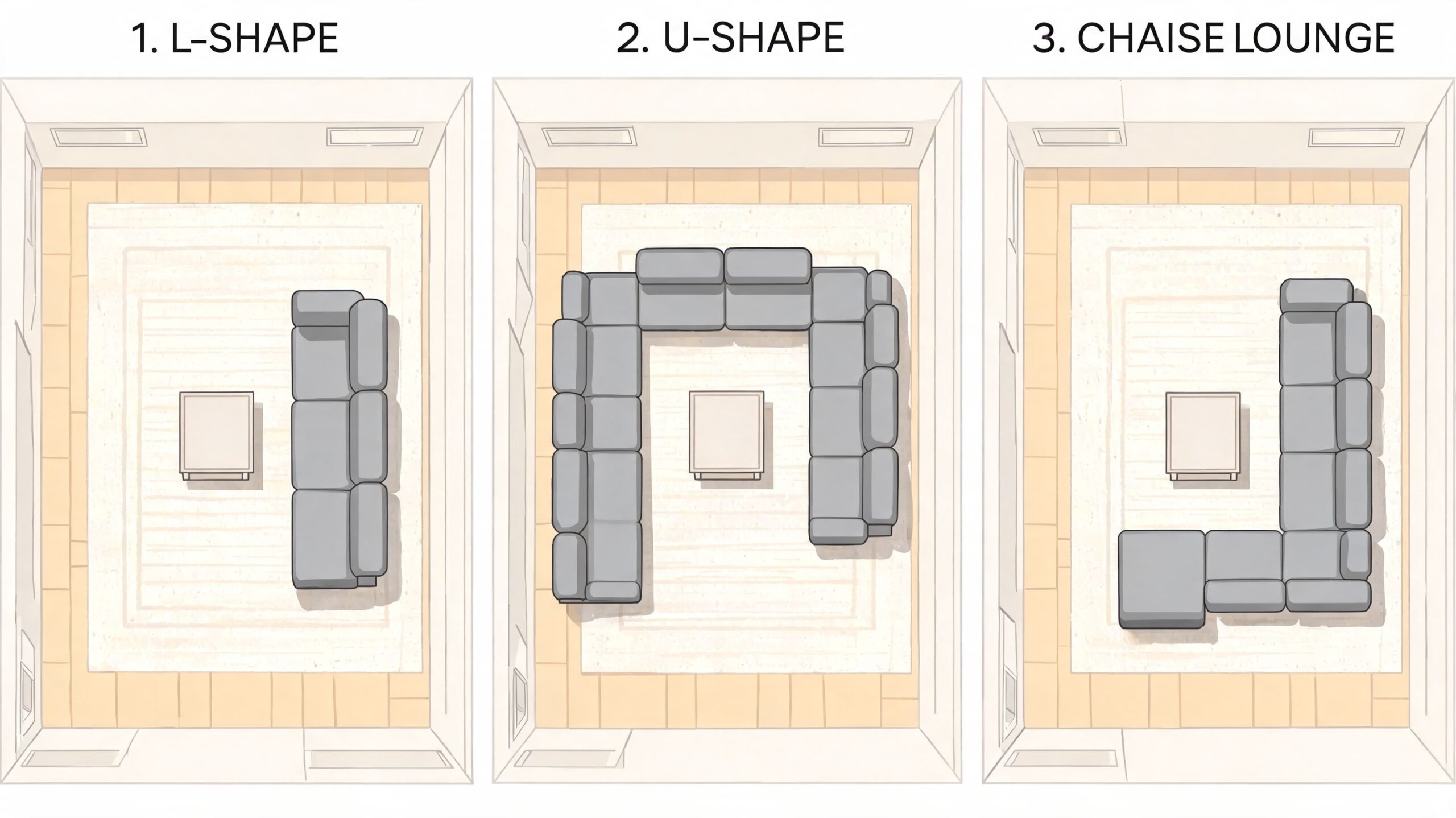
Match the shape to the room
An L-shape often suits open family rooms and corners. It gives you generous seating without closing off the space too aggressively. A chaise sectional works well when one side of the room wants a lounging zone but you don't need a full wraparound footprint.
A U-shape makes sense in larger rooms where conversation is the goal and the furniture can float comfortably. A modular sectional gives you more freedom if doorways are tight, the room is unusual, or you want the option to rework the layout later.
Measure for living, not just for fit
A sectional can technically fit and still be wrong. What matters is whether people can move around it comfortably, whether the chaise blocks a walkway, and whether the recline or depth crowds the room.
Use a simple sequence:
- Measure wall lengths where the sectional might sit
- Mark traffic paths from entry points to adjacent rooms
- Note fixed obstacles like radiators, floor vents, windows, and outlets
- Tape the footprint on the floor before ordering
- Check delivery access through doors, stairs, and turns
Personalization moves beyond mere decoration to become practical. If a standard layout is almost right but not quite, a custom configuration usually solves the problem better than trying to force a ready-made shape into an awkward room.
Why customization often beats compromise
In older Columbus homes, room proportions can be quirky. In condos near Easton Town Center, space can be tighter and more exacting. A sectional that's two cushions too long or one arm too bulky can throw the whole room off.
That's why many investment-minded shoppers end up preferring made-to-order options. You're not just picking a sofa. You're tuning the scale, orientation, and function to the room you have.
Personalizing Your Piece with Customization
You sit down in a sectional that looked perfect online, then notice the arm is too wide for the room, the seat is too shallow for how you relax, and the leather feels dressed up for a life your household does not live. That is where customization earns its keep. On a piece you plan to own for many years, small specification choices shape comfort, durability, and how well the sectional belongs in your home.
A well-made sectional works like a custom-fit jacket. The overall style matters, but the true difference is in the fit through the shoulders, the sleeve length, and the way it moves with you. With leather sectionals, those details include arm scale, seat depth, back height, cushion fill, stitching, leg finish, and the leather itself.
The problems customization solves
Customization helps when a standard model is close, but not right. A room may need a slimmer track arm to keep sightlines open. A taller homeowner may want more seat depth and a higher back for proper support. A busy family room may call for leather with a bit more finish so it resists everyday wear more gracefully.
The strongest custom programs make those choices tangible. Instead of guessing from a small swatch, shoppers can compare proportions, test cushion feels, and review layouts before placing an order. Vinson's design-your-own sectional options show how configuration, upholstery, and scale can be worked through with more clarity before a piece is built.
A better order for making decisions
Customization gets easier when you decide in the same order a designer would. Start with the parts that affect function most, then refine the visual details.
Set the footprint and orientation
Begin with how the sectional needs to live in the room. Left-facing chaise, right-facing chaise, classic L-shape, or modular composition. This choice affects traffic flow, conversation, and how open the room feels.Choose the leather by use, not by color alone
Leather should match the pace of the household. If the sectional is for daily use, ask how it feels under your hand, how it will wear on the most-used seat, and whether you want a natural patina or a more uniform appearance over time.Refine the sit
At this stage, comfort becomes personal. Some clients prefer a more upright, supportive seat for reading or entertaining. Others want a deeper, more relaxed sit that encourages long evenings and stretched-out lounging.Finish with the visual details
Arm profile, seam treatment, leg shape, and cushion style set the tone. These are the details that make a sectional feel crisp and architectural, soft and casual, or somewhere in between.
For local shoppers in Columbus, this process is usually clearer in person. At Vinson Fine Furniture, the in-store design studio and Custom Order Program let buyers compare leathers, finishes, configurations, and digital room views face to face, which is especially helpful when the goal is to buy one sectional for the long term rather than replace a trend-driven piece in a few years.
Maintenance starts with the choices you make before ordering
Many long-term disappointments begin at the specification stage. A delicate leather goes into the busiest room in the house. A very light color is placed beside strong afternoon sun. A plush seat is chosen by someone who really prefers firmer support after thirty minutes.
A few practical questions can prevent that mistake:
- Who will use the sectional every day
- Will children or pets be on it often
- Does the room get strong direct sunlight
- Do you like leather that shows character as it ages, or a more even appearance
- Do you want a seat that feels relaxed, or one that stays crisp and supportive
Choose the sectional that fits your real habits. That is how customization turns a beautiful purchase into a lasting one.
Protecting Your Investment for a Lifetime
Once a leather sectional is in your home, care becomes part of the value equation. Good leather doesn't ask for complicated treatment, but it does respond to steady, thoughtful maintenance.
Everyday care that preserves the feel
Dust and body oils build up gradually, especially on headrests, arms, and favorite seats. A soft dry cloth and routine attention go a long way. Spills should be blotted quickly, not rubbed deeper into the surface.
Placement matters too. Keep leather away from strong heat sources and long periods of direct sun when possible. Leather likes a stable environment more than extremes.
For a practical care overview, this guide on protecting leather furniture covers the basics homeowners should know.
The best choice for active households
Many buyers love the look of very natural leather, but family life asks more of a sectional than looks alone. Dogs jump up. Children slide across cushions. Windows brighten one side of the room more than the other.
For those homes, material choice becomes strategic. According to this guide on leather sectionals for family use, semi-aniline leathers offer a superior balance of durability and softness for households with pets and children, and recent data suggests they can provide up to 30% better fade resistance in high-humidity climates like Ohio's.
That's a useful distinction because Ohio homes often move through humid summers and dry indoor winter air. A leather that balances natural beauty with a bit more protection usually ages more predictably in daily use.
A simple long-term care rhythm
You don't need a complicated system. You do need consistency.
- Wipe gently and regularly to remove dust before it settles into the grain
- Condition on schedule if your leather type requires it
- Rotate where people sit when possible, especially on large family sectionals
- Trim pet nails and use throws selectively on favorite corners
- Address small issues early before dryness or abrasion becomes permanent damage
Leather should soften into your life. It shouldn't look exhausted by it.
Investing Wisely and Shopping Local in Columbus
On a busy Saturday at Easton, it is easy to sit on two leather sectionals that look nearly identical and wonder why one costs noticeably more. Then you run your hand across the arm, settle into the cushion for ten minutes instead of ten seconds, and ask what supports the seat underneath. That is usually where the difference becomes clear.
A higher-quality sectional earns its price through materials and construction you can feel over time. Better leather breaks in with character instead of wearing out early. A stronger frame stays quiet and square. Careful tailoring keeps the piece looking composed after years of real use. For an investment-minded buyer, that is the distinction that matters.
What actually drives the price
From across the room, two sectionals can seem almost interchangeable. In daily life, they are not. Price usually reflects six things:
- Leather quality and how it will age
- The frame species and how the joints are built
- Seat support, cushion density, and long-term comfort
- Whether the size and configuration are made to fit your room
- The precision of stitching, panel matching, and finishing
- Delivery and setup service that protects the furniture on day one
That is why experienced shoppers in Columbus ask a better question than “Why is this one more?” They ask, “What am I paying for, and will I still appreciate it in ten years?”
A sectional works a lot like a well-fitted jacket. From a distance, many look polished. The difference shows up in the cut, the structure, and how well it holds its shape after repeated use.
A Columbus buyer's checklist
Bring these questions into the showroom, especially if you want a leather sectional that serves your home for decades rather than a few stylish years.
| Ask this question | Why it matters |
|---|---|
| What leather covers the seats, backs, and arms? | Those are the contact points you will feel and age most noticeably |
| Is the frame kiln-dried hardwood, and how are the corners reinforced? | The frame determines whether the sectional stays solid and quiet over time |
| How does the seat feel after several minutes? | Good support reveals itself slowly, once your body settles in |
| Does this configuration support how we walk through the room? | A sectional should guide traffic comfortably, not interrupt it |
| Can the scale, orientation, or leather be customized? | A near fit often turns into a daily irritation |
| What is included with delivery and placement? | Proper setup protects walls, floors, and the sectional itself |
Local shopping matters here because a lifetime purchase should be judged in person. You can test seat depth with your own posture, compare leather hands side by side, and see whether a sectional's scale feels graceful or bulky in real space. At Vinson's Easton Town Center showroom, that process also opens the door to customization, which is often the difference between buying something available now and ordering something that fits your room and routines.
That same mindset often carries into the rest of the home. Shoppers who care about well-built case goods, custom dining sets, Amish-made furniture, or even mattresses in the Easton area usually start evaluating everything through the same lens. How is it made? How will it age? Will I still be happy with it years from now?
Use value tools without lowering your standards
A careful purchase does not have to mean a rigid one. Practical value tools can help you buy the right sectional without stepping down in quality.
- Low Price Guarantee for peace of mind after you order
- Clearance Gallery options if a floor sample or closeout fits your needs
- Flexible financing through Synchrony HOME
- White-Glove In-Home Delivery for proper placement and assembly
- Complimentary design consultations for complex rooms or whole-home projects
One last piece of advice. Stay seated.
Sit the way you live. Lean into the corner. Rest your arm where you would during a movie. Notice whether the back supports you or asks your body to compensate. A leather sectional is too expensive, and too central to daily life, to choose by photo alone.
If you are ready to compare leather by touch, test comfort, and work through custom options in person, visit Vinson Fine Furniture at Easton Town Center. The showroom experience, design help, custom order options with 3D visualizers, clearance offerings, financing through Synchrony HOME, and white-glove delivery give Columbus shoppers a clearer path to buying one sectional for the long haul, rather than replacing a trendy one later.