Home Office Furniture for Small Spaces: An Expert Guide

The makeshift home office usually starts the same way. A laptop lands on the dining table, cords snake across the floor, paperwork collects in a basket that was never meant to hold work, and the chair feels worse by midafternoon than it did at breakfast.
That setup can get you through a week. It rarely serves you well for years.
Small spaces deserve a more deliberate approach. Office utilization has dropped to under 40% as remote work reshaped how people use space, which has pushed demand toward compact, efficient home office setups that make better use of every square foot without giving up function or style, according to CDI Spaces on shrinking office footprints. In practice, that means a corner of a bedroom, a section of a loft, or the edge of a living room now has to perform like a real workspace.
The mistake I see most often is treating that corner like a temporary problem. Home office furniture for small spaces works better when you treat it like part of the home's long-term design. The right desk scale, real storage, proper chair clearance, and durable materials make a compact workspace feel intentional instead of improvised.
Designing Your Productive Nook
A productive nook doesn't need a dedicated room. It needs boundaries, proportion, and furniture that fits how you work.
One of the most common situations is a homeowner trying to claim part of a guest room or living room without letting work take over the entire space. That's where thoughtful planning matters. A desk needs more than fitting the wall. It has to support your screen height, your daily tools, and your movement around the chair.
The most successful small offices usually start with one decision. Stop asking, “What's the smallest desk I can get away with?” Start asking, “What's the smallest setup that still feels complete?”
A compact office feels calmer when every piece has a defined job and a defined place.
That shift changes everything. Instead of a narrow console table pretending to be a desk, you choose a real work surface. Instead of scattered storage, you use one vertical cabinet or bookcase that keeps supplies off the floor. Instead of a chair that gets pushed into another room, you pick one that belongs visually and functionally in the space.
For homeowners working through layouts and inspiration, creating an inspiring home office is often less about adding more furniture and more about selecting fewer, better-scaled pieces.
What usually works
A small home office tends to succeed when it includes:
- A true workstation: Enough surface for the tools you use every day.
- Contained storage: Vertical shelving, drawers, or a credenza that prevents visual sprawl.
- A chair with presence but not bulk: Support matters, but so does keeping the room open.
- Materials that belong in the home: Solid wood, hand-finished surfaces, and upholstery that feel intentional in a bedroom or living area.
What usually fails
The weak setups follow a pattern too:
- Shallow desks: They look light, but they force cramped posture.
- Oversized executive pieces: They dominate the room and make circulation awkward.
- Disposable materials: Thin laminates and particleboard often show wear quickly in daily use.
- Storage added as an afterthought: Bins underfoot and stacks on the desk create friction every day.
A small office isn't a compromise when it's planned well. It's a disciplined, highly functional part of the home.
The Blueprint for Success Measuring Your Space
Buying first and measuring later is how small offices become frustrating. In a compact room, an inch in the wrong place can make a desk feel fine on paper and unworkable in real life.

The two dimensions that matter most are the ones people skip. For ergonomic safety in micro-spaces, a desk should be at least 24 inches deep, and you should preserve 30 to 32 inches of clearance behind the chair for functional mobility with ergonomic seating, as explained in this guide to small home office dimensions.
Start with the room, not the desk
Measure the full footprint first, then measure the usable footprint. Those are not always the same.
Use this checklist:
Record wall dimensions
Measure width and height. Ceiling height matters more than people think because it affects whether vertical shelving will help or overwhelm.Mark door swing and entry points
A desk that fits the wall still has to arrive through the doorway and allow the door to operate cleanly.Locate outlets and light sources
Power access shapes where monitors, lamps, and charging stations can sit. Window placement also affects screen glare.Note obstructions
Baseboards, vents, radiators, trim, and low windows can all change how a desk sits against the wall.
Measure for movement
Practical planning separates a pretty setup from a comfortable one.
A small office has to work when the chair is occupied, not only when it's pushed in for a photo. If your desk is too deep, you lose clearance. If your desk is too shallow, you lose usable working distance. The goal is a balanced footprint.
Practical rule: In a small room, protect chair clearance before you add extra desk bulk.
That usually means resisting the urge to buy a deeper desk just because it looks substantial. In compact rooms, deeper isn't always better. A disciplined footprint often performs better than a larger one that interrupts circulation.
A simple measuring framework
| Priority | What to verify | Why it matters |
|---|---|---|
| Desk depth | Minimum 24 inches | Supports monitor distance and basic desktop function |
| Chair clearance | 30 to 32 inches behind chair | Allows movement with ergonomic seating |
| Entry access | Doorways and turns | Prevents delivery and placement problems |
| Power and light | Outlet map and glare points | Keeps cords controlled and screens comfortable |
A good measurement plan also accounts for your workflow. If you use a monitor, a laptop stand, notebooks, and a task lamp, measure for those objects now. If you file paper regularly, plan vertical storage now. Small spaces reward early decisions.
Smart Furniture Solutions for Compact Workspaces
The strongest small offices don't rely on one miracle piece. They combine the right desk shape, the right storage strategy, and a chair that supports long hours without visually crowding the room.
Remote workers already show how varied these locations can be. A survey found that 28.6% work in dedicated home offices, 28.5% work from master bedrooms, and 19.9% work from living rooms, which is why adaptable furniture matters so much in shared spaces, according to Loctek's roundup of home office ergonomics statistics.
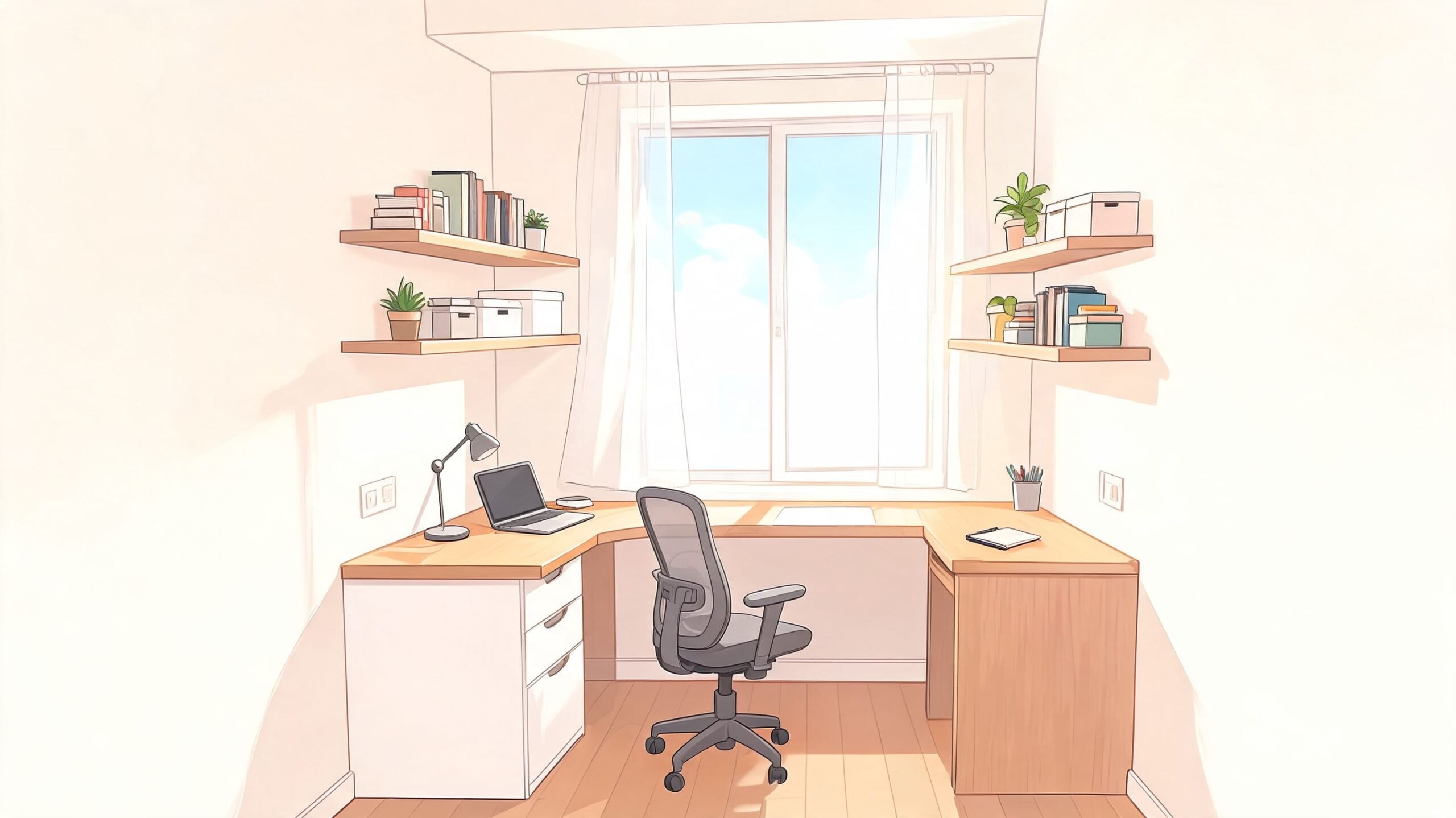
For more layout-specific inspiration, these ideas for the best furniture for small spaces show how scale and storage can work together.
Comparing the main furniture types
| Furniture type | Works well when | Trade-off to watch |
|---|---|---|
| L-shaped corner desk | You want to reclaim an awkward corner and keep work contained | It can feel heavy if the return is too deep |
| Straight writing desk | You need a clean profile in a bedroom or living room | Limited storage unless paired with shelving |
| Secretary desk | You want work to visually disappear after hours | Not ideal for larger monitor setups |
| Credenza-based workstation | You need enclosed storage for printers and supplies | Requires careful top-surface planning |
| Vertical bookcase or cabinet | You need storage without using more floor area | Must be proportioned so it doesn't feel top-heavy |
What works in real rooms
An L-shaped corner desk is often the smartest answer for an underused nook. It turns dead corner space into active workspace and can separate computer tasks from writing or paperwork. In a bedroom, that can keep the work zone visually contained.
A straight desk with a refined profile works well in living rooms or multipurpose rooms where the office needs to blend with the rest of the furniture. The key is not making it too narrow to function. Good small-space furniture should look light without becoming flimsy.
A secretary desk suits homeowners who want the room to reset once tasks are complete. Close the panel, hide the paperwork, and the room looks residential again. The trade-off is capacity. If you rely on a full monitor, papers spread out, or multiple devices, it can feel restrictive.
Storage that earns its footprint
In small offices, horizontal storage usually loses. Vertical storage usually wins.
Consider these pairings:
- Desk plus bookcase: Good for books, baskets, reference materials, and display.
- Desk plus slim cabinet: Better when you want doors to hide equipment and visual clutter.
- Desk plus credenza: Useful when the room needs to read more like furnished living space than office.
The desk should hold today's work. Storage should hold everything else.
A printer on the main desktop is rarely the best use of space. The same goes for stacks of paper, spare chargers, and office supplies. When those items move into a credenza or vertical cabinet, the room feels larger because the working surface stays clear.
The chair matters more than people expect
A small office chair shouldn't be chosen purely for appearance. You still need lumbar support, stable seat depth, and comfortable arm positioning. But bulk matters too. A chair with a slimmer profile often integrates better into bedrooms and living spaces than a large executive model.
This is also one place where custom solutions help. Pieces from custom-made office furniture options can be ordered around a room's actual constraints instead of forcing the room to accommodate standard dimensions.
Investing in Quality The Power of Customization
A small office asks more from each piece of furniture. The desk is under daily use. The storage has to stay organized. The finish has to look at home in a visible part of the house. That's why material quality matters even more in compact spaces than it does in a dedicated office room.

The durability gap is significant. MicroFlex notes that solid wood furniture can last 20 to 50+ years, while particleboard often lasts 5 to 10 years. For a high-use desk, that difference changes the entire value equation.
Why solid wood makes sense in a small office
In a compact room, you notice details more. You see the grain. You touch the edge profile constantly. Drawer action, joinery, finish depth, and surface repairability all become part of daily life.
Particleboard often looks acceptable at first. Under regular use, edges can chip, finishes can fatigue, and the piece may not age gracefully. A solid-wood desk or cabinet usually holds up better to repeated use and can remain part of the home through room changes and future moves.
That long life matters in a bedroom corner office or living room workstation because the furniture isn't hidden away. It has to perform and also belong visually in the home.
Customization solves the real small-space problem
Most small rooms don't fail because the homeowner chose the wrong style. They fail because stock dimensions don't align with the room.
Customization fixes that. A desk can be ordered with the right width for a wall, a return that fits a corner properly, a finish that lightens the visual weight, or storage configured for the way you work. Through the Custom Order Program, homeowners can choose finishes, fabrics, and configurations using digital 3D visualizers, which makes it easier to evaluate scale before ordering. That process becomes more useful in a compact room because proportion is everything.
A lighter hand-finished wood tone can make a desk feel less imposing. A darker walnut can add richness when the room already has enough light and open floor area. Drawers can be placed where the dominant hand reaches naturally. Shelving can be open, closed, or mixed depending on how much visual calm you want.
What custom furniture does better than off-the-rack pieces
- Fits architectural oddities: Corners, low windows, trim details, and shallow walls.
- Solves mixed-use rooms: A desk can feel like part of the bedroom or living room instead of a foreign object.
- Improves storage discipline: File drawers, keyboard trays, printer cabinets, and shelving can be built around habits.
- Supports long-term design: Materials and finishes can coordinate with the rest of the house.
A small office doesn't need less intention. It needs more precision.
A design studio earns its keep, allowing homeowners to test proportions, compare finishes, and make decisions with the room's actual limits in mind. That's particularly helpful when ordering solid-wood or Amish-made furniture, where the goal is to buy once and live with the piece for a long time. Among the available options in Central Ohio, Vinson Fine Furniture offers an in-store Design Studio, complimentary design consultations, and a Custom Order Program that lets shoppers work through those choices in person.
Budgeting for Value and a Seamless Experience
A well-made home office doesn't have to be approached as a rushed purchase. It helps to think about value in layers: product quality, price protection, financing flexibility, and what happens after the sale.
That approach matters because small offices have less room for mistakes. If a desk arrives damaged, doesn't fit the doorway, or requires a complicated assembly in a tight room, the stress lands directly in your living space.

For shoppers trying to balance style, function, and spending, these ideas on how to decorate on a budget are useful because they focus on prioritizing the pieces that matter most.
What value actually looks like
A lower upfront price isn't always lower cost over time. If a chair becomes uncomfortable, a finish fails, or storage never quite works, you tend to replace the piece sooner or add secondary furniture to compensate.
A stronger buying framework looks like this:
- Price confidence: A Low Price Guarantee with a 110% refund of the difference can reduce the risk of paying more locally than necessary.
- Clearance opportunities: A Clearance Gallery with savings up to 70% can make premium pieces more accessible.
- Manageable timing: Flexible financing through Synchrony HOME can spread out a larger furniture investment.
- Delivery that protects the purchase: White-Glove In-Home Delivery matters when furniture has to be inspected, assembled, and placed correctly in a tight room.
Why service matters in small spaces
Small-space furniture is harder to place than large-room furniture. There's less margin for error, less turning radius, and less tolerance for pieces that need “good enough” positioning.
White-glove service changes the outcome. Instead of leaving cartons in a hallway, the delivery team can bring the furniture into the room, place it where it belongs, assemble it, and remove the packaging. That makes the office usable immediately and reduces the chance of damage during homeowner assembly.
Good service is part of the product when the room has no room for error.
For many homeowners, the smarter budget move is simple. Buy fewer pieces, buy the right ones, and protect the experience from measurement to delivery.
Create a Workspace That Works for You
The finished small office usually feels different from what people expected at the start. It doesn't feel cramped. It feels edited. The desk sits where the light works. The chair moves cleanly. Storage handles the clutter before it can spread. The materials feel like they belong with the rest of the home.
That's the core promise of home office furniture for small spaces. Not just fitting more into less, but making a smaller footprint work with more clarity and less friction.
A bedroom corner can become a focused workstation. A living room wall can hold a desk and cabinet that read as furniture first and office second. A spare room can finally support daily work without looking temporary. If you need ideas for that next step, these home office furniture ideas can help you think through style, scale, and layout.
The most satisfying rooms come from good measurements, disciplined furniture choices, and materials that improve with age instead of wearing out under pressure. Small spaces respond well to that level of care. They often reward it more than large rooms do.
If you're ready to create a small home office that feels permanent, polished, and practical, visit Vinson Fine Furniture at Easton Town Center. You can explore solid-wood desks, Amish-made furniture, custom configurations, and complimentary design consultations in person, along with the Custom Order Program, 3D visualizers, the Low Price Guarantee, Clearance Gallery savings, flexible financing through Synchrony HOME, and White-Glove In-Home Delivery.