Home Office Furniture Storage: An Investment Guide

A familiar scene plays out in many Columbus homes. The dining chair is doing office duty, paper stacks have migrated to the floor, the printer has claimed a corner table, and cords seem to multiply overnight. What began as a practical work-from-home arrangement now feels less like a room and more like a holding pattern.
That's usually the moment a homeowner stops looking for one more organizer and starts asking a better question. What would it take to make this room feel permanent, composed, and worth keeping for years? A thoughtful home office setup guide can help clarify the basics, but the larger shift is philosophical. Storage stops being a utility add-on and becomes part of the architecture of daily work.
That shift reflects a broader market reality. The home office furniture category is projected to reach USD 41.21 billion in 2026, and wood represents 45.78% of material demand, according to Mordor Intelligence's home office furniture market report. Buyers aren't furnishing for a temporary season. They're building rooms with lasting structure, visual calm, and materials that feel settled inside the home.
Table of Contents
- From Chaos to Calm An Enduring Home Office
- Foundational Pieces for Home Office Storage
- Matching Storage to Your Room and Workflow
- The Enduring Beauty of Solid Hardwood
- Tailoring Your Office in Our Design Studio
- Styling and Organizing Your Workspace
- Your Guide to a Smart Furniture Investment
From Chaos to Calm An Enduring Home Office
The improvised office usually fails in the same way. It asks one surface to do everything. Bills mix with notebooks, the laptop shares space with chargers and envelopes, and storage gets handled by whatever happened to fit. Even a beautiful room starts to feel visually noisy when nothing has a real home.
A lasting office works differently. It gives each category a place before clutter ever appears. The desk handles active work. The cabinet conceals what shouldn't stay in sight. The bookcase holds the reference materials and objects that deserve to be seen. Once the room has that structure, concentration becomes easier because the eye isn't negotiating disorder all day.
Design principle: Calm rarely comes from owning less furniture. It usually comes from owning the right furniture, in the right proportions, with storage integrated from the beginning.
For an investment-minded homeowner, home office furniture storage should support both performance and permanence. A room that feels resolved can serve remote work today, household administration tomorrow, and resale value later. That's especially true when the storage reads like part of the room's design language instead of a collection of stopgap pieces.
The most successful home offices don't chase novelty. They rely on enduring forms and materials that feel grounded in the home. A substantial credenza beneath a window, a desk with integrated drawers, a tall bookcase in solid cherry or maple. These pieces don't just store belongings. They establish rhythm, weight, and visual order.
Foundational Pieces for Home Office Storage
Storage works best when it begins with a few architectural pieces rather than a pile of accessories. Most homeowners don't need more bins. They need furniture that carries visual weight, hides the right things, and feels coherent from one wall to the next.
Market behavior supports that instinct. In 2020, U.S. consumers selecting home office furniture chose storage cabinets at 10%, equal to printer stands, according to Market.us office furniture statistics. Storage isn't an afterthought in the buying process. It's part of the initial plan.
A homeowner evaluating home office organization furniture should start by thinking in zones, not individual gadgets.
Start with the desk zone
The desk is the operational center. If the desk has no built-in storage, every active item ends up on the top. That's how the room starts feeling temporary.
An executive desk with integrated drawers solves several problems at once:
- Daily tools stay close: Pens, chargers, notepads, and current paperwork can live within reach instead of spreading across the work surface.
- The room looks quieter: Closed storage below the top keeps visual clutter down during the workday.
- The furniture feels substantial: A solid hardwood desk has a settled presence. The drawer fronts feel weighty in hand, and the glide of well-made hardware adds a sense of precision that lighter office pieces rarely deliver.
Add a secondary storage anchor
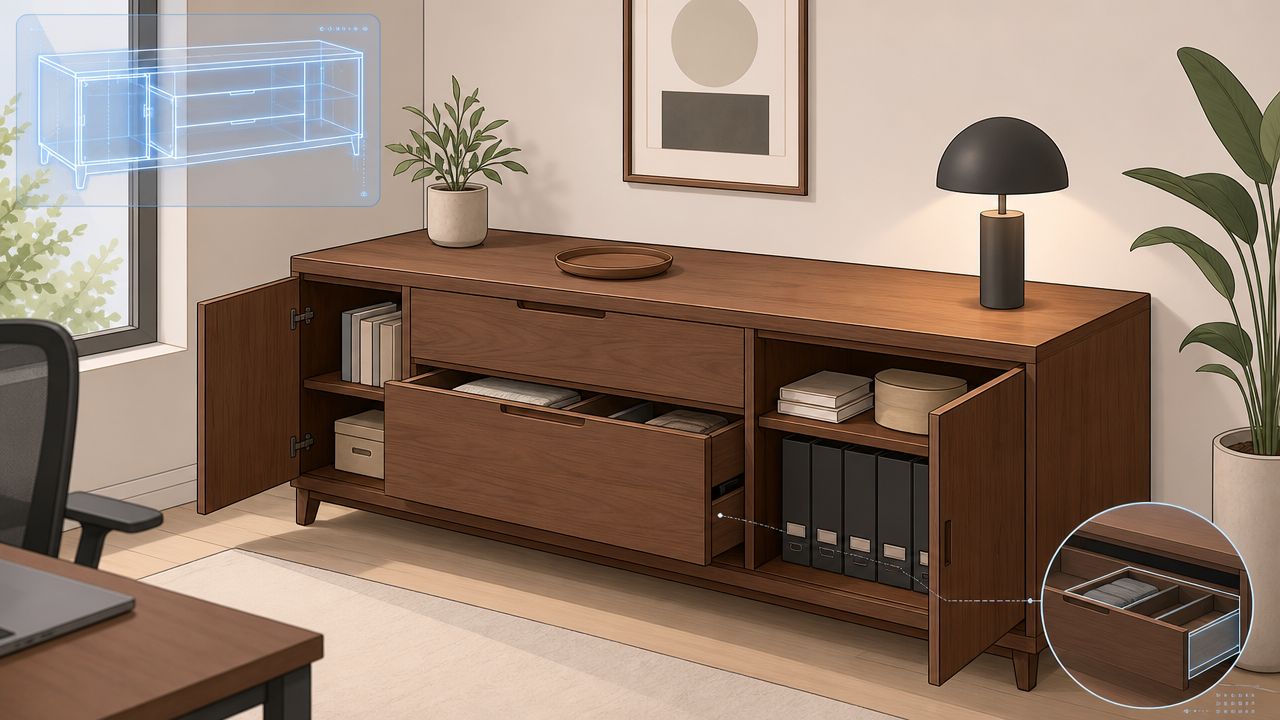
Most offices need one larger piece beyond the desk. That piece is often a credenza, sideboard, or file cabinet grouping.
A credenza is especially useful because it does double duty. It offers concealed storage behind doors or within drawers, and it provides a secondary surface for a printer, trays, a lamp, or framed art. In a room that doubles as a guest space or library, that low horizontal profile also keeps the room feeling residential.
A file-focused piece works best when paper records still matter. Tax folders, client files, household documents, manuals, and warranty paperwork need more than decorative baskets. They need dedicated compartments that can be opened, sorted, and closed without friction.
A good credenza often does the quietest work in the room. It carries the overflow so the desk can remain clear enough for actual thinking.
Build upward with bookcases
Bookcases are often dismissed as display furniture, but in a home office they're part library, part storage wall, part visual framing device. A solid hardwood bookcase can hold books, binders, archival boxes, and selected objects without making the room feel purely utilitarian.
They're especially effective when a homeowner wants the office to feel cultivated rather than corporate. Lower shelves can hold work materials in baskets or document boxes. Eye-level shelves can display books and a few meaningful objects. The top shelves can stay lighter, which helps the whole piece breathe.
The strongest rooms usually combine all three categories: a hard-working desk, a substantial closed-storage piece, and one vertical element. That combination gives home office furniture storage both discipline and grace.
Matching Storage to Your Room and Workflow
A beautiful office can still fail if it doesn't allow the body to move comfortably. Most storage mistakes aren't about choosing the wrong cabinet height. They're about ignoring how drawers open, how chairs roll back, and where a person stands while reaching for what's needed.

For homeowners planning a flexible room, this guide to multifunctional home office furniture is useful alongside layout planning. It helps frame how one room can support more than one role without becoming crowded.
Why clearance matters more than people expect
A typical 60-inch desk needs 36 to 42 inches of clearance behind it for a chair, and a standard vertical file cabinet requires about 23 inches of front-side space to open fully, as noted in RoomSketcher's office layout measurements. That's the practical reality of clearance geometry. A cabinet can fit on paper and still fail in daily life.
Many small offices go wrong when a homeowner sees an empty wall beside the desk and places a file cabinet there. The room still looks tidy at first glance, but now the chair collides with the drawer path, or the user has to sidestep the desk to open storage properly. Good layout planning protects use before appearance.
A quick way to think about the room is to divide it into three bands:
- Working band: The desk, chair, and immediate reach zone.
- Access band: The space needed for drawers, cabinet doors, and standing use.
- Quiet band: The wall or perimeter storage that doesn't interrupt movement.
For compact rooms, space-saving office storage solutions can help homeowners think through low-footprint options. The key is choosing pieces that respect circulation rather than consume it.
Different professions need different storage logic
Workflow should drive furniture selection. Two people can use the same room size and need completely different storage plans.
A homeowner handling legal files or dense household administration usually benefits from more concealed, structured storage. That might mean a desk with filing drawers plus a credenza that keeps folders, devices, and document boxes out of sight. The room will function better when paper categories have a formal home.
A creative professional often needs more display and faster access. Sample materials, sketchbooks, books, cords, and tools may need open shelving or mixed storage that allows active items to remain visible without spilling onto the desk.
A hybrid room needs another layer of discipline. If the office also hosts guests or serves as a library, the storage should let work disappear quickly at day's end. Closed cabinets, integrated wire management, and coordinated wood tones help the room return to domestic calm.
The right storage plan doesn't start with the question, “What fits?” It starts with, “What does the work ask this room to do every day?”
The Enduring Beauty of Solid Hardwood
Home office furniture storage is only as enduring as the material carrying it. When homeowners want permanence, material choice isn't a small decision. It's the decision.
Solid hardwood earns that role because it brings both structural integrity and visual depth. Drawers feel substantial in motion. Shelves carry books with confidence. The surface develops character over time instead of asking to be replaced when the room matures.
Why material choice decides the long-term outcome
Some homeowners compare cabinet-door construction before committing to a project, and a review of MDF vs wood cabinet doors can help clarify the conversation. For an investment-minded office, the conclusion is straightforward. Solid hardwood remains the only choice aligned with legacy, repairability, and lasting presence.
That matters even more in a home office because storage gets used constantly. Drawers open daily. File weight adds up. Shelves support books, technology, and accessories. A substantial wood species handles that repetitive use with dignity, and it does so while aging into the home rather than out of fashion.
Homeowners in Central Ohio often gravitate toward four species for good reason. Each brings a different mood to the room.
Choosing Your Solid Hardwood for a Lifetime of Use
| Hardwood Type | Grain & Texture | Color & Aging | Best For |
|---|---|---|---|
| Cherry | Fine, smooth grain with a refined texture | Starts warm and deepens beautifully with age | Executive desks, refined credenzas, formal study settings |
| Oak | Pronounced grain with visible texture and strong character | Warm, classic tone that emphasizes craftsmanship | Bookcases, file storage, traditional offices with architectural weight |
| Maple | Smooth, tight grain with a clean, tailored appearance | Light, bright coloring that suits transitional rooms | Streamlined desks, compact storage pieces, versatile family offices |
| Walnut | Rich grain with a naturally luxurious feel | Deep brown tones that bring immediate depth | Statement desks, library-like offices, rooms that need warmth and drama |
Each species changes the emotional tone of the room.
- Cherry feels established: It suits a study that leans formal and collected.
- Oak feels rooted: It works beautifully when the home already has visible trim, beams, or classic detailing.
- Maple feels crisp: It's often the right answer for lighter interiors or multipurpose spaces.
- Walnut feels enveloping: It gives a room instant richness and a more intimate mood.
The material also connects to place. In a market that values solid wood furniture Ohio, homeowners often want furniture that feels bench-made, regionally grounded, and capable of staying in the family. That same preference appears across categories, from Amish-made dining sets to office storage that carries the same sense of durability.
A homeowner exploring wood species and configurations can review solid wood home office furniture options to compare forms, finishes, and storage approaches built around that standard.
Tailoring Your Office in Our Design Studio
A home office rarely fits neatly into a template. One room has a narrow wall between windows. Another has a deep alcove that needs a credenza with exact proportions. A third must coordinate with existing trim, flooring, and nearby built-ins. That's where customization becomes practical, not decorative.

A consultation turns ideas into dimensions
At Easton Town Center, the in-store Design Studio gives homeowners a place to move from rough ideas to actual decisions. Complimentary design consultations help organize the questions that usually slow a project down. How much enclosed storage is needed? Should the desk face the room or the wall? Would one large credenza work better than two smaller file pieces?
That planning is especially useful for households furnishing more than one room at once. The office may need to coordinate with nearby living spaces, especially when the homeowner also wants Smith Brothers furniture Easton, Custom leather sectionals Columbus, or a connected reading chair in top-grain leather with swivel or motion features. A home office doesn't have to stand apart from the rest of the house. It should belong to it.
Selection rule: Choose the dimensions first, the storage mix second, and the finish third. When the order gets reversed, the room often ends up compromised.
Customization changes the result
The Custom Order Program matters because storage needs are rarely generic. A homeowner may want a deeper file drawer, a smaller bookcase footprint, a darker stain to pair with existing floors, or hardware that feels more customized. Brands such as Canadel, Mavin, and Smith Brothers are relevant here because customization is central to their appeal. The available options can include finishes, fabrics, leather selections, dimensions, and digital 3D visualizers that help a buyer see the piece before it's built.
Mavin is especially useful in this conversation because the same Amish craftsmanship associated with bedroom furniture translates naturally into office casegoods. A well-proportioned desk or bookcase in solid hardwood can feel as composed and permanent as a bed or dining table. That continuity matters in a home furnished for decades, not seasons.
For homeowners ready to specify dimensions, wood species, and storage functions in detail, custom-made office furniture offers a practical starting point.
Styling and Organizing Your Workspace
Once the right furniture is in place, organization becomes a design exercise. The goal isn't to hide everything. It's to decide what deserves visibility and what should disappear.
That distinction matters because the office is still part of the home. It needs professional discipline, but it also needs warmth. The most successful rooms use storage to control the mood as much as the mess.
Use conceal and reveal
Open shelving should carry edited, purposeful items. Books, a few archival boxes, a framed photograph, and one or two sculptural objects usually feel composed. Too many small items create visual static and weaken the architecture of the bookcase.
Closed storage should absorb the busy categories:
- Paperwork: Active files, receipts, household admin, and warranty folders
- Technology: Chargers, backup drives, routers, and spare cables
- Supplies: Printer paper, envelopes, labels, and extra notebooks
- Personal records: Documents that shouldn't remain visible
Security deserves more attention than it usually gets. Most office advice focuses on tidiness, but hidden-compartment desk guidance points to a real need for discreet storage of contracts, personal records, passports, and laptops. In a residential office, locking drawers or concealed compartments can protect sensitive items without making the room feel commercial.
Make the room feel lived in, not overloaded
A credenza top should work like a curated console table. One lamp. One tray. One framed piece or small plant. The surface needs some breathing room, especially if it occasionally supports a printer or active paperwork.
Bookshelves benefit from variation. A row of upright books can sit beside a horizontal stack. A cabinet base can anchor the visual weight below while upper shelves stay lighter. That balance keeps solid hardwood storage from feeling heavy even when the furniture itself is substantial.
A few styling rules help preserve order over time:
- Group by function first: Office supplies shouldn't compete with decorative objects for the same drawer.
- Leave negative space: Every shelf doesn't need to be filled.
- Keep the desktop active, not permanent: Only current-use items should live there.
- Match containers to the furniture: Simple boxes and trays look calmer against hardwood than an assortment of unrelated organizers.
A well-styled office doesn't announce its storage. It lets the room feel composed, then quietly handles the work of daily life.
Your Guide to a Smart Furniture Investment
A homeowner investing in a permanent office usually wants reassurance on two fronts. First, the furniture should justify its place in the home over time. Second, the buying process should feel clear, protected, and well supported.
Value is more than the ticket price
That's where policy and service matter. Vinson Fine Furniture offers a Low Price Guarantee with a 110% refund of the difference if a lower price is found at a local authorized dealer within the stated period. For shoppers who enjoy finding value in premium goods, the Clearance Gallery also offers savings of up to 70% on selected pieces. Those programs help frame quality furniture as a considered purchase, not an impulsive luxury.
For homeowners trying to think carefully about timing, budgeting, and long-term household priorities, this guide on how to shop for furniture smartly is a useful companion.
The value conversation should also include durability, customization, and the likelihood that the piece will still suit the home years from now. A well-made hardwood desk or credenza doesn't need to chase trends because its value comes from proportion, material, and craftsmanship.
Delivery matters at the finish line
The final stage often gets overlooked. It shouldn't. Large office furniture has to arrive safely, fit through the home cleanly, and land exactly where the room functions best.
White-glove delivery changes that experience. Careful placement, assembly, packaging removal, and pre-delivery inspection all protect the investment and reduce stress for the homeowner. That's especially important with substantial solid wood pieces that aren't meant to be wrestled into place and reconsidered later.
A smart investment feels coherent from selection through installation. The furniture should last, and the process should respect the home it's entering.
A thoughtfully planned office should feel calm on Monday morning, substantial on a winter afternoon, and just as relevant years from now as it does today. Homeowners ready to explore solid hardwood storage, custom dimensions, and complimentary design guidance can start with Vinson Fine Furniture at Easton Town Center, where the conversation can move from temporary fixes to lasting furniture.