Custom Furniture Design San Francisco: A Complete Guide 2026

A homeowner is standing in a beautiful room with a frustrating problem. The walls have character. The windows sit lower than expected. The hallway turns tightly. The room needs storage, comfort, and scale that feel intentional, but every standard sofa is too deep, every dining table is a little too long, and every media piece wastes valuable inches.
That tension is why interest in custom furniture design in San Francisco stays so strong. In a city known for design leadership, compact urban footprints, and architecturally distinct homes, furniture often has to do more than look good. It has to fit precisely, move through difficult entries, and support daily life without making a room feel crowded. Those same lessons apply anywhere. A well-designed custom piece is rarely about extravagance. It is about solving the room correctly the first time.
Table of Contents
- The Challenge of the Perfect Piece in a Unique City
- Decoding Custom Furniture From Made-to-Order to Truly Bespoke
- The San Francisco Custom Furniture Market
- A Step-by-Step Guide to Commissioning Your Piece
- Inspired by the Best The Vinson Fine Furniture Approach
- Your Custom Furniture Questions Answered
The Challenge of the Perfect Piece in a Unique City
In San Francisco, the furniture problem often starts before style enters the discussion. A family may live in a Victorian with ornate trim and compact rooms. A condo owner may have a sleek open-plan loft where one oversized sectional throws off the whole layout. In both cases, the room asks for something more disciplined than showroom averages.
That is why custom furniture design in San Francisco is such a useful case study. The city forces good design decisions. Every inch matters. Circulation matters. Sightlines matter. A chair cannot be merely attractive. It has to work with the architecture, the path through the home, and the way people live.
A dining banquette is a good example. In a narrow breakfast area, standard pieces can leave dead space at the corners and awkward gaps along the wall. A custom solution can tuck in cleanly, support the right seat height, and leave enough room for movement.
Good custom furniture starts by respecting the room before it tries to impress the eye.
Confusion usually begins with measurement. Buyers often measure wall width and stop there. That misses radiator clearance, window casing depth, baseboard projection, door swing, and the turning radius needed for delivery. A room that looks generous on paper can become very tight once these details are accounted for.
That is why careful planning matters long before wood species or upholstery enter the conversation. A homeowner who wants a better starting point can use a practical furniture measuring guide to think through access, scale, and fit with fewer surprises.
The room is the brief
San Francisco teaches a lesson that applies in Columbus, Chicago, or anywhere else. The room itself writes the design brief.
- Architecture sets the tone: Tall ceilings may allow visual weight, while low windows may require a lower back profile.
- Daily routines shape function: A home that hosts often needs flexibility. A quiet reading room needs comfort and proportion.
- Access limits possibilities: A piece still has to get through stairs, elevators, entries, and corners.
When off-the-shelf pieces fail, they usually fail in one of these three ways. Custom work solves them by design rather than by compromise.
Decoding Custom Furniture From Made-to-Order to Truly Bespoke
Many buyers use the word custom to mean anything that is not picked up directly from stock. In furniture, that is too broad. The clearer the vocabulary, the smoother the process.

A useful way to think about it is clothing. An off-the-rack suit is standard. A custom-fit suit starts from an existing pattern but adjusts the fit. A fully bespoke suit is created from scratch for one person. Furniture follows a similar spectrum, and understanding that spectrum helps buyers ask for the right thing instead of the most expensive sounding thing.
For homeowners comparing options, custom furniture made simple is a helpful way to see how personalization can range from finish selections to more customized specifications.
Three levels of custom work
| Level | What it usually means | Best for |
|---|---|---|
| Made-to-order | A buyer chooses from approved fabrics, leathers, finishes, or sizes within an existing design | Rooms that need personalization, but not redesign |
| Semi-custom | A standard piece is modified in a meaningful way, such as dimensions, arm style, storage details, or configuration | Homes with specific scale or functional needs |
| Fully bespoke | The piece is designed from the ground up for one room and one use | Unusual spaces, statement pieces, or highly exacting projects |
Made-to-order is often enough. A homeowner may love a dining table shape but want a different stain and chair fabric. That is custom, but within a controlled framework. It tends to keep decision-making simpler.
Semi-custom is where many practical victories happen. A sofa can become shallower for a city apartment. A console can be narrowed so traffic flow feels natural. A bed can gain storage that fits the room.
Fully bespoke is different. The maker or design team develops proportions, materials, and details from scratch. This route makes sense when architecture is unusual, dimensions are unforgiving, or the homeowner wants a piece that doesn't exist in any standard line.
How buyers choose the right level
The right question is not “How custom can this be?” The better question is “What problem has to be solved?”
- If the issue is finish or fabric, made-to-order may be enough.
- If the issue is fit, semi-custom usually earns serious attention.
- If the issue is both fit and concept, bespoke becomes the right conversation.
Practical rule: The more exact the room, the more disciplined the specification needs to be.
Buyers also get tripped up by the word bespoke because it sounds prestigious. But a fully original piece is not automatically the smartest choice. If an existing frame, table base, or cabinet concept already solves the problem well, adapting it can preserve time, clarity, and budget.
The strongest projects match the level of customization to the actual need. That sounds simple, but it prevents many of the headaches that custom buyers fear.
The San Francisco Custom Furniture Market
A San Francisco homeowner finds a beautiful chair online, measures the wall, and clicks order. Then the critical test begins. Will it clear a tight stair turn, sit at the right height under an older window, and feel proportionate in a room with strong architectural character? In this city, custom furniture is often less about indulgence and more about solving a precise fit problem with good judgment.
What the market reveals about budget
For buyers looking for a starting range, San Francisco custom furniture listings on Houzz show custom projects averaging roughly $1,210 to $4,521. That figure helps only if it is read as a range shaped by scope, not as a promise about what any one piece should cost.
A custom dining table and a fully specified upholstered piece do not ask the same amount from a shop. One may involve straightforward dimensions and material choices. The other may require pattern matching, comfort testing, finish sampling, access planning, and several rounds of drawings before production begins.
That is why experienced buyers treat price as the outcome of decisions, not the starting point. Clear dimensions, clear priorities, and a realistic understanding of complexity protect more of the budget for the part that matters most: how well the piece is made.
Why San Francisco works as a useful case study
San Francisco is a strong teaching example because the city puts pressure on every weak assumption in the custom process. Older homes can have uneven walls, narrow passages, and rooms with memorable details that standard furniture ignores. Newer spaces often ask for cleaner lines and tighter proportions. In both cases, the furniture has to respond to architecture instead of competing with it.
The city also has a long memory for craftsmanship. Local custom retail and workshop traditions have been part of the market for decades, which helps explain why buyers there often ask sharper questions about joinery, upholstery, wood movement, and scale than buyers in more purely trend-driven markets.
That mindset travels well. A row house in Columbus, an older suburban home in Ohio, or a downtown condo can create many of the same design questions, even if the architecture looks different. The lesson from San Francisco is universal. Good custom work begins when the room, the circulation path, and the daily use of the piece are taken seriously from the start.
A homeowner comparing workshops and construction standards may also benefit from learning more about American-made furniture brands known for craftsmanship.
What careful buyers notice quickly
San Francisco buyers often discover that a polished portfolio is the easy part. The harder and more important questions involve process. Who verifies measurements? How are proportions tested before fabrication? What happens if site conditions differ from the original assumptions? How is delivery handled in a home with difficult access?
Furniture works like architecture at a smaller scale. If the underlying measurements are wrong, the finish and styling cannot rescue the result.
That is why this market rewards discipline.
- Budget follows clarity. A well-defined brief reduces preventable revisions.
- Style follows the room. Strong architecture usually benefits from furniture with restraint and confidence.
- Delivery belongs in the design conversation. Tight entries, stair runs, and historic details can affect dimensions as much as aesthetics do.
San Francisco deserves its reputation for design leadership because it asks more of custom furniture than appearance alone. The same standard applies anywhere. In Ohio, our design team uses that same logic by starting with the room, the constraints, and the life the piece needs to support.
A Step-by-Step Guide to Commissioning Your Piece
A couple finds the right corner for a reading chair, or the last open wall for a media cabinet, and suddenly the problem becomes clear. The room is asking for a piece with exact dimensions, specific function, and the right visual weight. That is the beginning of custom furniture.

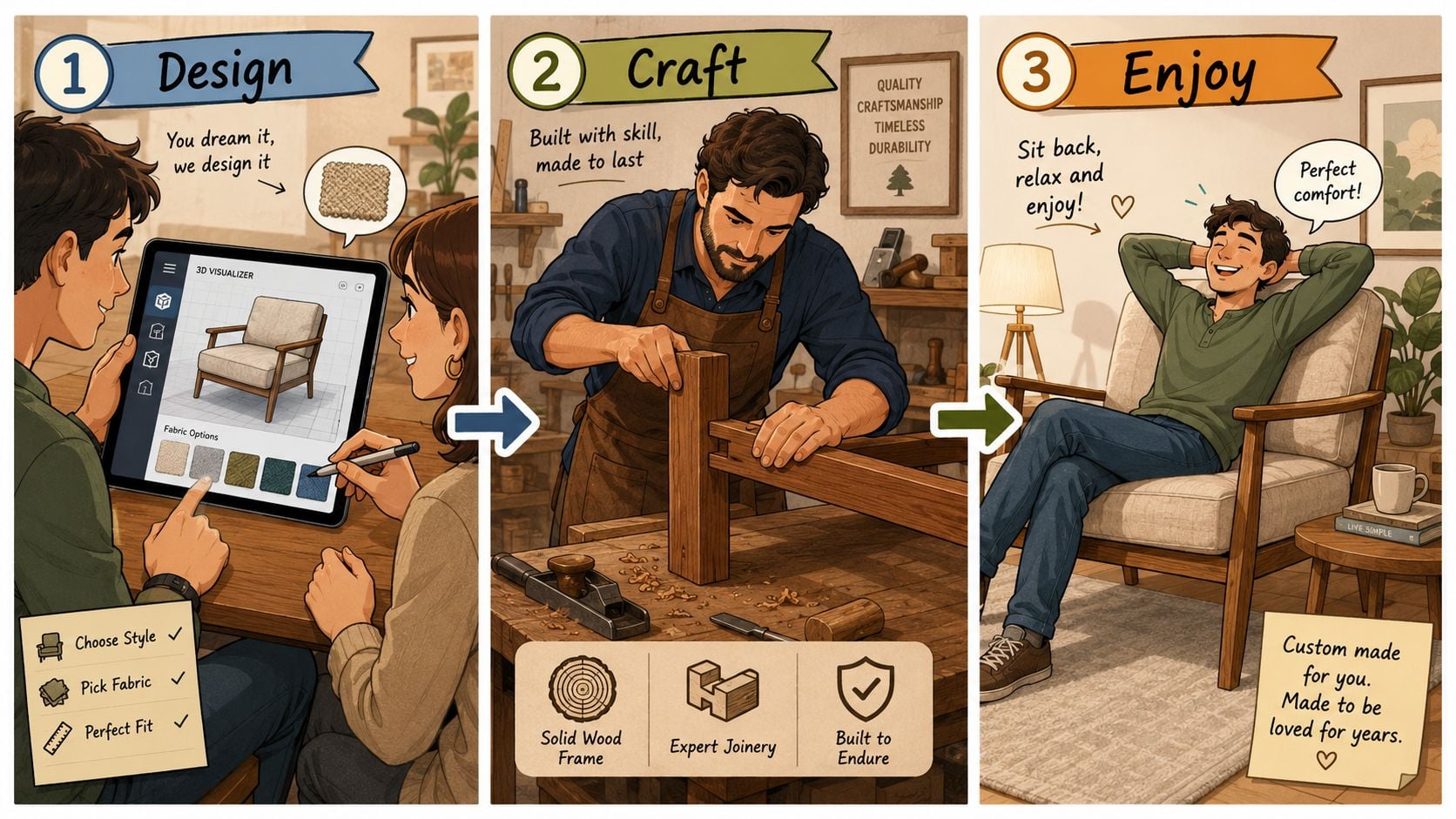
San Francisco homeowners often reach this point sooner than others because their homes ask more from every square foot. A bay-window niche, a narrow stair, or a compact dining area forces clear decisions. Those same pressures teach a useful lesson anywhere, including Columbus. Custom work succeeds when the process turns a room problem into a buildable plan.
A homeowner who wants a reliable planning framework can review how to get started with custom order furniture before meeting with a designer or sales professional. It helps turn vague ideas into useful decisions.
Start with the room, not the object
Good custom furniture begins with context. A sofa is not just a sofa. It is part traffic plan, part comfort tool, part visual anchor. If the room is wrong in any of those areas, the piece will feel wrong even if the craftsmanship is strong.
Start by defining the pressure point the furniture needs to solve. That may be a shallow depth for a city apartment, concealed storage in a family room, a table shape that improves circulation, or a seat height that better suits the people who use it every day.
A clear project brief usually includes:
Room purpose
Daily lounging, formal entertaining, reading, working, dining, and display all call for different proportions and materials.Required dimensions
Note the maximum width, depth, and height, plus the open space needed around the piece for movement, doors, and adjacent furniture.Performance needs
Pets, children, frequent guests, direct sun, and heavy use all affect fabric, finish, and cushion choices.Visual direction
Simple words are enough. Quiet. Warm. Architectural. Light. Grounded. Those terms give the maker a design target without forcing you to speak like an interior designer.
Clear priorities matter more than polished vocabulary.
Questions that prevent expensive confusion
The costliest mistakes in custom furniture rarely begin in the woodshop. They begin in the handoff between idea, measurement, approval, and installation.
In a city like San Francisco, that is easy to understand. A piece may need to fit the room, the entry, the elevator, and the turn at the top of the stairs. The same principle applies in any market. Furniture has to work through the full journey, not just at the final destination.
Ask these questions early:
Who confirms final site measurements?
One accountable party should own that task.Will you receive a drawing, rendering, or full specification for approval?
Buyers should be able to see proportion and detail before materials are cut.How are revisions handled at each stage?
Some changes are simple at the sketch phase and costly after fabrication begins.Who manages delivery and in-room placement?
Access matters. Historic trim, tight halls, stair turns, and apartment entries can all affect what is possible.Will materials be reviewed as real samples or only as photos?
Wood and upholstery behave differently in person than they do on a screen.
A custom project works like a house plan at smaller scale. Drawings, measurements, and sequence protect the result.
If measurement, approvals, and delivery responsibilities remain vague, the buyer is carrying more risk than expected.
How to review a proposal calmly
A strong proposal should let you picture the finished piece clearly and judge whether it fits your room, your use, and your expectations. If it reads like a collection of style adjectives, ask for more detail.
Look for these elements:
| Proposal item | Why it matters |
|---|---|
| Dimensions | Confirms fit and circulation |
| Materials | Shows what will age, wear, patina, or reveal natural variation |
| Finish and upholstery details | Reduces surprises in color, texture, and sheen |
| Construction notes | Reveals how the piece is assembled and how seriously durability is treated |
| Delivery and installation terms | Clarifies who is responsible for the final and often most delicate stage |
Review the proposal in the room if you can. Tape the footprint on the floor. Compare the height to a windowsill or nearby chair arm. Check clearances with doors and walkways. Those simple tests can reveal proportion issues long before production begins.
That discipline is one reason San Francisco has helped shape the conversation around custom furniture. The lesson travels well. Buyers in Ohio benefit from the same careful sequence: define the problem, verify the dimensions, approve the details, and build with confidence.
Inspired by the Best The Vinson Fine Furniture Approach
A homeowner may admire the clarity and restraint often associated with San Francisco interiors, then wonder whether that level of custom thinking is limited to the Bay Area. It is not. The lesson is broader. Good custom furniture comes from a disciplined process that makes size, materials, and use easy to understand before a piece is built.
Design leadership travels well
San Francisco has helped set a high bar because the city rewards careful design. Rooms are often compact, architectural details matter, and buyers tend to notice proportion quickly. Those conditions sharpen judgment. They teach a useful habit. Every choice should answer a practical question first, then a stylistic one.
That standard applies just as well in Ohio.
A large great room in Columbus can go wrong for the same reason a narrow city apartment can. The furniture is out of scale for the room, the traffic path, or the way the household lives. Newer homes often need visual warmth so they do not feel generic. Older homes need pieces that respect trim, window heights, and established character. The setting changes, but the design logic stays the same.
How Vinson applies those principles in Ohio
At Vinson Fine Furniture's design services studio, the process reflects that same respect for fit and clarity. Clients can review options in person, compare finishes and fabrics directly, and use visual tools to confirm direction before placing an order. That matters because custom furniture is easier to judge when you can see how a wood tone reacts to light, how a fabric reads at room scale, and how a silhouette feels next to the rest of the home.
This is the part many buyers find reassuring. Custom does not require a dramatic design vocabulary. It requires a clear problem to solve and a team that can translate that problem into dimensions, materials, and construction decisions.
In practical terms, that often means focusing on a few high-impact categories:
- Dining furniture: Table length, base placement, chair spacing, and finish all shape how comfortably the room works during everyday meals and larger gatherings.
- Solid wood pieces: Buyers usually care about grain character, joinery, and finishes that will wear gracefully rather than look tired after a few years.
- Amish-made furniture: The appeal often comes from construction discipline, repair potential, and a quieter design language that does not chase trends.
- Furniture shopping in Columbus: Online research helps narrow options, but many final decisions improve when buyers can test comfort, compare scale, and inspect materials in person.
- Sleep and bedroom purchases near Easton: Even when a shopper begins with mattresses or bedroom basics, the same principle applies. Comfort and fit are best judged with direct experience, not guesses from a screen.
Where value enters the decision
A strong custom program should explain where precision matters most. Some rooms need a fully bespoke solution. Others benefit from a well-made piece with the right finish, fabric, or configuration choices. The difference is similar to creating a custom suit. Sometimes you need a pattern drafted for your body. Sometimes expert alterations produce the better answer for the budget.
That flexibility is useful for full-home projects. A homeowner may choose custom work for the dining table that anchors daily life, then select other pieces that preserve visual continuity without requiring the same level of specification. Services such as in-home delivery, assembly, financing options, and access to reduced-price floor samples can support that balancing act and make the overall furnishing plan more coherent.
San Francisco remains a strong case study because it shows what careful buyers expect. Clear drawings. Honest material guidance. Respect for architecture. Confidence before production begins. Those values are not regional. They are the foundation of good custom furniture in any market, including Columbus.
Your Custom Furniture Questions Answered
Is custom furniture a practical choice or a luxury choice
It can be either, but the best custom pieces are practical first. When a room has awkward dimensions, difficult access, or a very specific use, custom work becomes a problem-solving tool. The beauty comes from the fit being correct.
A standard piece can still be the right answer for many rooms. Custom earns its place when compromise would be obvious every day.
What if the homeowner doesn't have a clear design vision yet
That is common. Most buyers begin with fragments. They know the room feels off, the old piece is too large, or the storage is not working.
A clear starting point is usually enough:
- One photo that captures the mood
- One list of functional needs
- One honest measurement sheet
- One note about what currently frustrates the room
That is plenty for a productive conversation with a designer, consultant, or maker.
How should a custom piece be protected over time
Protection starts at specification, not after delivery. The right finish, wood choice, cushion construction, and upholstery matter more than any after-the-fact accessory.
After installation, consistency matters most. Keep the piece clean with methods appropriate to its materials. Protect surfaces from avoidable moisture and heat. Rotate use when possible so wear develops evenly. Address small issues early before they become structural or cosmetic problems.
A custom piece lasts longer when the owner treats maintenance as part of ownership, not as a repair plan.
Can custom furniture be a responsible long-term choice
Yes, especially when the piece is designed to stay useful and stay loved. Furniture that fits correctly, suits the household, and is built with repairable materials is less likely to be replaced quickly.
That does not mean every custom purchase is automatically responsible. A smart custom project aligns purpose, materials, and longevity. When those three things line up, the piece has a better chance of remaining in the home for years instead of becoming an expensive mismatch.
Homeowners who want to turn ideas into a measured, material-aware plan can explore Vinson Fine Furniture and visit the Easton Town Center showroom to compare solid-wood construction, upholstery options, custom dining sets, premium sleep products, and design consultation support in person.