Home Office Desk for Two: A Buyer’s & Design Guide


Two people can share a dining table for a week. They can tolerate it for a month. After that, the friction becomes obvious. Someone is always moving a charger, shifting a notebook, angling a monitor, or apologizing for taking yet another call in the same room.
That's why a home office desk for two has become less of a convenience and more of a design problem worth solving properly. The desk isn't just a surface. It's where posture, workflow, lighting, storage, and household harmony all meet.
The shift happened quickly. By December 2020, 71% of people with jobs that could be done remotely were working from home, up from 20% before the pandemic, and nearly a quarter found it difficult to locate adequate space at home, according to home office ergonomics statistics summarized here. Many homes were never designed for two adults working side by side every day.
A well-planned shared office changes that. It gives each person enough territory to work comfortably, reduces visual clutter, and makes the room feel intentional rather than improvised. If you're comparing options, this guide to the best furniture for a home office is a useful starting point before you narrow in on desk style and room layout.
A good shared office should feel calm at 9 a.m. and still feel calm at 4 p.m. That usually comes down to planning, not square footage.
Creating Harmony in Your Shared Home Office
The first mistake most homeowners make is shopping for a desk before defining the problem. They look at finishes, price points, and silhouettes, then try to force a furniture piece to solve a room-planning issue.
What two people are really sharing
A shared workspace means two sets of needs overlap every day:
- Devices and power. Laptops, monitors, docks, chargers, task lamps, and headphones all compete for outlets and surface space.
- Work styles. One person may need quiet focus. The other may spend part of the day in meetings.
- Body dimensions. The same desk height and monitor placement rarely suit two people equally well.
- Visual tolerance. Some pairs don't mind a lively, active room. Others need clean sight lines to concentrate.
That's why a desk for two should be treated as a system. The shape matters, but the system matters more. You're deciding how two adults will move, store, plug in, write, type, and take calls without stepping into each other's rhythm.
Why the investment is worth making
A thoughtful office feels different immediately. Chairs pull out easily. Screens sit where they should. The room has a sense of order. You're not negotiating for elbow room every morning.
For an investment-minded homeowner, this is also about permanence. A carefully chosen desk in solid wood, with proper scale and a finish that suits the room, can outlast changing laptops, changing jobs, and even changing houses. It becomes part of the architecture of daily life, not a temporary fix.
First Steps Before You Shop Measuring for Two
Most desk mistakes begin with one incomplete measurement. People record wall width and stop there. For a shared office, that isn't enough.
Start with a simple sketch of the room. Mark every wall, door, window, outlet, floor vent, and ceiling light. Then note where each person naturally wants to sit. Many clients are surprised to discover that the best wall for a desk is not the longest wall, but the one with the cleanest circulation and the least troublesome glare.

A practical room-planning checklist from this furniture measuring guide can help you organize those dimensions before you visit a showroom or request a custom design.
Measure the room like a designer
Work through the room in this order:
Overall footprint
Measure wall length and room depth first. Those dimensions tell you whether a long linear desk, an L-shape, or a divided arrangement is realistic.Door and drawer clearance
Record door swings, closet access, and any built-ins already in the room. A desk that technically fits can still make the room awkward if it blocks movement.Window placement
Natural light is valuable, but glare is not. If one person sits with a bright window directly behind them, video calls and monitor visibility often suffer.Outlet locations
This often proves more critical than expected. If all power sits on one side of the room, one workstation may end up tidy while the other depends on extension cords and adapters.
Think beyond length
For comfortable concurrent use, a two-person desk is commonly benchmarked at 78 inches long, giving each person about 30 to 36 inches of personal work zone, according to this desk length guide. That benchmark is useful because it separates a genuine dual workstation from a merely oversized single desk.
Still, don't let length distract you from the room itself. A desk can be long enough and still fail because the chairs can't move freely, the monitors are too close to a window, or one person has no nearby storage.
Ask workflow questions before you buy
A room plan becomes much stronger when you answer a few behavioral questions early:
- Who takes more calls?
- Who uses larger monitors or more equipment?
- Do you need a shared printer zone, or should each station feel fully independent?
- Will this office double as a guest room, bedroom corner, or library?
Practical rule: Measure for the way you actually work on a Tuesday afternoon, not for the way you hope the room will look in a catalog photo.
Choosing Your Ideal Two-Person Desk Layout
At 10 a.m., one person is on a client call while the other is trying to finish focused work before lunch. By 2 p.m., one needs room to spread out samples or paperwork, while the other wants a clear, quiet surface with very little visual noise. That is why layout deserves careful thought. A desk for two is not a single workstation made larger. It is two daily routines sharing one footprint.
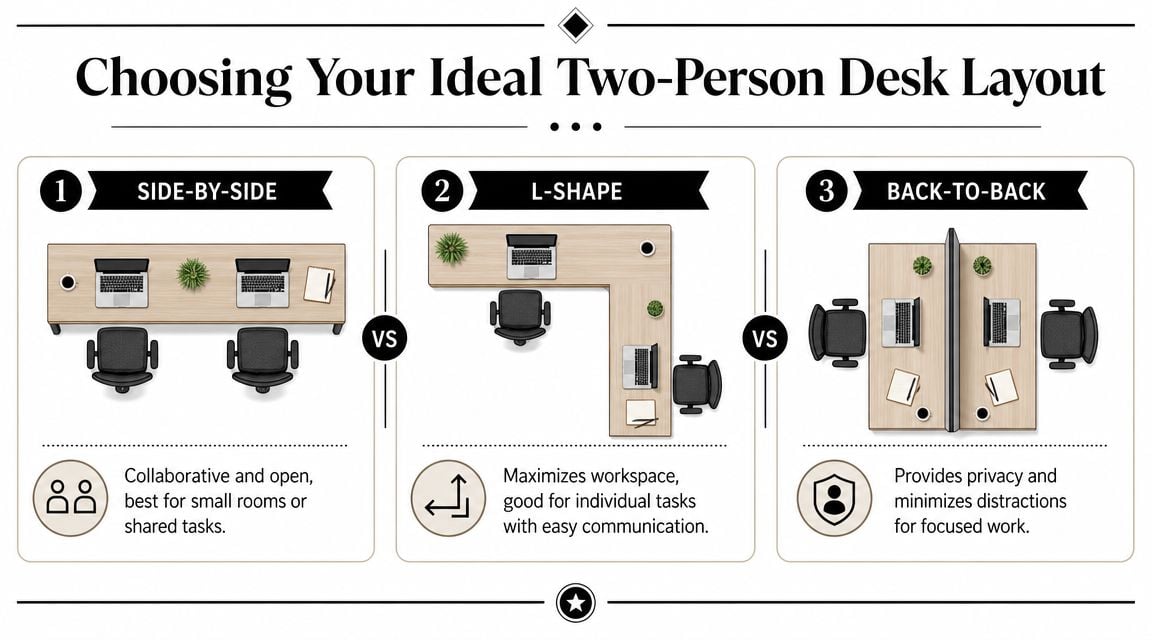
A quick comparison
| Layout | Best for | Main strength | Main caution |
|---|---|---|---|
| Side-by-side | Smaller rooms and collaborative work | Keeps the room visually simple and makes quick conversation easy | Shared sight lines can pull attention away from work |
| L-shape | Different work styles and mixed equipment needs | Creates clearer personal zones without feeling disconnected | The corner must be planned carefully so it becomes useful, not wasted |
| Back-to-back | Focus-heavy work and frequent calls | Reduces visual distraction and gives each person more psychological privacy | Usually asks more of the room's depth and circulation |
Side-by-side
Side-by-side layouts often appeal first because they feel orderly. The desk reads as one composed piece of furniture, which can be especially attractive in a bedroom office, study, or any room where the workspace remains visible throughout the day.
This arrangement works well for couples or housemates who collaborate often, share similar tools, or like being able to speak without turning their chairs. If both people work in short bursts of conversation and reference the same materials, the setup can feel natural.
The tradeoff is behavioral, not just spatial. Shared sight lines mean you notice each other's movement constantly. A second monitor glowing in peripheral vision, a stack of papers creeping outward, or one person typing intensely during the other's quiet work block can create low-level friction over time. Good side-by-side layouts usually need stronger boundaries than people expect, such as divided drawers, distinct task lighting, or a modest screen between stations.
L-shape
L-shaped desks often solve the problem that side-by-side desks reveal. Each person gets a zone with a different orientation, so the room supports independence without making communication awkward.
For homes, this can be one of the most graceful options. It uses a corner efficiently, leaves more open floor area in the center of the room, and feels less like a corporate bullpen. One partner can keep reference materials, sketches, or a larger monitor setup on one leg of the desk, while the other maintains a more minimal station on the other. The corner can also serve as a neutral shared zone for a printer, charging tray, or inbox.
L-shape layouts are especially helpful when two people work differently. One may need a broad surface and visible materials to think well. The other may work better with very little on the desk at all. An L-shape lets both approaches coexist.
Back-to-back
Back-to-back layouts deserve more attention than they usually get. They are often the strongest choice when both people spend long stretches in concentration, take frequent video calls, or prefer a little psychological separation during the workday.
The advantage is subtle but powerful. Each person sees less of the other's screen, hand movement, and body language. That changes the feel of the room. It can lower the sense of interruption, even when both people are present all day.
The caution is practical. This layout asks the room to support chair movement, walkways, and monitor placement comfortably. In a shallow room, back-to-back can feel compressed. In a deeper room, it often feels calm and professional.
Choose for behavior, not just geometry
The best layout usually comes from observing habits rather than picking the shape that looks best in a product photo.
Ask simple questions. Does one person need to talk through ideas out loud? Does the other become distracted by motion in their peripheral vision? Are both people doing similar work, or are you combining two very different modes such as administrative work and design work? The answers often point to the right layout faster than dimensions alone.
A good shared office works like a well-planned kitchen. Two people should be able to work at the same time without constantly crossing into each other's task zone. Once you view the desk as a system for two distinct workflows, the layout choice becomes much clearer.
Ergonomics A Desk That Fits Both of You
At 9:00 a.m., one person is sitting upright on a video call while the other is hunching forward to edit a spreadsheet. They may be sharing one desk, but they are not doing the same job with the same body. That is why ergonomic planning matters so much in a two-person office.
A shared desk often disappoints for one simple reason. It assumes both people can work well at the same height, with the same reach, and at the same screen distance. Real households rarely work that way. One partner may be taller. The other may write by hand for part of the day. One may use a laptop riser and external keyboard, while the other prefers dual monitors and a larger mouse area.
Height is usually the first problem. As noted earlier, a standard fixed desk can suit one person and leave the other working with raised shoulders, bent wrists, or feet that no longer rest comfortably on the floor. Those small posture errors feel minor at first. Over a full workweek, they become the reason a desk looks attractive but never feels settled.
Depth matters just as much. A shallow top pulls the monitor too close and pushes the keyboard toward the front edge. That creates a cramped posture, especially for someone using a larger screen, a desk mat, or papers beside the keyboard. A desk for two should let each person keep the screen centered, the forearms supported, and a little open surface available for real work, not just device storage.
The better approach is to design two ergonomic zones within one composition.
Each zone should give its user:
- A centered primary screen
- Enough depth for monitor distance and keyboard placement
- Comfortable legroom without pedestal interference
- Task lighting that supports one person without bouncing glare onto the other
- A chair height and desk relationship that fits that specific body, not an average one
This is where custom design earns its keep. A well-made desk can include different drawer placements, a keyboard-friendly working height, or one side left more open for longer legs and more movement. In some homes, the smartest answer is not matching halves. It is a balanced overall design with subtle differences built into each workstation.
That approach also protects the look of the room. Instead of patching a poor fit with footrests, stacked monitor stands, and improvised accessories, you begin with proportions that work from the start. The office feels calmer because the furniture is carrying the burden, not the people using it.
If you are still deciding on material and build quality, this guide to choosing the right hardwood for longevity and style helps connect ergonomic planning with a desk that will hold up beautifully over time.
A desk for two works like a suit custom-fit for a pair instead of a single off-the-rack size. It should support two distinct workflows, two bodies, and two ways of concentrating, all within one cohesive piece of furniture.
Solid Wood and Fine Finishes An Investment in Style
Most home offices ask a piece of furniture to do two jobs at once. It has to work hard, and it has to belong in the home. That's why material choice matters so much.
A two-person desk sees daily wear from chairs, cords, laptops, mugs, notebooks, and routine cleaning. In that setting, solid wood furniture Ohio homeowners often prefer has a distinct advantage. It can be refinished, repaired, and appreciated over time in a way many disposable work surfaces cannot.
For a deeper look at species, durability, and finish character, this guide to choosing the right hardwood for longevity and style is worth reading before you finalize a desk.
How wood choice changes the feel of the room
Different woods bring different visual weight:
| Wood impression | Design effect in a shared office |
|---|---|
| Oak | Grounded, architectural, excellent for a substantial desk presence |
| Maple | Clean and bright, useful in smaller rooms or modern interiors |
| Cherry | Rich and refined, especially appealing in traditional or transitional homes |
A hand-finished top also ages differently than a purely utilitarian office surface. Minor wear tends to read as character rather than failure. That's important in a room that sees real use from two people.
Why craftsmanship matters more in a desk for two
A desk for one can get away with weaker joinery and lighter construction for a while. A desk for two places more stress on the top, drawers, and structure. Two users lean, write, pull chairs in and out, and load the piece with more equipment.
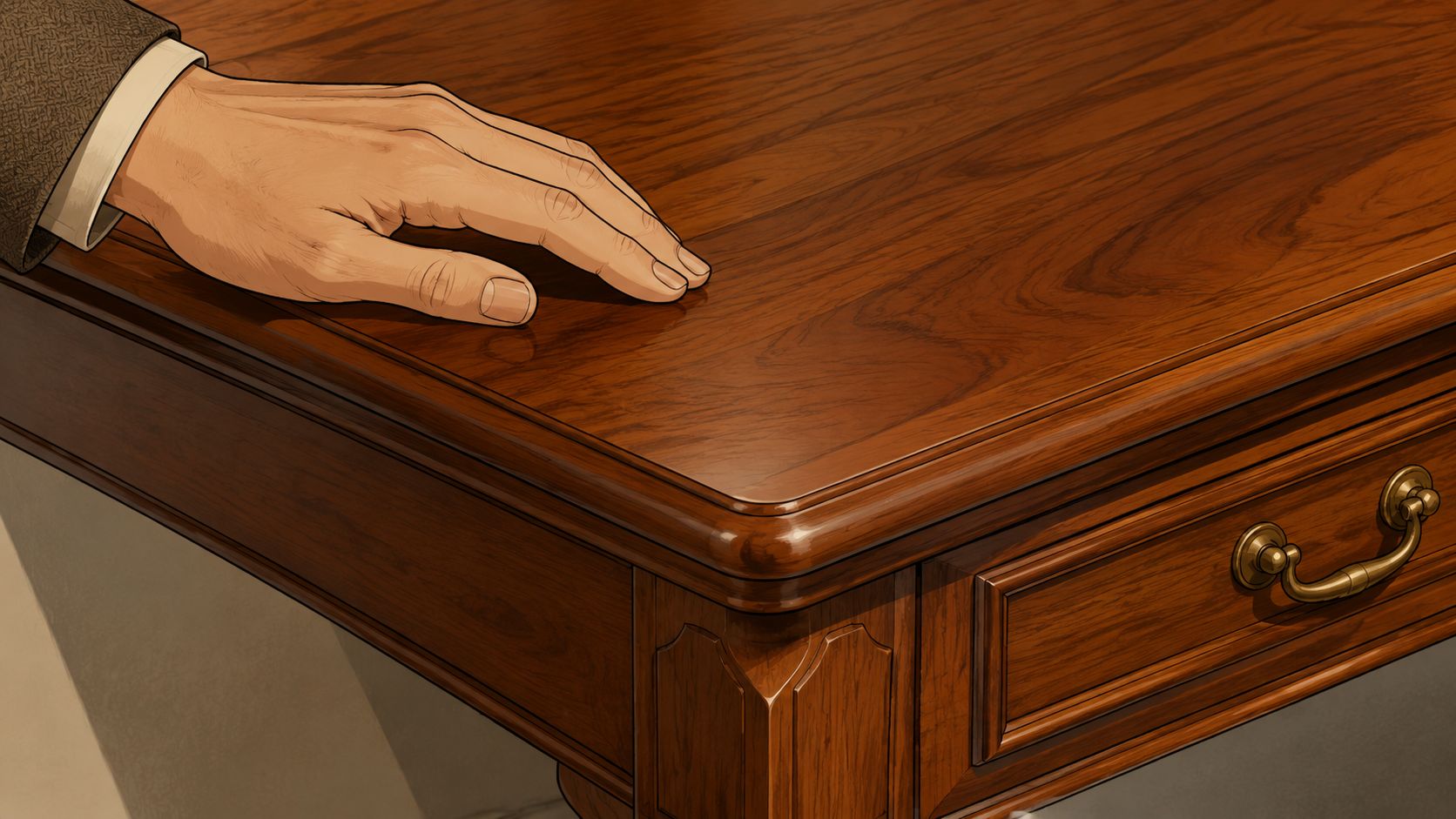
That's one reason many homeowners exploring Amish-made furniture or other bench-crafted pieces find the category appealing for office use. The workmanship is visible in the details you touch every day. Smooth drawer action, sturdy bases, thoughtfully finished edges, and a surface that feels substantial under the hand.
The aesthetic value matters too. In many homes, the office is visible from a hallway, guest room, or family area. A handsome desk in a thoughtful finish makes the room feel designed, not improvised.
Solving Shared Storage and Cable Chaos
Most two-person office problems don't start with the desktop. They start just below it and just behind it.
A primary pain point of a shared desk is often not its shape, but whether the surface can support two distinct task zones without crossing cables or blocking legroom, as noted in this multi-monitor workspace guide. That's why the cleanest desks on installation day sometimes become the messiest after a month of actual use.
If clutter is already taking over another part of your home, these ideas for solving clutter issues once and for all translate well to a shared office.
Treat the desk like a workflow map
A successful shared desk usually has three zones per person:
- Work zone for keyboard, mouse, notebook, and the immediate task at hand
- Visual zone for monitor placement and task lighting
- Utility zone for charging, small supplies, and daily accessories
Then there's a fourth area that often gets missed. The shared zone. That might hold a printer, a tray for incoming mail, a lamp, or a docking area for devices that don't belong to just one person.
Storage that reduces friction
Storage works best when it prevents negotiations. The goal isn't merely to hide things. It's to keep each person from having to ask where something belongs.
Consider these features:
- Dedicated drawers for each user, even if one person thinks they won't need them
- Open shelves above or nearby for reference books and decorative objects
- A central file area if household paperwork is managed jointly
- Closed storage for routers, accessories, and visual clutter that can make the room feel busy
Cable planning should happen before the desk is built
Good cable management feels invisible. Great cable management also protects legroom. If power bricks and bundles of cords gather under the center of the desk, someone will lose comfortable foot space.
One useful way to think about it is simple: power should travel to each workstation without crossing the other person's knees, chair path, or storage area. Grommets, cable trays, and discreet power access matter because they support daily calm, not because they sound technical.
A beautiful desk stops feeling beautiful when both users have to duck under it to untangle chargers.
Design Your Perfect Desk at Vinson Fine Furniture
By the time most homeowners have worked through layout, ergonomics, wood selection, and storage, they usually reach the same conclusion. A two-person office is hard to solve with a one-size-fits-all desk.
That's where a design-led process becomes useful. At Vinson's custom-made office furniture page, homeowners can explore office pieces suited to personalized configurations rather than settling for a standard format that almost works.

Where customization changes the outcome
The most effective shared offices are often customized in ways that seem modest on paper but make a real difference in use:
- Finish selection so the desk belongs with the surrounding architecture
- Configuration choices that reflect side-by-side, L-shaped, or more separated layouts
- Storage planning suited for paper-heavy work, device-heavy work, or a mix of both
- Visualizers and design support that help clients see proportion before production begins
For Columbus homeowners, the in-store Design Studio at Easton Town Center gives those choices a physical context. That matters because desk planning is tactile. You notice edge profiles, scale, chair clearance, and finish depth differently in person than you do on a screen.
The practical side of the buying decision
A large desk is a meaningful purchase, so the buying experience matters almost as much as the piece itself. The Custom Order Program, complimentary design consultations, and 3D visualizers help remove guesswork before an order is placed. The Low Price Guarantee offers a 110% refund of the difference if a lower price is found at a local authorized dealer within the stated window, and the Clearance Gallery includes savings up to 70% off on select pieces, as described by the publisher. Flexible financing through Synchrony HOME and White-Glove In-Home Delivery also make a more substantial office project easier to execute.
That combination is relevant for homeowners comparing a temporary purchase with a permanent one. If the room is meant to support years of hybrid work, video calls, writing, studying, and household management, it makes sense to choose a desk with enough quality and flexibility to keep up.
For readers searching terms such as Furniture store Columbus Ohio, solid wood furniture Ohio, custom dining sets, best mattresses Easton Town Center, or Amish-made furniture, the larger point is the same. A good showroom isn't only a place to buy furniture. It's a place to test proportion, materials, and long-term fit before you bring a substantial piece into your home.
If you're ready to plan a home office desk for two that feels composed, durable, and designed for the way you live, visit Vinson Fine Furniture. Their Easton Town Center showroom, complimentary design consultations, Custom Order Program, financing options, and White-Glove Delivery can help you turn a difficult shared workspace into a room that works beautifully every day.