Home Office Furniture with Storage: Design Your Workspace

The laptop has migrated from the kitchen table to the end of the dining room, then to a guest room corner, then to a desk that never quite fit the room or the work. Papers stack where a lamp should sit. Chargers coil across the floor. A printer claims more visual space than it deserves. The room works, technically, but it doesn't feel settled.
That temporary phase has ended for many households. The demand for home workspaces has solidified, with the global home office furniture market valued at over USD 25 billion, and storage units account for over 18% of the market as households separate professional files from personal life, according to this global home office furniture market analysis. That matters because the main challenge isn't finding a desk. It's creating a workspace that feels permanent, composed, and worthy of the home around it.
A well-designed office should carry the same standard as a dining room, bedroom, or library. It should feel intentional. It should hold what needs to be hidden, display what deserves to be seen, and age with dignity. Thoughtful home office furniture ideas start there, with the belief that a work surface is part of the home's architecture, not a disposable accessory.
Table of Contents
- Elevating Your Workday Beyond the Kitchen Table
- The Solid Hardwood Standard for Your Home Office
- Building Your Suite Key Pieces for Storage and Style
- Hallmarks of Quality That Go Beyond the Surface
- Customization Designing Furniture That Fits Your Life
- Space Planning for Function and Flow
- Experience The Vinson Difference From Showroom to Home
Elevating Your Workday Beyond the Kitchen Table
A makeshift office always announces itself. It's visible in the rolling cart that has nowhere graceful to live, the shallow drawers that jam, and the bookshelf pressed into service for tax files, notebooks, and unopened mail. The room never feels calm because nothing in it was chosen to do this job well.
That tension shows up in the workday. A homeowner sits down to answer email and starts by moving a stack of folders. A video call begins with a glance over one shoulder to make sure household clutter stays out of frame. By midafternoon, the desk surface has disappeared under devices, papers, and the daily debris of hybrid work. Storage isn't a decorative extra. It's the difference between a room that supports concentration and a room that resists it.
A permanent workspace needs permanent furniture
The right response isn't another stopgap organizer. It's a better foundation. Home office furniture with storage should function like a suite of residential furniture pieces that happen to support work. That means a substantial desk with real presence, concealed storage that keeps business materials private, and shelving or cabinetry that restores order without making the room look institutional.
Practical rule: If the office still feels temporary after years of use, the furniture is the problem.
An elegant workspace does more than hold equipment. It improves posture, supports routines, and gives the room visual authority. It also respects the rest of the house. A handsome credenza in cherry or walnut belongs in a study, library wall, or guest room far more comfortably than a metal filing unit ever will.
The room should work hard and look settled
The most successful offices no longer read as office-supply purchases. They read as furnished rooms. That's an important distinction for households where one room may serve work, reading, planning, and occasional guests. A desk with drawers, a bookcase with disciplined display, and closed storage for the unattractive necessities can transform a chaotic corner into a room with stature.
Clear recommendations matter here:
- Choose fewer, better pieces. One bench-made desk and one substantial storage piece outperform a cluster of small stopgaps.
- Hide the ugly work. Printers, cables, receipts, and paper stock belong behind doors or in drawers.
- Let one piece anchor the room. In most offices, that's the desk. In narrower spaces, it may be a credenza or bookcase wall.
The goal isn't to mimic a corporate office. It's to create a room that supports serious work and still feels at home.
The Solid Hardwood Standard for Your Home Office
A home office takes daily punishment. Drawers open and close constantly. Chairs brush desk edges. Elbows rest in the same spot for hours. Lamps, monitors, and file trays leave their mark. Furniture built for short-term convenience doesn't hold up under that kind of repetition. Solid hardwood does.
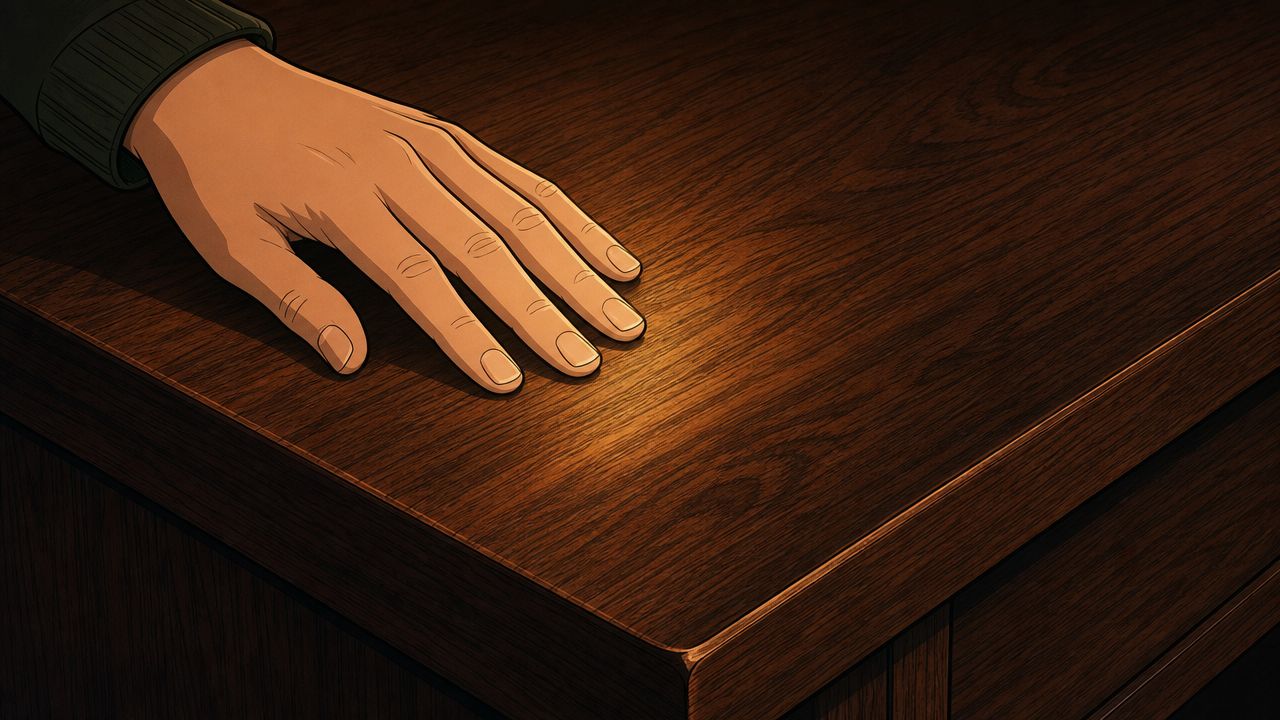
A proper desk in solid cherry, oak, maple, or walnut has a different presence from the moment a hand meets the surface. It carries weight. The grain has variation and depth. The edges feel crisp, not hollow. Over time, that difference becomes even more obvious because real wood doesn't merely survive use. It develops character.
For homeowners considering solid wood home office furniture, this is the right standard to insist on. A serious workspace deserves furniture made with the same integrity expected in a dining table or bedroom suite.
Why weight and grain matter
Solid hardwood earns its keep in three ways.
| Feature | What it means in daily use |
|---|---|
| Structural weight | The desk stays planted, drawers track properly, and the piece feels stable during long work sessions. |
| Natural grain | Each board brings variation and warmth, which keeps the office from feeling cold or generic. |
| Refinishable surface | Minor wear can become part of the patina or be renewed, rather than signaling the end of the piece. |
That last point matters more than many buyers realize. Work furniture gets touched constantly. A piece that can mature gracefully is a better investment than one that looks tired the moment the first scratch appears.
What lasting craftsmanship changes
Amish-made and bench-made hardwood furniture has another advantage. It doesn't treat the office as a temporary category. It treats it as furniture. That's exactly the right mindset for a room that has become a permanent part of the house.
A well-built office desk should feel less like equipment and more like cabinetry.
That shift in perspective changes what gets chosen. Instead of shopping for features first and material second, the investment homeowner starts with construction, wood species, and proportion. Storage still matters, of course, but it's built into a piece with architectural dignity.
This is also where the broader Vinson philosophy carries weight. The same showroom that presents Custom leather sectionals Columbus clients can sit in, motion seating with smooth engineering, and handcrafted dining collections also frames the office as part of a fully furnished home. A solid-wood desk belongs in that company. So does a custom-designed office chair in top-grain leather, a swivel accent chair for reading, or a compact recliner in an adjoining study nook.
The office shouldn't be furnished like a temporary workstation. It should be furnished like a room that will still matter a decade from now.
Building Your Suite Key Pieces for Storage and Style
Most homeowners buy office furniture one piece at a time and end up with a collection instead of a suite. That's the mistake. Home office furniture with storage works best when each piece has a distinct job and the room reads as one composition.
That approach matches the market itself. In the home office furniture market, desks and tables hold 33.74% of share, while storage units hold 18.15%, which underscores that storage is a major component, not an afterthought, according to this home office furniture market report. The practical takeaway is simple. A handsome desk alone won't finish the room.
The desk as command center
The desk is where the room takes its cues. It establishes scale, wood tone, and posture. It also determines whether the room feels composed or cramped.
A strong desk should provide enough surface for real work without forcing every supply item into view. Built-in drawers are useful, but they shouldn't shoulder the entire storage burden. Once a desk becomes overloaded with paper, accessories, and devices, the visual calm is gone.
The best desk choices usually fall into one of these directions:
- Executive desks for dedicated rooms where presence matters as much as function.
- Writing desks with selective drawers for lighter workflows and cleaner visual lines.
- Partnered desk and file combinations for homeowners who need organization without bulk.
For those who want a concrete example of this category, the Atwood lateral file cabinet by Mavin Furniture shows the kind of substantial, furniture-grade storage that belongs with a serious desk rather than beside it as an afterthought. That same standard is why Mavin bedroom furniture often appeals to the same buyer. The construction language feels consistent across the home.
The credenza and bookcase earn their space
A credenza is often the most useful piece in the room. It handles the unattractive realities of work. Printer, paper stock, charging equipment, archived files, extra cords, and reference materials can all disappear behind doors or inside drawers. The desktop stays open for thinking instead of storage overflow.
A bookcase plays a different role. It introduces verticality, softens the office, and creates a place where work and personal life can coexist with some discipline.
Closed storage keeps the room quiet. Open storage gives it personality. Good offices need both.
A balanced suite often includes:
- A credenza behind or beside the desk for concealed utility.
- A bookcase or library cabinet for books, objects, framed art, and selective binders.
- A lateral file or low cabinet when paper storage still matters but visual bulk doesn't.
This is the difference between filling a room and furnishing one. The pieces should talk to each other in scale, wood species, and finish. When they do, the office stops looking assembled and starts looking designed.
Hallmarks of Quality That Go Beyond the Surface
A furniture tag can say solid wood and still leave plenty unsaid. Quality reveals itself in the details a homeowner sees, touches, and uses every day. That's where heirloom standards separate themselves from furniture that only looks convincing from across the room.
Joinery tells the truth
The first place to look is where one piece of wood meets another. Good joinery doesn't rely on bulk alone. It relies on precision. Mortise-and-tenon construction, tight casework, and properly fitted drawer boxes tell a clearer story than a glossy finish ever could.
Drawers deserve special attention because they expose weak construction quickly. A well-made drawer should feel composed in the hand, not rattling or flimsy. English dovetail drawer construction is a strong sign that the maker expected the piece to be used for years, not merely delivered and admired.
A discerning buyer should check these points:
- Drawer fit: The reveal should look even, and the drawer shouldn't shift side to side.
- Interior construction: The inside matters as much as the face. Rough shortcuts are a warning.
- Case alignment: Doors and drawers should sit cleanly within the frame.
Finish and hardware reveal daily quality
The second test is tactile. Hands notice what eyes sometimes miss. A hand-rubbed finish tends to feel quieter and richer than a finish that sits on the wood like a shell. Grain should still read through the surface. Edges should feel softened by craftsmanship, not machine sharpness pretending to be refinement.
Hardware matters just as much because storage furniture succeeds or fails in motion. Drawer glides should open with control, not with resistance or a jolt. Pulls should feel substantial enough to match the case. Hinges should close with confidence.
A quick showroom checklist helps:
| What to test | What quality feels like |
|---|---|
| Open a drawer fully | Smooth travel, solid stop, no wobble |
| Rest a hand on the top | Dense, grounded, quiet under touch |
| Inspect the finish in light | Depth, consistency, visible character in the wood |
| Look at the back and underside | Care continues where casual buyers rarely look |
That last point matters. Furniture made with integrity doesn't save its standards only for the visible side.
A refined office doesn't come from ornate styling. It comes from disciplined construction, honest materials, and a piece that feels better the longer it's used.
Customization Designing Furniture That Fits Your Life
Most office furniture misses by a few inches, one wrong finish, or the wrong mix of open and closed storage. That's why so many homeowners end up compromising. The desk is handsome but too shallow. The file cabinet fits the need but not the room. The bookcase works functionally but fights every other wood tone nearby.
Customization solves that. Not decorative customization. Real customization that adjusts the piece to the room, the work habits, and the rest of the home.
For homeowners exploring custom-made office furniture, the strongest path is usually a guided one. An In-Store Design Studio and complimentary design consultation let the buyer work through dimensions, wood species, finish, hardware, and storage priorities before a piece is built. That's far better than buying close enough and living with the mismatch.
Stop settling for almost right
A home office has too many variables for off-the-shelf guesswork. One person needs files hidden and chargers accessible. Another needs shelves for books and doors for equipment. Another wants the office to disappear into a guest room by evening.
The Custom Order Program is valuable precisely because it eliminates those small but costly compromises. Through customizable collections from Canadel, Mavin, and Smith Brothers of Berne, homeowners can shape furniture around actual use.
That might mean:
- Selecting wood species that match adjacent rooms, such as maple for a brighter look or walnut for depth.
- Adjusting finish tones so the office doesn't feel imported from another house.
- Choosing hardware that leans refined, classic, or subtly contemporary.
- Specifying seating materials in fabric or top-grain leather for an office chair, swivel chair, rocker, or glider used in the same room.
The right customization points
The best custom decisions usually happen in this order:
- Start with function. Decide what must be hidden, what should stay within reach, and what deserves display space.
- Move to scale. Fit the furniture to the room's proportions, not the other way around.
- Finish with feel. Select wood tone, hardware, and seating materials that make the office part of the home's larger story.
The most expensive mistake in furniture isn't paying for quality. It's paying for the wrong piece twice.
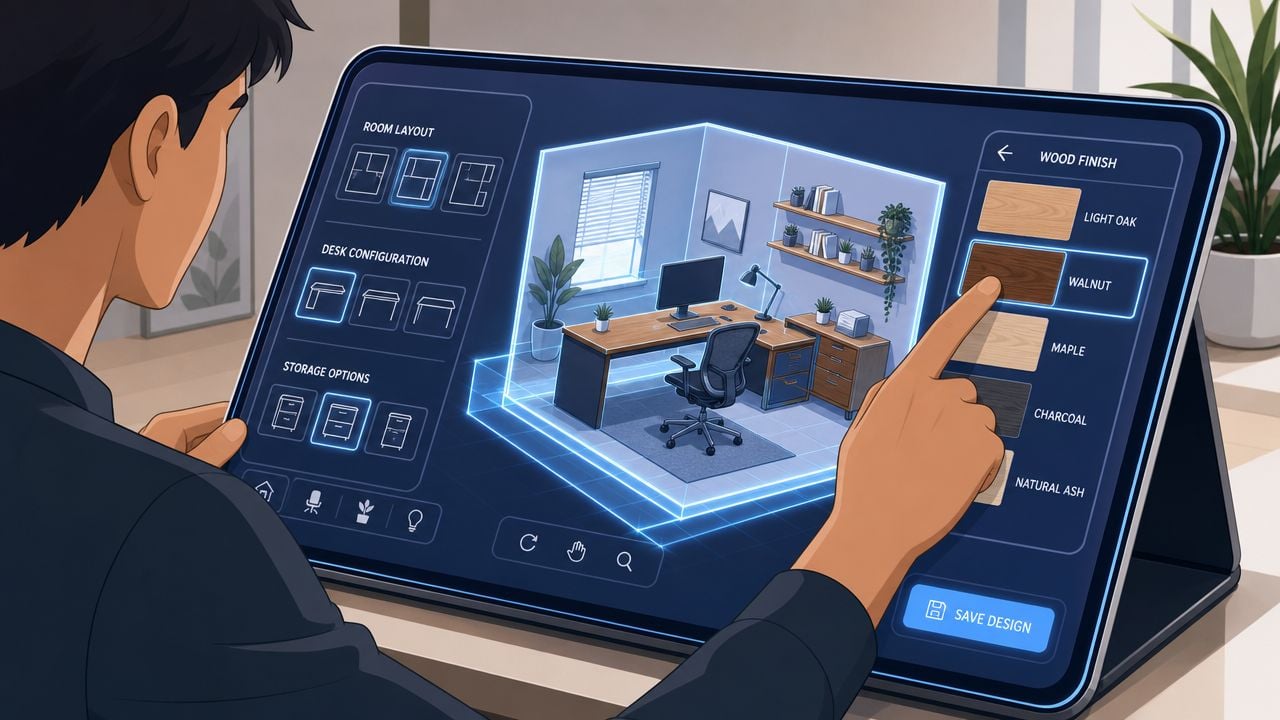
Digital 3D visualizers make this process much easier because they remove the guesswork from custom work. A homeowner can see how finish, form, and configuration come together before production begins. That matters in an office, where proportion is everything and visual calm depends on details lining up correctly.
This is also where broad showroom expertise helps. A client interested in Smith Brothers furniture Easton for living spaces may want office-adjacent seating with the same refined comfort. Someone shopping solid wood furniture Ohio may want the office to relate to the dining room or bedroom suite. Good customization respects the whole house, not just one corner of it.
Space Planning for Function and Flow
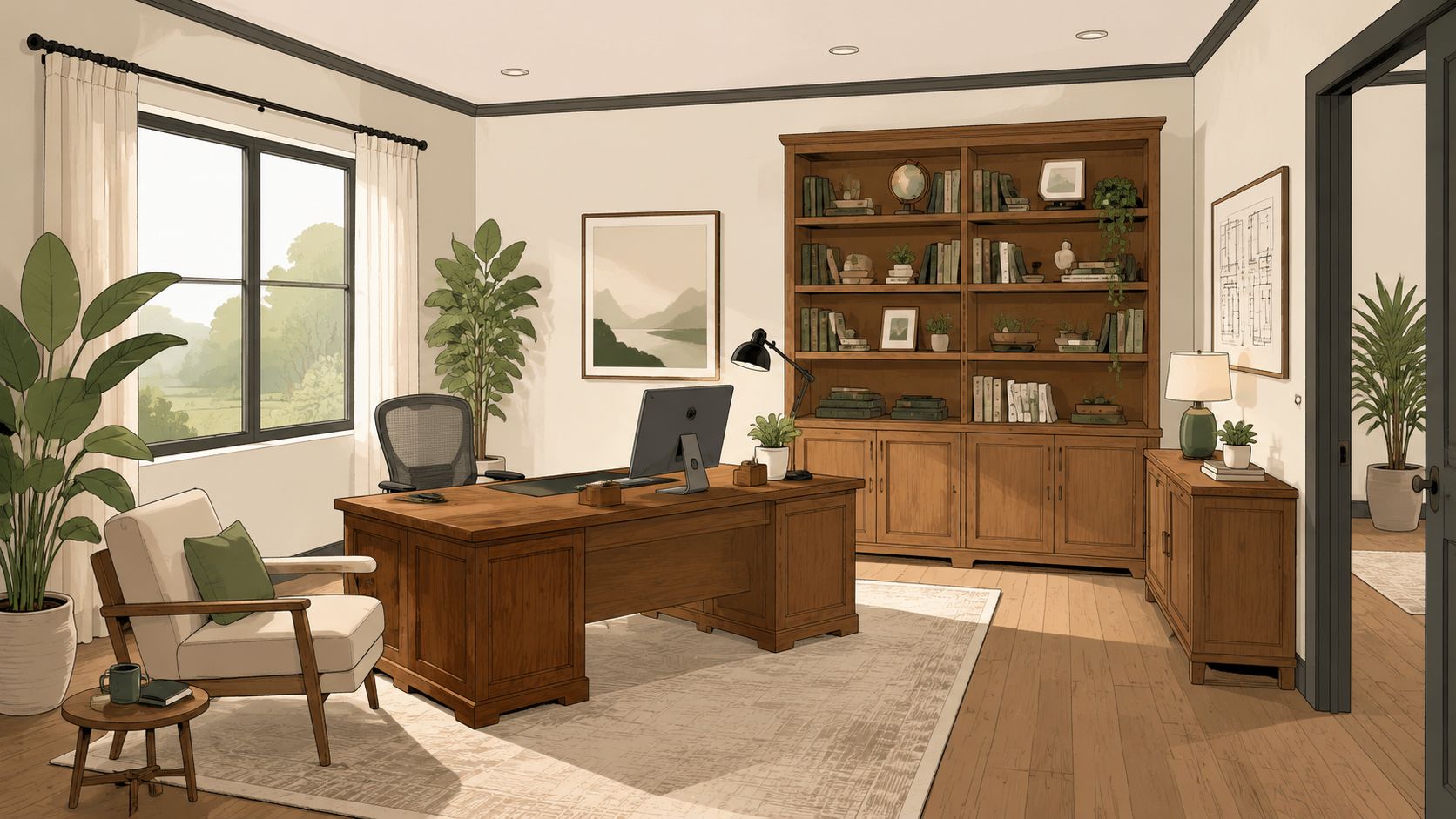
A beautiful office can still fail if the room is crowded, dark, or awkward to move through. Space planning matters just as much as furniture quality. The best rooms feel orderly because every piece has enough air around it.
The practical measurements are straightforward. Standard desk height is 29 to 30 inches, and a common two-drawer file cabinet is about 30 inches high and 29 inches deep, which matters when matching desk depth and preserving circulation, as noted in this home office measurement guide. Those dimensions are not trivial details. They determine whether the room feels graceful or blocked.
Start with dimensions that protect comfort
A desk that's too large for the room creates stress before the workday even begins. Knees feel boxed in. Walking paths tighten. Storage starts pushing outward because there's no room for it to sit properly.
A cleaner plan usually follows these rules:
- Match cabinet depth to desk depth. When one piece projects farther into the room, the layout starts to feel clumsy.
- Protect circulation first. A handsome lateral file isn't worth it if it narrows the passage every time a drawer opens.
- Use vertical storage intentionally. Tall bookcases add authority without stealing as much floor area as multiple low pieces.
For homeowners needing layout help, home office furniture layout guidance can help clarify proportions before any furniture is ordered.
Make the office feel like part of the home
Placement matters beyond measurements. A desk should take advantage of useful light without forcing glare onto a screen. A credenza can anchor a long wall and keep equipment discreet. A bookcase can define an office zone in a guest room or open-plan area without making the space feel severed.
Visual integration matters, too. Art, lighting, and accessories should support the furniture instead of floating randomly around it. Thoughtful wall composition can make a workspace feel polished rather than improvised, and these tips for transforming your space with art are useful for anyone trying to finish a home office with more confidence.
A well-planned office doesn't just fit the room. It improves the room.
The most successful layouts allow the office to shift with the household. A room may still host guests, reading, planning, or household administration. Furniture should support that flexibility. Closed storage keeps work contained. Good scale keeps the room open. Strong materials keep the whole composition feeling substantial rather than overdesigned.
Experience The Vinson Difference From Showroom to Home
The final decision shouldn't happen from a product photo alone. Office furniture is too tactile, too dimensional, and too permanent for that. A homeowner needs to open the drawers, test the glide, study the finish under light, and feel the difference between a piece that merely looks substantial and one that is substantial.
Why the showroom still matters
At Easton Town Center, the showroom visit gives the office the same level of attention buyers already expect for dining, bedroom, and seating purchases. That matters because office decisions are rarely isolated. The desk may need to relate to an adjacent guest room. The chair may need to feel at home beside a bookcase or reading lamp. The finish may need to sit comfortably with existing cherry, oak, maple, or walnut in the home.
A broader planning mindset helps here, and this complete guide to office planning is a useful outside resource for thinking through workflow, layout, and room function before final selections are made.
Value that respects the investment
Real value in fine furniture doesn't mean chasing disposable prices. It means buying once, buying correctly, and receiving the service that protects the investment. That includes the practical support around the furniture itself.
The strongest showroom experience includes:
- Complimentary design consultations that help with room layout, finish coordination, and storage planning.
- Custom Order Program options for brands such as Smith Brothers, Canadel, and Mavin, including fabrics, finishes, and 3D visualizers.
- A Low Price Guarantee with a 110% refund of the difference if a lower local authorized-dealer price is found within the stated period.
- A Clearance Gallery with savings of up to 70% for buyers who want immediate value on premium pieces.
- White-Glove Delivery so substantial furniture arrives, is assembled properly, and doesn't become a logistical problem at the end of the process.
This is also where premium motion and leather options matter. A home office often extends into an adjacent sitting area or reading corner. A top-grain leather swivel chair, a smooth power recliner, or a compact glider can make the room more useful without diluting its sophistication.
The office has become permanent. The furniture should reflect that permanence in material, craftsmanship, and planning.
A thoughtfully furnished office should feel settled, capable, and lasting. Homeowners ready to create that kind of workspace can explore Vinson Fine Furniture at Easton Town Center for design guidance, custom options, and heirloom-quality pieces that bring real order and beauty to the workday.