White Glove Delivery Explained: What to Expect


The truck pulls up, the hallway is clear, and a new solid hardwood dining set is finally on site. For the homeowner, that moment can feel equal parts relief and tension, because one wrong scrape on a cherry leg or one awkward turn through a tight foyer can change the whole experience. White glove delivery exists for exactly that moment, when the furniture matters enough that the delivery needs to feel like part of the purchase, not an afterthought.
What White Glove Delivery Really Means
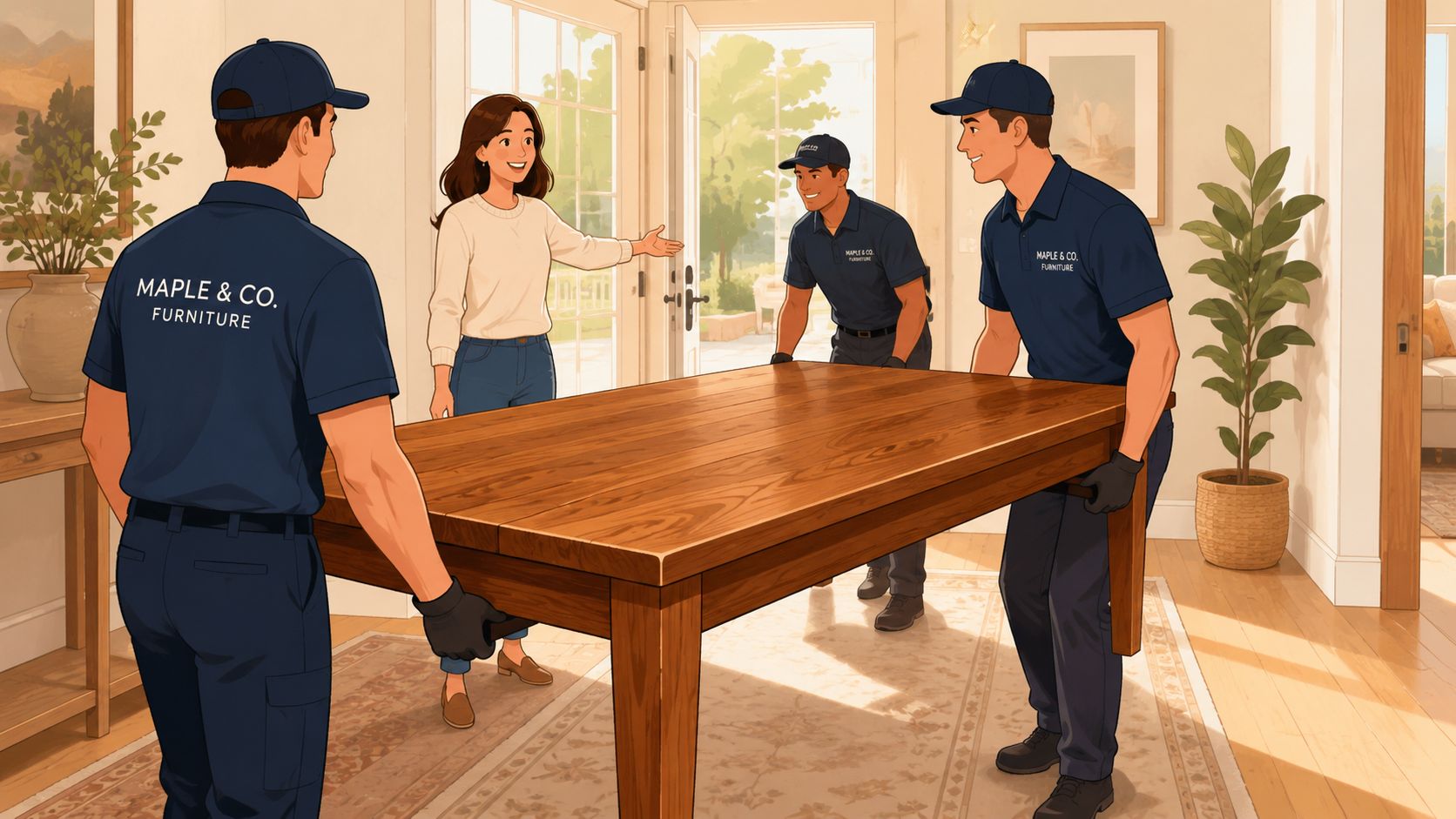
A two-person crew carries the table through the front door, turns it carefully at the stair landing, and sets it in the dining room without dropping the box, scuffing the walls, or making the homeowner wrestle with a flat pack. That scene is the practical meaning of white glove delivery. It's a premium last-mile service that goes well beyond curbside drop-off and treats the item as something that should arrive, enter the home, and be finished properly.
Courier Authority's logistics guide describes the service as scheduled appointments, trained handlers, interior placement, unpacking, assembly or installation, and debris removal, along with real-time tracking and proof-of-condition documentation. Those details matter because they show this isn't just a bigger truck or a friendlier driver. It's a delivery model built around chain-of-custody and accountability.
The working definition
For a homeowner, the simplest definition is this. White glove delivery means the product is brought inside, placed where it belongs, assembled or installed when needed, and cleaned up before the crew leaves. Ryder's white glove guide describes the same full-service idea with in-home placement, product assembly, installation, and haul-away of packaging or old products.
Practical rule: If the piece is valuable, heavy, awkward, or difficult to finish after delivery, the delivery service should be treated as part of the furniture investment.
That's why the service makes sense for heirloom pieces, not commodity goods. A solid-maple dining table, an Amish-made bedroom set, or a top-grain leather sectional deserves handling that matches the quality of the build. The point isn't luxury for its own sake. The point is protecting the furniture from unnecessary risk at the exact stage where damage usually happens, the handoff.
Inside the Service Bundle
A true white glove visit starts before the truck reaches the driveway. The crew should already know what is on the route, what is in the load, and what kind of access the home presents. That is why trained providers use scheduled delivery windows, two-person crews, and documentation that tracks the item from loading to placement. AIT Worldwide's guide lays out the common bundle clearly, including final-mile delivery, online scheduling, room-of-choice placement, unpacking, installation and assembly, debris removal, reverse logistics, and return distribution.
What each piece of the bundle does
| Service Element | What It Means in Your Home |
|---|---|
| Scheduled delivery window | The crew arrives in an agreed time block, which helps the homeowner plan the day. |
| Two-person trained crew | Two handlers can lift, turn, and place heavy furniture more safely than one person can. |
| Room-of-choice placement | The item goes into the bedroom, dining room, or living room where it will actually be used. |
| Unpacking | Boxes, wraps, and protective material come off before the furniture is set. |
| Assembly or installation | Legs, sections, hardware, or attached components are finished on site. |
| Debris removal | Packaging leaves with the crew instead of piling up in the garage. |
| Chain-of-custody documentation | The handoff is recorded, which supports accountability if there is damage or a missing part. |
In a Columbus condo, room-of-choice may mean carrying a chair through a narrow hallway and setting it exactly where a reading lamp already stands. For a motorized Smith Brothers sectional, assembly may involve connecting sections, testing the recline, and making sure cords or power components are correctly positioned, a process detailed in our guide to furniture assembly and installation. The exact scope should be clear before delivery day, not guessed at after the truck arrives.
Some of the confusion comes from the word “setup.” In furniture delivery, setup should mean the item is made ready for use, not just dropped inside the door.
A provider should also explain what happens if the crew finds damage during inspection or if a piece needs a second trip for a missing hardware kit. Insurance-backed handling and documented condition checks give the homeowner a paper trail instead of a memory test. That matters most when the furniture is already delicate, already expensive, and already tied to a careful shipment path.
What Drives the Cost of White Glove Delivery
The price is tied to labor and risk, not just mileage. A two-person crew costs more to dispatch than a single driver, and a dedicated vehicle has to be routed, loaded, and maintained for furniture that may be bulky, heavy, or fragile. When a home has stairs, tight turns, or a long carry from curb to entry, the job becomes slower and more physical, which affects the delivery economics in a very direct way.
The main cost drivers
- Labor count: Two trained handlers can move furniture more safely, but the second pair of hands adds real labor cost.
- Route density: A truck that can make several stops in one dense area is easier to schedule than a truck serving scattered homes.
- Item size and weight: A solid walnut nightstand is simpler than a multi-piece dining room shipment or a sectional with motion mechanisms.
- Stairs and access: Each flight, landing, and corner adds time and handling risk.
- Assembly complexity: A basic placement is different from a room full of tables, beds, and upholstered motion pieces.
- Documentation and insurance: Condition checks and chain-of-custody records take time, but they reduce the chance of disputes.
A buyer furnishing one room may experience delivery very differently from someone ordering multiple solid wood pieces at once. A single nightstand, a dresser, and a bed frame still need careful handling, but they don't create the same route density or labor load as a full-home order. The more touchpoints a shipment has, the more the logistics matter.
Vinson's delivery page explains how the service is handled locally and ties that support to the store's delivery process (Vinson delivery). That kind of framework matters because premium furniture doesn't just cost more at purchase, it also deserves a delivery plan that reduces the chance of scratches, compression damage, or avoidable assembly mistakes.
The right question isn't, “Why does this cost more?” It's, “How many handling steps are being removed from the customer's plate?”
For heirloom-grade furniture, each extra step a crew absorbs is another layer of protection for the piece and less stress for the household.
White Glove vs Standard Delivery
Standard delivery and white glove delivery are not the same job with different labels. One drops the furniture near the home. The other brings it inside and finishes the handoff. For buyers comparing a small accent chair, a mattress, or a full dining set, the difference shows up in where the piece lands, who unpacks it, and who clears away the evidence.
| Delivery Type | Where It Ends Up | Assembly Included | Packaging Removal | Best Fit |
|---|---|---|---|---|
| Curbside | At the curb or driveway | No | No | Small, easy-to-move items where the buyer can handle the rest |
| Threshold | Inside the first entry point | Usually no | Usually no | Pieces that need basic protection from weather but not full setup |
| White glove | Room of choice inside the home | Yes, when scoped | Yes, when scoped | Heavier, higher-value, or more complex furniture |
A small accent chair may not justify the full service. A mattress often does better with room placement, especially in a home with stairs or a tight hall. A Canadel dining set or a top-grain leather sectional needs a higher level of care, because the buyer is paying for a finished room, not a box in the foyer.
A useful way to think about it is by risk. The more the buyer wants to avoid lifting, unpacking, assembly, and cleanup, the stronger the case for white glove. That's especially true when the furniture includes solid hardwood, motion components, or custom upholstery that shouldn't be dragged, flipped, or improvised in a hallway.
White glove mattress delivery details can help buyers who are only weighing sleep-system placement, but the same logic applies to dining and bedroom furniture. A service that ends with the furniture ready to use is doing more than making arrival easier. It's reducing the number of chances for damage between the truck and the final room.
How to Prepare Your Home for Delivery Day
The best crews move quickly when the path is ready. The worst delivery days usually start with a cluttered entry, a blocked turn, or a homeowner trying to guess which bedroom the dresser should go into after the truck is already parked. A little preparation removes most of that friction.
A simple preparation checklist
- Measure the tight spots: Doorways, stair turns, elevator openings, and hall bends should be checked before delivery day.
- Clear the route: Shoes, baskets, side tables, and temporary clutter should be moved out of the path.
- Protect the surfaces: Floors and nearby walls should be ready for traffic, especially in homes with new hardwood or fresh paint.
- Keep pets secured: Animals do better in a closed room or another safe area while the crew is carrying furniture.
- Confirm final placement: Each piece should have a designated room before the truck arrives.
- Share access details: Gate codes, parking notes, elevator reservations, and HOA rules should be passed along ahead of time.
A homeowner who has just finished renovations may also want a deeper cleanup before delivery. A practical resource for that kind of transition is Palm Beach County move-out cleaning, which fits the broader need for a home that's clear and ready before heavy furniture enters. The cleaner the path, the less time the crew spends improvising around obstacles.
What happens during the visit
The scheduling call usually confirms the address, the access points, and any special handling needs. The crew then arrives, inspects the item, carries it inside, assembles or places it, and removes packaging if that service is included. Protecting floors from furniture becomes easier when the delivery team knows exactly where the piece is going and the homeowner has already cleared the travel path.
A calm delivery day usually looks boring. That's the goal.
A Realistic Delivery Timeline Step by Step
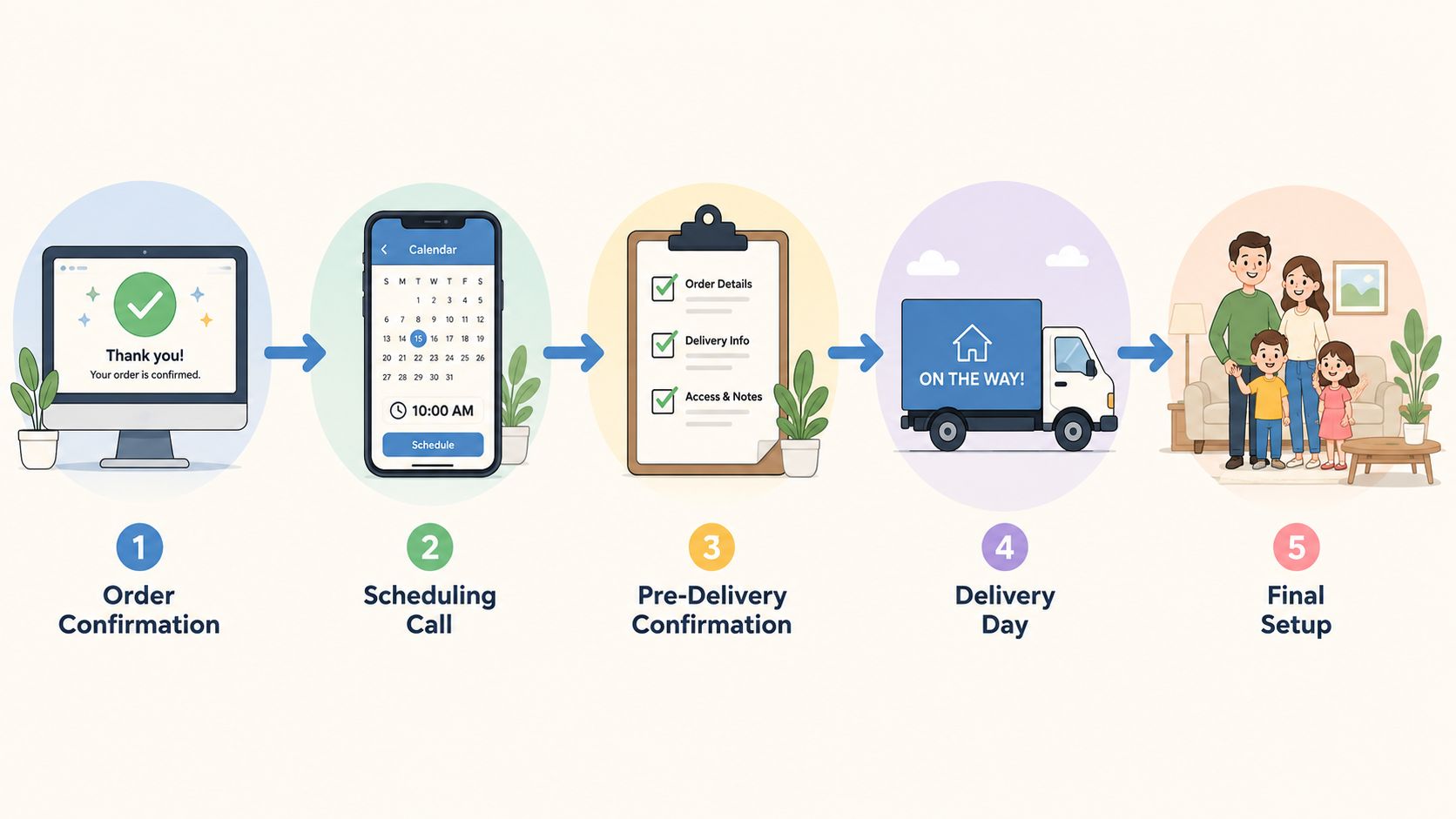
The order is confirmed first, then the delivery is scheduled, and the rest of the visit should feel predictable from there. A good white glove process has a rhythm. The homeowner gets a call or confirmation, the crew gets route details, and the furniture moves through a controlled handoff instead of a rushed drop-off.
What happens at each stage
- Order confirmation. The item, finish, and delivery scope are verified before the truck leaves.
- Scheduling call. The delivery window is set, and access notes are collected.
- Pre-delivery check. The home's route, access, and contact details are confirmed again the day before.
- Arrival and inspection. The crew checks the condition before bringing the piece inside.
- Placement, assembly, cleanup. The furniture is set, assembled, and the packaging is removed if included.
That process sounds simple, but it depends on route density and local carrier coverage. Rural and exurban homes can be harder to serve well, because a lower-density route gives the provider fewer nearby stops and less local labor to draw on. In those areas, quality can slip if a company promises full setup without enough nearby crew capacity or fallback coverage.
Straight answer: the farther a home sits from dense metro routes, the more important it becomes to ask how the delivery is actually staffed.
A showroom-driven order process helps reduce surprises because the delivery discussion starts with the sale, not after the truck is already halfway across the city. That matters for investment furniture, where the delivery is part of the long-term value equation. Service request details belong in the same conversation as the purchase itself, because the delivery plan should fit the item, the home, and the access conditions.
The final walkthrough should confirm that the item is where it belongs and ready for use. If anything looks off, that is the moment to flag it, not later after the packaging has disappeared.
Service Limits and the Rural Question
White glove delivery sounds universal until the route leaves the dense part of town. Carrier coverage, local labor, and route density all get harder outside major metro corridors, and that creates a real service gap for buyers in rural and exurban ZIP codes. The issue is not whether the service exists in theory. The issue is whether the crew can arrive on time, complete assembly, and support the same quality level without overpromising.
Buyers should ask direct questions before the order is final. Does the route cover the address regularly? Is the crew local or coming from a distant hub? What happens if assembly needs a second visit? Those questions aren't fussy. They're the difference between a smooth home setup and a delivery that turns into a half-finished project.
A showroom-anchored retailer can reduce some of that uncertainty because the conversation stays tied to the actual order, the actual home, and the actual delivery zone. Vinson Fine Furniture's Columbus presence at Easton Town Center gives Central Ohio buyers a place to talk through service scope before the furniture ships, which helps keep the promise realistic for the home and the route. That local structure matters more than a glossy delivery label.
For buyers who care about solid wood furniture Ohio, Amish-made dining sets, Custom leather sectionals Columbus, Smith Brothers furniture Easton, or Mavin bedroom furniture, delivery should be treated as part of the investment, not a separate inconvenience. The more substantial the piece, the more important it is that the provider can support it after the sale.
FAQs From Real Buyers
Can the delivery window be changed after scheduling?
Sometimes, yes, but only if the route still has room to absorb the change. A homeowner should call as soon as the conflict appears, because a tight route can make last-minute changes difficult. The earlier the request, the more likely the crew can adjust without affecting other stops.
What happens if a piece arrives damaged?
The crew should document the condition and note the issue before the handoff is completed. That's where inspection and proof-of-condition documentation matter, because the record shows what was found and when it was found. If a problem appears, the buyer should report it immediately and keep all packaging until the next steps are clear.
Does white glove delivery include haul-away of an old mattress or sectional?
Sometimes it does, but only when the service scope specifically includes removal. The buyer should ask before delivery day, because haul-away is part of the bundle only when it's been arranged in advance. If the old item must leave the home, that detail should be written into the delivery plan.
Is the service available outside Columbus?
It may be, but coverage depends on route density, carrier availability, and local labor. That's why exurban and rural ZIP codes need a direct check instead of a generic assumption. The question isn't just whether delivery is offered, it's whether the full setup can be completed reliably in that location.
What should be ready before the crew arrives?
The path, the room assignment, and the access details should all be ready. A clear route, secured pets, and confirmed stair or elevator access save the crew from having to improvise. That preparation also protects the furniture, which is the whole point of paying for a premium handoff.
Visit Vinson Fine Furniture to see how solid hardwood, custom upholstery, and white glove delivery come together for a home that's built to last. The Easton showroom gives Central Ohio buyers a place to review delivery options, ask the right access questions, and choose furniture with a service plan that fits the piece.