Custom Solid Wood Coffee Table How to Design and Order

A living room can look beautifully furnished and still feel wrong. The sectional may be deep enough for an afternoon nap, yet the coffee table leaves an awkward gap at one end. A low rug, a power recliner, and a busy walkway can make a standard table feel either undersized or intrusive. For an Investment Homeowner in Columbus, a custom solid wood coffee table solves that problem by treating the table as part of the room's architecture, not as an afterthought.
The decision deserves more than a finish sample and a quick glance at a product photo. Species, moisture stability, edge shape, joinery, height, delivery, and daily circulation all affect whether the finished piece feels natural in the room. At Easton Town Center, the right process begins with measurements, a sit-test, and a clear understanding of how solid hardwood behaves through Ohio's changing indoor climate.
Why a Custom Solid Wood Coffee Table Is Worth the Investment
A coffee table can look right in a showroom and still work poorly at home. Its corners may interrupt the route between the sofa and kitchen, or its footprint may leave a sectional without enough usable tray space. A low organic form can also read beautifully in a visualizer yet become awkward for meals, games, or remote controls if the height ignores daily habits.
A custom solid wood coffee table addresses those conflicts at the design stage. The length can follow the seating's usable span, the width can respect the rug and walking paths, and the height can relate to the sofa cushion. This is how trend-forward form becomes livable rather than decorative alone.
Solid hardwood earns its place over time
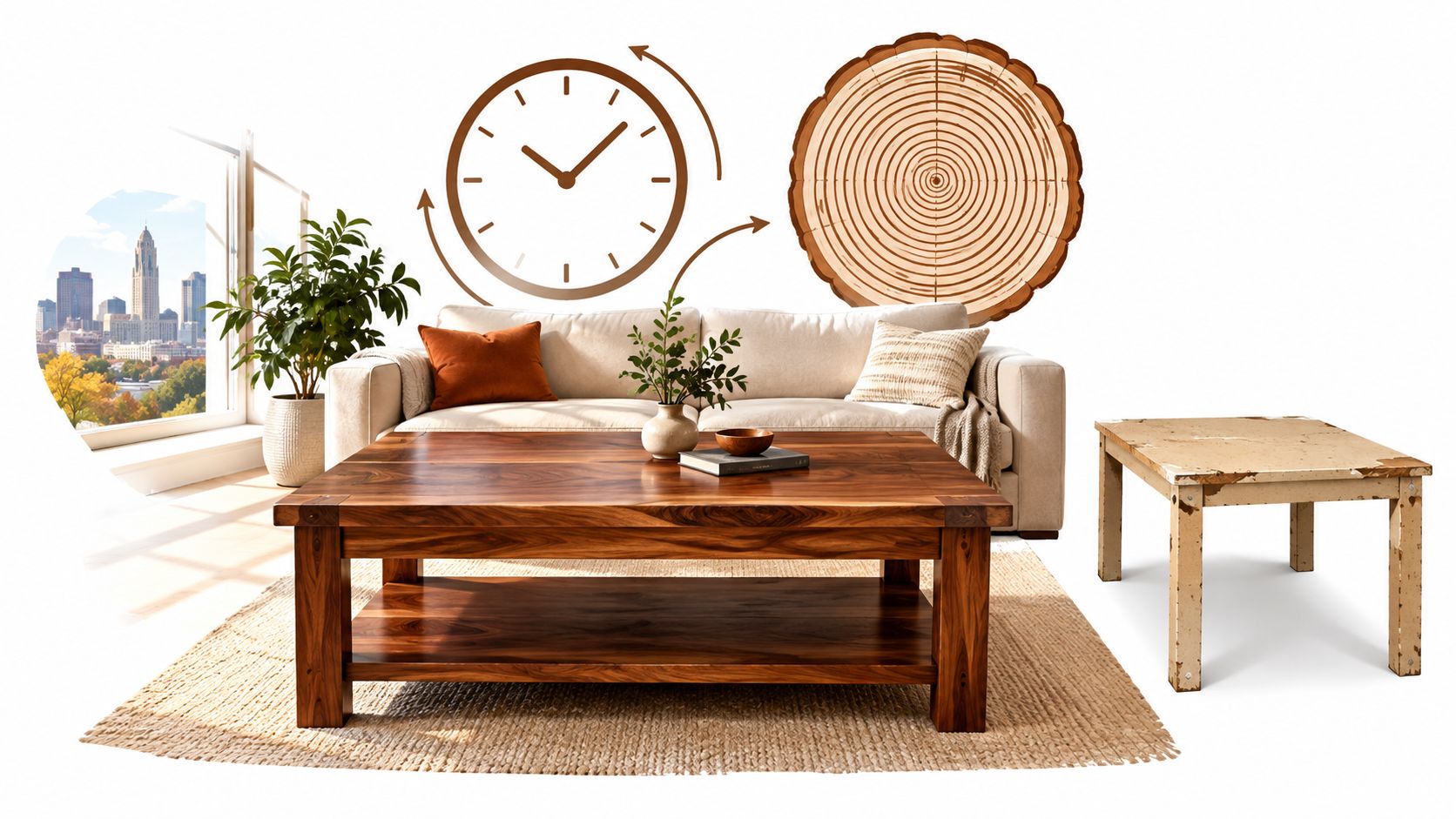
Vinson's Hardwood Standard is direct. The business sells solid hardwood furniture, centered on solid cherry, oak, maple, and walnut. It does not sell or promote engineered wood, MDF, laminate, or particle board. That material choice matters because solid hardwood can be repaired and refinished. A well-built table can remain useful as rooms, finishes, and household routines change. Furniture research likewise describes solid hardwood as repairable and refinishable, with the capacity to stay in families for decades or generations. Read the furniture research on long-term repair and reuse.
Wood also holds a strong position within the coffee-table category. The global coffee tables market was valued at USD 11.0 billion in 2025 and is projected to reach USD 15.6 billion by 2032, according to Ken Research's coffee tables market analysis. The same analysis identifies solid and engineered wood as the dominant product category. Those figures describe a broad market, not custom pricing, but they show that wood remains a substantial category while made-to-order solid hardwood occupies a more considered premium niche.
Custom construction changes the ownership equation
A custom table earns its cost when construction and ownership are considered together. American-made craftsmanship, durable joinery, and individualized details give a homeowner more control over how the piece performs and ages. A solid hardwood surface can also be refinished as the room evolves, something a non-renewable surface cannot match in the same way.
Custom construction makes sense when:
- The room has difficult proportions: An L-shaped sectional, fireplace, or open-plan route needs a table based on actual clearances.
- The homeowner expects long use: A repairable hardwood top can move with the household instead of being replaced when the room changes.
- The design needs a specific material language: Solid walnut, oak, maple, or cherry can coordinate with dining furniture and bedroom pieces without appearing generic.
- The buyer values local guidance: A showroom consultation can catch proportion, finish, moisture-stability, and delivery-access issues before production begins.
Moisture stability deserves attention in Ohio homes. Solid wood responds to indoor humidity, so species selection, construction, and a suitable finish work together. The goal is not to prevent wood from moving. It is to specify and build the table so normal seasonal change is managed rather than treated as a surprise.
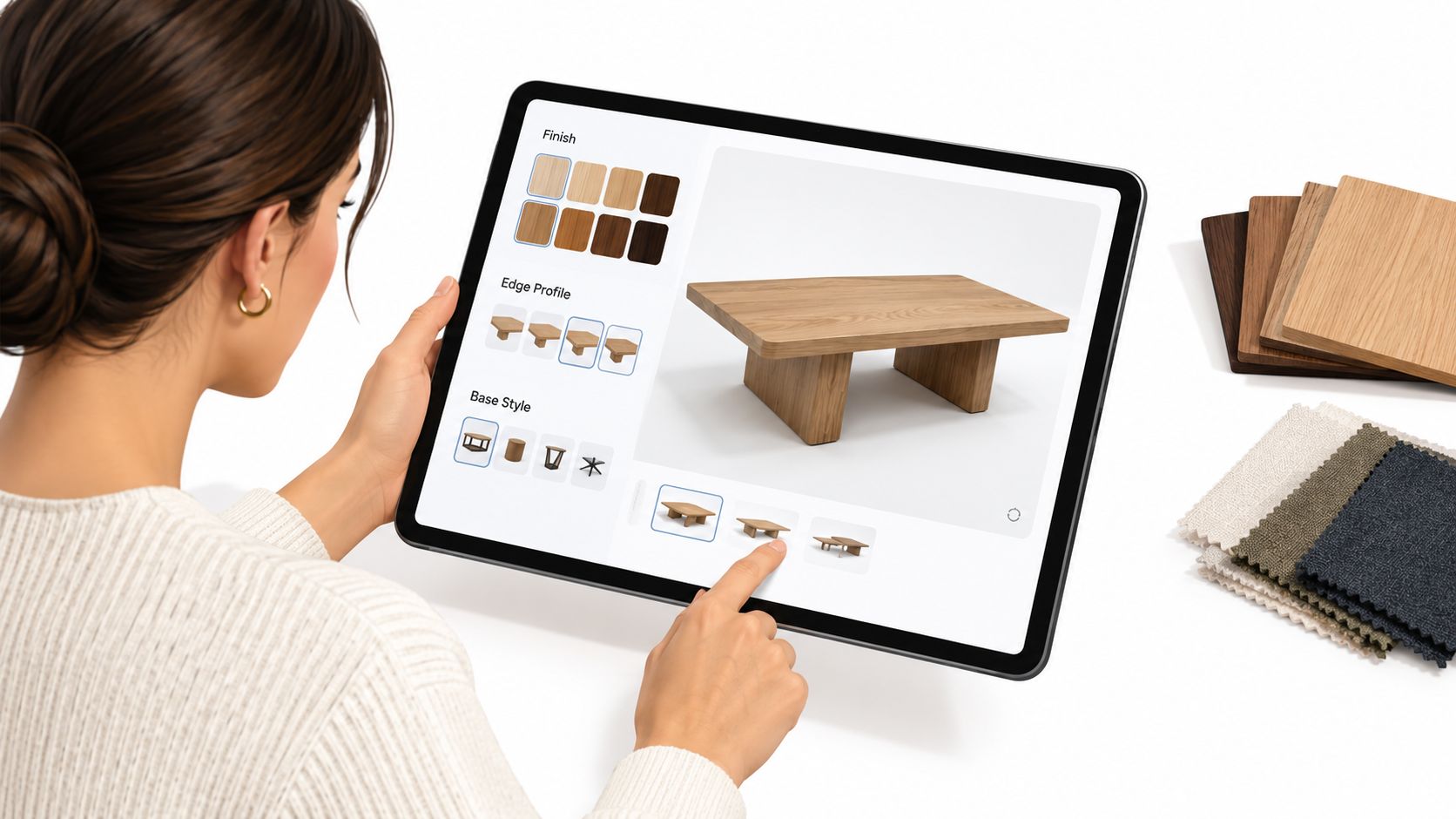
Vinson's in-store visualizers and Custom Order Program help test the low profile, edge treatment, finish, and scale before an order is placed. Seeing those choices together can prevent an expensive mismatch between a trend-driven silhouette and the way the household uses the room.
Clearance can be the better value when a ready-made size and finish already fit. Vinson's Clearance Gallery offers savings of up to 70%, making it sensible to check before commissioning a specific build. Custom is not automatically the right answer. It becomes compelling when the table must solve a real spatial, material, or functional problem.
How to Measure Your Space for Perfect Proportion
Start with the room, not the table. A coffee table needs to sit comfortably within the seating arrangement while preserving a clear route through the living area. The best measurements describe how people move, sit, recline, reach, and stand.
Build a simple measurement map
Use painter's tape to mark the rug perimeter and the approximate table footprint. Then record:
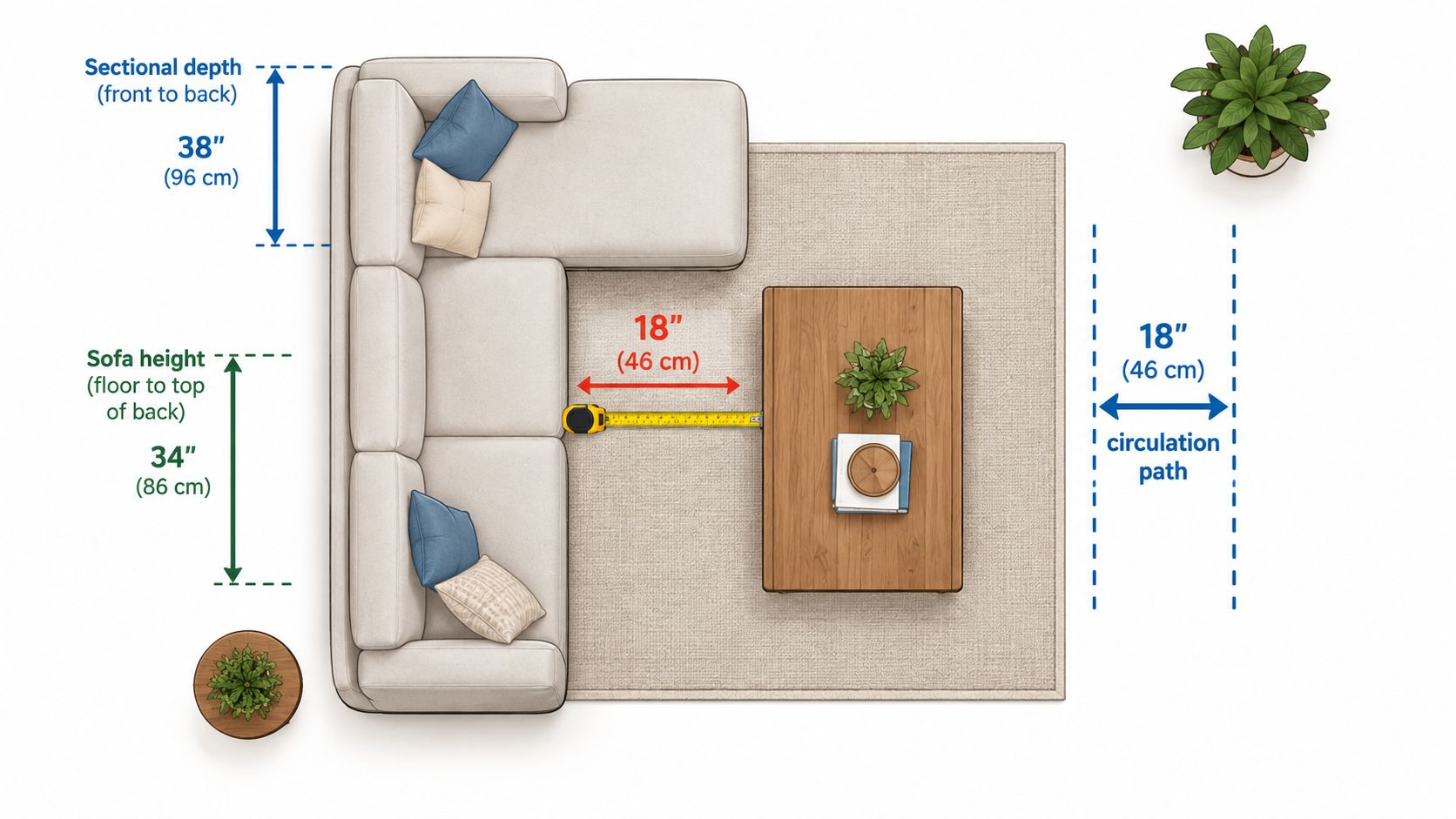
- Sofa and sectional length: Measure the usable inside span, especially if the seating turns a corner.
- Seat height: Measure from the floor to the top of the finished seat cushion. A table that sits close to the cushion height generally feels more integrated than one that is dramatically taller or lower.
- Seating depth: Record the distance from the front edge of the cushion to the back. Deep sectionals often need a wider table to keep the surface within easy reach.
- Rug position: Note whether the rug sits under all seating or only beneath the central grouping. The table should visually belong to the rug, not float beyond it.
- Circulation paths: Mark the route to doorways, stairs, kitchens, and adjacent chairs. Measure the open passage rather than estimating it by eye.
- Motion clearances: For reclining, swivel, rocker, and glider seating, measure the fully open position, not the closed showroom position.
Power motion sectionals deserve special attention. A table that works with the footrests closed may block the recliners when the seats extend. The same applies to swivel chairs and gliders, whose movement can sweep beyond the chair's stationary footprint.
Bring useful information to the consultation
Photograph the room from each corner, including the television wall, windows, doorways, vents, and stair access. Note the dimensions of nearby furniture and bring fabric or flooring samples if available. These details help the In-Store Design Studio evaluate finish warmth, edge scale, and visual weight together.
A small apartment may benefit from a round or oval top that softens circulation. An open-plan great room may need a longer rectangular design that anchors the seating zone. A family room with reclining seats may need a narrower top or a base that leaves more room for feet and moving mechanisms.
Practical rule: Measure the room in the position where the furniture is actually used, including recliners fully extended and chairs turned toward the conversation area.
Before visiting Easton, homeowners can also review recommended distance between a couch and coffee table and bring a short list of preferred dimensions. The consultation can then focus on refining a viable range rather than starting with guesswork.
Choosing Wood Species and Joinery That Lasts
Species selection should begin with the room's character and the household's habits. Solid cherry warms and deepens visually as it ages. Solid oak shows a pronounced grain and brings a familiar, substantial presence. Solid maple offers a lighter, cleaner appearance, while solid walnut supplies a darker, more dramatic surface with natural variation.
No species is universally superior. The better choice depends on whether the table should blend into a room, stand as a visual anchor, or tolerate a busy family routine without making every mark conspicuous.
Solid hardwood species comparison for coffee tables
| Wood Species | Grain and Color Character | Durability and Best For |
|---|---|---|
| Solid cherry | Warm, refined grain with a richening color as the finish matures | Suits traditional, transitional, and collected interiors where graceful aging matters |
| Solid oak | Strong, visible grain with a grounded, tactile appearance | Works well for family rooms and entertaining spaces that benefit from visual texture |
| Solid maple | Light color and relatively restrained grain | Fits clean, contemporary rooms and homeowners seeking a bright, calm surface |
| Solid walnut | Deep brown tones with expressive natural variation | Makes a sophisticated centerpiece for modern and high-end interiors |
Finish samples should be viewed in the home's actual light. A stain that looks balanced under showroom lighting may read warmer, darker, or more contrasted beside flooring and upholstery. For broader guidance on evaluating grain and finish response, The Cabinet Coach offers useful cabinet wood stainability tips.
Joinery must accommodate movement
Solid wood moves as indoor conditions change. For furniture intended for indoor use, a practical build target is a final moisture content of about 6% to 8%, and industry guidance commonly warns against assembling furniture above 9% moisture content or applying finish before the stock has stabilized. The moisture-content guidance from Sensora Home recommends acclimating stock, taking readings at multiple points, waiting for readings to stop changing, and accounting for wetter material inside a board.
The structural benchmark is not to trap the top rigidly. Interior furniture is commonly specified within a 6% to 12% moisture-content band, and Fine Woodworking's discussion of wood moisture content emphasizes matching mating parts and allowing seasonal expansion and contraction. Wide panels that are glued in a way that resists all movement can develop stressed joints, visible seams, or distortion.
Mortise-and-tenon joinery is a sensible choice for a solid hardwood table base because the joint resists pulling apart, twisting, and racking. This overview of mortise-and-tenon construction describes why the method remains a standard structural approach for hardwood furniture frames. Homeowners evaluating a table should ask how the base connects, how the top is attached, and how the design permits movement. Vinson's guide to various wood joints gives additional context for that conversation.
Designing Finishes Dimensions and Details in the Visualizer
A low oval top can look perfect on a screen and become awkward in a busy living room. Finish tone, edge profile, base geometry, height, and species need to support one another, especially when the table must handle drinks, books, feet, and daily cleaning.
Vinson's Custom Order Program supports customization for brands such as Smith Brothers, Canadel, and Mavin, including available fabrics and finishes. Smith Brothers offers an American-made option from Indiana, Mavin offers Amish-made furniture from Ohio, and Canadel is handcrafted in Quebec, Canada. These North American lines provide useful design range while keeping the order tied to the selected piece's construction and options.
Make the attractive option usable
Low, organic forms soften a room and show the hand of the maker. Curved corners, oval tops, and sculptural bases can make a sectional arrangement feel less formal. Their practical limits deserve equal attention. An unusually low or irregular table may reduce tray space, storage, legroom, and access for cleaning.
Review the design against everyday use:
- Where will drinks land: A narrow organic top may leave little room for glasses, remotes, and books.
- How will people pass through: Rounded corners can improve circulation, while a wide sculptural base may create an obstruction.
- Does the household need storage: Drawers, shelves, or nesting tables can give a trend-forward shape more daily function.
- Will children use the room: Softer edges and a durable finish may matter more than a dramatic silhouette.
- How does the table relate to seating: The top should stay within comfortable reach without forcing anyone to lean forward.
Use the visualizer to test these decisions together. A live 3D configurator can display material, color, and product-rule changes before purchase, giving the homeowner a clearer view of proportions and available options. This explanation of live 3D furniture customization explains how real-time variants can help identify ordering mistakes before they become costly.
Treat finish and climate as design choices
In an Ohio home, finish selection should account for placement and care. A table beside a heating vent, exterior door, or strong afternoon sun experiences different conditions from one in a protected interior corner. Manufacturer guidance recommends keeping relative humidity above 40%, with 50% to 60% described as an ideal range for helping limit shrinkage, distortion, cupping, cracks, and gaps. The bespoke furniture guidance from Petra Madalena also notes that a 1% change in wood moisture can change mass by about 0.6%.
Solid hardwood will still respond to its surroundings. The design target is stable construction, sensible placement, and care that matches the finish. Review natural wood finish guidance before choosing sheen or maintenance routines, then use the visualizer to compare the finish with flooring, upholstery, and daylight. That check can prevent a warm stain from competing with the room or a delicate sheen from clashing with heavy daily use.
Pricing Timeline and Value When Ordering Custom
A custom solid wood coffee table earns its price through decisions made before production. Material, footprint, joinery, finish complexity, and design time all affect the quote. A broad walnut top with a shaped edge and specialized base will cost more than a simpler maple design. Compare the full specification, not just the opening figure.
Market context helps explain why custom hardwood sits apart from mass-market pricing. Coffee tables serve residential, hospitality, corporate-lounge, and institutional settings, with solid and engineered wood remaining major product categories. A custom table competes through fit, craftsmanship, repairability, and finish control rather than commodity pricing.
Build value into the decision
The North American rustic segment offers a useful reference point. Solid wood coffee tables represent about 50% to 55% of unit sales by value in that segment, while hybrid metal-and-wood designs are growing at approximately 7% to 10% annually, according to IndexBox's Northern America rustic coffee table analysis. For a homeowner, those figures point to an active market where material, weight, and construction choices still shape the final price.
Start with the room's daily demands. A low organic form may suit a trend-forward interior, but its footprint must leave clear walking paths and enough surface for drinks, books, or remote controls. Heavier tops and substantial bases can add stability, though they also affect delivery, placement, and future rearrangement. Use Vinson's visualizer to test these choices before approving an order, especially when the table must balance sculptural form with practical living.
Vinson's Low Price Guarantee provides a defined value safeguard. If a local authorized dealer offers a lower price within the applicable period, the guarantee provides a 110% refund of the difference. For a ready-to-take-home option, the Clearance Gallery offers savings up to 70%. A floor sample or closeout can make sense when its dimensions, moisture-stable construction, and finish already suit the room.
Custom production takes time because the table must be specified, built, finished, inspected, and scheduled for delivery. Bench-made and Amish-made furniture may follow different production calendars, so confirm the expected timeline before approval. The custom order guide helps organize dimensions, materials, finish, delivery, and other decisions that are easy to overlook.
Account for the final delivery
White-Glove Delivery adds practical value for a substantial hardwood table. The service typically covers careful in-home placement, assembly where needed, packaging removal, and inspection before the piece enters the room. Vinson's process includes multi-point inspection, placement, assembly, and packaging removal, so delivery is not limited to leaving a boxed item at the curb.
Financing through the Synchrony HOME Credit Card may be available for qualified buyers, subject to account terms and promotional conditions. Compare total ownership cost, including fit, construction, delivery, and future service, rather than choosing solely by the lowest initial figure.
Working With Vinson to Bring Your Table Home
The Easton showroom process should begin with a design conversation, not a rushed purchase. A homeowner can bring room photographs, a rough floor plan, seating dimensions, rug measurements, and notes about how the living room is used. The In-Store Design Studio then helps connect those practical details to wood species, finish, top shape, base style, and the rest of the home.
A Complimentary Design Consultation can move through a clear sequence:
- Review the room: Confirm traffic paths, seating scale, rug placement, and motion clearances.
- Narrow the material: Compare solid cherry, oak, maple, and walnut in the room's light.
- Test the design: Use the visualizer to review finish, edge, base, and proportion choices.
- Confirm the order: Check every dimension, finish, hardware detail, and delivery requirement before production.
- Prepare the home: Clear the entry path, measure doorways, and protect the intended placement area.
The sit-test remains valuable even for a table. While visiting, homeowners can assess solid hardwood surfaces by touch and evaluate the relationship between a coffee table and premium living-room seating. That includes top-grain and performance leather sectionals with motorized or power motion, as well as swivel chairs, accent chairs, rockers, and gliders. The same showroom can support related searches such as Solid wood furniture Ohio, Amish-made dining sets, Custom leather sectionals Columbus, Smith Brothers furniture Easton, and Mavin bedroom furniture, helping the homeowner maintain a consistent material standard across living, dining, and bedroom spaces.
Before delivery, the buyer should verify the final order against the approved visualizer and written specification. On installation day, confirm the table's placement, inspect the top and base, and ask about care. Vinson's White-Glove Furniture Delivery information explains the service expectations for a smoother arrival.
Vinson Fine Furniture offers solid hardwood furniture, a Custom Order Program, an In-Store Design Studio, and complimentary design consultations for homeowners planning a custom solid wood coffee table. Visit Vinson Fine Furniture at Easton Town Center to measure, compare finishes, test seating and motion options, and turn a carefully fitted table into a lasting part of the home.