Amish Trestle Table Sizes, Seating and Price

The dining room is nearly finished, but the table decision has stalled. A long solid-wood top looks right in the space, the chairs seem comfortable, and the catalog promises room for guests. Then someone sits down and finds a trestle exactly where a knee needs to go.
An Amish trestle table deserves a closer look than its overall length or advertised seat count. The useful questions concern support spacing, chair placement, fitted joinery, and how the top handles seasonal movement. For Columbus homeowners investing in furniture for everyday meals and future gatherings, those details matter more than a rustic silhouette.
Where Chairs Actually Fit on an Amish Trestle Table
The seating map starts underneath the tabletop. Published specifications for the LaPorte solid-top trestle table show that a 42-by-60-inch top may leave about 30 inches between trestles, while a 42-by-72-inch model may provide roughly 42 inches. Those clear spans, rather than the outside dimensions alone, determine where knees and chair seats can fit.
A trestle is an obstruction only when a diner needs to occupy its position. End seating can feel generous when the supports sit sufficiently inward, while a side chair can become uncomfortable if its occupant straddles a broad upright or foot. Catalog capacity therefore needs a chair-by-chair test.
Trestle span and comfortable seating
These are planning arrangements, not guaranteed capacities. The published spans establish the starting point; chair width, support shape, and end overhang must confirm the final layout.
| Table size | Clear span between trestles | Comfortable seats | Where chairs go |
|---|---|---|---|
| 42 x 60 in | About 30 in | 4 as a planning target | Ends and just outside the trestles; mid-span is tight |
| 42 x 72 in | About 42 in | 6 after a chair-placement test | One armless chair per side between trestles, additional side positions beyond the supports, plus the ends |
| 72 in plus one 12-in leaf | Extra end clearance, subject to leaf position | 6 to 8 after testing | Leaf stays in for knee room, not only for parties |
| 48 in wide top | Span still set by trestle spacing | Same count, deeper settings | Check armchair arms against the apron |
| Five or more extension leaves | Confirm the extended base arrangement | Nominal large-party layout | Ask for center support legs before counting seats |
The extension-support question is practical, not theoretical. The solid-wood dining-table guidance from Giorgi Bros. notes that some tables with five or more extensions use drop-down legs for stability, creating additional places that chairs must avoid.
Map the chairs, not just the tabletop
For a hypothetical layout using armless chairs about 18 to 20 inches wide, a homeowner can cut paper templates to those dimensions and arrange them around a taped tabletop outline. A chair fitting within the clear span doesn't prove that neighboring diners have enough elbow room. The templates must represent the entire seating arrangement, including the positions outside the trestles.
Wide upholstered host chairs need a separate check. Their arms may strike the apron, the vertical frame beneath the top, even when the seat fits between supports.
- Measure the chair envelope. Include arms, splayed legs, and the space needed to pull the chair back.
- Check usable apron clearance. Measure from the floor to the lowest obstruction, not to the tabletop surface.
- Locate the leaf. Added length helps only where the extension creates usable seating space.
Practical rule: A longer top doesn't fix crowding when the support positions and chair widths still conflict.
The dining-space guide to table shapes and seating arrangements helps place that seating map within an open-plan room. Once the chairs work, Jolitee's farmhouse table decor guide offers ideas for dressing the surface without making the arrangement feel crowded.
The final test belongs on the floor: tape the trestle footprints, mark the clear span, and sketch each chair at its actual width. A table advertised for a large gathering may be better treated as a smaller everyday arrangement with occasional extra seats.
What Solid Hardwood Trestle Tables Listed for in 2026
Published prices provide a useful starting point, but a catalog listing isn't a completed room quote. Regular, starting, current, and sale prices describe different offers. A fair comparison keeps those labels visible rather than treating every number as an equivalent purchase price.
2026 listed Amish trestle table prices and sizes
Each linked listing documents the price and dimensions shown in its row.
| Listed table | 2026 price | Standard size | Size options |
|---|---|---|---|
| Tucson Contemporary Trestle Table | $1,997 regular | 42 x 60 and 42 x 72 in | Up to four 12-in extensions |
| Rustic Trestle Dining Table | $2,547 starting | 42 x 72 x 30.5 in | Starting size as listed |
| El Paso Trestle Table | $2,684.30 current | 30 in dining height | Widths 42 or 48 in; lengths 68 or 80 in |
| Vandalia Trestle Table | $1,793.50 sale | 30 in height | Widths 36, 42, or 48 in; lengths 54 to 96 in |
These listings establish a market reference, not Vinson shelf tags or a promise that every configuration costs the displayed amount. A buyer still needs to confirm the selected species, finish, extension package, and delivery terms. Available size options don't automatically mean that every size carries the entry price.
Compare the completed specification
A written quote should identify the exact top and base rather than merely name the collection. Custom dimensions, a different hardwood, and additional leaves can change the total, so the useful comparison is between matching configurations.
- Table configuration. Record the closed dimensions, extended dimensions, edge profile, and leaf storage.
- Finish and species. Name the solid hardwood and approved finish sample.
- Service scope. Separate furniture charges from delivery, assembly, and any other quoted services.
The solid-wood dining-table buying guide can help narrow the specification before a showroom consultation.
Value also includes the terms surrounding the purchase. At Vinson, the Low Price Guarantee refunds 110% of a qualifying local authorized-dealer price difference within 30 days, while the Clearance Gallery offers savings up to 70% on eligible inventory.
Clearance deserves its own evaluation. A floor sample with the right proportions and finish may suit a household better than a custom order that adds options the room doesn't need. Condition, availability, and the final written price should remain clear before approval.
How the Trestle Form Reached Ohio Shops
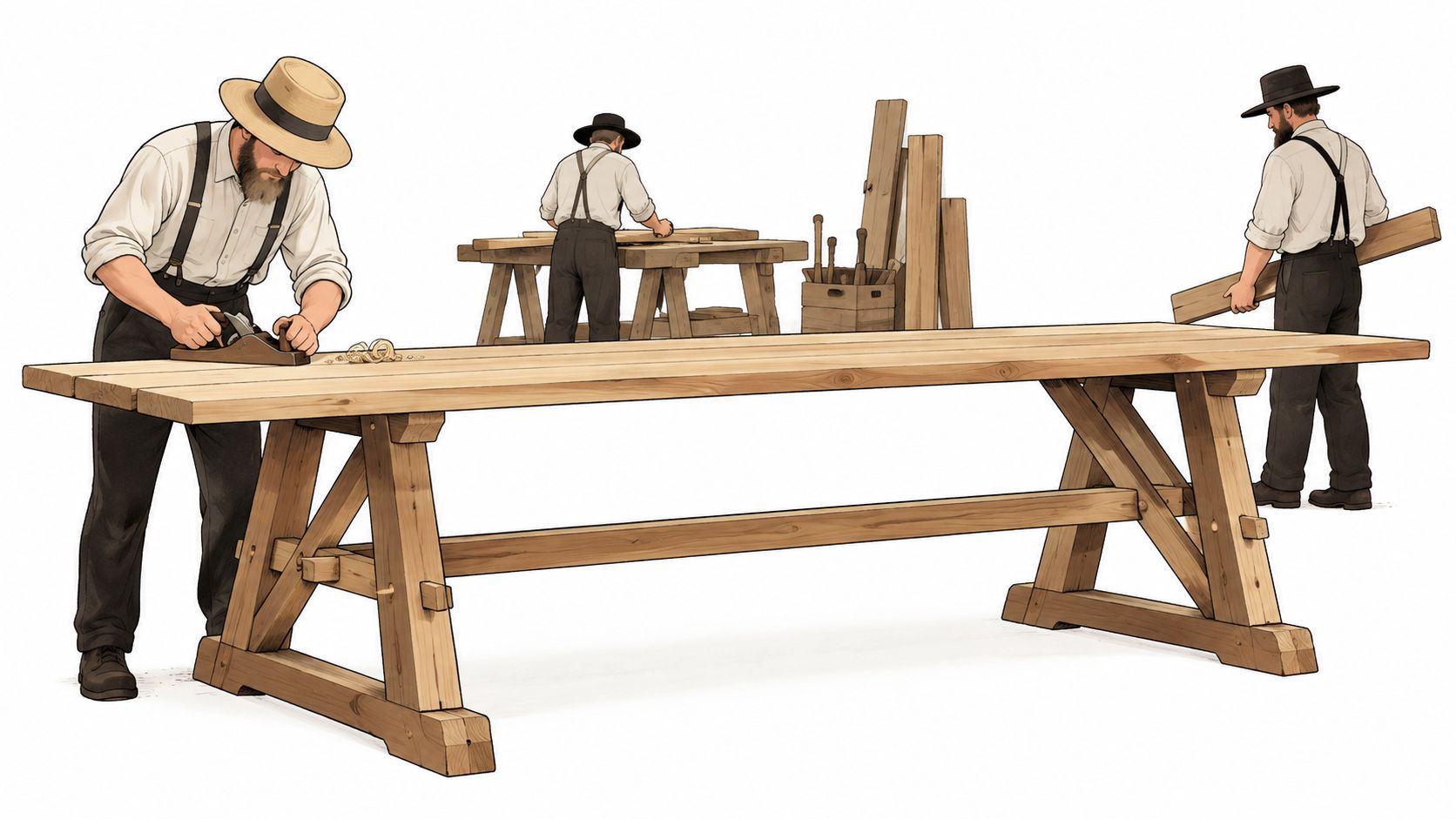
Before a trestle table became a familiar dining-room form, it solved a straightforward household problem: creating a substantial eating surface that could be taken apart. A long board rested on supporting trestles, with bracing or pegs keeping the arrangement together. When the surface wasn't needed, the components could be moved or stored.
The historical account of Arts-and-Crafts trestle tables traces that practical table-board tradition into later Amish Americana, Shaker, and Mission interpretations. The important inheritance isn't a distressed finish. It's a base arrangement that supports a long surface without placing a leg at every corner.
A working structure became a furniture tradition
Consider a household that needs an everyday dining surface but also moves furniture for gatherings. A base that separates into manageable components has an obvious advantage. The same functional thinking remains relevant when a delivery team must pass through a doorway or a family eventually moves house.
Mission versions make that structure especially visible. A substantial stretcher runs between the trestles, sometimes ending in a keyed tenon that becomes part of the table's appearance. Shaker-inspired versions can express the same underlying idea with quieter lines.
Heritage matters most when the original solution still serves the household.
Ohio craftsmanship with a clear sense of origin
Mavin is Amish-made in Ohio, USA, placing its dining furniture within the local solid-hardwood tradition. For a Central Ohio homeowner, that origin provides a concrete maker connection rather than a vague suggestion of country craftsmanship.
The American-made conversation can also include Smith Brothers of Berne, made in Indiana, USA, when coordinated upholstered seating belongs elsewhere in the adjoining living space. Origin should stay attached to the maker and product category, not become a blanket description of everything in a showroom.
The discussion of tables made from Ohio barns offers another way to consider regional material character. Reclaimed appearance, however, isn't a requirement for an Amish trestle table; a smoothly finished solid-maple or cherry top can express the form just as clearly.
The lasting lesson is functional. This furniture tradition began with a surface people needed to move, gather around, and use. Its value today still depends on whether the actual base serves those activities.
Solid Oak Cherry Maple and Walnut Compared
Species comes before stain. A dark finish doesn't erase oak's open grain, and a pale finish doesn't make maple display oak's broad pattern. Homeowners get a more predictable result by choosing the wood's natural character first, then refining its color.
For a trestle top, the decision concerns both the view across the room and the experience at the edge. Prominent grain gives the surface visual texture; a quieter grain allows the base, chairs, or surrounding cabinetry to draw more attention.
Solid hardwoods for an Amish trestle top
| Species | Look | Daily character | Fits best |
|---|---|---|---|
| Solid red oak | Open, prominent grain | Takes medium stains and suits family use | Everyday Amish dining |
| Quarter-sawn white oak | Ray flake across the top | Stable show grain for a Mission base | Arts and Crafts trestles |
| Solid cherry | Color deepens with light | Smooth heirloom surface that can be refinished | Formal dining rooms |
| Solid maple | Tight, even grain | Hard wearing under lighter finishes | Pale kitchens and casual dining |
| Solid walnut | Dark chocolate tone | Showpiece grain, often a custom upgrade | Formal rooms with lower sun exposure |
Red oak offers a familiar starting point for Amish-made dining sets. Its visible grain can sit comfortably beside textured upholstery and other natural surfaces. Quarter-sawn white oak has a more specific visual signature, with ray flake that complements a strongly expressed Mission base.
Cherry suits a room where warmth and gradual color development are welcome. Maple offers a calmer backdrop in a light kitchen, while walnut can give a dining area depth without relying on a heavily colored stain.
Match the sample to the household
A household with daily meals, schoolwork, and frequent wiping needs realistic expectations from every species. Hardness doesn't make a finish scratchproof, and a darker surface doesn't automatically hide wear. The finish system and care routine remain part of the decision.
Solid lumber also offers a meaningful repair path. The furniture-quality explanation from BILTRITE identifies sanding, refinishing, and repair as advantages of solid-hardwood construction, allowing a worn surface to be renewed rather than automatically replaced.
- Compare broad samples. A small color chip can't show how grain repeats across a tabletop.
- Check the room's light. Daylight and evening fixtures can make the same finish look noticeably different.
- Discuss natural change. Cherry's developing color and walnut's response to light deserve consideration before placement.
- Price the actual choice. A walnut upgrade needs a written quote rather than an assumed premium.
At the Easton In-Store Design Studio, sample boards can be placed beside fabric and finish selections. That's a more reliable basis for choosing Solid wood furniture Ohio households will live with than a screen swatch viewed in isolation. The strongest choice isn't the most fashionable species; it's the one whose grain, maintenance expectations, and appearance suit the room.
Joinery Moisture and a Top That Can Move
A thick tabletop can look reassuring while concealing a poorly resolved base. The useful inspection begins underneath, where the trestles meet their feet, the stretcher meets the uprights, and the top connects to the supporting structure.
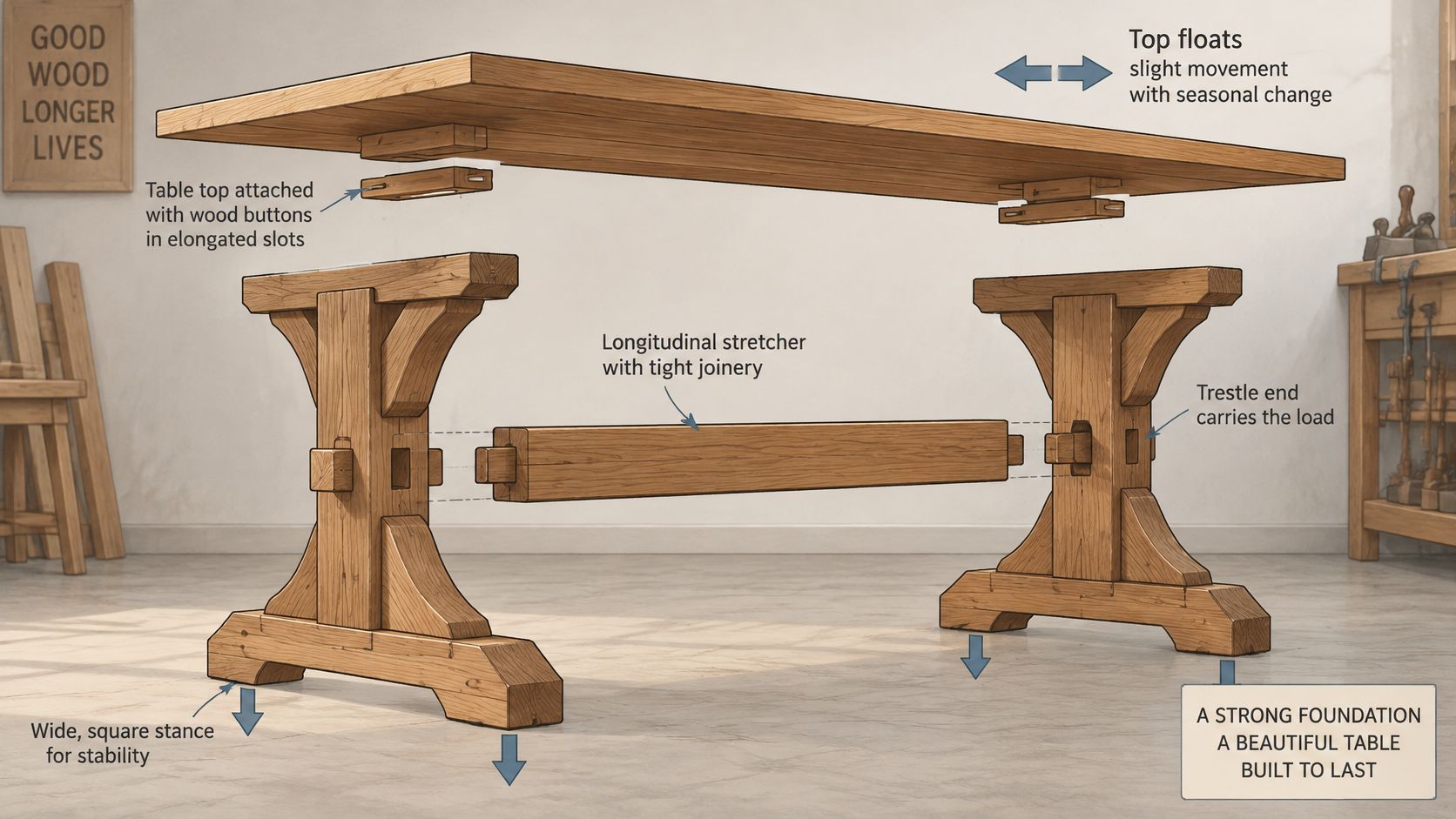
In Fine Woodworking's trestle-table construction guidance, the stretcher keeps the legs square while the top helps resist twisting and lateral racking; the published design limits width to about 3 feet, illustrating why a 48-inch top needs deliberate engineering rather than thicker stock.
Inspect the load path
A well-fitted mortise-and-tenon joint places a projecting section of wood inside a matching cavity. Bridle and half-lap joints use different shapes but can also provide substantial bearing surfaces. The joint's fit and placement matter more than the romance of its name.
The wood-joint guide helps distinguish those connections during a showroom inspection. Pegs and bolts can reinforce an assembly, and accessible knock-down hardware can make a stretcher serviceable when the table needs to move.
- At the feet. Look for clean-fitting connections without unexplained gaps or movement.
- At the stretcher. Confirm how the connection tightens and whether hardware remains accessible.
- At the floor. Check for rocking and ask how levelers or floor irregularities will be handled.
- At the extension. Confirm how the enlarged surface receives support.
A floating top is controlled movement
Floating doesn't mean loose. It means the attachment holds the tabletop securely while allowing the wood to expand and contract across its grain.
The USDA Forest Products Laboratory wood handbook describes furniture-grade hardwood kiln-dried to approximately 6–8% moisture content, with moisture-related problems minimized when wood remains near 9–14% in service. These are wood-moisture figures, not recommended room-humidity settings.
A wide top changes more across its width than along its length. Figure-eight fasteners, elongated screw slots, or comparable connectors accommodate that movement. Rigidly restraining the top can concentrate stress, contributing to splits, cupping, or opened glue lines.
Inspection insight: A secure base and a movement-friendly top attachment serve different purposes. A durable table needs both.
Central Ohio households should avoid placing the table directly beside radiators, HVAC outlets, or frequently opened exterior doors. Stable indoor conditions and the maker's acclimation guidance help reduce environmental stress.
Winter cracking isn't an inevitable feature of solid hardwood, but the Amish label alone can't prevent it. Buyers should also ask which scratches or water marks permit local repair and which require broader refinishing.
The quote should close the inspection with clear answers to top width, trestle spacing, joint type, stretcher attachment, and top removal for delivery. Those specifications give a homeowner something tangible to approve.
How a Custom Order Becomes a Built Table
A custom order begins with a room and a household routine, not a stain name. The consultant needs to know where meals happen, how often guests visit, which chairs remain, and how the delivery team will reach the dining area.
The independent custom-furniture design guide from Giorgi Bros. describes consultation, measurements, visual approval, a written quote, production updates, and final placement; it reports an average order-to-delivery cycle of 16.3 weeks, compared with 11.8 weeks in late 2022. That historical benchmark isn't a Vinson delivery promise, so the actual order needs its own estimated schedule.
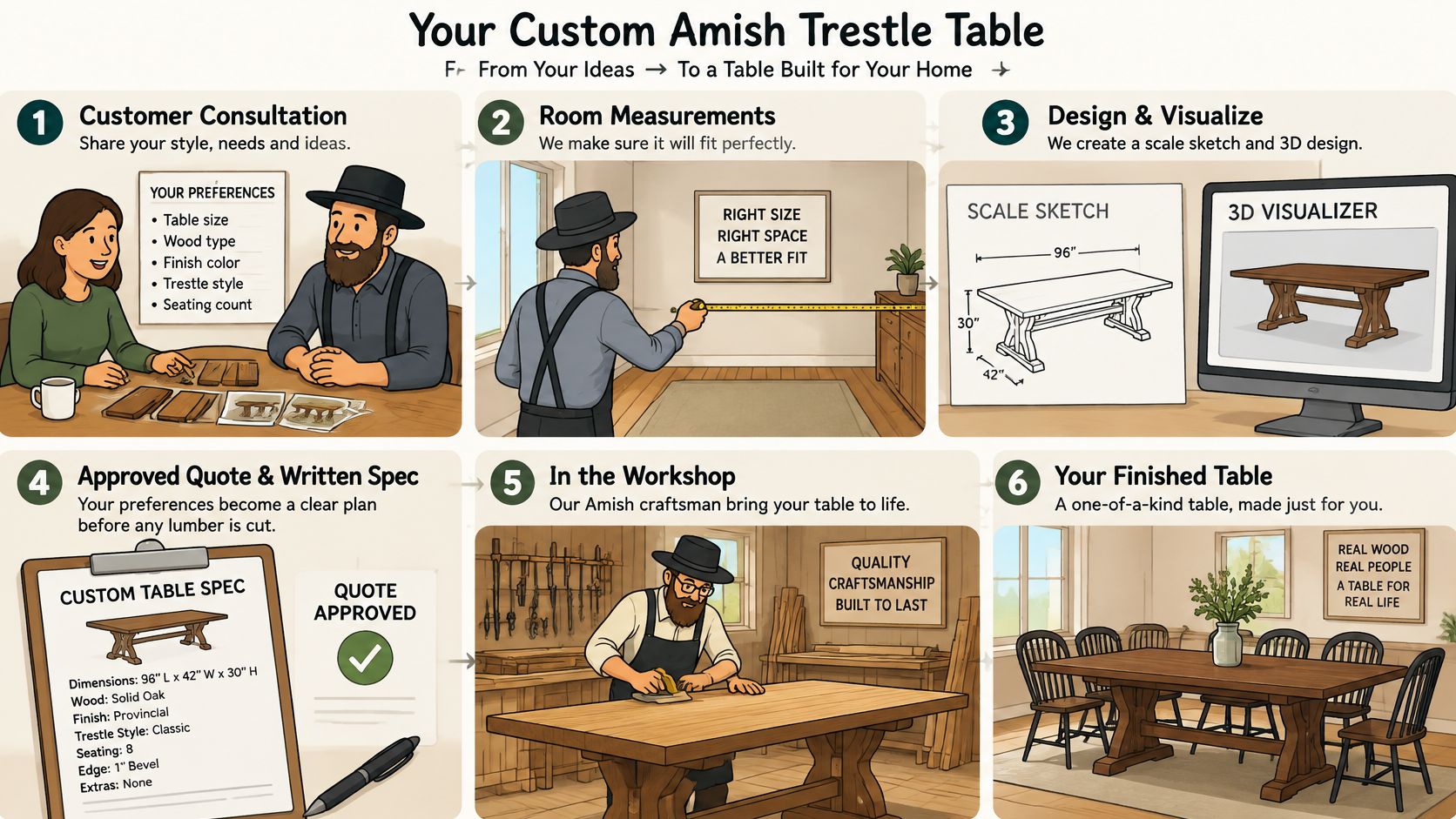
Turn preferences into approvals
Vinson's In-Store Design Studio at Easton Town Center offers Complimentary Design Consultations for space planning, fabric coordination, and finish selection. Its Custom Order Program brings together fabrics, finishes, and digital or 3D visualizers, with available choices determined by the maker and collection.
A useful approval packet includes more than an attractive rendering.
- Measured plan. Record the dining zone, circulation routes, and delivery openings.
- Visual selection. Pair the chosen finish sample with chair upholstery and surrounding furniture.
- Written specification. Identify dimensions, base configuration, extension arrangement, and approved options.
- Service agreement. Confirm the expected schedule, delivery scope, and inspection process.
The custom dining-room table guide provides a practical starting point for that conversation. A visualizer helps communicate appearance, but it doesn't replace physical measurements or sitting in a chair.
Keep each maker's origin and role clear
Mavin provides the Ohio Amish-made solid-hardwood connection for dining and Mavin bedroom furniture. Canadel is handcrafted in Quebec, Canada, so its dining collections belong within a North American crafted discussion, not a USA-only grouping.
Smith Brothers offers Indiana-made upholstery for adjacent living spaces. A consultation about Smith Brothers furniture Easton can explore top-grain and performance leathers, fabrics, sectionals, reclining furniture, swivel chairs, accent chairs, rockers, and gliders, with motorized or power-motion features on applicable models.
A homeowner searching for Custom leather sectionals Columbus may be coordinating the living and dining areas together. Available power motion, including quiet-operation preferences, should be demonstrated on the actual model rather than assumed across a collection.
Plan payment and placement
Vinson's showroom resources include the Design Quiz and Clearance Gallery as preparation tools, not substitutes for a sit-test. Synchrony HOME financing may include no-interest plans for qualified buyers, subject to the available offer and terms.
White-Glove Delivery includes inspection, placement, assembly, and packaging removal. Before production approval, the household should confirm who checks the finished table, how any concern is documented, and what access the delivery crew requires.
Book the Easton Sit Test Before You Order
The final decision belongs in a chair, with feet resting naturally and knees clear of the base. A homeowner should be able to approach the table, sit down, shift position, and stand without planning around an awkward support.
The Easton visit works best with a measured floor plan and photographs of the room. Existing chairs deserve special attention because replacing a table doesn't automatically make their proportions compatible with a different base.
Bring and ask
- Bring the room outline. Include the dining zone, doorway widths, nearby cabinetry, and the route from the entrance.
- Bring chair measurements. Record seat width, arm height, and the widest outside dimension.
- Ask for a complete seating demonstration. Test the everyday arrangement and the guest configuration with the intended chair style.
- Ask for construction details in writing. The quote should identify flexible top fasteners, joint type, and stretcher hardware.
- Approve a physical finish sample. The selected solid cherry, oak, maple, or walnut should work beside the room's other materials.
A household working toward a near-term gathering should inspect available Clearance Gallery pieces before committing to a full custom build. Availability and delivery timing still need confirmation; a floor sample shouldn't be assumed ready for immediate placement.
For a room requiring a custom top, a complimentary Design Studio consultation provides a place to resolve the specification before ordering. Family-owned Vinson, formerly Kitchen Tables & More, centers that process on solid hardwood and long-term household use.
The right Amish trestle table isn't the one with the largest advertised capacity. It's the one whose supports, approved materials, and delivery plan fit the measured home.
Vinson offers solid-hardwood dining furniture, custom finish and size options, and complimentary design guidance for a table that fits daily life. Homeowners can visit Vinson Fine Furniture at Easton Town Center with a floor plan and chair measurements to arrange a sit-test, compare finish samples, and develop a written trestle-table specification.