Custom Dining Room Table: Planning and Design Guide

The new dining room is finally ready, but the old table tells a different story. It crowds the breakfast nook, leaves guests balancing plates at the holidays, or looks out of place beside carefully chosen solid hardwood furniture. A custom dining room table solves that mismatch by treating the room, the household, and the intended use as one design problem.
The right order starts with measurements, not wood samples. From there, homeowners can select solid cherry, oak, maple, or walnut, define the base and edge profile, and decide how much customization is worth the additional wait. For Columbus homeowners, the Easton Town Center showroom offers a practical place to sit, touch samples, and test the proportions before committing.
Why Custom Dining Tables Solve Real Space Problems
A homeowner moving into a larger house often discovers that a table designed for a previous dining area no longer works. The old six-seat table may look undersized beneath a broad light fixture, while a larger retail table could block the path between the kitchen and family room. Renovations create the same problem in reverse. A wall removed for an open plan can leave a formerly adequate table floating awkwardly in a much larger room.
A custom dining room table addresses those specific constraints. Its length can follow the room rather than forcing the room to accommodate a predetermined product. Its width can preserve walking paths, and its base can keep chairs clear where a conventional leg arrangement would interfere. Customization also helps homeowners coordinate the table with existing floors, cabinetry, lighting, and dining chairs without making the room feel assembled from unrelated pieces.
When standard sizing is enough
A standard table makes sense when the room already has comfortable circulation, the household's seating needs are stable, and a showroom piece offers the desired shape and finish. Custom work earns its place when one of these conditions fails:
- Unusual room proportions: Narrow dining rooms often need a carefully controlled width, while broad rooms may require more length without making the top visually heavy.
- Changing household needs: A couple who hosts extended family may want a compact everyday footprint with extensions for larger gatherings.
- Chair compatibility: Thick aprons, stretchers, arms, and unusual chair widths can make an almost-right table frustrating every day.
- Design continuity: A solid cherry, oak, maple, or walnut table can be specified to complement existing hardwood floors and case goods.
A useful visual reference is this mid century dining room photorealistic render, especially for homeowners comparing table scale, chair spacing, and lighting in a restrained interior. It helps translate an abstract preference into a room-level decision before a custom order begins.
Customization should serve daily life
Custom doesn't mean adding ornament to justify a higher price. It means solving a real need with deliberate construction. A pedestal can improve legroom, a trestle can create a strong architectural presence, and an extension system can let one table serve quiet weeknight meals and larger celebrations.
Homeowners who want more guidance on proportions and seating arrangements can use this resource on maximizing dining space with table shapes and seating arrangements. The strongest custom orders begin with the way people move and gather, not with a catalog photograph.
Measuring Your Space and Planning Seating Capacity
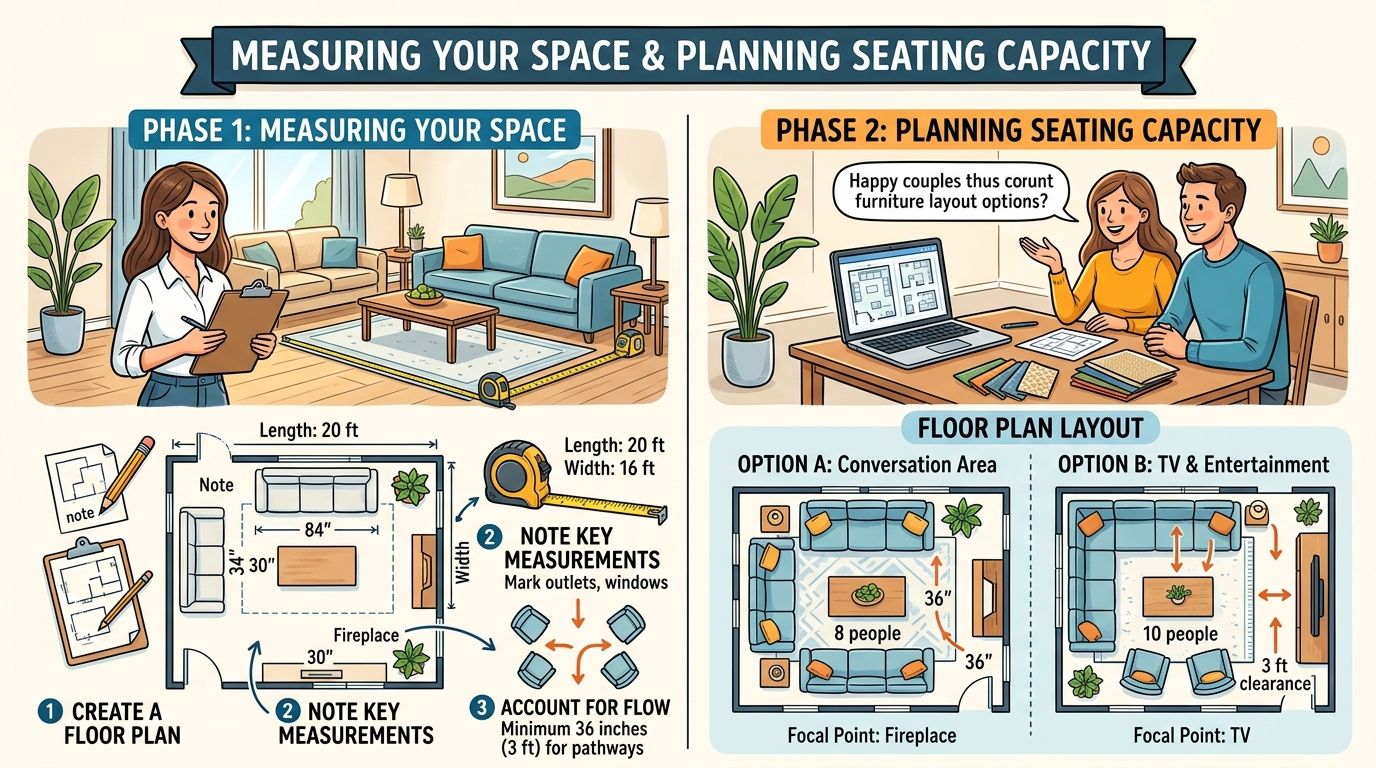
Before selecting a finish, measure the room as though every chair were occupied. A table that fits on paper can still fail in practice if pulled-out chairs block a doorway, collide with a buffet, or narrow the route to the kitchen.
Start with the usable footprint
Measure the clear floor area, then mark anything that consumes it. Include door swings, radiators, built-in cabinetry, chandeliers that visually constrain the table, and nearby furniture such as buffets or china cabinets. A practical planning allowance is 90 to 120 centimeters of clearance around the table, which helps chairs pull back and allows people to pass without creating a bottleneck. This range is included in a custom contemporary dining table build guide.
The calculation is straightforward:
- Measure the room's clear length and width.
- Subtract the planned circulation allowance from both dimensions.
- Compare the remaining footprint with the proposed tabletop.
- Test the layout with painter's tape or cardboard before ordering.
That last step catches problems a tape measure misses. A table may technically fit while leaving an awkward corner where a chair cannot move freely.
Match dimensions to comfort
A practical custom dining table design baseline is 30 to 31 inches high, with a typical width of 36 to 42 inches and a common length of 6 to 8 feet, according to the same build guidance. Seating planning should allow about 24 inches of linear space per person, so the number of chairs depends on both the table's perimeter and the width of the selected seating.
A long top also needs structural planning. The guide notes that a 60-inch table may need about 40 inches between the legs to provide chair clearance. Once a table reaches 132 inches, a third center support is often needed to reduce deflection and wobble. Those details affect the base design before the finish or edge profile enters the conversation.
Avoid the oversizing trap
The most common mistake is choosing the largest tabletop that fits between the walls. Chair pull-back, leg clearance, and traffic flow matter just as much as the top's footprint. Homeowners can find additional practical guidance through Vinson's resource on how to measure furniture, then bring room dimensions and photographs to a design consultation.
Practical rule: Measure the table with the chairs in use, not pushed neatly underneath it.
Choosing Solid Hardwood Species and Durable Finishes
The wood species determines the table's grain, color, aging pattern, and response to years of use. Vinson's hardwood standard is firm. The collection centers on solid cherry, oak, maple, and walnut, with no promotion of engineered construction. Solid hardwood furniture can last 30 to 100 years and can be sanded and refinished multiple times, as explained in this solid hardwood longevity guide.
Solid hardwood species comparison
| Wood Species | Grain Pattern | Durability | Aging Characteristics | Best For |
|---|---|---|---|---|
| Solid cherry | Smooth, flowing grain | Reliable for daily dining use | Deepens in warmth and richness over time | Formal rooms and heirloom interiors |
| Solid oak | Pronounced grain with visible character | Highly practical for active households | Retains a strong, textured presence | Families, farmhouse rooms, and durable everyday use |
| Solid maple | Fine, restrained grain | Dense, clean, and resistant to everyday wear | Holds a light, refined appearance | Contemporary rooms and lighter palettes |
| Solid walnut | Dramatic grain with deep natural color | Strong and substantial for daily use | Develops a softer, more layered character | Statement tables and sophisticated dining rooms |
The table should fit the household, not just the mood board. Oak and maple suit busy rooms where visible grain and practical durability matter. Cherry rewards a more formal setting with a surface that becomes richer. Walnut creates immediate visual weight, so its base and surrounding chairs should be scaled carefully.
Homeowners comparing grain and cabinetry materials can also review this wood type guide for kitchen cabinets, which offers useful vocabulary for discussing grain, color, and finish coordination.
Finish performance depends on preparation
For a dining surface, catalyzed lacquer and other high-durability film finishes are strong choices because they offer moisture resistance and can be more repairable than general-purpose coatings. The finish itself can't compensate for poor preparation. A reliable sequence includes sanding the surface, filling pores on open-grain species, removing dust, testing the application, and allowing the final coat to cure before heavy use. This durable dining table finish guide details those preparation priorities.
Skipped pore filling can allow grain to telegraph through the finish, while inadequate surface preparation can cause adhesion problems. Families with young children should prioritize a resilient, maintainable surface. Empty nesters who entertain formally may place more emphasis on sheen, color depth, and the way the finish frames the wood.
For a deeper explanation of species, construction, and longevity, Vinson provides guidance on choosing hardwood for style and durability. The best choice is the one that looks right now and remains serviceable after years of real meals.
Customizing Edge Profiles, Bases, and Design Details
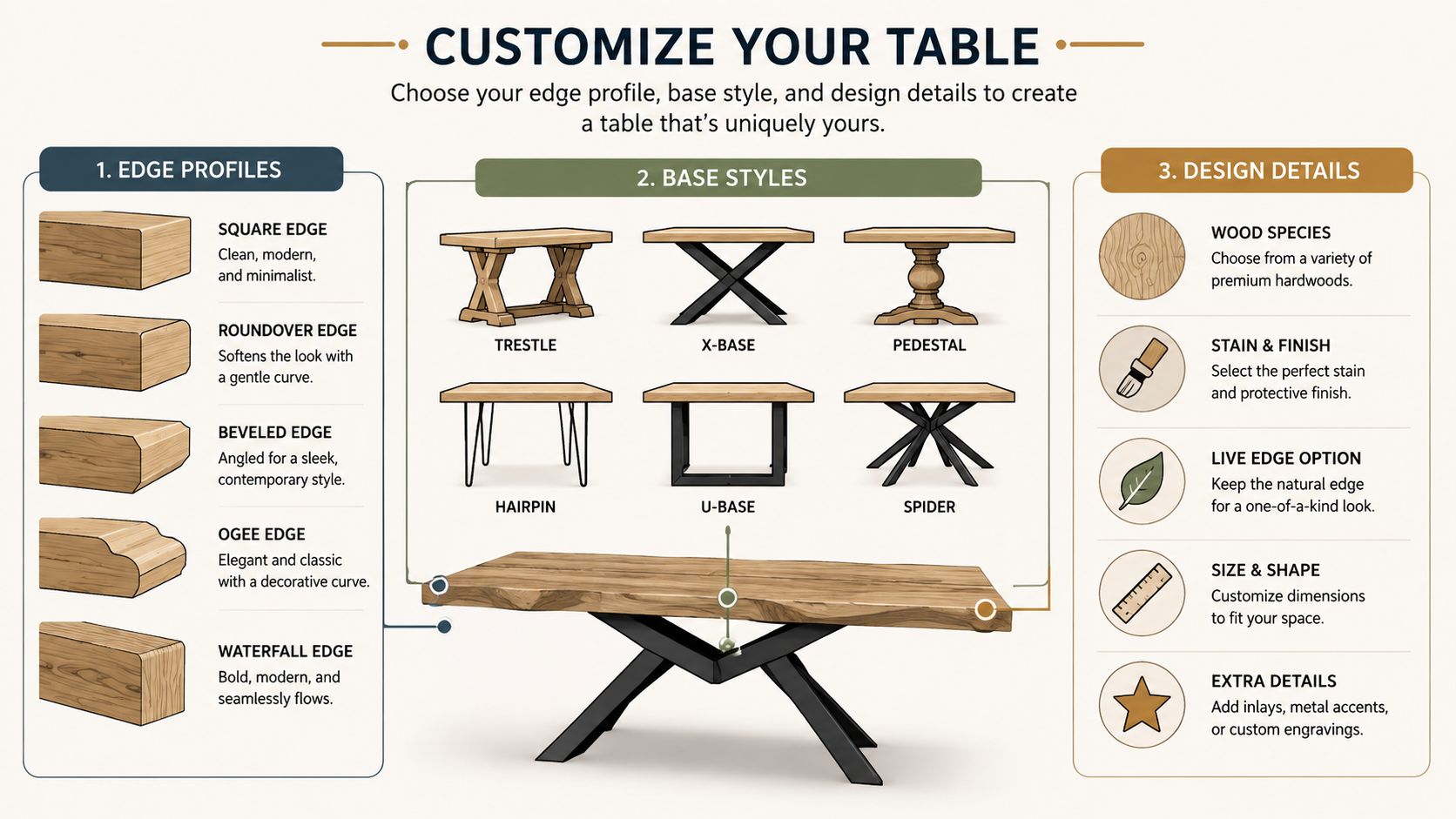
Once the dimensions and hardwood species are established, the table's character comes from the details people touch and notice every day. An eased edge feels quiet and contemporary. A beveled edge adds definition without excessive ornament, while an ogee profile introduces a more traditional silhouette. Live-edge treatment preserves the irregular contour of the slab, but it demands careful chair placement and a room that can support a more organic focal point.
Choose the base for seating first
A base isn't merely decorative. It determines where knees go, how chairs tuck in, and whether guests can sit comfortably along the ends.
- Pedestal bases: Central support keeps corner areas open and works well when seating flexibility matters.
- Trestle bases: Strong horizontal structure creates a substantial, architectural look, but stretcher placement must preserve footroom.
- Leg bases: Corner legs offer a familiar profile and can suit rooms where visual lightness matters.
- Live-edge supports: The irregular top calls for a base that balances the slab without competing with its natural outline.
A homeowner selecting a live-edge top should review Vinson's information on table legs for live-edge designs, particularly when the slab's shape affects chair positions.
Digital visualization improves decisions
The Custom Order Program supports fabrics, finishes, and 3D visualizers for brands such as Smith Brothers of Berne, Canadel, and Mavin. A 3D furniture configurator can accept product models, colors, materials, and business rules, allowing customers to preview a broad range of variants before purchase, as described by this 3D furniture configurator overview.
Canadel is handcrafted in Quebec, Canada, while Mavin is Amish-made in Ohio. Their approaches give homeowners different paths through North American craftsmanship. Smith Brothers of Berne, made in Indiana, USA, extends the same customization mindset into upholstered seating, including premium top-grain and performance leathers.
Digital previews are useful, but they aren't a substitute for physical samples. Grain scale, sheen, edge feel, and the visual weight of a solid hardwood top become clear only when seen in person. A design consultant can also check whether the chosen chairs, including swivel chairs, rockers, or gliders in nearby living areas, support the table's overall rhythm.
Understanding Lead Times and Budgeting for Custom Orders
Custom ordering rewards preparation and punishes wishful scheduling. Public guidance for custom dining tables ranges from 7 to 9 weeks, to 10 to 12 weeks, to 4 to 6 months, depending on the maker and specification. Those differences aren't contradictory. Material choice, table size, production volume, and customization depth can change the schedule materially, as outlined in this custom dining table FAQ.
Build the calendar backward
Industry guidance for custom furniture indicates that actual delivery often runs about 1.4 to 1.8 times the quoted lead time, with quoted 6-week projects frequently arriving closer to 9 to 11 weeks, while quoted 10-week projects can stretch to 14 to 18 weeks. These figures appear in this custom furniture finish and delivery discussion.
A homeowner planning for a holiday meal, move-in date, or renovation completion should provide that date before approving the order. The consultant can then identify which choices create the greatest schedule exposure. A highly specified finish, unusual dimensions, or a busy production period may justify ordering earlier or selecting a more readily available configuration.
The best custom order is the one that arrives before the room needs it, not the one that receives the most optimistic promise.
Evaluate value beyond the invoice
Solid hardwood is a long-term asset because it can be maintained, repaired, and refinished. The right quote should identify the species, dimensions, finish, extension features, base construction, seating, delivery, and installation rather than presenting a vague package price.
Vinson's custom order starting guide can help homeowners prepare the questions that keep quotes comparable. The Custom Order Program also covers brands such as Smith Brothers, Canadel, and Mavin, while the Low Price Guarantee provides a 110% refund of the difference when its stated conditions are met. For immediate availability, the Clearance Gallery offers savings of up to 70%, according to the publisher's stated store policy.
The same showroom can support broader room planning, from Amish-made dining sets to living room seating. Premium motion and leather options include motorized reclining, swivel chairs, rockers, gliders, and top-grain or performance leather sectionals. Those pieces belong in the same investment conversation because a dining table rarely exists in isolation from the rest of the home.
Working with Design Consultants and Planning Delivery
A complimentary design consultation turns preferences into a buildable specification. At the In-Store Design Studio, a consultant can review room dimensions, seating habits, finish samples, chair clearances, and the relationship between the table and adjacent living room or bedroom furnishings. Physical samples matter because solid cherry, oak, maple, and walnut change noticeably under different lighting and finish treatments.
Prepare for the consultation
Bring the information that prevents avoidable revisions:
- Room measurements: Include clear length, clear width, door swings, nearby case goods, and ceiling fixture placement.
- Reference images: Show the preferred edge, base, chair profile, and overall room character.
- Seating requirements: State the everyday seat count and the larger gathering size.
- Deadline: Share the move-in, renovation, or entertaining date before selecting complex options.
- Existing materials: Bring flooring, cabinet, or upholstery samples when available.
The consultant can use digital visualizers to present possible configurations, but the Easton showroom remains important for the sit-test. A table should be judged from a seated position, with attention to knee clearance, edge comfort, chair movement, and the visual relationship between the top and base.
Plan for white-glove delivery
White-glove delivery is more than curbside drop-off. A two-person crew brings the furniture inside, places it in the specified room, assembles or installs it when needed, and removes packaging, as described in this white-glove delivery explanation. Another white-glove furniture delivery guide describes the service as in-home placement, room-of-choice positioning, unpacking, assembly or installation, and debris removal.
Before delivery, clear the route, protect fragile fixtures, remove temporary furniture, and confirm that the table can pass through every doorway and turn. Vinson Fine Furniture is a family-owned business serving Central Ohio, formerly known as Kitchen Tables & More, with a focus on North American manufacturing in Ohio, the USA, and Canada.
Visit Vinson Fine Furniture at Easton Town Center for a complimentary design consultation, solid hardwood samples, and an in-store sit-test before ordering a custom dining room table. The team can help specify the size, species, finish, seating, delivery plan, and customization level that fit both the room and the deadline.