Furniture Floor Samples: A Buyer’s Guide to Smart Savings


Furniture floor samples use the same premium construction as boxed inventory but typically sell for 30% to 50% off, with discounts reaching up to 60% during showroom resets. The question isn't whether the price is lower. It's whether the condition, delivery terms, and remaining service value justify buying the exact piece on the floor.
A buyer standing in a Columbus showroom usually has a practical problem: a living room, dining room, or bedroom needs finishing, but a custom order brings a longer wait and a higher initial commitment. A floor sample offers a different path. The piece can be sat in, opened, operated, measured, and judged under real showroom lighting before money changes hands.
That makes furniture floor samples a strategic purchase, not merely a clearance shortcut. The smart buyer treats the showroom like an inspection site, not a warehouse. The frame, joinery, finish, upholstery, motion hardware, paperwork, and delivery terms all deserve attention.
At Easton Town Center, that decision can also lead to a custom solution. Solid hardwood furniture, premium leather seating, motorized sectionals, reclining chairs, swivel chairs, rockers, gliders, dining sets, and bedroom furniture all call for different inspection standards. A floor sample can be the right buy, but only when the buyer knows what condition is acceptable and when a custom order makes more sense.
Why Smart Buyers Start in the Clearance Gallery
A Columbus homeowner needs a bedroom set now, but the custom-order price feels difficult to justify. In the Clearance Gallery, the same display may offer a faster, more accessible route. The smart question is not whether the markdown looks impressive. It is whether the exact piece earns its price after you inspect its condition, confirm service terms, and compare it with the Custom Order Program.
Furniture floor samples are commonly discounted 30% to 50%, with some pieces reaching up to 60% off when condition, age, and showroom space create pressure to sell. House Beautiful's floor-sample buying guidance illustrates the effect with a $2,000 sofa example, placing a typical discounted price around $1,000 to $1,400 before deeper markdowns.
The discount reflects inventory pressure
A displayed piece generally carries the same manufacturing cost as comparable boxed inventory. The retailer reduces the price because the furniture has occupied showroom space, received customer handling, and must move before the next reset. That pressure affects the price, not necessarily the construction standard.
Retailers commonly explain clearance pricing as a way to move displayed merchandise into customers' homes and make room for incoming collections. The clearance explanation for floor samples reflects that basic retail logic. Treat the markdown as compensation for visible use, not as proof of a defect or automatic evidence of superior value.
Start with the actual item in front of you. At Vinson Fine Furniture's Clearance Gallery, available inventory may include solid hardwood and custom upholstery pieces, including display furniture from selected lines when available. Catalog photographs cannot show surface marks, fabric wear, drawer alignment, or the feel of a reclining mechanism.
A practical showroom sequence
Use this order during your visit:
- Start with the room. Measure doorways, stair turns, wall lengths, and the clearance around the intended furniture.
- Set your priorities. Decide whether solid cherry, oak, maple, or walnut matters more than an exact finish or fabric.
- Operate everything. Sit on every seat, open every drawer, test each motion feature, and examine exposed surfaces at close range.
- Document condition. Photograph scratches, fading, loose hardware, compression, and upholstery wear before discussing price.
- Compare purchase paths. Judge the floor sample against the Custom Order Program, not only against its former ticket price.
- Ask for written terms. Confirm warranty coverage, final-sale status, delivery arrangements, and service before signing.
Timing can affect available inventory, so this guide to end-of-season furniture finds is useful context. Negotiate from documented condition and confirmed terms. A floor sample earns its discount when its present condition fits your standards and its delivery and service value justify buying it now.
What Furniture Floor Samples Are
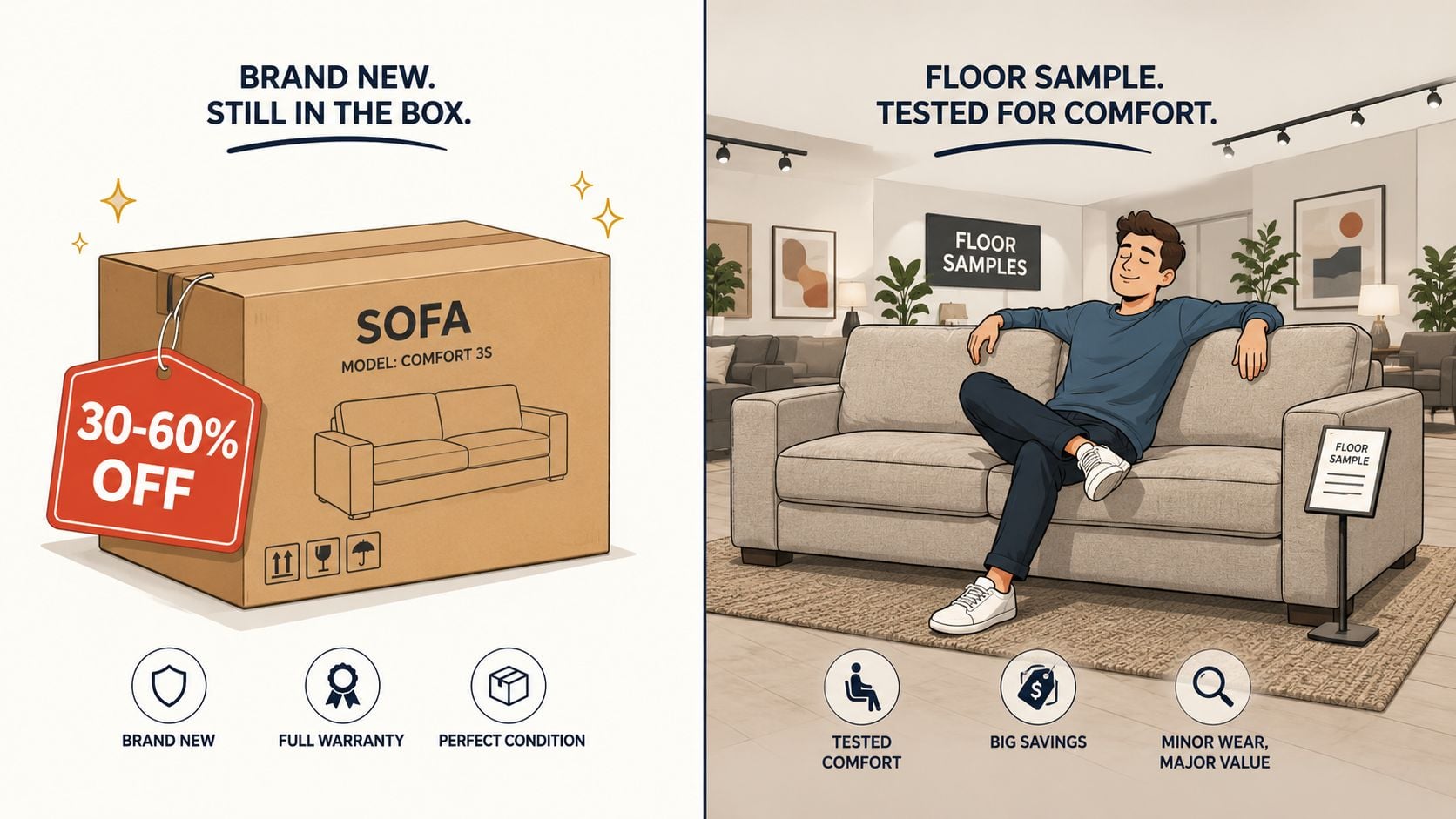
A furniture floor sample is a fully assembled display piece placed in an active showroom for shoppers to inspect and use. In a well-run showroom, it uses the same frame, materials, joinery, finish, and upholstery construction specified for the corresponding boxed or made-to-order piece.
That classification matters for buyers. A floor sample is not automatically second quality, discontinued, or built to a different construction standard. It may be a current design being removed to make room for another collection, or it may show a finish, fabric, or configuration no longer available through regular ordering.
What remains the same
For solid hardwood furniture, inspect the construction represented by the collection, not only the condition of the display. The piece should reflect the same species category, such as solid cherry, oak, maple, or walnut, along with the same joinery and finishing approach used in regular inventory.
Mortise-and-tenon construction is a recognized method for durable furniture, yet the joint's performance depends on several factors. Wood species, moisture content, grain orientation, adhesive type, and adhesive distribution all influence the result. The technical review of mortise-and-tenon joint performance provides technical background for evaluating that construction.
A separate review recommends controlling moisture-content differences between joined wood parts, with maximum differences of 4% for pinewood joints and 5% for beechwood joints. The review of mortise-and-tenon design addresses joint design rather than a particular retailer. Its practical lesson is clear: solid-wood quality depends on construction discipline, not appearance alone.
What changes on the showroom floor
Exposure creates the main difference. Arm caps may carry hand oils, a sofa may develop slight seat compression, and a table near a window may show a fade zone. Hardware can also differ from a current catalog version when the manufacturer has updated the collection since the display was built.
The display may be ready for shipment or pickup because it is already assembled and has served as a showroom example. That timing can matter when custom upholstery or imported case goods require a longer production wait. Online resale and auction platforms often highlight the same tradeoff: display pieces have experienced showroom traffic, so the discount should account for any expected repair or refinishing.
Ask the retailer to confirm whether the piece is sold as-is, whether its configuration is discontinued, and whether replacement parts or matching pieces remain available. If you need a precise finish, fabric, dimension, or coordinated bedroom case, use the floor sample as a physical reference. Do not assume the same specification can be recreated indefinitely.
A smart buyer documents the condition before discussing price, then compares the sample with the Custom Order Program and confirms how Vinson's white-glove delivery applies to that specific piece. The purchase makes sense when the observed condition, available service, and remaining configuration options match your requirements.
The Benefits and Honest Trade-Offs
A floor sample gives you a decision advantage: you can judge the finished furniture before committing. Custom ordering requires approval of specifications while the piece still exists only on paper. A showroom sample lets you assess comfort, proportion, color, texture, and operation with your own hands.
That advantage matters most with large or highly functional pieces. A sectional may look balanced in a photograph yet dominate the room in person. A dining chair can appear elegant and feel too firm. A recliner may have attractive leather but place the headrest awkwardly. Test the furniture where your judgment is strongest, in the showroom.
The advantages are concrete
- Immediate availability: The item is already built, so pickup or delivery can often proceed without factory production.
- Known comfort: Sit, recline, swivel, rock, glide, and test seat depth before you commit.
- Visible scale: Tape measurements and a physical walk-around show whether a sofa, table, bed, or cabinet suits the room.
- Access to discontinued details: A display piece may have a fabric, stain, leather, or hardware treatment no longer offered through regular ordering.
- Material confidence: Touch and operation reveal the difference between solid hardwood, top-grain leather, performance leather, and premium motion features more clearly than a description.
- Clearance value: The reduction reflects showroom exposure and space turnover. It does not change the furniture's category or intended use.
Floor samples also clarify construction choices. Review engineered wood and particle board terminology before evaluating case goods, then ask what materials the specific piece uses. Vinson's hardwood offering centers on solid cherry, oak, maple, and walnut rather than engineered categories.
The compromises need a threshold
Availability is usually limited to the displayed piece. A second matching nightstand, different chaise orientation, or replacement upholstery cover may not be available. Customization is limited as well, so the sample cannot satisfy every dimensional or color requirement.
Cosmetic wear deserves a measured response. Light rubbing on an arm cap, a small surface mark, or modest fading may be acceptable when documented and reflected in the price. Structural movement, a warped cabinet door, a failing recliner mechanism, a loose joint, a damaged drawer runner, or deep upholstery damage calls for a much firmer response.
White-glove delivery can remain available for clearance pieces, while expedited shipping may not fit an already-built unit's delivery schedule. Confirm the delivery window and placement service before signing the order.
The right comparison weighs known condition and immediate availability against exact specifications and new production timing. A floor sample earns the purchase when you can name every visible defect, estimate the likely remedy, and still value the piece at delivery.
An In-Store Inspection Checklist That Actually Works
A proper inspection doesn't require a technical background. It requires a deliberate pass over the furniture before the salesperson writes the order.
The first pass should happen from a distance. Stand where the piece will be viewed most often, then walk around it slowly. Look for uneven color, a leaning cabinet, a sagging sofa deck, asymmetrical cushions, or a sectional configuration that feels larger than the room can support.

Start with structure
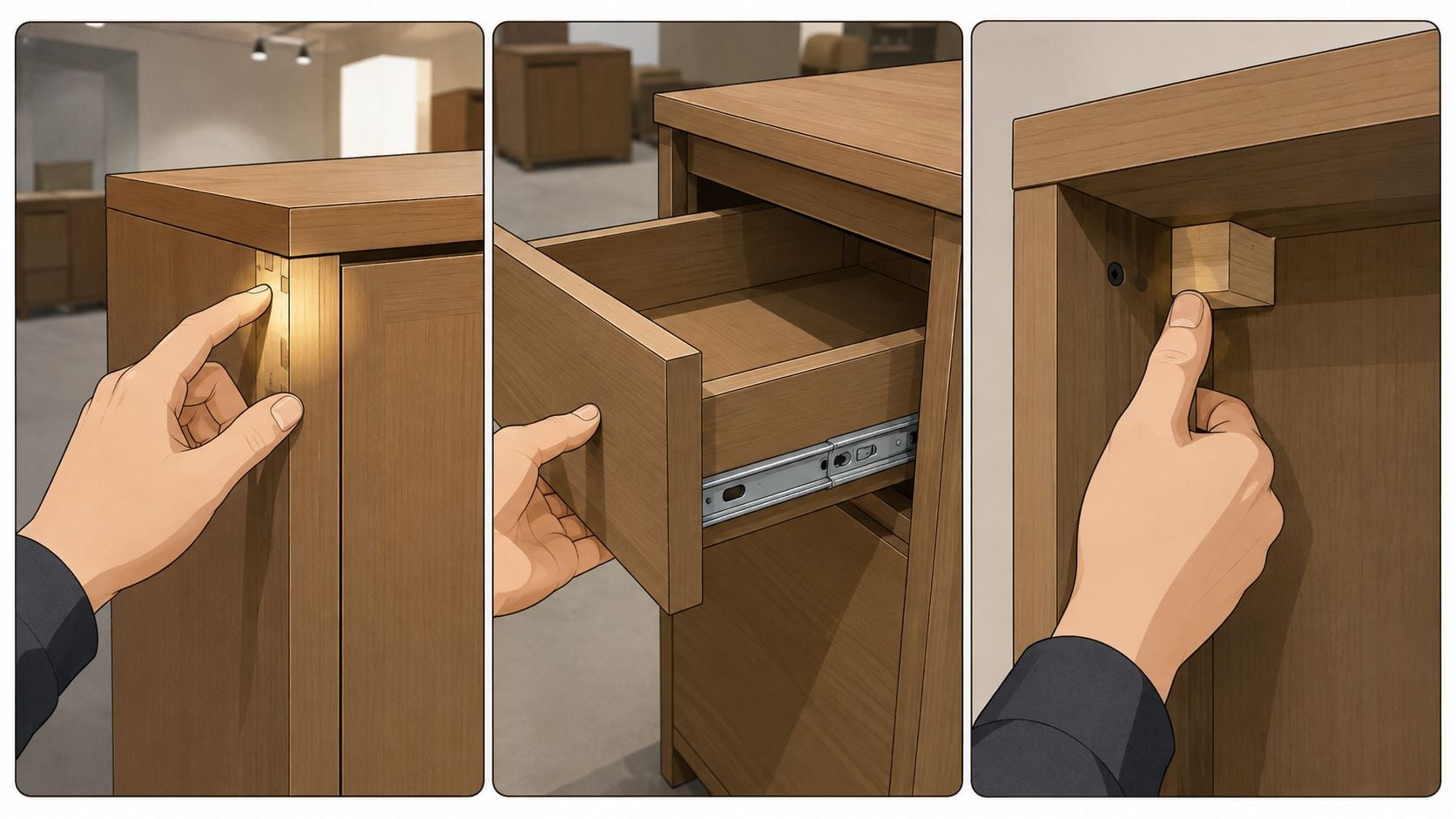
Run both hands over exposed solid hardwood surfaces. A well-built table, bed, dresser, or dining set should feel stable rather than loose or unusually light for its size. Examine corners, legs, stretchers, drawer fronts, and visible joints.
Then perform these checks:
- Joint integrity: Apply gentle opposing pressure at corners and rails. Movement, clicking, or separation warrants an explanation.
- Tabletop condition: Inspect the full surface from several angles. Look for scratches, swelling, finish rub-through, and inconsistent coloration.
- Drawer action: Open every drawer completely. Check glide smoothness, stopping points, front alignment, and unusual resistance.
- Cabinet alignment: Open and close doors. Uneven reveals, rubbing edges, or hardware that shifts under normal use should be documented.
- Weight and balance: Test whether the piece rocks on a level showroom surface. A small floor irregularity can mislead, so ask staff to reposition it if necessary.
The construction method deserves attention. Published comparisons report mortise-and-tenon furniture outperforming simpler fastener-based approaches under repeated stress, including one cited result of 87% less racking movement after 10,000 cycles. The mortise-and-tenon comparison provides that specific performance reference. The showroom inspection still matters because a strong design can be compromised by damage, misuse, or poor adjustment.
Test upholstery and motion
Sit in every seat for long enough to notice pressure points. Check whether cushions return to shape, whether the seat depth supports the intended posture, and whether the back remains aligned when the sitter shifts position.
For top-grain leather and performance leather, inspect high-contact areas for scratches, discoloration, surface dryness, and stretching. For fabric, check pilling, flattened nap, stains, pulled threads, and seam straightness. Pay special attention to arm fronts, seat edges, headrests, and the inside backs of chairs.
Operate every motorized feature on power sectionals and reclining chairs. Test footrests, headrests, swivel bases, rockers, and gliders through their full range. A motion piece should move smoothly, stop correctly, and return without unusual noise or hesitation.
Separate walk-away issues from negotiating points
Walk away or pause the purchase when the defect affects safety, structure, electrical operation, frame integrity, or basic function. A loose joint, failed motor, unstable base, persistent odor, major water damage, or distorted cabinet body isn't a minor showroom mark.
Negotiate firmly when the issue is cosmetic and visible. Photograph each defect, note its exact location, and ask for the condition to appear on the sales documentation. The buyer should never rely on memory at delivery.
For a more detailed seating review, use Vinson's sofa and chair inspection guide before visiting the showroom. The strongest inspection is tactile, specific, and recorded.
Pricing Strategies and Negotiation Tactics
A floor sample earns its discount in three ways: the standard display markdown, the condition of the specific piece, and the showroom's need to clear space. Buyers should evaluate each pressure on its own merits rather than requesting a blanket reduction.
The base markdown accounts for display use. A scratch, faded area, compressed cushion, or missing accessory can justify a further condition adjustment. Timing creates another opening when a collection must leave the floor for incoming merchandise. Ask the showroom to identify which factor shaped the posted price.
Furniture floor samples commonly carry discounts of 30% to 50%, with some reaching up to 60% during urgent clearance conditions. Use visible condition and showroom urgency as the basis for the conversation. A markdown alone does not make every item equally negotiable.
Build the negotiation around evidence
Start with the comparison price for the same model, configuration, material, and finish. Then confirm exactly what the floor piece includes and what it lacks. A top-grain leather sectional with power motion requires a different assessment from a stationary fabric sofa, even when their dimensions are similar.
At Vinson Fine Furniture, the Clearance Gallery can include floor samples, overstocks, and seasonal closeouts with savings up to 70%, based on the publisher information supplied for the showroom. Ask whether the posted price is already the best-and-final price, whether the item has a condition grade, and whether a matching component can be added through the Custom Order Program.
Use a specific script:
“The piece fits the room and the construction is right. The visible wear is on this arm cap and this side panel. If those defects are documented, can the showroom provide its best final price and confirm delivery, warranty, and service terms before purchase?”
Keep the request factual. A documented defect gives the sales team something concrete to price, while a general request for “a better deal” gives them little to evaluate.
Use the right lever for the right purchase
The Custom Order Program fits buyers who can use the floor sample for the main room but still need a coordinated component. Fabrics, finishes, and 3D visualizers support custom specifications for Smith Brothers of Berne, Mavin, and Canadel. Smith Brothers is made in Indiana, Mavin is Amish-made in Ohio, and Canadel is handcrafted in Quebec. Those options let buyers compare American-made, local Amish-made, and broader North American craftsmanship while keeping a clearance purchase separate from a custom specification.
The Low Price Guarantee offers a 110% refund of the difference when its stated conditions are met, according to the publisher information. Treat that guarantee as a value check, not as an automatic reason to raise a floor-sample price. Ask which terms apply to clearance and final-sale merchandise.
| Scenario | Base Floor Discount | Additional Levers | Realistic Total Savings |
|---|---|---|---|
| Clean display piece during routine turnover | 30% off | Immediate availability and known condition | About 30% off |
| Display piece with documented cosmetic wear | 30% to 50% off | Condition-based price discussion | Above the posted floor discount when approved |
| Showroom reset with urgent space needs | 50% to 60% off | Best-and-final request and prompt delivery scheduling | About 50% to 60% off |
| Clearance Gallery item during a deep reset | Posted clearance price | Ask about final-sale terms, service, and matching custom pieces | Up to 70% off where the item is marked accordingly |
These ranges describe possible pricing, not a promised extra reduction. The practical negotiation target is a documented condition, clear terms, and a final price that reflects the piece's actual state.
Delivery, Warranty, and Financing Implications
A floor sample can be ready sooner, but its delivery requires closer planning. The piece has already been assembled and displayed, so the process differs from a boxed or custom order even when it is headed to the same Columbus home.
Before paying, ask how the furniture will be protected during showroom removal, transport, entry, placement, and final inspection. Display pieces may have less original packaging because they were already unpacked. That can reduce preparation time, but it puts more responsibility on the delivery plan.
Confirm the exact scope of white-glove service. Will the crew carry the piece into the intended room, assemble or reassemble components, level the furniture, remove packaging, and record damage at arrival? Review Vinson's white-glove furniture delivery information before purchase, then have the agreed services written into the order.
Retailers commonly describe clearance floor samples as pieces moved from showroom display spaces into customers' homes at prices intended to encourage fast movement. That pricing does not erase the need to document condition, service responsibility, and final-sale status.
Warranty language deserves careful reading
Manufacturer warranty coverage may remain available, but do not assume every service promise transfers unchanged. Ask whether coverage begins on the purchase date, whether the item is sold as-is, whether existing wear is excluded, and whether the condition grade changes service coverage. Get the answers in writing.
Financing needs the same attention. A store credit line may apply, while final-sale clearance terms may set different payment requirements, payoff timing, or down-payment expectations. Rely on the written agreement, not an informal showroom explanation.
Storage can affect the delivery plan when renovation work or a closing date creates a gap between purchase and placement. Buyers comparing temporary arrangements can compare furniture storage units and review how furniture should be protected during that interval. Confirm who handles loading, storage, and later delivery before scheduling the purchase.
Compare the full purchase path
| Factor | Floor Sample | Custom Order |
|---|---|---|
| Selection | Limited to available display pieces | Chosen configuration, size, fabric, and finish |
| Inspection | Physical item can be tested before purchase | Finished item is evaluated after production |
| Availability | Often ready for scheduled pickup or delivery | Requires factory production and shipping |
| Condition | Display exposure must be documented | New production condition |
| Customization | Usually unavailable for the exact floor piece | Central benefit of the order |
| Warranty | Must be confirmed for the specific clearance item | Written terms apply to the new order |
| Delivery | Schedule depends on showroom logistics | Schedule depends on production and freight |
| Financing | Terms may reflect final-sale status | Standard order terms may apply |
Compare the complete purchase path, not just the discount. A floor sample offers a known physical condition and potentially faster availability. A custom order offers exact specifications and new production. Choose only after reviewing delivery, warranty, financing, storage, and service language together.
When to Order Custom Instead and What to Do Next
A floor sample isn't the right answer when the room depends on exact dimensions. A narrow passage, unusual wall length, tight stair turn, or open-plan sightline can make a few inches matter. A custom order also makes more sense when the buyer needs a specific chaise orientation, dining-table extension, bed size, storage layout, or coordinated finish.
The same applies to material requirements. If the available floor piece doesn't provide the required fabric, finish, top-grain leather, performance leather, or solid cherry, oak, maple, or walnut specification, forcing the purchase creates a long-term compromise. Investment homeowners shouldn't accept a visible mismatch just because the display price looks attractive.
Use the Design Studio as a planning tool
Vinson's In-Store Design Studio and Complimentary Design Consultations can turn a room problem into a buildable furniture specification. The Custom Order Program supports fabrics, finishes, and 3D visualizers for Smith Brothers of Berne, Mavin, and Canadel. Smith Brothers represents made-in-Indiana American manufacturing, Mavin represents Amish-made Ohio furniture, and Canadel represents handcrafted Quebec production within a North American sourcing conversation.
The product categories should match the room's actual use. A living room may call for a custom leather sectional with motorized power motion, a swivel chair, or a rocker or glider. A dining room may need an Amish-made dining set in solid oak, cherry, maple, or walnut. A bedroom may benefit from Mavin bedroom furniture built around a specific wall, mattress height, and storage requirement.
A custom route also suits buyers who need matching pieces, a consistent finish across rooms, or more predictable long-term service terms. It takes longer, but the result is specified before production rather than accepted from the showroom floor.
Make the next visit productive
A buyer should walk through the Clearance Gallery with room measurements, fabric and finish priorities, and a short inspection list. Each promising piece should be recorded by its product or serial number, with photographs of the overall furniture and every visible condition issue.
If no floor piece solves the room without compromise, the next move is a Design Studio consultation, not repeated browsing. Vinson's guide to getting started with a custom order provides the starting point for that conversation.
The strongest decision is often clear after the sit-test. Buy the floor sample when its construction, comfort, condition, price, and delivery terms all work together. Order custom when the home requires precision that the available display piece cannot provide.
Visit Vinson Fine Furniture at Easton Town Center to inspect furniture floor samples in person, test solid hardwood case goods and premium motion seating, and review Clearance Gallery options. The showroom also offers Complimentary Design Consultations and a Custom Order Program for buyers who need specific fabrics, finishes, dimensions, or matching pieces.