High Quality Sectional Sofa Buyer Guide


The family room looked finished on move-in day. Months later, the sectional told a different story. Cushions had flattened, the corner had begun to shift, and the once-comfortable seat no longer supported long evenings with family or guests. Replacing it means more than choosing a color. A high quality sectional sofa should earn its place through solid construction, adaptable design, serviceable components, and comfort that feels right in person.
For an investment homeowner, the right purchase starts beneath the upholstery. Frame material, joinery, suspension, foam density, connectors, leather or fabric performance, delivery, and future maintenance all shape the ownership experience. A sectional is the room's architectural anchor, so it needs to withstand daily lounging, pets, children, entertaining, and changes in the household without losing its composure.
Redefining the Living Room Centerpiece
A sectional changes how a living room functions. It establishes the direction of conversation, defines the boundary between seating and circulation, and often becomes the household's most-used piece of furniture. That makes a disposable approach expensive, even when the original price seems attractive. A sofa that loses its support quickly may need replacement before the room, floor plan, or family has changed.
The investment homeowner looks at the purchase differently. Timeless proportion matters more than a passing silhouette. Structural integrity matters more than decorative labeling. Tactile comfort matters more than a product photograph. The goal isn't just to find a large sofa. It's to select a piece that can carry the rhythm of the home for years.
Furniture histories place sectional furniture in the United States as far back as 1800, with early development in central Virginia between 1800 and 1820, while the modern sectional became mainstream in the 1930s and 1940s. That history supports a useful point: the sectional isn't a novelty. It's a durable furniture form that has evolved because households need flexible, generous seating.
A market signal reinforces its importance. Sectionals accounted for 27.3% of global sofa revenue in 2025, according to sectional sofa market data. Another industry estimate placed the category at about $23.4 billion in 2025, with a projection of $38.7 billion by 2034 at a 5.8% CAGR, also reported in that source. The figures point to a major category shaped by flexible layouts, residential comfort, and long-term value.
Practical rule: A sectional should be judged as a system, not as a cushion, color, or room photograph.
Families comparing layouts can also benefit from region-specific planning, especially when room proportions, climate, and household habits differ. This sectional sofa advice for Georgia homeowners offers another perspective on choosing a configuration for real residential use. For Columbus homeowners, the same principle applies: the sectional needs to suit the architecture and the way people live.
Vinson Fine Furniture centers that investment approach on heirloom-quality furniture, with solid hardwood construction, North American manufacturing, and a design process built around the homeowner's room. The Easton Town Center showroom gives Columbus-area buyers an opportunity to assess scale and comfort before committing to a major living room purchase.
The Hidden Anatomy of Enduring Comfort
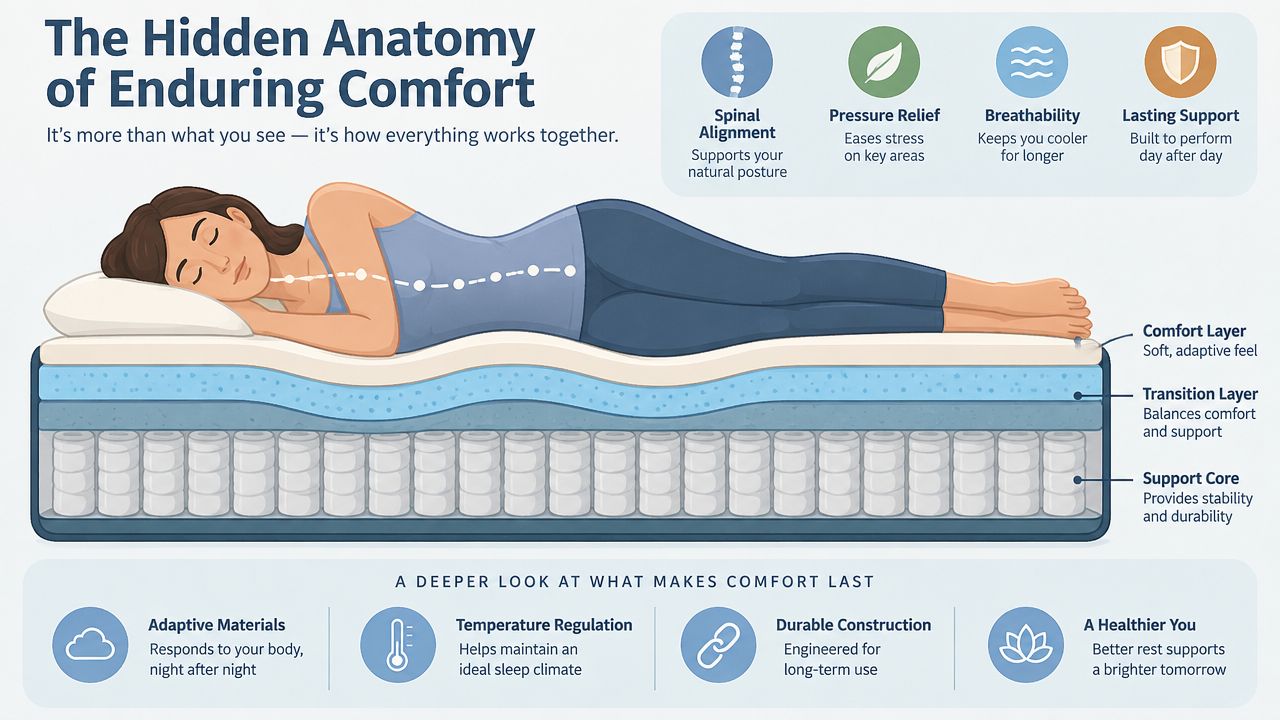
A premium sectional earns its comfort from layers that remain invisible after upholstery is finished. The frame carries the load, the joinery keeps the geometry stable, the suspension distributes pressure, and the foam determines how the seat responds to repeated use. A beautiful textile can't compensate for weak anatomy.
Start with the frame
For a high quality sectional sofa, the strongest starting point is a kiln-dried solid hardwood frame. Solid maple, oak, cherry, and walnut offer the tactile density and long-term repairability expected from fine furniture. Kiln drying reduces moisture-driven warping and cracking, while solid wood allows skilled builders to form durable connections rather than relying on superficial reinforcement.
Mortise-and-tenon joinery gives adjoining members a substantial mechanical connection. Corner-blocked joints add support at the areas where sectional frames absorb concentrated force, particularly around corners and arms. Engineered hardwood can be acceptable in some furniture construction when it uses thick multi-ply layers and reinforced joinery, but Vinson's standard is more specific: it strictly sells solid hardwood furniture and focuses its wood selections on solid cherry, oak, maple, and walnut.
Construction guidance for premium sectionals also identifies kiln-dried hardwood and durable suspension as key quality markers. The sofa and chair construction guide gives buyers a practical checklist for evaluating the parts beneath the upholstery.
Examine suspension and foam
Suspension controls how the sectional carries weight over time. Sinuous springs can provide dependable support when properly installed, while eight-way hand-tied systems distribute load through individually secured coils and are associated with traditional bench-made upholstery. Weaker frame-and-webbing builds may feel acceptable at first but can lose resilience sooner under demanding household use.
Seat foam deserves equal scrutiny. High-quality guidance places residential seat foam in the 1.8 to 2.5 lb/ft³ density range, with 1.8 lb/ft³ treated as a baseline and 2.0 to 2.5 lb/ft³ preferred for longer service life, according to custom upholstery foam guidance. Foams below 30 kg/m³ generally aren't recommended for demanding upholstery because they lose support faster and develop permanent compression sooner.
Durability benchmarks provide context, not a guarantee. Consumer and trade estimates place an average sofa's life at about 7 to 8 years, while a well-built high-quality sectional can last 15 to 25+ years. Premium indicators include kiln-dried hardwood frames, support ratings of 800 pounds or more, and upholstery fabrics above 25,000 Martindale rub cycles, as outlined in furniture lifespan guidance.
The first component to fail often isn't the entire sofa. Cushions, connectors, and suspension systems may need attention before the frame becomes unusable. Buyers should ask whether cushions can be replaced, whether connectors are available, and what the warranty covers.
Evaluating Modular Flexibility and Fixed Frames
Modularity is useful, but it isn't automatically superior. A modular sectional can move more easily through narrow entries, adapt to a future home, and allow individual covers or cushions to be addressed without replacing the entire arrangement. A fixed-frame sectional generally offers greater rigidity, a cleaner continuous profile, and fewer connection points to maintain.
The right decision depends on the homeowner's expected changes. A household moving from an apartment to a larger home may value pieces that can separate and reconfigure. A homeowner renovating a settled living room may prefer the visual calm and structural permanence of a fixed build.
The modular case
Modular construction works particularly well when the room needs to evolve. Individual sections can be rearranged around a new window treatment, fireplace orientation, or architectural change. Replaceable covers and cushions can also improve the lifecycle value, provided the manufacturer continues to supply compatible parts.
The tradeoff appears at the connections. Connectors can wear, sections can move apart during use, and a configuration with many separate pieces may feel less unified than a fixed frame. Buyers should test whether the hardware locks firmly, whether the pieces remain aligned when someone shifts position, and whether replacement connectors are available.
The fixed-frame case
Fixed sectionals make sense when the room's geometry is established and the seating plan won't change frequently. A continuous frame can create a more polished appearance, especially in formal living rooms where the sectional needs to read as one composed piece. The drawback is logistical: the original dimensions need to work through delivery routes and remain suitable if the room changes.
| Priority | Modular sectional | Fixed-frame sectional |
|---|---|---|
| Future room changes | Strong adaptability | Requires more planning |
| Moving between homes | Individual pieces can simplify access | Larger single units may be difficult |
| Visual continuity | Depends on connector alignment | Usually more seamless |
| Serviceability | Replaceable parts can be valuable | Frame has fewer connection points |
| Long-term risk | Connector wear and movement | Less flexibility after purchase |
A practical buying framework is simple. Choose modularity when portability, reconfiguration, and replaceable components are central to the household's plans. Choose a fixed frame when rigidity, visual continuity, and settled room planning carry more weight. The configurations shown in Vinson's sectional sofa guide can help homeowners compare L-shaped, U-shaped, reclining, and modular arrangements before visiting the showroom.
Mastering Room Layout and the Showroom Sit-Test
A sectional can be beautifully made and still be wrong for a room. The correct choice respects walkways, sightlines, door swings, focal points, and the relationship between seating and natural light. Dimensions on a product page provide a starting point, but they can't reveal whether the seat depth supports an upright posture or encourages a comfortable lounge.
Measure the room in sequence
Record the architecture. Measure each wall, doorway, hallway turn, stair access, and opening that the delivery team will use. Note windows, radiators, vents, fireplaces, and built-ins that affect placement.
Map circulation. Mark the routes people use to enter the room, reach adjacent spaces, and access windows or storage. The sectional shouldn't force household traffic through the center of the seating zone.
Create the footprint. Use painter's tape or paper to mark the proposed length, depth, chaise, and recline clearance on the floor. Live with the outline long enough to notice whether it crowds a door or interrupts the room's visual balance.
Test the focal point. Decide whether the sectional faces a fireplace, television, view, or conversation center. A strong layout gives the room a clear purpose without making every seat point in only one direction.
Check motion clearance. Power recliners and adjustable headrests need room to operate. Motorized motion should feel smooth and quiet, and cables should remain discreetly positioned.
The in-person sit-test then answers questions measurements cannot. Each adult should sit in the preferred position, lean back, adjust the headrest if available, and assess whether the lumbar support meets the natural curve of the back. The seat should provide support without creating pressure behind the knees, and the arms should feel comfortable rather than ornamental.
Test the materials with hands and movement
Top-grain leather should feel supple, substantial, and naturally varied. Performance leather offers a more demanding-use option, while performance fabrics provide practical resistance for households managing pets, children, or frequent entertaining. None should be selected from a screen alone.
At the Easton Town Center showroom, shoppers can compare stationary seating with power reclining, swivel, rocker, and glider motion. A sectional's mechanism should operate without abrupt noise, and the seated position should remain comfortable at rest, not only while fully reclined. The living room furniture arrangement guide provides further planning support before the sit-test.
Tailoring Your Vision Through Custom Design

A custom sectional should solve the room's demands, not force the room around a standard package. Specify the details that shape daily comfort and long-term value: seat depth, cushion firmness, arm profile, upholstery, exposed wood, configuration, and finish. These decisions also determine whether the sofa can coordinate with other furnishings or look like an isolated purchase.
The Custom Order Program supports that level of control through fabrics, finishes, and 3D visualizers. Homeowners can develop a coordinated furniture plan, then assess the sectional alongside the room's existing architecture and furnishings. For a major purchase, that planning is more useful than choosing a color from a screen.
Choose materials for the household
Start with use, then select the finish. Top-grain and performance leathers provide a substantial hand and can develop character over time. High-performance fabrics suit households dealing with daily spills, pet contact, children, or frequent entertaining. A beautiful material that cannot handle the household will become an expensive compromise.
North American upholstery and solid wood manufacturing programs give Columbus-area buyers local and American-made routes for seating and case goods. That sourcing flexibility supports a more consistent plan across the living room, dining room, and bedroom.
Exposed maple, oak, cherry, or walnut accents can tie the sectional to nearby furnishings. Match undertones and finish character rather than forcing every wood surface to look identical. Warm architectural finishes usually benefit from similarly warm furniture details.
Use professional design guidance
The In-Store Design Studio makes customization more precise. During a Complimentary Design Consultation, a homeowner can review room dimensions, compare fabric samples, coordinate finishes, and test configurations with a design consultant. A 3D visualizer shows how the proposed sectional may relate to the room before production begins.
Professional review catches costly mismatches early. A fabric that appears neutral under showroom lighting may look different beside the home's flooring. A chaise that seems generous may restrict a walkway. A deep seat can feel luxurious to one household and poorly suited to another.
Use this custom home interior design resource to consider furniture as part of a complete interior rather than a standalone purchase. For sectional-specific decisions, review the custom sectional sofa program and assess configuration and materials together.
The finished piece should feel personal without chasing a short-lived trend. Choose enough character to anchor the room, with enough restraint to remain convincing when surrounding décor changes.
Securing Value and a Seamless Delivery Experience
Price matters, but the lowest initial figure isn't the same as the strongest value. A sectional's real cost includes its construction, serviceability, delivery conditions, warranty, and the likelihood that the household will still want to use it after years of daily wear.
Vinson's Low Price Guarantee addresses local price confidence with a 110% refund of the difference when a lower price is found at a local authorized dealer within the stated policy period. The details should be confirmed with the showroom before purchase, but the principle is sound: a premium furniture transaction should include clear value protection.
The Clearance Gallery offers another route for disciplined savings. Floor samples, overstocks, and seasonal closeouts may provide savings up to 70%, while still allowing a homeowner to inspect the actual piece in person. Clearance buying requires careful examination of fabric condition, cushion resilience, finish, warranty coverage, and whether the configuration fits the room exactly.
Treat delivery as part of the purchase
A sectional can be damaged by a poor delivery process before it ever reaches the living room. White-glove service typically includes two-person inside delivery, placement in the room of choice, light or full assembly, and removal of packaging debris, according to white-glove furniture delivery guidance.
That service is particularly important for large sectionals, power motion pieces, and homes with tight stairs or difficult turns. The delivery team should inspect the piece, protect the home's surfaces, assemble the components correctly, and confirm that motion mechanisms operate as intended.
Homeowners planning access routes can review this couch delivery service guide for practical considerations around moving a large upholstered piece. Vinson's white-glove furniture delivery service connects that logistical care to the full furniture experience.
A well-managed purchase therefore has three layers of value: sound construction, transparent price protection, and careful placement. Each protects the investment in a different way.
Preserving Beauty Through Proper Care
A well-built sectional still needs intelligent maintenance. Care protects the upholstery, keeps cushions performing properly, and prevents small problems from becoming expensive repairs. The routine should match the material, not rely on a single universal cleaner.
Maintain leather with restraint
Top-grain and performance leathers should be dusted regularly with a soft, dry cloth or gently vacuumed with an upholstery attachment. Spills should be blotted rather than rubbed, since aggressive friction can spread moisture and disturb the surface.
Leather conditioning should follow the manufacturer's instructions. Applied appropriately, conditioner helps prevent drying and cracking, but excessive product can leave buildup or alter the finish. Household cleaners, alcohol-based products, and improvised treatments should stay away from premium leather unless the manufacturer specifically approves them.
Direct sunlight deserves attention. Prolonged exposure can shift color and dry the material, so window treatments or thoughtful placement can protect the sectional without making the room feel dark. A solid cherry, oak, maple, or walnut accent should also be kept away from intense direct sun when possible.
Keep performance fabric functional
Performance fabrics still need prompt care. Blot spills, remove loose debris before it becomes embedded, and use only the cleaning method specified for the fabric. Removable covers can simplify maintenance, but they should be washed and dried according to the manufacturer's instructions to avoid shrinkage or distortion.
Rotate and fluff loose cushions when the design permits. This distributes daily pressure and helps preserve the intended silhouette. Fixed cushions should be checked for uneven compression, while modular connectors should be inspected if sections begin to shift.
Control the room environment
Solid hardwood responds to its surroundings. Large humidity fluctuations can stress wood components and contribute to movement, while direct heat can dry surfaces unevenly. Stable indoor conditions, sensible furniture placement, and prompt attention to loose hardware help preserve the sectional's structure.
A lasting sectional isn't maintenance-free. It's designed so routine care can preserve the materials and replaceable components rather than forcing premature replacement.
The best long-term habit is a scheduled inspection. The homeowner should check seams, cushions, connectors, motion controls, and exposed wood before a minor issue affects the rest of the piece. That attention allows the sectional to age with the home, developing a lived-in character while retaining its support and dignity.
Visit Vinson Fine Furniture at Easton Town Center to sit-test solid hardwood sectionals, power motion seating, top-grain leather, and performance fabrics in person. The In-Store Design Studio, Complimentary Design Consultations, Custom Order Program, Low Price Guarantee, Clearance Gallery, and White-Glove Delivery give Columbus homeowners a practical path to selecting a sectional built for lasting use.