Oak vs Cherry Wood: Which Is Best for Furniture

A lot of homeowners reach the same point after narrowing the room layout, the finish palette, and the budget. The final question sits right in front of them on two wood samples or two dining tables. One is oak, with visible grain and a sturdier visual weight. The other is cherry, smoother and warmer, with the kind of surface that seems to quiet a room.
That decision usually isn't about which wood is “better.” It's about which wood fits the way a home runs in Central Ohio. Daily family dinners, homework at the table, holiday hosting, sun from large windows, and the humidity swings that come with Ohio seasons all affect how furniture looks and performs over time.
Choosing Between Oak and Cherry Starts With Your Lifestyle
A homeowner comparing oak and cherry usually starts with color, then gets pulled toward durability, and then circles back to appearance again. That's normal. These two hardwoods solve different problems, even when they're built into the same kind of piece.
In a busy household, oak often makes sense first. It has a stronger surface presence, a pronounced grain, and a reputation for handling harder use without feeling delicate. In homes where the dining table serves as command center, school desk, buffet station, and weekend gathering spot, that matters.
Cherry appeals to a different kind of priority. It suits homeowners who want furniture to mature gracefully and develop more character over time. In a quieter dining room or a primary bedroom, that softer visual language can feel exactly right.
The better question to ask
Instead of asking which species wins in a simple oak vs cherry wood debate, it helps to ask three lifestyle questions:
- How hard will the piece be used: Daily meals and active households push many buyers toward oak.
- How much visual change is welcome: Cherry changes more noticeably with age, while oak tends to stay more visually consistent.
- How much maintenance awareness is realistic: Some households are attentive about sunlight, humidity, and surface protection. Others need furniture that asks less.
Practical rule: The right wood usually matches the room's pace before it matches the room's color palette.
A thoughtful furniture purchase should also account for construction, finish, room function, and how long the piece is expected to serve. Buyers who want a broader framework for evaluating those factors can use this smart furniture shopping guide before settling on species alone.
Grain, Color, and the Aging Story of Each Wood
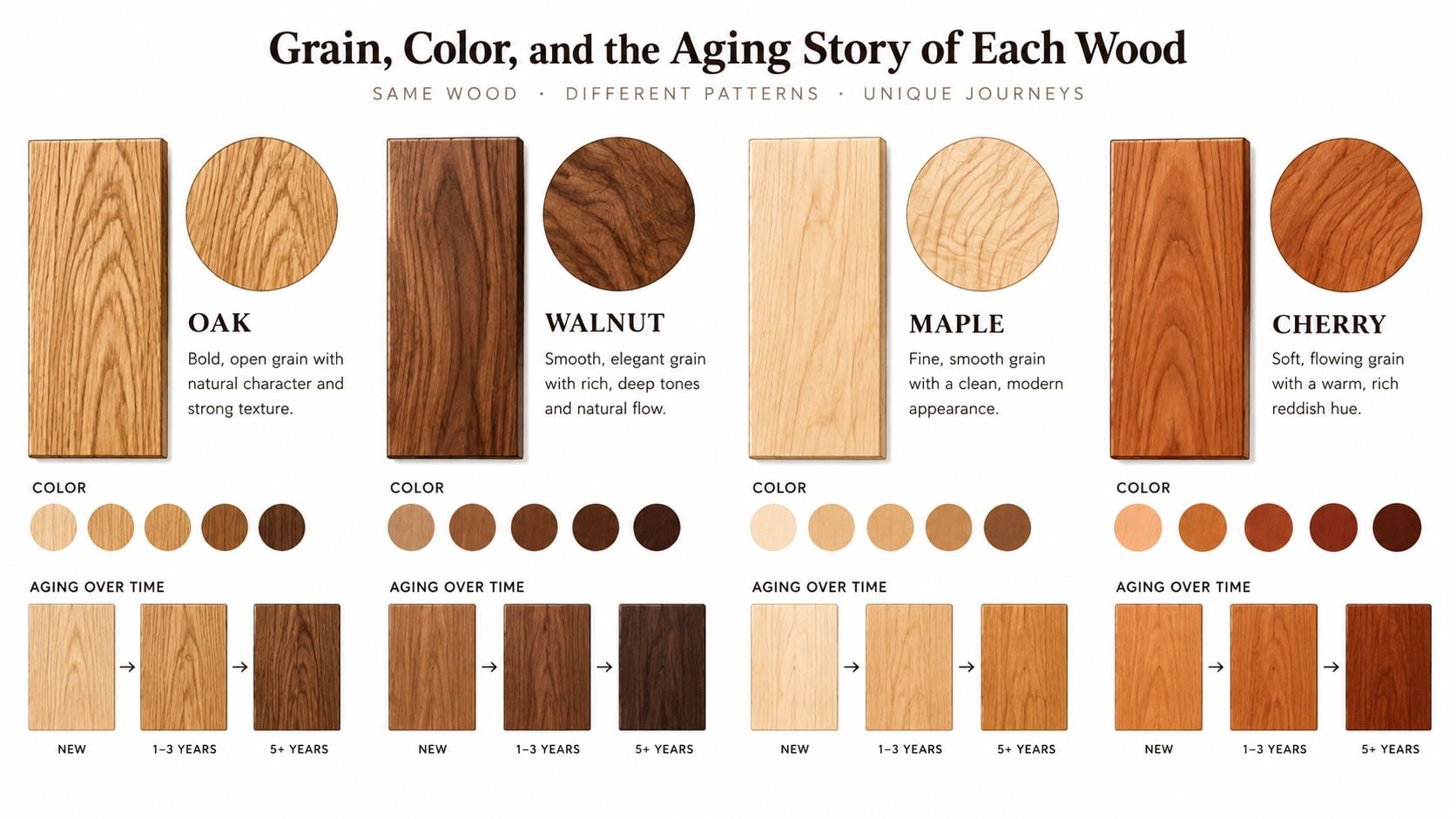
The first difference anyone notices between oak and cherry is texture. Oak announces itself. Cherry feels more restrained.
What oak looks like in a room
Oak has an open, prominent grain that gives furniture visible structure even from across the room. That grain reads well in traditional, farmhouse, and transitional interiors because it adds pattern without relying on ornament. On larger pieces like trestle tables, bed frames, and wide dressers, oak tends to hold its visual definition.
Its color usually sits in a warm tan-to-brown range. Over time, one source notes that oak may yellow slightly with age, while maintaining its recognizably bold grain pattern.
What cherry looks like in a room
Cherry presents a finer, smoother grain and a more polished face. It doesn't compete with upholstery, drapery, or painted walls. It complements them. That's one reason it works so well in dressers, nightstands, and formal dining pieces where visual calm is part of the appeal.
Cherry also carries one of the most distinctive aging stories in furniture. It's favored by buyers who like the idea that a piece won't look exactly the same years from now. Rather than holding steady, cherry develops a deeper, richer tone as it lives in the home.
Cherry tends to reward patience. Its character often becomes more compelling after years of normal indoor light exposure.
Which appearance ages better
That depends on what “better” means in the household.
- Choose oak if a room needs visible grain, stronger texture, and a look that feels grounded from the first day.
- Choose cherry if a room benefits from smoother surfaces, warmer undertones, and a finish that becomes richer with time.
- Choose based on wall color too. Homeowners pairing species with paint often find cherry asks for more careful coordination. This guide to paint colors that work with cherry wood is useful before making a final decision.
Oak usually offers broader stain flexibility because its pore structure shows color variation so clearly. Cherry often looks strongest when its natural warmth is allowed to lead, rather than being pushed too far away from its native tone.
Hardness, Density, and Real-World Durability
Durability discussions often get flattened into one sentence: oak is harder than cherry. That's true, but it doesn't tell a homeowner enough.
Early in the buying process, a simple comparison helps.
Oak vs Cherry Hardness and Density Comparison
| Species | Janka Hardness (lbf) | Density (kg/m³) |
|---|---|---|
| Cherry | 950 | 620 |
| Red Oak | 1,290 | 700 |
| White Oak | 1,360 | 750 |
Verified Janka values place cherry at about 950 lbf, red oak at about 1,290 lbf, and white oak at about 1,360 lbf. A PEFC reference table lists sweet cherry at about 620 kg/m³, red oak at about 700 kg/m³, and white oak at about 750 kg/m³ at 12% moisture content (PEFC wood species reference).
What those numbers mean on real furniture
Oak's advantage shows up most clearly on high-contact surfaces. Dining tabletops, chair rails, bench edges, and bed rails all live through bumps, dragged objects, rings from daily use, and the occasional impact from something harder than it should be. In those situations, oak usually gives the homeowner more margin.
That's why many buyers lean toward oak when they know a piece will take regular abuse. Hardness and density don't guarantee a flawless surface, but they improve resistance to denting and everyday wear.
Cherry handles normal household use well, but it doesn't absorb the same level of rough treatment as casually. Its appeal is less about brute toughness and more about balance. It offers a smoother face and a refined look, which some owners value more than maximum dent resistance.
Why durability isn't the whole story
Wood movement matters almost as much as hardness once the furniture is in the home. One comparison notes that oak is the harder, more dent-resistant wood, while cherry is more dimensionally stable and may show roughly half the width movement of oak in typical interior conditions.
That changes the conversation for wide panels and tight joinery.
A tabletop doesn't only need to resist forks and dropped keys. It also needs to move predictably through Ohio's seasonal humidity changes.
For large cabinet doors, broad case fronts, and wide solid-wood tops in climate-controlled homes, cherry's stability can be a practical strength. Homeowners comparing species against other hardwood standards sometimes also look at this overview of maple hardness and furniture durability to understand how surface toughness varies across premium woods.
Workability, Joinery, and Finish Performance
Two pieces can use the same species and still age very differently because of how they were shaped, joined, and finished. That's where craftsmanship matters.
Why cherry appeals to furniture makers
Cherry is repeatedly described as easier to shape, carve, plane, and finish cleanly, with a fine, smooth texture that takes a polished appearance well. Oak, by contrast, has an open, coarser grain that often needs more finishing attention when the goal is a glass-smooth surface.
That practical difference affects what buyers see and feel.
- Cherry usually suits refined surfaces: Dressers, nightstands, and sleigh beds often benefit from its smoother presentation.
- Oak usually suits expressive texture: Dining tables, hutches, and statement pieces often look better when the grain is allowed to remain visible.
- Finish expectations should match the species: A homeowner wanting a perfectly sleek face may prefer cherry. A homeowner wanting texture and stain depth may prefer oak.
Joinery still matters more than species alone
A quality table or bed isn't held together by wood choice alone. Traditional mortise-and-tenon joinery remains a benchmark because it uses a cavity in one board to receive a matching tenon from another, creating long-grain-to-long-grain contact that helps distribute load and resist twisting. One reference notes a common rule that the tenon should be about one-third of the stock thickness.
That matters in oak and cherry alike. A well-built solid hardwood piece with proper joinery will usually outlast a poorly built one in a “better” species.
Shop-floor reality: Wood species sets the character. Joinery decides whether that character stays square and tight after years of use.
Homeowners who want to understand the construction side more clearly can review these common furniture wood joints before comparing casegoods or dining sets on the floor.
Finishes behave differently on each wood
Cherry can darken and may be more prone to blotching, while oak's open-pore structure changes how stain and moisture interact with the surface (Sensora Home on finish behavior and moisture). Buyers who want a plain-language refresher on what protects wood versus what colors it can use this helpful wood stain vs finish guide before choosing a final treatment.
Best Room Applications for Oak and Cherry Furniture
The strongest oak vs cherry wood decision usually comes into focus when the species is matched to the room, not just to a sample block.

Where oak usually performs best
Oak is often the safer choice in spaces that take regular hits from daily life.
- Dining rooms with constant use: Family meals, homework, serving dishes, and frequent chair movement all favor a tougher surface.
- Kitchen-adjacent breakfast spaces: These rooms ask furniture to be practical first.
- Benches and chairs: Parts that get bumped, kicked, and leaned on benefit from oak's sturdier nature.
Oak also suits homeowners who want visible grain as part of the room's architecture. In larger dining rooms, that stronger pattern helps a table hold visual presence without needing ornate styling.
Where cherry often shines
Cherry tends to feel most at home in rooms where touch, quiet detail, and long-term visual richness matter more than impact resistance.
A cherry dresser, nightstand, or bed frame can bring warmth without looking heavy. Its fine texture works well in primary bedrooms, formal dining rooms, and spaces that aren't subject to the same daily punishment as a kitchen table.
This is also where named collections matter. Mavin, Amish-made in Ohio, is a strong fit for solid-wood bedroom furniture where cherry's smooth grain and aging character are part of the appeal. Smith Brothers of Berne, made in Indiana, is better known for upholstered seating, including top-grain and performance leathers, plus sectionals, reclining pieces, swivel chairs, rockers, and gliders with power motion options that pair well with solid hardwood case pieces in the same room. For buyers who want a broader North American crafted custom program, Canadel, handcrafted in Quebec, offers extensive dining customization.
Matching species to room function
A practical room-by-room framework looks like this:
- Busy family dining table: Oak
- Formal dining room with lighter use: Cherry or oak, depending on visual preference
- Primary bedroom suite: Cherry
- Living room occasional tables: Either species can work well
- Large panel doors or wide solid surfaces in stable interiors: Cherry deserves a hard look because of movement behavior already covered above
The best answer usually isn't “always oak” or “always cherry.” It's “oak for punishment, cherry for poise.”
Pricing, Availability, and Long-Term Care
Most homeowners settle the visual question first. The practical decision often comes down to availability, value, and how much ongoing attention the furniture will need.
What tends to affect value
Oak is commonly treated as the more straightforward choice when a buyer wants solid hardwood furniture with broad style flexibility and dependable wear performance. Cherry usually sits in the more refined lane. It's often chosen because the buyer wants its particular look and aging pattern, not because it's the most forgiving option for every room.
Oak also generally benchmarks higher on dent resistance and stiffness than cherry. One comparison places oak's Janka hardness at about 1,290 to 1,360 lbf versus cherry at about 950 lbf, and notes density ranges of about 37 to 56 lb/ft³ for oak compared with about 35 to 43 lb/ft³ for cherry, making oak roughly 35% harder for high-traffic surfaces.
Care habits that make a difference
Both woods reward consistent, simple habits more than complicated treatments.
- Use placemats and coasters: Surface protection matters on both species.
- Keep spills from sitting: Moisture and heat aren't kind to fine furniture finishes.
- Watch direct sunlight: Cherry's color development is part of its charm, but uneven light can create mismatched tones.
- Clean accidents carefully: If wax ends up on a tabletop after a dinner gathering, this practical candle wax cleanup guide for wood surfaces is worth bookmarking.
Homeowners comparing care routines can also review this wood furniture care guide before choosing a finish and species.
Where savings and customization fit
Solid hardwood furniture should be evaluated as a long-term purchase, but value still matters. That's where practical showroom programs help. The Custom Order Program gives buyers control over fabrics, finishes, and 3D visualizers for lines such as Smith Brothers, Canadel, and Mavin, while the In-Store Design Studio and Complimentary Design Consultations help tie those choices back to room use. For buyers focused on savings, the Low Price Guarantee with a 110% refund and the Clearance Gallery with savings up to 70% can make premium solid wood more reachable without stepping outside the hardwood category.
How to Choose the Right Wood for Your Home
A useful decision framework doesn't start with species names. It starts with the room's workload, the look the homeowner wants in ten years, and how much visible aging feels welcome rather than inconvenient.
Three decisions that usually settle it
- Choose oak when the room works hard. Daily-use dining rooms, active family spaces, and homes where furniture gets handled casually usually benefit from oak's tougher personality.
- Choose cherry when visual refinement leads. Bedrooms, formal dining rooms, and quieter spaces often benefit from cherry's smoother face and richer aging story.
- Choose by maintenance temperament too. Some households don't want to think about marks, shifting light, or seasonal movement very much. Others enjoy furniture that changes and deepens over time.
The best furniture choice is the one that still makes sense after years of ordinary living, not the one that only looks right under showroom lighting.
Don't choose wood in isolation
Species selection works best when it's tied to room planning, finish choice, and the other materials around it. Leather tone, fabric texture, floor color, and wall paint all influence whether oak or cherry feels settled in a space. That's especially true in open-concept homes where a dining table and bedroom pieces need to relate to upholstery and motion seating nearby.
This is also where a showroom visit helps more than scrolling sample photos. A buyer can compare grain, sheen, edge profiles, chair comfort, and scale in person. The sit-test still matters, especially when a project includes more than wood furniture alone and extends into custom leather sectionals in Columbus, power reclining seating, swivel chairs, or gliders that need to live comfortably with solid wood dining or bedroom pieces.
For homeowners shopping solid wood furniture in Ohio, especially those considering Amish-made dining sets, Smith Brothers furniture at Easton, or Mavin bedroom furniture, one practical option is Vinson Fine Furniture, which offers solid hardwood furniture, an in-store design studio, complimentary design consultations, and custom-order visualizers for brands including Smith Brothers, Canadel, and Mavin.
A good oak vs cherry wood decision should feel less like a guess and more like a fit. Oak serves the home that needs resilience with visible character. Cherry serves the home that values polish, warmth, and a finish that earns its age.
Homeowners comparing oak and cherry in Columbus can see both species in person, evaluate grain and finish under real lighting, and talk through room use with the design team at Vinson Fine Furniture. The showroom at Easton Town Center also offers solid hardwood customization, complimentary design help, and value options that make it easier to choose the right wood for a dining room, bedroom, or living space that's meant to last.