How to Design Mid Century Modern Custom Furniture


The room is furnished, but it still feels unfinished. A sofa fits the wall, the dining table serves its purpose, and the bedroom has storage, yet the proportions feel arbitrary and the materials don't relate. That's the point at which many homeowners start considering mid-century modern custom furniture, not to recreate a museum room, but to bring clean geometry, warm hardwood, and everyday comfort into a home with precise control over size and finish.
The strongest approach preserves the style's recognizable DNA while adapting it to real life. A low profile can remain intact while upholstery becomes more durable. Tapered legs can stay visually light while a dining table gains the exact length a room requires. At Vinson Fine Furniture's Easton Town Center setting, Columbus-area homeowners can evaluate those decisions in person, rather than relying on photographs alone.
Understanding the Enduring Appeal of Mid-Century Modern Design
A classic home often needs furniture that respects its architecture without becoming overly formal. Mid-century modern design answers that need with a disciplined vocabulary: clear lines, useful proportions, organic curves, and surfaces that let material do the visual work. The result feels considered without looking precious, which explains why the style continues to bridge older homes and contemporary renovations.
Historians generally place the era between 1945 and 1969, although some references extend the period from 1933 to 1965 or from 1945 to 1970. The term “mid-century modern” came later, coined by Cara Greenberg in 1984. Important milestones include the Tulip Chair from 1955, the Eames Lounge Chair and Ottoman from 1956, and Arne Jacobsen's Egg Chair from 1958, designs associated with clean lines, organic forms, and functional elegance. This historical overview of mid-century modern furniture provides useful context for distinguishing the period's principles from generic contemporary styling.
Why solid hardwood changes the decision
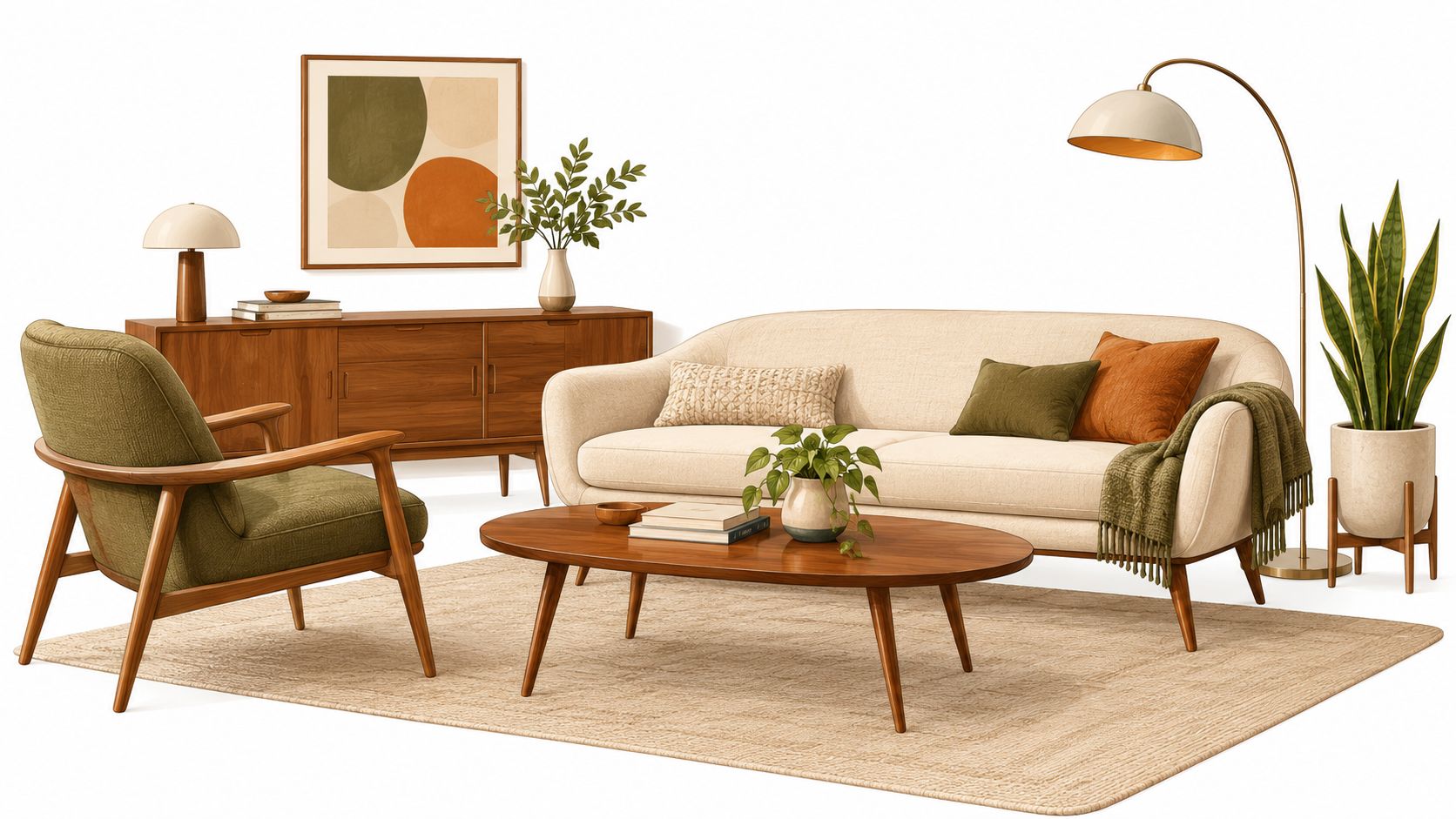
Custom furniture becomes a long-term purchase when its structure can withstand use and remain serviceable. Solid walnut, cherry, oak, and maple bring natural grain, tactile edges, and the ability to refinish a well-maintained piece. Solid wood furniture is generally stronger and more refinishable than engineered alternatives because it retains the structural character of the lumber itself. This practical comparison of solid wood and engineered wood explains that distinction in more detail.
The Hardwood Standard at Vinson centers strictly on solid hardwood furniture. The collection doesn't sell or promote engineered wood, MDF, laminate, or particle board. That position suits mid-century design particularly well because a sharp edge, visible grain line, or slender leg has nowhere to hide under heavy ornament.
Flooring matters, too. A carefully selected surface can either support the furniture's warmth or compete with it, so homeowners planning a complete renovation may find this guide to mid-century modern flooring helpful when coordinating wood tones and visual rhythm.
A custom dining table, bedroom case piece, or living room frame should feel like part of the home's architecture. For dining-specific inspiration and sizing considerations, explore Vinson's mid-century modern dining furniture.
Identifying the Key Design Elements of the Era
Authenticity doesn't require copying an iconic original. It requires recognizing which decisions create the style's visual language, then knowing which decisions can change without weakening it. Mid-century modern furniture usually feels lighter than traditional furniture because its geometry is deliberate, its ornament is restrained, and its legs create visible space beneath the frame.
The features worth protecting
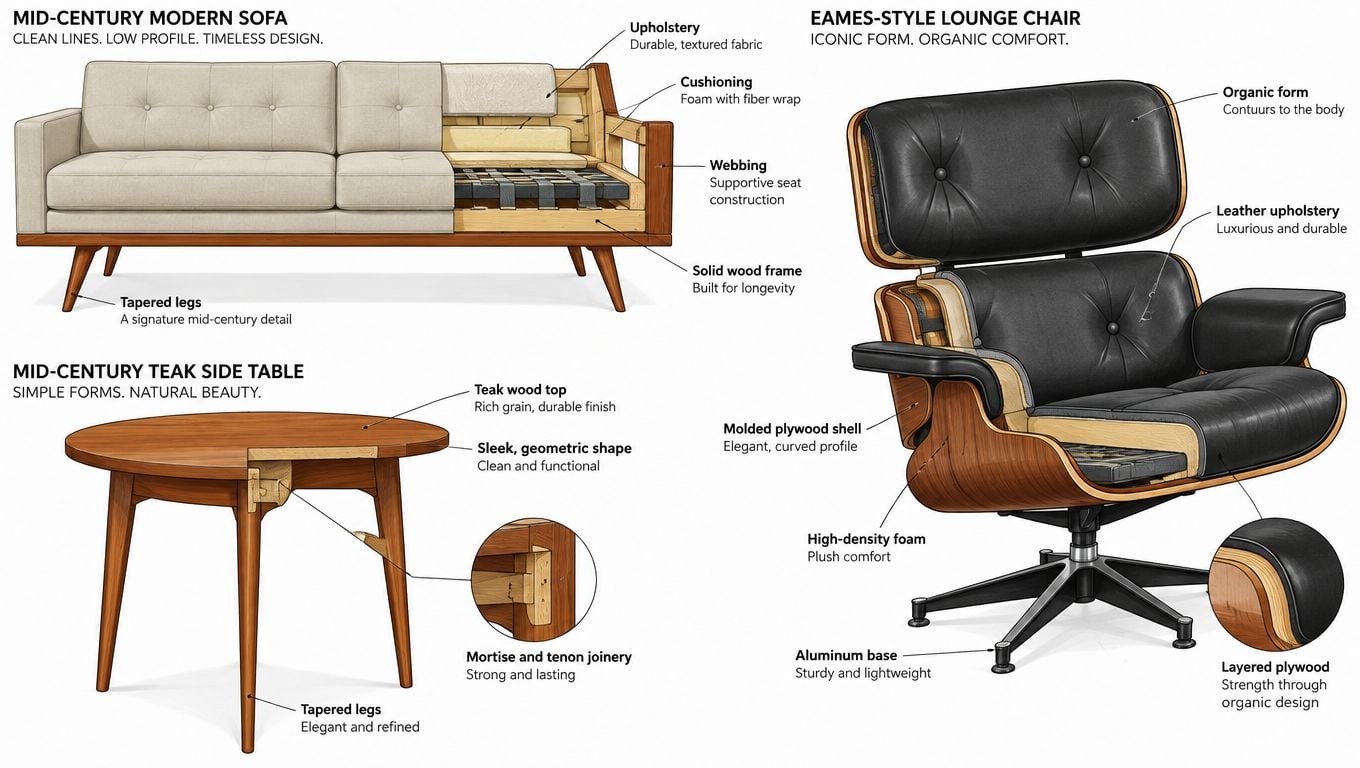
Low profiles ground a room and preserve sightlines. A sofa that sits close to the floor can make a living area feel calm and architectural, while a dining table with a visually open base keeps circulation clear. Raising every piece to gain storage or a more traditional presence may make the room practical, but it often removes the style's characteristic lightness.
Tapered legs are another essential. Their narrowing shape gives tables, chairs, and case pieces a sense of lift. The angle and thickness matter more than many buyers expect. A leg that is too heavy can make a refined walnut table look provincial, while one that is too delicate may not suit daily family use.
Organic curves soften the style's straight edges. A rounded chair back, gently shaped arm, or softly radiused tabletop can introduce comfort without turning the room ornate. Bold geometric forms should read as architectural statements, not decoration applied after the fact.
Customization without losing the style
A buyer can usually alter dimensions, upholstery, wood tone, and finish while retaining the core silhouette. The following choices tend to preserve the period's character:
- Keep the profile low: Adjust seat depth or table length before increasing the overall visual mass.
- Protect the leg language: Choose tapered, angled, or carefully inset supports rather than bulky bases.
- Limit ornament: Let grain, curve, and proportion create interest instead of adding excessive carving or hardware.
- Use contrast carefully: Warm hardwood paired with a restrained textile or leather can look authentic, while too many competing materials dilute the composition.
A bedroom can follow the same logic. Homeowners looking for practical ways to create a vintage bedroom can apply the principles to a solid walnut bed, a maple case piece, or a low-profile dresser without making the room feel staged.
For a closer look at related silhouettes and materials, review Danish mid-century modern furniture. The useful question isn't whether every detail is historically exact. It's whether the finished piece still communicates restraint, proportion, and purposeful craftsmanship.
Choosing the Right Solid Hardwood and Finish
Wood selection determines how a custom piece feels in changing light, how it relates to existing floors, and how gracefully it may age. Mid-century modern design benefits from visible grain, but “visible” doesn't mean every species should be treated the same way. Walnut, cherry, and maple each create a different atmosphere even when the form remains identical.
Vinson's hardwood standard keeps this decision focused on solid cherry, oak, maple, and walnut. Solid wood can generally be refinished and repaired over a long service life, which makes the species and finish worth considering as part of the home's broader material plan. Solid wood is also often regarded as a long-term investment because properly maintained pieces can serve for decades or generations and may retain resale value better than engineered alternatives. This discussion of solid wood's long-term value offers additional perspective.
Solid hardwood species comparison
| Species | Color Profile | Grain Appearance | Best For |
|---|---|---|---|
| Walnut | Deep brown with a naturally warm presence | Expressive, flowing grain with tonal variation | Sophisticated living rooms, dining tables, and statement case pieces |
| Cherry | Warm reddish tone that develops greater depth with age | Smooth grain with a refined, steady appearance | Traditional-to-modern interiors needing warmth and gradual patina |
| Maple | Light cream to pale honey tones | Subtle, even grain with a clean surface | Airy rooms, brighter dining spaces, and crisp modern contrast |
| Oak | Warm neutral tones with visible character | Open, pronounced grain | Homes seeking texture, durability, and a more grounded MCM interpretation |
Matching finish to daily life
A walnut table with a low-sheen finish can emphasize depth without looking glossy. Cherry can support a warmer, more settled room, while maple works well when the homeowner wants the furniture to remain visually quiet against brighter walls or natural textiles. Oak offers stronger grain presence, so it can anchor a room where upholstery and accessories stay restrained.
Finish selection should also reflect use. A dining table needs protection from plates, moisture, and repeated cleaning. A bedroom case piece may allow a more tactile surface because it faces less abrasion. The design studio can help coordinate the finish across visible components, which matters because mismatched color is especially obvious on clean-lined furniture.
Practical rule: Select the hardwood after considering the room's flooring, daylight, upholstery, and adjacent case pieces. A beautiful species can still feel wrong if its undertone fights the rest of the room.
For a deeper guide to grain, tone, and longevity, consult this explanation of choosing the right hardwood. The best choice isn't necessarily the darkest or most dramatic. It's the one that supports the silhouette and remains comfortable to live with.
Collaborating with Our In-Store Design Studio
A custom order works best when the homeowner makes decisions in a deliberate sequence. The In-Store Design Studio at Easton Town Center gives Columbus-area buyers a place to examine hardwood samples, sit in seating, compare upholstery, and discuss room dimensions with a design consultant. Complimentary Design Consultations help turn a broad preference for mid-century style into a specification that can be built.
Start with the room, not the catalog
Bring measurements, photographs taken in daylight, and notes about how the room functions. A dining area that hosts extended family needs a different table length and chair performance than a rarely used formal space. A compact living room may benefit more from a carefully sized sofa and swivel chair than from a large sectional chosen only for its appearance.
The consultation should establish:
- The primary function: Dining, lounging, reading, conversation, or several of these at once.
- The essential dimensions: Wall length, doorway clearance, walking paths, and table-to-seat relationships.
- The visual anchor: Walnut, cherry, maple, or oak, followed by upholstery and finish coordination.
- The comfort specification: Seat depth, cushion feel, arm height, and whether motion features matter.
Use visualization to test the compromises
The Custom Order Program supports fabrics, finishes, and 3D visualizers for brands including Smith Brothers of Berne, Canadel, and Mavin. A visualizer can't replace the sit-test, but it can expose proportion problems before production. A homeowner may see that a darker finish overwhelms a narrow dining room, or that a selected fabric makes an otherwise restrained chair too visually busy.
Smith Brothers furniture in Easton can be specified for American-made upholstered seating from Indiana. Mavin bedroom furniture brings Amish-made Ohio craftsmanship to bedroom planning, while Canadel's North American production in Quebec supports customized dining choices. These origins matter when buyers are balancing design preferences with manufacturing priorities.
A solid maple dining set may need a quieter fabric and a more pronounced leg profile to retain visual definition. A top-grain leather sectional may support a richer walnut table, especially when the leather has a soft, low-contrast finish. Homeowners can explore the process through Vinson's interior design consultation service, then confirm the final choices in person.
Navigating Timelines and Budget Considerations
Custom furniture rewards patience because the order contains decisions that a ready-made piece has already made on the buyer's behalf. The production schedule depends on the design, materials, upholstery, finish, and maker. American-made Smith Brothers pieces are produced in Indiana, while Mavin furniture is Amish-made in Ohio. Canadel is handcrafted in Quebec, Canada, making all three relevant to a North American-crafted furniture plan, though only Smith Brothers and Mavin belong in a USA-made selection.
Budgeting should begin with the room's highest-impact pieces. A dining table, sofa, or bed affects comfort and daily use far more than a minor accent. Buyers can then decide where customization creates genuine value, rather than paying for changes that won't improve proportion, durability, or long-term satisfaction.
A practical value framework
- Customize dimensions first: The correct length, depth, and height prevent expensive mistakes in small or irregular rooms.
- Choose the performance requirement: Top-grain leather and performance leathers suit households seeking durable upholstery, while carefully selected fabrics can provide softness and color flexibility.
- Spend on structure: Solid hardwood, sound joinery, reliable hardware, and a controlled finish matter more than decorative extras.
- Use clearance strategically: The Clearance Gallery offers savings of up to 70% on select pieces, as stated by Vinson's published overview. Clearance can make sense when the size and silhouette already work, even if the buyer gives up some customization.
- Check local pricing: Vinson's Low Price Guarantee provides a 110% refund on the price difference when a lower price is found at a local authorized dealer within thirty days, subject to the guarantee's terms.
Market context also shows why customization has moved beyond a niche purchase. One 2026 report estimated the global customized furniture market at USD 54.16 billion in 2025, projected to reach USD 112.48 billion by 2032 at an 11.00% CAGR. A separate report valued the global custom furniture market at USD 34,685.77 million in 2024 and forecast USD 73,136.50 million by 2032 at a 9.10% CAGR. These are projections and estimates, not a promise about any individual order. The customized furniture market report and the independent custom furniture market analysis show the broader category's direction.
Delivery is part of the purchase decision, not an afterthought. White-glove service commonly includes in-home placement, setup, and packaging removal, so buyers should confirm access, assembly, and inspection procedures before the order arrives.
For a clearer sequence from research through delivery, use this furniture buying journey guide. A written specification, including dimensions, finish, upholstery, and delivery expectations, protects both the buyer and the maker from avoidable confusion.
Integrating Custom Pieces into Your Living Space
A well-chosen piece shouldn't force an entire home into a period set. Consider a Columbus living room with an existing neutral rug, contemporary lighting, and a generous window. A low-profile solid walnut table can establish the mid-century reference without competing with the architecture. Add a top-grain leather sectional with motorized power motion for daily comfort, then soften the geometry with a swivel chair or a fabric rocker.
The room feels authentic because the important relationships remain intact. The table stays visually light, the seating avoids excessive ornament, and the hardwood introduces warmth. Modern performance enters through the upholstery and movement rather than through a change to the style's underlying form.
Build the room around one strong gesture
A dining room may start with a solid maple table and tapered base. Canadel's customizable dining approach allows the buyer to consider table shape, base style, chair style, and color, which makes it possible to tailor the composition to the room rather than force a fixed arrangement. The homeowner can then repeat a restrained wood tone in a nearby cabinet or bedroom piece without matching every surface exactly.
In the living room, custom leather sectionals Columbus homeowners choose should be assessed by more than seat count. Motorized reclining, swivel components, and carefully placed rockers or gliders can support different routines while preserving a clean silhouette. Premium motion features work best when the hardware remains visually quiet and the sectional's proportions stay controlled.
Let comfort modernize the period reference
A bedroom can combine a low solid walnut bed with custom bedding and a Mavin case piece in a related finish. A contemporary mattress and supportive upholstery don't undermine the design. They make the room usable, which is the central mid-century principle in the first place.
White-Glove Delivery helps complete the transition by placing and assembling the furniture and removing packaging. After installation, the homeowner should check sightlines from the entry, clearance around moving parts, and the balance between wood and upholstery before adding smaller objects. The furniture should carry the room through proportion and material, not through a crowded collection of references.
Vinson Fine Furniture offers solid hardwood construction, custom orders for Smith Brothers, Canadel, and Mavin, an Easton In-Store Design Studio with complimentary consultations, premium leather and motion seating, White-Glove Delivery, and Clearance Gallery savings up to 70%. Visit Vinson Fine Furniture to schedule a sit-test and shape mid-century modern furniture around the rooms, materials, and daily routines that matter most.