Custom End Tables: A Complete 2026 Guide

A homeowner can spend an afternoon measuring the empty corner beside a deep sectional, only to discover that every ready-made table creates a different problem. One leaves a noticeable gap beside the arm, another blocks the walking path, and a third looks undersized next to the chaise. The room doesn't need another decorative object. It needs a surface that fits the way people sit, reach, walk, read, and relax.
That's the purpose of custom end tables. A made-to-order piece can coordinate its wood, finish, height, depth, and footprint with the room instead of forcing the room to accommodate a fixed size. The broader custom furniture market reflects how established this buying pattern has become. One analysis projects global custom furniture growth from $23.51 billion in 2021 to $74.60 billion by 2033, at a 10.1% CAGR, and estimates the United States represented about 21.0% of global demand in 2025 (Cognitive Market Research custom furniture analysis).
For an investment homeowner in Columbus or Central Ohio, the practical questions are straightforward. Which hardwood species suits the room? How much clearance is needed? Which joints support long-term use? And when does custom ordering make more sense than choosing an in-stock piece?
Why a Custom End Table Earns Its Place in Your Living Room
The problem is usually proportion, not style
A deep sectional can have a broad arm, a projecting chaise, or a narrow side return that makes standard table dimensions awkward. An attractive table may still sit too far from the seat, intrude on the walking route, or disappear beside an oversized sofa. Custom sizing addresses the relationship between upholstery, walls, lighting, and movement through the room.
The same issue appears in smaller spaces. A reading nook may leave only a slim strip between a chair and a baseboard heater. A low outlet may occupy the spot where a table leg would normally land. A tall-backed sofa may need more tabletop depth for a lamp, while a narrow room still requires a restrained footprint.
Start by defining the table's daily job:
- Reachable surface: It should hold a drink, reading material, a remote, or a small lamp without requiring a stretch.
- Clear walking route: It should leave enough room to pass beside a sectional without turning sideways.
- Visual anchor: Its scale should look intentional beside the sofa, not like a temporary filler.
- Stable support: Its construction should handle repeated daily use without feeling fragile.
Practical rule: Measure the furniture and the movement around it before choosing a silhouette. A beautiful table with the wrong footprint will remain inconvenient.
Customization solves the room's exceptions
Stock furniture suits rooms with familiar proportions. Custom work earns its place when a room has an exception. A compact table can be narrowed for a tight corner, deepened for a tall-backed sofa, or shaped to follow the angle of a sectional return. The finish can also coordinate with millwork, flooring, cabinetry, or a dining set without making the table look copied from a catalog.
The broader preference for made-to-order furniture has moved beyond occasional luxury purchases. One global market report values customized furniture at $39.55 billion in 2025 and projects $110.12 billion by 2034, implying a 12.05% CAGR (First Chair market overview). Because market reports may define the category differently, this single projection is best read as an indication of expanding interest, not as a universal baseline for every custom-furniture estimate.
The living room provides a clear test because the table receives constant use. Before a showroom consultation, review living room essentials and bring measurements of the sofa, walls, outlets, nearby paths, and any lamp you plan to place on the table. That information helps the designer solve the room's actual constraints instead of designing from an empty floor plan.
Solid Hardwood, Joinery, and What Makes the Build Last
A hardwood end table is to an upholstered chair what a brick foundation is to a frame house. The surface receives the daily activity, but the joints and rails determine whether the table stays square, steady, and repairable through years of use.
Solid hardwood refers to boards milled from a hardwood species such as cherry, oak, maple, or walnut. Those boards respond to moisture and seasonal changes, so responsible construction requires careful stock preparation, sound joinery, and a finish suited to the material. A furniture standard recommends solid-wood moisture content in the 8% to 12% range and finished wooden section tolerances of +2 mm (furniture standard for wooden tables).
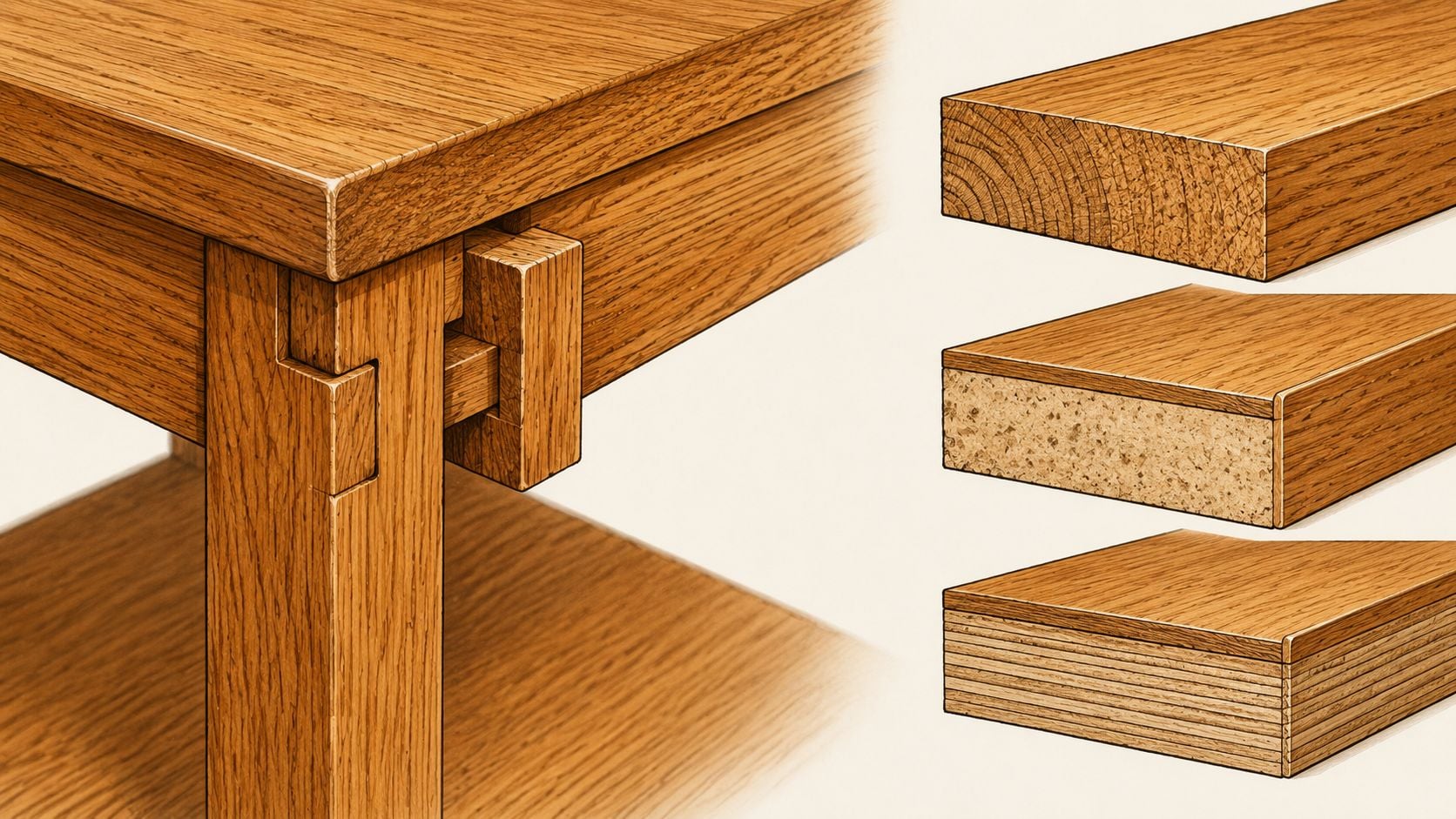
Joint vocabulary made simple
- Mortise-and-tenon: A projecting tenon fits into a matching mortise. The joint transfers force through wood surfaces rather than depending on fasteners alone.
- Dovetail: Interlocking pins and tails resist being pulled apart. This is especially useful in drawers.
- Dowel: A round wooden pin aligns adjoining parts and adds strength when the holes are accurately drilled and glued.
- Pocket-hole: An angled screw joins two components from a concealed position. It can be useful in some applications, but it doesn't provide the same interlocking geometry as a well-fitted mortise-and-tenon joint.
Amish-made construction often emphasizes glued and clamped frames, carefully fitted components, and joinery that keeps the load distributed through the hardwood. A buyer who wants a more technical explanation of material selection can consult this resource on the importance of premium hardwood.
Why repairability changes the value equation
A properly made solid-wood table can be sanded, refinished, and repaired when its surface eventually shows use. Traditional joinery also gives a craftsperson a practical way to address a loose connection instead of treating the entire piece as disposable. The result is furniture designed for serviceability, not just first-day appearance.
Vinson Fine Furniture's various wood joints guide offers a useful reference for buyers who want to recognize these construction terms before placing a custom order.
Choosing the Right Wood Species for Your Custom End Table
Vinson keeps wood selection focused on solid cherry, oak, maple, and walnut. Each species creates a different visual rhythm and responds differently to family life, lighting, and the desired finish.
Brown maple has a relatively smooth, quiet grain that works particularly well when the finish should feel calm or painted. It suits a room where the table needs to coordinate with upholstery and cabinetry without demanding attention. Its restrained surface also helps a shaped leg or distinctive edge profile remain the main detail.
Red oak brings pronounced grain and a familiar traditional character. It works comfortably in classic living rooms and spaces that already contain visible wood texture. The open grain gives a custom table a more expressive surface, especially when the finish is selected to preserve rather than conceal that pattern.
Quarter-sawn white oak is valued for its distinctive ray fleck and stable visual character. It offers a more refined, architectural appearance and can support a room built around clean lines, substantial upholstery, and carefully chosen millwork.
Rustic cherry begins with warmth and develops a richer appearance as it receives sunlight. It suits homeowners who want the table to gain patina rather than remain visually static. The knots and natural variation create a more relaxed, collected feel than a uniform surface.
A buyer choosing between maple and walnut can review walnut versus maple wood for a closer look at their differing character.
| Hardwood Species Comparison for Custom End Tables | Grain Character | Janka Hardness | Best Use |
|---|---|---|---|
| Brown maple | Smooth, understated grain | Confirm with the showroom for the selected board | Painted or quiet coordinated finishes |
| Red oak | Prominent, traditional grain | Confirm with the showroom for the selected board | Classic living rooms and visible texture |
| Quarter-sawn white oak | Ray fleck and structured grain | Confirm with the showroom for the selected board | Architectural, tailored interiors |
| Rustic cherry | Warm grain with natural variation | Confirm with the showroom for the selected board | Rooms where rich patina is welcome |
Janka hardness can vary by species and board selection, so the showroom should confirm the specific rating when dent resistance is a deciding factor. The more important first decision is whether the table should recede into the room or contribute a clear wood statement.
Sizing and Proportional Fit for Real Rooms
The sofa or sectional should set the starting point. A useful target is a tabletop within two inches of the seat height, while depth should relate to the sofa arm rather than follow an arbitrary standard. Common sofa-arm depths fall around 22 to 28 inches, but a room with a narrow passage may require less.
Walking clearance deserves equal attention. Aiming for 36 inches of walking clearance helps preserve a comfortable route through the living room, although the exact solution depends on the room's doors, chaise, and traffic pattern. A table that technically fits between two pieces can still make the space feel cramped if people must turn sideways to pass.
Adjusting for difficult layouts
A narrow sectional return under 18 inches can make a square table look too deep. In that situation, a slim rectangular or half-round top may preserve reach without pushing into the walkway. A tall-backed sofa may need additional depth so a lamp sits securely instead of balancing near the front edge.
Tight corners often benefit from a table around 14 inches wide when a larger footprint would pinch the passage. Oversized sectionals create the opposite challenge. A standard 22-inch square table can look visually lost beside deep, substantial upholstery, so a top between 26 and 30 inches wide with heavier visual weight often feels more proportional.
Room-planning insight: The best custom size is the largest surface that preserves the walking route and keeps the user's reach natural.
Leave at least three inches between the table edge and the wall when the layout permits. That small separation prevents a crowded sightline and gives the piece enough breathing room to read as furniture rather than an obstruction.
| End Table Dimensions by Sofa Style | Recommended Top Width | Recommended Depth | Recommended Height |
|---|---|---|---|
| Compact sofa or apartment seating | 14 to 20 inches | 16 to 22 inches | Within 2 inches of seat height |
| Standard sofa | 20 to 26 inches | 22 to 28 inches | Within 2 inches of seat height |
| Narrow sectional return | 14 to 18 inches | Sized to preserve the passage | Within 2 inches of seat height |
| Oversized sectional | 26 to 30 inches | Proportional to the arm and chaise | Within 2 inches of seat height |
Before visiting the showroom, the buyer can use how to measure furniture to record sofa height, arm depth, wall distance, outlet locations, and the intended walking path.
How the Custom Order Program and Design Studio Work
A first-time buyer doesn't need to arrive with a finished design. The process works best when the room's measurements, a few photographs, and a clear description of daily use come first.
The showroom visit establishes the brief
At the Easton showroom, a design advisor can review the room, sketch the layout, and identify constraints such as a chaise return, outlet, heater, or unusually deep arm. Material samples from partner lines including Howard Miller, Amish Heritage, and ClassicFlame can help establish the surrounding room's visual language, even when the end table itself requires a different specification.
The same conversation can expand to the Custom Order Program for fabrics, finishes, and 3D visualizers across brands such as Smith Brothers, Canadel, and Mavin. Smith Brothers of Berne is made in Indiana, Mavin is Amish-made in Ohio, and Canadel is handcrafted in Quebec, Canada. Those distinctions help buyers evaluate American-made and broader North American craftsmanship without treating every product line as interchangeable.
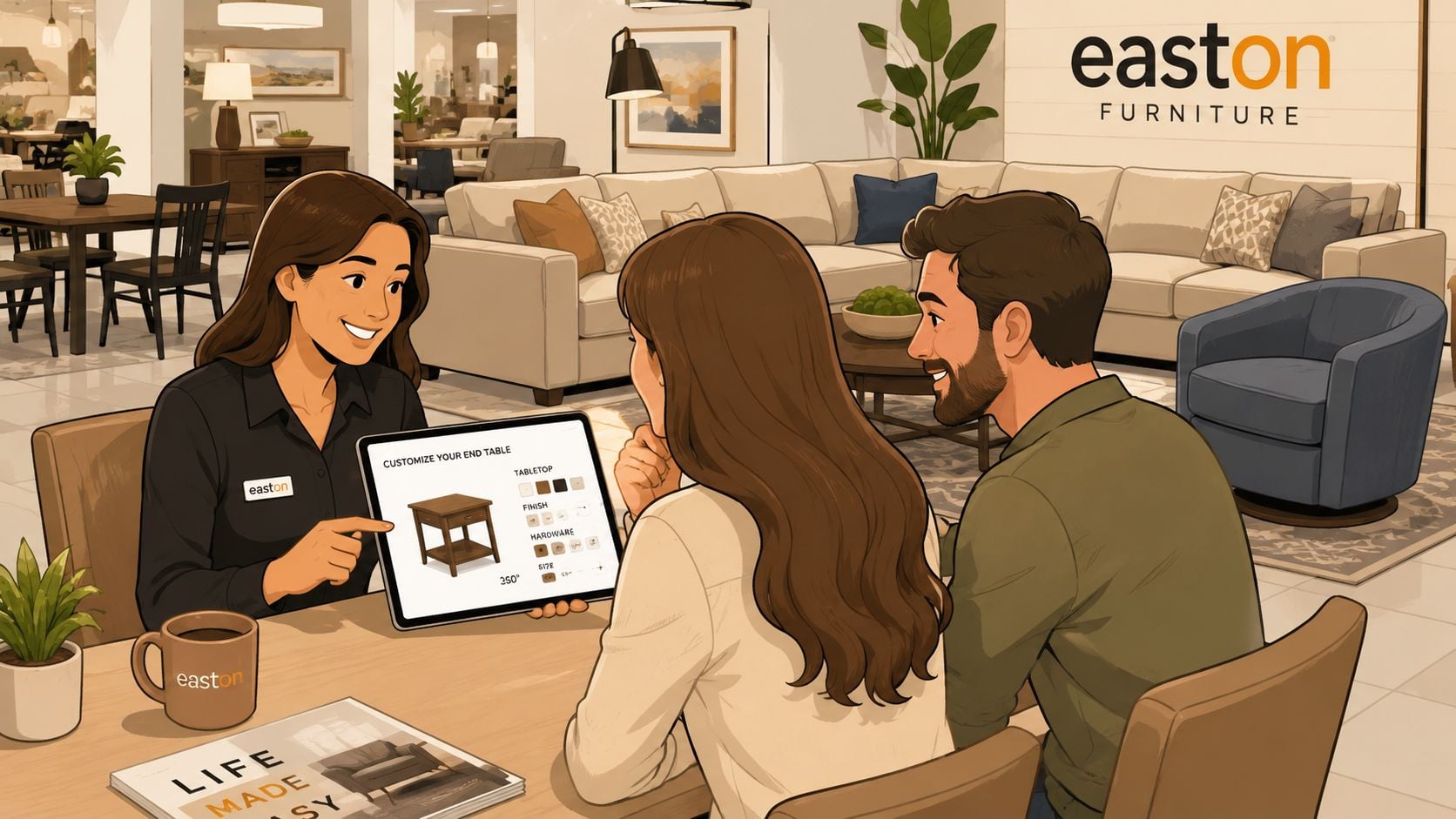
The visualizer turns abstract choices into decisions
In the In-Store Design Studio, a buyer can test wood species, stains, edge profiles, and hardware pulls against a photograph of the actual room. That step helps resolve questions that small samples can't answer alone. A warm cherry finish may feel right at the showroom table but compete with red-toned flooring at home, while a quieter maple finish may integrate more naturally.
The buyer can also specify practical features:
- Storage: A drawer for remotes or reading glasses.
- Open display: A lower shelf for books or a basket.
- Mobility: Casters where the layout changes frequently.
- Connectivity: A charging port when the table serves a reading chair or sectional seat.
A structured design process should make the specification clear before production. Readers interested in the broader discipline can review this overview of professional product design for manufacturers.
The order becomes a documented build
The formal quote records dimensions, species, finish, and hardware. After the deposit and order submission to the Amish workshop, the showroom provides progress communication and confirms the piece after inspection and crating. The build timeline is roughly eight to twelve weeks, depending on queue length and finish complexity.
Complimentary design consultations remain useful even when the final purchase is a different piece. The interior design consultation process gives buyers a place to test proportional ideas before committing to a specification.
Pricing Factors, Clearance Savings, and the Low Price Guarantee
Custom pricing reflects labor, material, and function rather than a single flat rate. Four choices usually shape the quote most directly.
Wood species affects both appearance and material selection. Brown maple and rustic cherry generally sit at a different price level from premium walnut or quarter-sawn white oak. Dimensions and thickness matter because a larger top or more substantial slab requires more material, preparation, and finishing work.
Finish complexity adds labor when the order calls for multiple stain steps, hand-rubbed treatments, or a more involved protective finish. Hardware and functional upgrades also change the build, particularly when a drawer needs soft-close hardware, a top includes a grommet, or the base incorporates hidden casters.
A practical quote should separate those elements instead of presenting one mysterious total.
Where value appears
Some buyers need an exact size and finish. Others need a finished table quickly. The Clearance Gallery serves the second group, with savings of up to 70% on eligible floor samples, overstocks, and seasonal closeouts. Clearance trades customization for immediate availability, but it can still offer a solid value when the existing dimensions work.
Vinson's Low Price Guarantee provides another point of protection. The policy includes a 110% refund when its qualifying price terms are met, giving buyers a reason to verify comparable pricing on identical solid-hardwood construction before finalizing a purchase.

Consider ownership, not only checkout price
A solid hardwood table can be repaired, refinished, and kept in service when its surface shows wear. That makes the total ownership calculation different from a purchase judged only by the first invoice. The right question is whether the table's construction, dimensions, and finish will continue serving the room as the household changes.
The same evaluation applies across a full furnishing plan. Buyers comparing an occasional table with premium motion pieces should also assess top-grain and performance leathers, motorized reclining features, swivel chairs, rockers, and gliders by their construction and expected use. The highest value usually comes from buying the feature that solves a real daily problem, not from adding options for appearance alone.
Lead Times, White-Glove Delivery, and Long-Term Care
A custom table's ownership begins before delivery. The build window is commonly described as six to twelve weeks for this type of order, depending on species and finish complexity, while the showroom's custom-order path may be quoted at eight to twelve weeks based on the workshop queue and specification. Buyers should treat the written order confirmation as the controlling timeline because finish details and production schedules can vary.
White-glove delivery is designed for a finished piece that deserves careful handling. The service typically includes inside delivery, room-of-choice placement, unpacking, light assembly or installation, inspection, and removal of packaging debris.

Inspect before the crew leaves
A careful delivery workflow includes pre-dispatch validation of dimensions, route planning, placement, assembly, and a post-install inspection. The customer should check the tabletop, edges, legs, alignment, and any drawer or door movement before signing off.
For ongoing care, a simple routine protects the finish:
- Dust gently: Use a clean microfiber cloth rather than a rough material.
- Manage sunlight: Rotate the table when practical so exposure isn't concentrated on one side.
- Condition thoughtfully: Apply a paste wax suited to the selected species and finish every six to nine months, after confirming compatibility with the maker.
- Watch seasonal movement: Slight gaps can occur as wood responds to indoor conditions. Ask the showroom or craftsperson before tightening or adjusting joinery.
Avoid aggressive cleaners
Silicone polishes can leave residue that complicates refinishing, and ammonia-based sprays may damage some finishes. A water ring should be addressed promptly with a dry cloth and the manufacturer's recommended method rather than treated with an improvised abrasive.
The point of care isn't to keep a table frozen in showroom condition. It's to let the hardwood develop character while protecting the joints, finish, and surfaces that make the piece useful for decades.
Bringing Your Custom End Table Home
The decision becomes manageable when four elements agree: species, dimensions, finish, and hardware. Species establishes grain and long-term visual character. Dimensions respond to the sofa arm, the sectional chaise, the lamp, and the walking route. Finish should relate to nearby flooring, millwork, or cabinetry, while hardware should feel at home beside existing pulls and metal details.
A custom end table earns its place when stock proportions don't. A narrow side return may need a compact top. An oversized sectional may require a broader, heavier table. A tight corner may call for a shaped edge or a slim footprint instead of a familiar square. Those are practical design decisions, not decorative indulgences.
The Easton sit-test reveals what measurements miss
A visit to the Easton Town Center showroom allows a buyer to compare hardwood samples at eye level, feel edge profiles, examine finish depth, and test the reach from an actual seat. A design advisor can sketch proportional options on the floor and discuss whether a drawer, shelf, charging port, caster, or clean open base best fits the room.
The same showroom conversation can support a broader furnishing plan. The Custom Order Program covers fabrics, finishes, and 3D visualizers for Smith Brothers, Canadel, and Mavin. It can also help coordinate a custom table with solid hardwood dining furniture, Mavin bedroom furniture, or a living room built around Custom leather sectionals Columbus shoppers can sit-test in person. For buyers comparing motion seating, the relevant options include motorized or power reclining, swivel chairs, rockers, and gliders, with top-grain and performance leathers available for different use patterns.
Buyers outside Columbus can begin with remote planning, then use the Design Studio tools to refine dimensions and finish choices before arranging the final order. Local homeowners should bring room measurements and photographs to a Complimentary Design Consultation so the conversation starts with the actual space rather than a generic display.
The right custom table won't just fill an empty corner. It will make the sofa easier to use, preserve the room's circulation, and bring solid hardwood craftsmanship into a part of the home touched every day.
Vinson Fine Furniture offers solid hardwood customization, an In-Store Design Studio, Complimentary Design Consultations, the Custom Order Program, Clearance Gallery savings up to 70%, and white-glove delivery for carefully planned rooms. Visit Vinson Fine Furniture in Easton Town Center to sit-test finished pieces, review proportional options, and begin a custom end table consultation.