Walnut vs Teak: Which Hardwood Is Right for Your Home?


A couple in Columbus is making two decisions at once. Their dining room needs a substantial table for family meals, while the covered patio needs seating that can handle humidity, spilled drinks, and changing weather. Walnut looks right under the dining-room chandelier. Teak seems better suited to the patio. The core question isn't which species wins. It's whether each wood is being asked to do the right job.
That distinction matters with premium furniture. Walnut and teak are both solid hardwood choices, but they reward different habits, room conditions, and maintenance expectations. Walnut brings depth, warmth, and a refined grain to indoor furniture. Teak brings moisture resistance and dimensional stability to spaces where water, sunlight, and daily abuse are part of ownership.
For Columbus homeowners comparing walnut vs teak, the decision should come down to appearance, hardness, indoor or outdoor exposure, finishing, maintenance, value, and responsible sourcing. The following guide turns those considerations into practical recommendations, then connects them to customizable North American-made furniture available through Vinson's Easton Town Center showroom.
Two Premium Hardwoods, Two Very Different Jobs
The couple comparing a walnut dining table with a teak patio set isn't choosing between a good wood and a bad one. They're choosing between two materials with different strengths. Walnut is usually the stronger visual choice for an heirloom dining room, where its dark color and fine grain can anchor the space for years. Teak is the more practical choice for a covered porch or outdoor-adjacent room, where moisture movement and finish failure can create constant frustration.
Walnut has earned its reputation in fine furniture because it works cleanly, accepts polish and stain well, and offers good dimensional stability. The American Hardwood Information Center's walnut guide describes walnut as a medium-density hardwood that works well with hand and machine tools, fasteners, and adhesives. Its straight, fine grain suits furniture and cabinetmaking, especially when a buyer wants shaped edges, carefully matched boards, or detailed joinery.
Teak answers a different problem. Its natural oil content helps it resist warping and decay, which makes it a logical material for wetter environments and outdoor furniture. FAO data summarized in this Janka hardness and wood reference shows teak's importance in global specialty hardwood markets. Between 2005 and 2014, annual teak roundwood trade averaged more than 1 million cubic meters, with imports valued at about US$487 million per year. In 2013, teak roundwood imports reached about US$720 million, representing 13.4% of tropical industrial roundwood import value.
Showroom rule: Walnut belongs where color and grain receive protection. Teak belongs where moisture resistance earns its keep.
The wrong selection can force refinishing, sanding, or replacement sooner than expected. The right selection feels almost effortless because the wood's natural behavior matches the room. Buyers can explore the broader principles behind long-lasting solid wood pieces in Vinson's guide to choosing hardwood for longevity and style.
How Walnut and Teak Look and Age Over Time
A walnut dining table suits a homeowner who wants the room's color and grain to stay central. Its heartwood typically runs from chocolate brown to purplish brown, while occasional blonde sapwood adds contrast along the board. The grain is tight and refined. With the right finish, the surface shows a soft luster instead of a mirror-like shine. Walnut works especially well with painted millwork, warm metals, textured upholstery, and lighter flooring.
Teak begins brighter, with golden-brown to medium-honey tones, straight grain, and a naturally oily surface. Outdoors, sunlight gradually turns it pale gray. That silver patina suits owners who want relaxed, established character and do not want to keep restoring the original color.
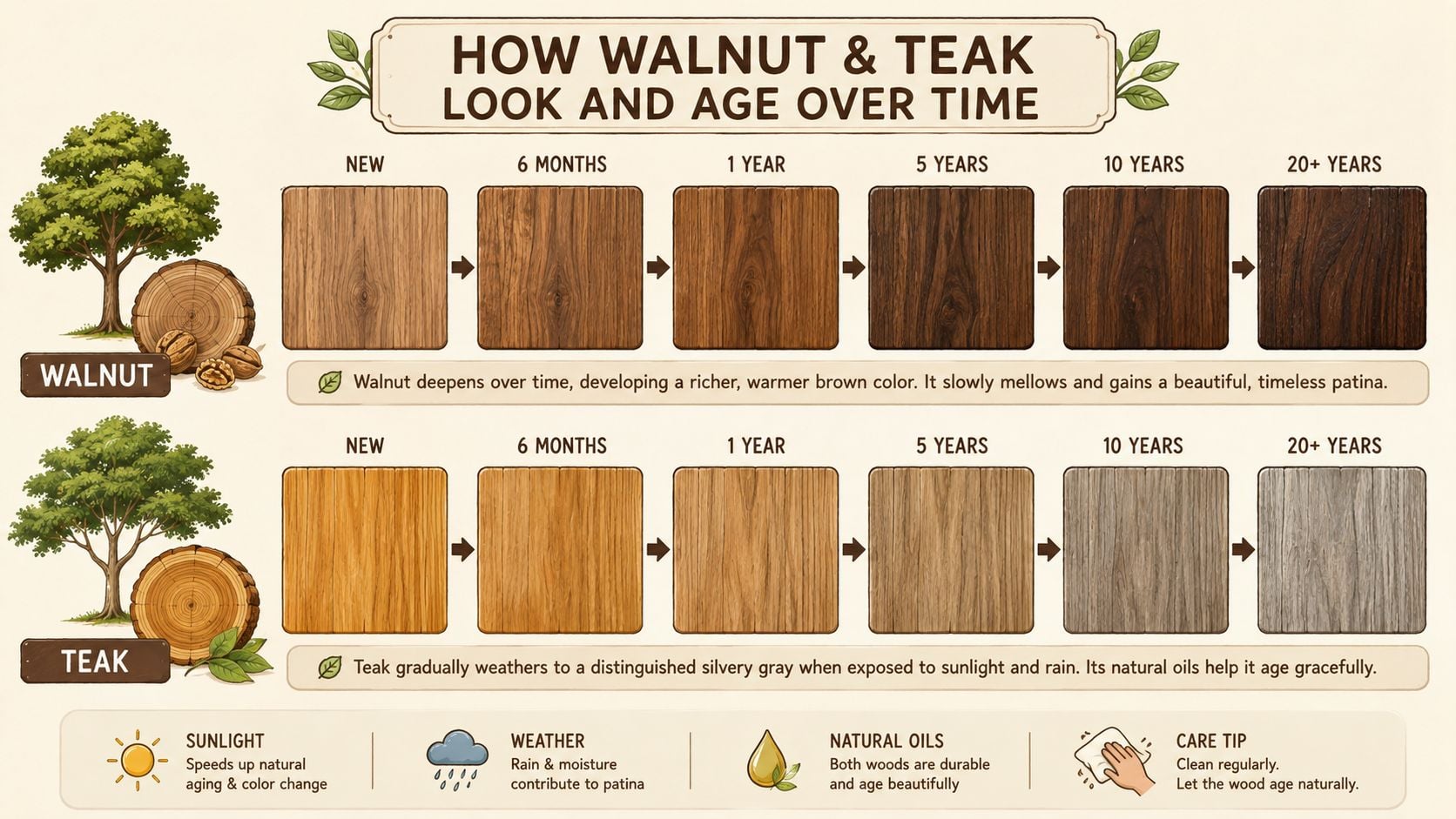
Color, grain, and finish behavior
Walnut usually accepts pigment evenly. A clear finish protects its natural depth, while a compatible stain can make the tone darker or warmer without obscuring the grain. Teak's oil content limits penetration, so makers typically choose a suitable surface finish or oil instead of treating it like walnut.
Choose walnut when preserving a rich brown tone matters, especially near a bright window. Choose teak when you are comfortable either maintaining its honey color or letting it weather naturally. The choice sets the care routine from the start.
In a walnut dining room, place the table away from harsh direct sun where possible, and use window coverings to reduce fading. Area rugs can help protect the surrounding interior from strong light, while a walnut bedroom suite can work in a bright room if direct exposure is managed.
Teak earns its place in a sunroom, covered porch, or transitional space where a silvery patina complements stone, woven textures, and neutral upholstery. At Vinson, that makes walnut the stronger fit for a protected interior centerpiece, while teak suits a relaxed setting built around changing light and outdoor influence. Review Vinson's explanation of walnut wood color before selecting a walnut finish.
Hardness, Density, and Structural Performance
Janka hardness measures resistance to denting, not whether a wood suits the room. Walnut and teak both handle demanding furniture use, but they solve different problems. For a dining table in a controlled interior, walnut has enough hardness for plates, serving pieces, and daily contact. For humid or outdoor-adjacent settings, teak's density, oil content, and dimensional stability matter more than a modest difference in dent resistance.
Reference charts place teak near 1,080 lbf and black walnut near 1,010 lbf. Another comparison lists teak at 1,155 lbf and walnut at 1,010 lbf. Teak is usually the slightly more dent-resistant option, although figures vary by source and material.
What the numbers mean in daily use
A furniture-materials reference lists teak at approximately 0.65 g/cm³ density, bending strength around 14,000 to 16,500 psi, radial shrinkage near 2.6%, tangential shrinkage near 5.3%, and Class-1 natural durability. A walnut study reports average density of 0.52 g/cm³, bending strength of 102.3 N/mm², and Janka values of 59.2 N/mm² across the cross section and 39.3 to 37.0 N/mm² along radial and tangential sections. These figures appear in the furniture material standards reference.
| Property | Walnut | Teak |
|---|---|---|
| Common Janka hardness | About 1,010 lbf | About 1,080 to 1,155 lbf |
| Approximate density | 0.52 g/cm³ in the cited walnut study | About 0.65 g/cm³ |
| Bending strength | 102.3 N/mm² in the cited study | About 14,000 to 16,500 psi |
| Radial shrinkage | Not stated in the verified data | Near 2.6% |
| Tangential shrinkage | Not stated in the verified data | Near 5.3% |
| Natural durability | Solid interior hardwood performance | Class 1 natural durability |
For a walnut dining table, moderate hardness supports shaped edges and detailed joinery while remaining sturdy for normal indoor use. Teak's lower shrinkage and natural oils give legs and joints more tolerance in humid, outdoor-adjacent conditions. Buyers comparing several hardwood species can also consult this maple hardwood hardness guide, while keeping the final decision focused on walnut or teak.
At Vinson, that distinction guides the recommendation. Choose walnut for a protected interior centerpiece where construction detail and everyday comfort lead. Choose teak when humidity, changing conditions, and less demanding structural care shape the brief. For broader exterior hardwood planning, Ipe decking for Guelph homeowners reinforces the same point: exposure, structure, and maintenance expectations matter alongside hardness.
Indoor vs Outdoor Suitability at a Glance
A walnut table belongs in a controlled interior where its color, grain, and joinery can take center stage. Use it in a dining room, living room, or bedroom, with reasonable protection from standing moisture and strong direct sun. Walnut suits homeowners who want a refined centerpiece and are willing to keep its finish looking cared for.
Teak fits homes where furniture must handle changing conditions. Covered porches, sunrooms, mudrooms, and bath-adjacent spaces all make sense. Its natural oils improve moisture tolerance, and its dimensional stability gives it more room to handle humidity shifts. Placement and construction still matter, but teak is the safer choice for exposure.
| Criterion | Walnut | Teak |
|---|---|---|
| Best setting | Refined, climate-controlled interiors | Covered or moisture-prone areas |
| Moisture tolerance | Moderate and finish-dependent | High, supported by natural oils |
| Appearance | Deep brown tones with fine grain | Honey brown, aging toward silver-gray |
| Care expectation | Regular attention to the finish | More forgiving in exposed locations |
| Lifestyle fit | Design-led indoor furnishing | Flexible furnishing for changing conditions |
The crossover cases
Walnut works in a four-season room when the space stays reasonably stable. It also suits a carefully finished kitchen or dining area, provided spills are handled promptly and the surface is not left wet.
Teak can move indoors without looking out of place. Choose it for warm grain, a relaxed material palette, or the silver-gray character it develops over time. A teak table works especially well in a sunroom with natural stone, linen, or woven textures. Indoors, select teak for its visual identity and tactile presence, not because it can tolerate outdoor conditions.
The better question is how the room is used. A homeowner hosting formal dinners in a protected dining room should choose walnut. Someone furnishing a breezy transition zone or a room with uneven humidity should choose teak.
For a broader room-by-room framework, Vinson's guide to essential outdoor furniture pieces helps distinguish furniture that needs weather-ready construction from pieces that only need a durable indoor finish. At Vinson, that distinction connects the wood choice to the homeowner's daily routine, not just the room label.
Finishing, Maintenance, and Long-Term Care
Walnut and teak ask for different kinds of attention. Walnut accepts oil, lacquer, and compatible stains evenly, so the finish can be selected to emphasize its chocolate tone or create a slightly deeper appearance. Teak's oil content makes stain penetration less predictable, and many owners choose either a natural weathered surface or a teak-specific oil designed to preserve warmer color.
Walnut near windows deserves particular care. Published comparisons note that walnut is more vulnerable to sunlight and moisture movement than teak, which means finish quality, room exposure, and daily habits all influence the result. Teak handles humidity better, but that advantage doesn't excuse neglect of joints, fasteners, or surface cleaning.
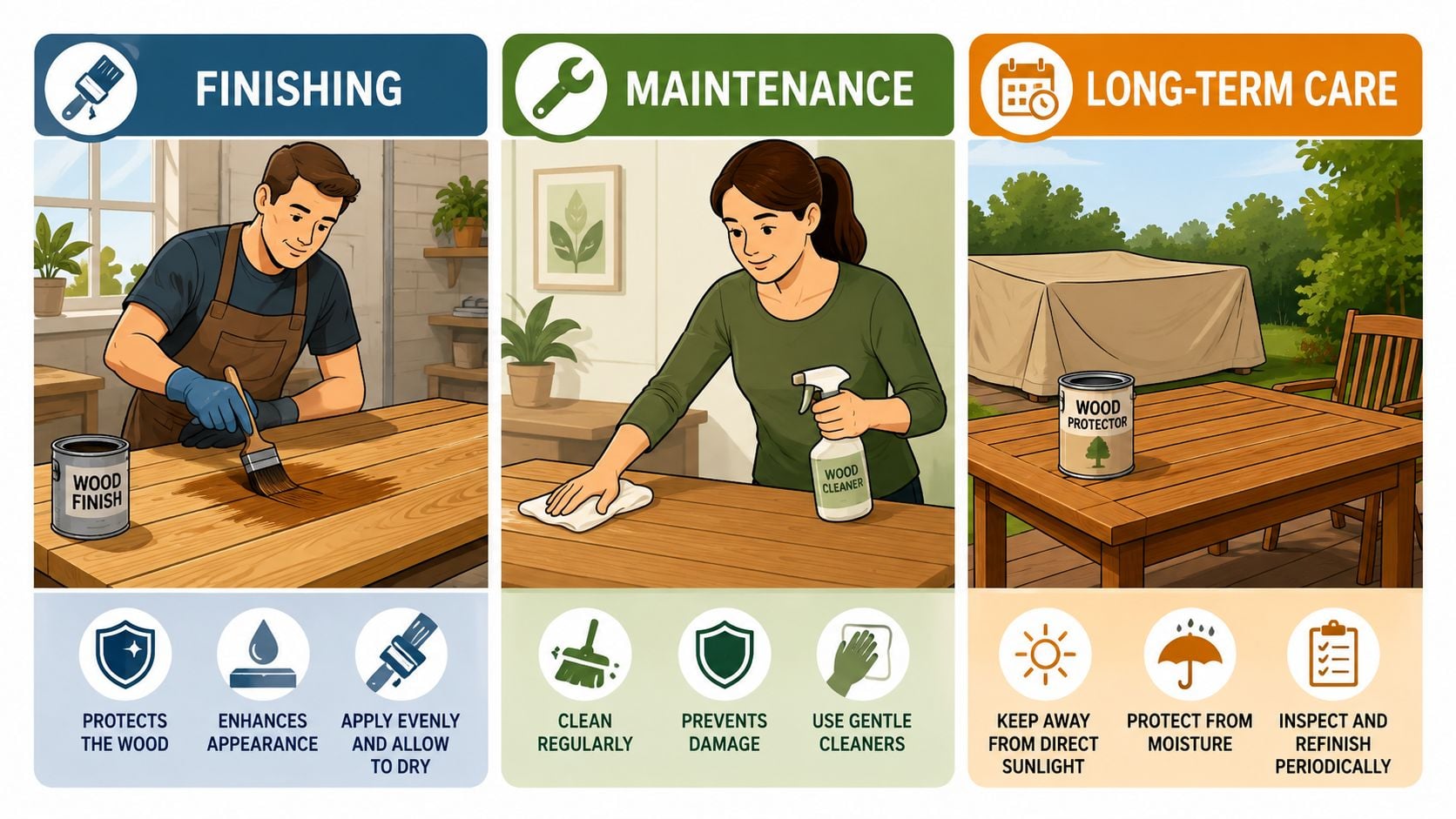
A practical care routine
- Dust gently: A dry microfiber cloth removes surface grit without scratching the finish.
- Handle spills promptly: Water rings and damp patches should be addressed within 30 minutes as a practical household rule.
- Avoid silicone polishes: Silicone can complicate future refinishing and may leave an artificial surface feel.
- Skip steam mops: Steam forces heat and moisture into joints and finish layers, making it unsuitable for solid wood furniture.
- Choose the finish deliberately: Walnut generally benefits from a protective interior finish, while teak owners can choose between preserving honey tones and accepting natural patina.
Walnut rewards consistency. Owners who manage direct sun, use coasters, clean carefully, and follow the maker's finish recommendations can preserve its appearance for a long time. Teak rewards restraint. In moisture-prone settings, a hands-off approach often works better than repeated aggressive polishing.
Homeowners considering exterior finishing decisions can use this guide to compare deck staining options, then keep furniture maintenance separate from deck-care products. For indoor pieces, Vinson's wood furniture care guide provides a more appropriate framework for cleaning and protecting finished surfaces.
Matching Each Wood to the Right Room and Lifestyle
Walnut wins when the room calls for visual depth. A formal dining room with a chandelier, upholstered chairs, and painted cabinetry benefits from walnut's darker tone and controlled grain. The same logic applies to a statement bedroom suite, where the wood can give the space a quiet, refined quality without relying on ornate decoration.
A walnut dining set from Smith Brothers of Berne, made in Indiana, USA, fits the American-made side of that decision. Its place in a controlled-humidity room matters as much as the species. A household that values consistent color, rich grain, and a surface that coordinates with surrounding millwork should choose walnut and accept the need for attentive indoor care.
Where teak makes more sense
Teak earns its place in covered patios, three-season porches, mudrooms, and bath-adjacent areas. It also suits vacation homes that aren't climate-controlled year-round, families with small children, and coastal properties where moisture exposure is part of the environment rather than an occasional accident.
A Canadian-made option such as Canadel, handcrafted in Quebec, can suit buyers designing a North American dining environment around teak's warmer character. The wood can also work indoors when the homeowner specifically wants its golden grain or eventual patina, rather than trying to make it imitate walnut.
For households weighing species choices alongside refinishing expectations, this resource on types of wood for refinishing provides helpful background on how wood selection affects future surface work. The practical recommendation remains simple. Stable interior conditions favor walnut. Moisture, sun, and unpredictable use favor teak.
Choosing and Customizing Your Piece at Vinson
Walnut and teak shoppers usually arrive with different priorities. Walnut buyers often want a dining-room centerpiece, bedroom suite, or occasional table with a controlled grain pattern and a finish that feels suited to the home. Teak buyers tend to focus on indoor-to-outdoor continuity, lower maintenance, or furniture that can tolerate more humidity and daily wear.
At the Easton showroom, the selection process can begin with the room rather than the species. The In-Store Design Studio and Complimentary Design Consultations give Columbus homeowners a place to bring room photographs, paint chips, fabric samples, and measurements. That makes it easier to judge whether walnut's chocolate tone will overpower a darker floor or whether teak's honey-brown surface will complement a three-season porch.
Custom order decisions
The Custom Order Program supports detailed choices for brands including Smith Brothers of Berne, Mavin, and Canadel. Buyers can review fabrics, finishes, and 3D visualizers before production, then specify details such as:
- Dimensions: Adjust table length, width, and height to suit the dining room.
- Edge profiles: Select a profile that changes how the tabletop feels at the hand.
- Leg styles: Match traditional, transitional, or clean-lined architecture.
- Finish combinations: Coordinate walnut tones or teak-inspired warmth with the surrounding room.
Mavin is Amish-made in Ohio, USA, making it a natural fit for buyers seeking locally crafted solid hardwood bedroom furniture or dining pieces. Smith Brothers of Berne is made in Indiana, USA, with a strong fit for upholstered living rooms, dining seating, and premium motion or leather applications. Canadel is handcrafted in Quebec, Canada, and belongs in a North American-crafted conversation rather than an American-made-only category.
The hardwood decision also extends beyond tables and casegoods. Vinson's solid hardwood focus pairs naturally with top-grain and performance leathers, custom leather sectionals, motorized power motion, reclining seating, swivel chairs, rockers, and gliders. Those choices matter when a walnut dining room connects to a living room that needs everyday comfort rather than formal display.
The Clearance Gallery offers floor samples, overstocks, and seasonal closeouts with savings of up to 70%, while the Low Price Guarantee provides a 110% refund of the difference when its conditions are met against an identical qualifying specification. White-Glove Delivery completes the purchase by placing and assembling furniture in the home.
The clearest recommendation is still the simplest one. Choose walnut for protected interior rooms where color and grain lead the decision. Choose teak for moisture, sun, and transitional exposure. Then use customization, design guidance, and a proper sit-test to make the piece fit the home instead of forcing the home to fit a showroom sample.
Vinson Fine Furniture offers solid hardwood furniture, the Custom Order Program, complimentary design consultations, and White-Glove Delivery for homeowners comparing walnut and teak in real rooms. Visit Vinson Fine Furniture at Easton Town Center to inspect finishes, test seating, review Mavin, Smith Brothers, and Canadel options, and choose the hardwood that matches the household's maintenance tolerance.