Custom Wood Table Top Buying Guide for 2026


A homeowner slides a stock tabletop off its base, sets it back down, and hears the familiar wobble. The top doesn't align with the mounting plate, the overhang feels wrong against the chairs, and the dining room suddenly looks smaller than it did on the showroom floor. That's the moment a custom wood table top stops being a decorating choice and becomes a practical investment decision.
A solid hardwood top must fit the room, the base, the people using it, and the climate protecting it. It also has to tolerate daily meals, seasonal humidity, cleaning, chair impacts, and years of changing design preferences. The global wooden furniture market was estimated at USD 417.5 billion in 2025 and is projected to reach USD 434.7 billion in 2026 and USD 668.5 billion by 2035, at a 4.9% CAGR, according to Global Market Insights' wooden furniture market analysis. Customization sits inside a substantial furniture category, not a passing niche.
This guide treats the top as a structural component. Species, board layout, joinery, moisture content, thickness, edge profile, base attachment, finish, delivery, and care all matter. A thoughtful specification prevents the expensive frustration of a surface that warps, cracks, feels cramped, or never quite belongs in the room.
Why a Custom Wood Table Top Is a Different Decision
A stock tabletop usually asks the homeowner to adapt. The base determines the mounting pattern, the manufacturer determines the dimensions, and the finish arrives as a fixed decision. That can work when the room, seating, and existing structure happen to cooperate. It fails when the top needs to span a wide pedestal, clear chair arms, fit through a narrow entry, or match a particular dining room proportion.
A custom wood table top reverses that process. The room and base establish the requirements, then the builder selects the material and construction that can meet them. The result should feel stable under a resting elbow, comfortable beside a chair, and proportionate from every angle.
Style choices carry structural consequences
Solid hardwood brings warmth and repairability, but it also responds to moisture. The USDA Forest Products Laboratory Wood Handbook recommends an interior furniture moisture target of about 6% to 10%, with furniture and woodwork commonly centered around 6% to 8% in heated interiors. If lumber enters a home too wet, it can continue drying and shrink. If it arrives too dry for a humid setting, it can swell and cup.
That makes several familiar design decisions more consequential than they appear:
- Thickness versus weight: A thicker top can deliver visual authority and stiffness, but it needs a base capable of carrying that mass.
- Breadboard ends versus flush edges: Breadboard construction can control the appearance of end grain while allowing seasonal movement when the tenons and fasteners are designed correctly.
- Factory-applied finish versus hand-rubbed oil: A sprayed film finish generally prioritizes protection, while oil emphasizes touch and localized repair.
- Solid hardwood versus a thin decorative surface: Solid construction keeps the material itself central to the design and supports a furniture piece intended for long service.
Wood movement is not a manufacturing defect by itself. Wood moves far more across its width than along its length, and tangential movement is roughly twice radial movement, as explained in this wood movement guidance. The builder's job is to let that movement happen without turning it into splits, broken glue lines, or stressed hardware.
The questions worth answering before ordering
The serious questions are straightforward:
- Which species still suits the home after years of changing décor?
- What edge profile feels safe and comfortable for the household?
- Does the current pedestal or trestle support the new dimensions?
- Which attachment method allows cross-grain movement?
- Can the finished top travel through the doorway and reach its final position?
- What care routine fits Ohio heating seasons and humid summers?
A design consultation should answer those questions before production begins. For homeowners comparing custom and stock furniture, this guide to high-consideration furniture purchases offers useful context for treating the decision as a long-term commitment rather than an impulse purchase.
Choosing the Right Hardwood Species for Your Home
Species selection should begin with the way the table will feel and age, not with a stain name on a sample card. Vinson's hardwood-focused approach centers on solid oak, maple, walnut, and cherry, each with a distinct grain pattern, color response, and personality.
Oak is the practical choice for an active household. Its pronounced grain gives minor marks visual texture, and its character suits a dining room that sees homework, family meals, and frequent hosting. Maple presents a cleaner, paler surface with a tighter visual rhythm. It feels contemporary and calm, though stain can read unevenly across its comparatively restrained grain, so finish samples deserve close attention.
Walnut makes the strongest statement. Its chocolate and brown tones bring depth to formal dining rooms, and the color can lighten with sun exposure. Cherry is the long-term patina choice. Its tight grain starts warm and develops a deeper, richer appearance as it ages, making it especially appealing to buyers who want the table to record time rather than resist it.
The solid wood furniture segment was estimated at USD 5.76 billion in 2025 and is projected to reach USD 6.03 billion in 2026 and USD 8.36 billion by 2035, at a 4.8% CAGR, according to Mordor Intelligence's solid wood furniture market report. That steady premium category fits the logic of selecting a species for decades of satisfaction, not a short-lived color trend.
Hardwood Species at a Glance
| Species | Grain Character | Hardness (Janka) | Color Shift Over Time | Best Fit |
|---|---|---|---|---|
| Oak | Pronounced, open, visibly textured | Ask the builder for the exact grade and species rating | Usually develops deeper visual warmth | Busy family dining rooms |
| Maple | Fine, pale, and comparatively quiet | Ask the builder for the exact species rating | Light surface can show finish variation clearly | Contemporary, low-grain interiors |
| Walnut | Rich, flowing, and naturally dramatic | Ask the builder for the exact species rating | Chocolate tones can lighten with sun | Formal dining and statement rooms |
| Cherry | Tight, smooth, and refined | Ask the builder for the exact species rating | Darkens noticeably as it develops patina | Traditional and transitional homes |
The practical decision is simple. Choose oak when visible grain and everyday resilience matter most. Choose maple for a light, disciplined appearance. Choose walnut for depth and formality. Choose cherry when the pleasure of gradual color development is part of the purchase.
For Ohio homes, kiln-dried indoor furniture should be specified around 6% to 8% moisture content, consistent with the interior guidance in the Wood Handbook. Species may influence the price tier, but the more important question is whether the buyer will still appreciate that species after the room's current trend has passed. The hardwood selection guide from Vinson Fine Furniture can help narrow the visual direction before a consultation.
Practical rule: Pick the wood that still feels right in twenty years, not the color that happens to dominate this spring.
How a Quality Custom Table Top Is Built
A credible specification should explain more than “solid hardwood.” The builder should be able to describe how lumber was dried, how boards were selected, how movement will be managed, and how the top will attach to its base. Those details determine whether the finished piece behaves like heirloom furniture or merely looks attractive on delivery day.
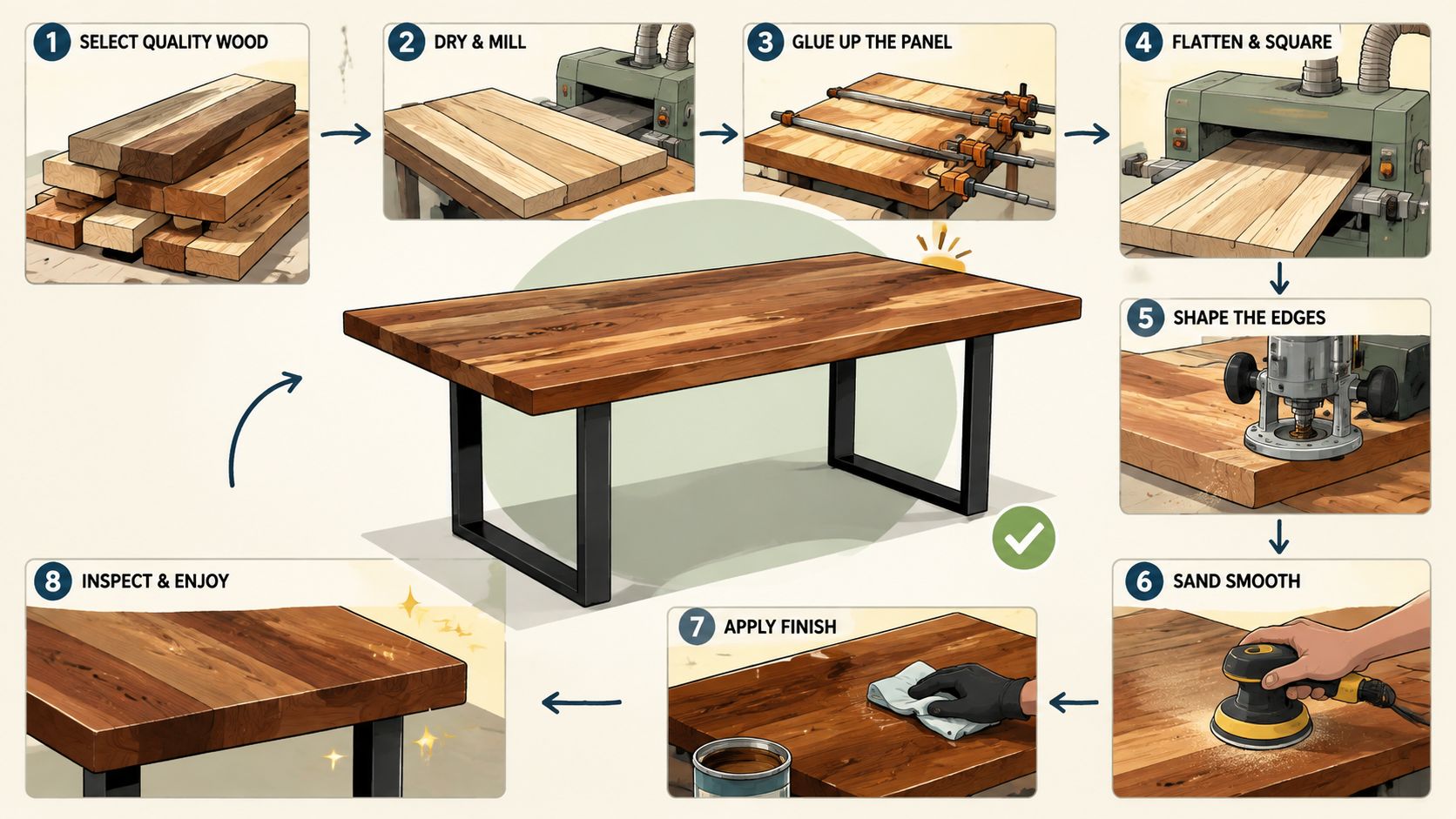
The process starts with rough boards. Lumber is air-dried, then kiln-dried to a moisture level suited to the destination climate. The USDA guidance for interior furniture points to approximately 6% to 10%, with 6% to 8% commonly appropriate for heated interior spaces. The completed top should remain in a conditioned environment before delivery so the material isn't forced to adjust abruptly after installation.
From board selection to panel glue-up
Board cut affects both appearance and movement. Plain-sawn boards show broad cathedral grain, quarter-sawn boards emphasize straighter grain and can improve dimensional behavior, and rift-sawn boards offer a more linear, restrained figure. A skilled builder lays boards out for color continuity, grain direction, and balanced tension before glue-up.
Wide tops need multiple boards rather than one impossibly broad piece. Edge joints create the panel, while narrower staves distribute seasonal movement across the surface. Floating wooden pins, splines, or related alignment methods can help maintain registration during assembly, but they don't eliminate the need for expansion allowance.
Traditional breadboard ends require particular care. Elongated tenons and compliant fastening allow the main panel to expand and contract across its width. Rigidly locking the cross-grain component can create stress instead of stability.
Mortise-and-tenon performance depends on tenon geometry, species, moisture content, grain orientation, adhesive type, and adhesive distribution, as detailed in a 2025 review of mortise-and-tenon joint performance. Furniture-frame reliability testing reported a highest average moment capacity of 204.29 Nm and reliability of 99.99% for mortise-and-tenon joints, compared with 153.53 Nm for dowel joints, with glued joints showing materially improved strength and reliability in that study. Those figures apply to the tested furniture frames, not automatically to every tabletop, but they reinforce the importance of specifying joinery rather than accepting vague craftsmanship language.
Thickness, sanding, and finishing
Custom tops commonly fall between 1 and 1.75 inches thick. The thicker the top, the more substantial the base must be, especially when the design includes a long span, a wide overhang, or a heavy species such as walnut.
After shaping, the surface is progressively sanded and prepared for its finish. Buyers who want to understand how fine abrasives function can review this practical resource on 1000 grit sandpaper explained. The final choice may be a hand-rubbed oil, a protective sprayed finish, or another system suited to use intensity. The top should cure fully before it leaves the shop.
A builder should answer these questions in writing:
- Drying method: Was the lumber kiln-dried, and was the final moisture content checked?
- Board layout: Which cut and stave arrangement were selected for the appearance and span?
- Movement control: Where are the slots, clips, figure-eight fasteners, or elongated tenons?
- Adhesive and finish: Which systems were used, and how were they applied?
- Warranty: What does the warranty cover if the top develops structural warping or joint failure?
Vinson's overview of wood joints provides a useful vocabulary for that conversation.
Edge Profiles and Finishes That Match Your Style
The edge is where hands, sleeves, chairs, and daily accidents meet the table. A square edge gives a crisp architectural line and preserves usable surface area, but a softened edge is more comfortable for a household that leans, reaches, and gathers around the top every day.
An eased edge removes the sharp corner without changing the table's geometry. A bevel introduces a deliberate angle that can disguise small edge impacts. A live edge preserves the natural contour of the board, but it demands a room that can support visual irregularity and a household comfortable with a less uniform perimeter.
Edge Profile and Finish Compatibility
| Profile / Finish | Best Room Style | Use Intensity | Best Species Match | Trade-Off |
|---|---|---|---|---|
| Square edge with satin protective finish | Modern dining | Daily to formal | Maple or oak | Clean geometry, but corners feel sharper |
| Eased edge with durable sprayed finish | Family dining | Heavy daily use | Oak or cherry | Comfortable and forgiving, less dramatic |
| Beveled edge with satin or matte finish | Transitional dining | Daily hosting | Cherry or walnut | Hides some edge wear, reduces visual mass |
| Live edge with hand-rubbed oil | Organic statement room | Moderate use | Walnut | Distinctive contour, more care around the edge |
| Eased edge with oil and wax | Warm traditional room | Moderate use | Cherry or walnut | Tactile surface, localized maintenance required |
| Square edge with semi-gloss finish | Formal dining | Occasional to moderate | Walnut | Elevated presentation, surface marks can catch light |
Conversion varnish is the durability-first option for a professionally sprayed surface. Oil and wax deliver warmth and a direct wood feel, with the advantage of spot repair when the owner accepts periodic maintenance. Polyurethane occupies the middle ground, offering a protective film without the full visual formality of a high-sheen surface.
Sheen should follow the room's light. Satin hides fine surface wear in a bright space, matte supports a relaxed rustic composition, and semi-gloss adds ceremony to formal dining. A dark finish may amplify reflections, while a lighter finish can make grain and small surface variation more visible.
The sample test that prevents regret
A finish sample viewed under showroom lights can mislead a buyer. The most reliable approach is to order a sample large enough to show grain, edge depth, and sheen, then place it near the flooring, cabinetry, windows, and dining chairs.
Finish advice: Never approve a stain from a small color chip alone. Judge the wood species and finish together, in the light where the table will live.
For a household with young children or frequent daily use, an eased profile with a durable satin finish is the strongest recommendation. For a formal dining room that hosts occasionally, a finer edge and richer sheen can make sense. The finish should serve the household's habits, not force the household to treat the table like an exhibit.
Sizing, Measuring, and Matching a Base
Most custom orders go wrong before construction begins. The mistake is usually a measurement taken from the widest part of a base instead of the actual mounting points, followed by a top that technically attaches but feels unbalanced in the room.
The first measurement should capture the base's top mounting points. Record the bolt pattern, thread pitch, plate dimensions, and any clips or brackets currently used. A replacement top must either align with those attachment points or include a new mounting strategy that allows the hardwood to move across its grain.
Measure the room and the diners
Dining comfort depends on more than the outside dimensions. A seated diner needs practical elbow room at each end and along the sides. A useful planning range is 10 to 12 inches of overhang per seated end and 6 to 8 inches along the sides, as specified for this design framework. Those are starting points, not universal laws, because chair arms, apron depth, pedestal geometry, and household posture can change the result.
Pedestal tables need a diagonal clearance check. Chair arms may pass under the edge in one position and collide with the pedestal when the chair turns. The homeowner should place the actual chairs around the base, not rely on a floor plan alone.
Tops wider than 48 inches need construction that accommodates across-grain expansion without forcing the base to rack, as outlined in the Canadian Woodworking movement guidance. That can involve compliant fasteners, slotted holes, clips, or carefully planned cleats. The attachment must hold the top securely while allowing normal seasonal movement.
Decide how the table will expand
Leaf systems should reflect real hosting habits:
- Self-storing butterfly leaves: Convenient for households that extend the table often and want the leaves available at the table.
- Separate leaves stored flat: Useful when the table usually stays compact and the owner has suitable storage.
- No leaves: The cleanest choice when the room has a fixed seating pattern and extension hardware adds unnecessary complexity.
Before releasing an order, confirm the following:
- The top dimensions and finished thickness.
- The base mounting points and fastener specifications.
- The intended overhang at every seating position.
- Chair-arm and pedestal clearance.
- Doorway, hallway, stair, and elevator access.
- The movement strategy for the final width.
- Leaf storage and extension requirements.
- The finished delivery location inside the home.
A top that fits the dining room but cannot pass through the front door isn't a successful custom order. Measurements must describe the entire route, not just the destination.
Designing and Ordering Through a Showroom Program
A showroom visit earns its place by replacing assumptions with physical evidence. Homeowners can sit at display tables, run a hand across oak, maple, walnut, and cherry samples, compare edge profiles, and see how seating interacts with a pedestal or trestle. That sit-test reveals discomfort and scale problems that a screen rarely exposes.
Vinson's In-Store Design Studio offers Complimentary Design Consultations for room planning, seating fit, finish coordination, and custom dining specifications. A consultant can translate the room's dimensions, existing base, chair count, traffic path, and daily use into a written order rather than leaving the homeowner to reconcile those details alone.
What the design process should catch
A good consultation identifies risks before the deposit becomes a production order. Those risks include a wide span over a heat source, an oversized top that cannot fit through a doorway, insufficient clearance for chair arms, or a finish that conflicts with a nearby floor.
The Custom Order Program supports fabrics, finishes, and 3D visualizers for partner brands including Smith Brothers of Berne, Canadel, and Mavin. Smith Brothers is made in Indiana, Mavin is Amish-made in Ohio, and Canadel is handcrafted in Quebec. For a homeowner furnishing the broader room, that flexibility can connect a custom table with American-made seating, Amish-made bedroom furniture, or North American dining pieces without treating every item as an isolated purchase.
A digital visualizer can show proportion and finish direction using room photographs. It can't replace a physical sample or the sit-test, but it can expose a top that feels too dominant beside the sofa or too narrow for the chairs.
What to bring to the appointment
Bring the following:
- Room measurements: Include wall lengths, doorway widths, stair turns, and the planned table location.
- Base information: Bring photographs of the underside, mounting plate, fasteners, and current top.
- Chair details: Include seat height, arm height, width, and the number of chairs used daily.
- Material references: Bring flooring, cabinetry, paint, or upholstery samples.
- Room photographs: Include wide shots and close views of the light at different times.
- Lifestyle requirements: Note children, pets, frequent hosting, writing, crafting, or other demanding use.
Homeowners furnishing a study or adjacent room may also bring references for items such as art prints office procurement, not because a table should become office décor, but because nearby visual materials can affect the selected wood tone and sheen.
The ordering timeline should be explained clearly, from deposit and stock selection through construction, finishing, cure time, inspection, and white-glove delivery. White-glove service means more than a curbside drop. A major logistics provider describes it as in-home delivery with setup, assembly, and debris removal, while furnishings logistics guidance includes blanket-wrapped placement and pre-delivery assembly and deluxing.
The Low Price Guarantee provides a 110% refund of the difference when the qualifying local authorized-dealer conditions are met, and the Clearance Gallery offers savings of up to 70% on selected floor samples, overstocks, and seasonal closeouts. Those programs serve different buyers. Custom ordering solves a fit and specification problem, while clearance savings can suit a homeowner who finds the right finished piece without needing a unique top.
Care and Maintenance for a Lifetime of Use
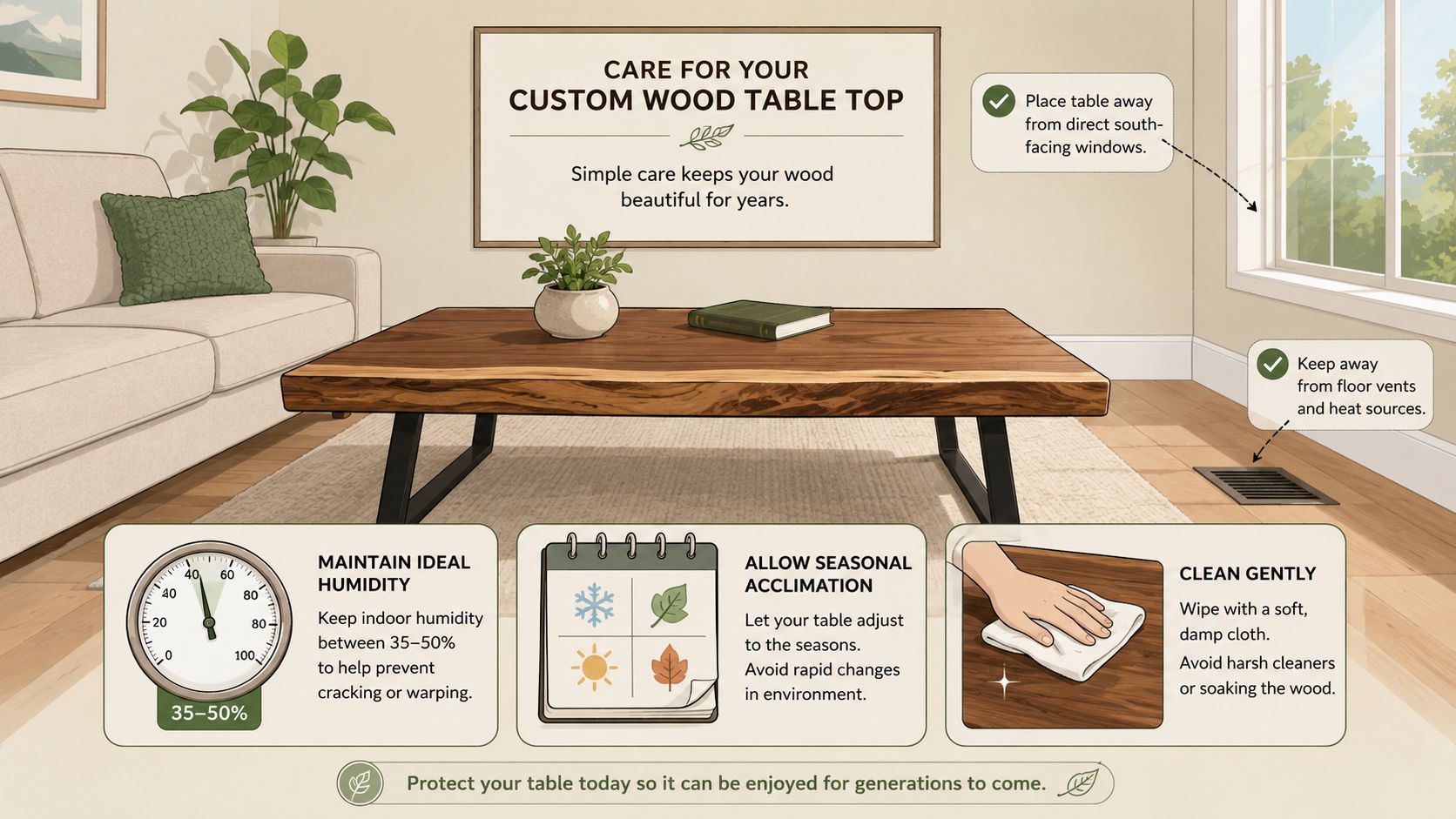
Ohio homes put solid hardwood through changing conditions. Heating seasons dry indoor air, while humid summer weather moves the material in the opposite direction. Care should focus less on chasing a perfectly static tabletop and more on limiting abrupt fluctuation, keeping the room conditioned, and allowing the construction to do its job.
Care guides commonly describe indoor relative humidity bands such as 35% to 55%, 40% to 60%, or 45% to 55%, as summarized in this solid wood table care guidance. The differing ranges point to the practical conclusion: stability matters more than one magic number. Small seasonal gaps, fine cracks, and modest cross-grain movement can occur in solid wood, especially during heating season. Structural splitting, severe cupping, loose joinery, or rapidly worsening movement deserves professional review.
Daily habits that protect the finish
Wipe the surface with a soft, slightly damp cloth and mild soap when needed, then dry it promptly. Remove wine, mustard, beet juice, lemon juice, and other staining foods quickly rather than allowing them to sit in the finish.
Use trivets under hot cookware, coasters beneath drinks, and felt under objects that move. Keep the table away from HVAC vents and strong south-facing glass when possible. Direct drafts and concentrated sunlight can create uneven environmental stress across the top.
Avoid furniture polish and silicone sprays unless the finish manufacturer specifically approves them. Residue can cloud the surface and complicate future refinishing.
A seasonal inspection worth doing
At the start of heating season and again before humid summer, check the base fasteners without over-tightening them. Inspect breadboard ends, visible joints, finish cracks, and any new gaps. A small ding is easier to address with an appropriate touch-up kit before moisture reaches exposed wood.
Owners of oil-finished tops should follow the specified refresh schedule rather than applying an unapproved product. Film-finished tops generally need gentle cleaning and inspection, not repeated polishing.
Humidity checklist: Keep room conditions steady, block direct HVAC flow, use coasters and trivets, wipe spills promptly, inspect fasteners seasonally, and contact the builder when movement appears structural.
For a complete household routine, Vinson's wood furniture care guide provides a useful reference. The same care mindset should extend to the rest of the room, including solid hardwood dining sets, premium leather seating, and motion furniture. A custom wood table top belongs in a home that uses it, but disciplined care keeps that use from becoming unnecessary damage.
Vinson Fine Furniture's Easton showroom lets Columbus homeowners compare solid hardwood species, sit-test dining bases, review custom finishes, and use Complimentary Design Consultations before ordering. Visit Vinson Fine Furniture to plan a custom wood table top, explore the Custom Order Program, review solid hardwood dining and bedroom options, or find value through the Clearance Gallery and White-Glove Delivery service.