
Round Pedestal Dining Table with Leaves: A Buyer’s Guide

A Columbus-area homeowner can spend most weeknights around a table for four, then face a very different problem when a holiday gathering calls for ten seats. The dining room still has to function on ordinary evenings, homework still needs a surface, and no one wants to store a second table for the few occasions when the guest list expands.
A round pedestal dining table with leaves can handle both demands, but only when the buyer treats it as an engineering decision rather than a shape selected from a showroom floor. The top, pedestal, extension hardware, leaf storage, hardwood, room clearance, and delivery plan all determine whether the table remains useful for decades. The equal-seating benefit is real, but it doesn't excuse a narrow base, a warped leaf, or an expanded footprint that blocks every chair.
Why a Round Pedestal Dining Table With Leaves Earns Its Place in the Home
On an ordinary evening, four people can sit around a round top without anyone being assigned the head or foot of the table. Conversation moves across the center, children aren't pushed toward a corner, and each chair can approach the table without a corner leg interrupting it. When guests arrive, the leaves enlarge the same table instead of forcing the dining room to absorb a separate occasional piece.
That flexibility explains why this format works especially well for homeowners who want one heirloom-quality table to serve several roles. It can support family dinners, board games, weekend projects, and lingering coffee without changing the room's visual center. A pedestal also gives chairs more freedom around the perimeter, though the base still has to be wide and heavy enough for the extended top.
Practical rule: The table should fit the household's everyday routine first, then accommodate the largest gathering without compromising circulation.
The historical appeal has a practical foundation. The round pedestal tradition became popular in France near the end of Louis XIV's reign, while drop-leaf tables trace their lineage to sixteenth-century England. In 1764, Antoine-Joseph Loriot invented an expandable round tabletop, addressing the seating limits of a standard round table. The historical development of dining tables shows why the modern version still solves a familiar domestic problem.
A buyer evaluating a table for a Columbus suburb should therefore ask more than whether the silhouette looks elegant. The useful questions are whether the base supports the open diameter, whether the leaves remain aligned, whether the room can handle the full footprint, and whether the maker offers the hardwood and finish the home requires. Those decisions matter more than a passing style preference.
What a Round Pedestal Dining Table With Leaves Actually Is
A round pedestal dining table with leaves has three defining parts. It starts with a circular dining surface, rests on a single central column or pedestal, and uses removable, folding, or integrated leaves to enlarge the top. The closed table preserves the social geometry of a round surface. The extended table adds length, often creating an oval or another elongated shape.
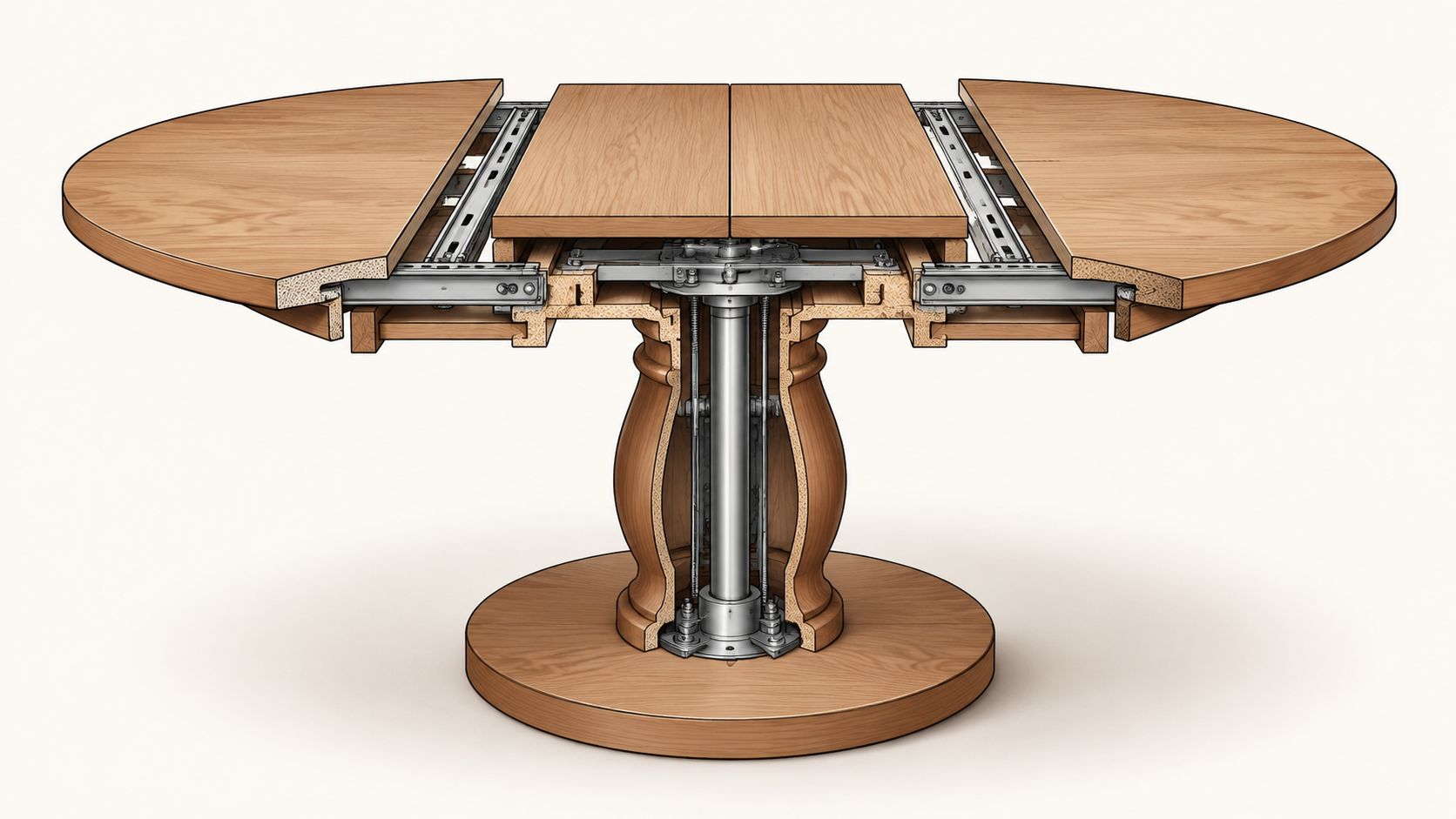
The pedestal isn't just a decorative substitute for four legs. It concentrates support beneath the center, leaving the perimeter open for chairs. The extension system must then separate the tabletop sections evenly, hold the leaf securely, and bring the edges back into alignment when the table closes.
Modern examples vary considerably. A 54-inch round table can convert to a 66-inch oval with one leaf, while a 48-inch or 54-inch table can grow by 18 inches to reach 66 or 72 inches. Those conversions are documented in furniture guidance on round extension tables and demonstrate why the closed diameter alone doesn't tell the full story. Explore round dining room table options before comparing a table's daily footprint with its hosting capacity.
The three details that define the category
- Round top: The closed surface has no head or foot position and supports more fluid conversation.
- Central pedestal: A single column and foot provide the support while keeping corner areas clear for chairs.
- Extension mechanism: Slides, equalizers, center leaves, or folding leaves enlarge the surface and return it to a closed position.
The terminology matters because a round table with a separate folding leg system behaves differently from a round pedestal table with leaves. A buyer should inspect where the leaf stores, how the halves open, and whether the base remains centered under the expanded top. A polished silhouette can conceal weak mechanics, while a quieter design may deliver the more dependable long-term performance.
How the Pedestal Base and Extension Hardware Hold Everything Together
A pedestal extension table presents a balance challenge. As the top expands, the seating load moves farther from the center column. That distance increases the force applied to the base, so a base that feels perfectly adequate beneath a closed table may feel less convincing once leaves are installed and guests lean against the rim.
Furniture guidance for round extension tables identifies a useful starting point. Smaller 36- to 42-inch tops typically use a pedestal about 6 inches in diameter, while a thicker pedestal around 8 inches is better suited when one or two leaves are added because the additional span increases wobble risk. Guidance on choosing a pedestal base explains why the extended diameter, not merely the closed size, should guide the selection.
The hardware has a structural job
Pedestal tables need more than ordinary tabletop slides. Equalizers keep both halves moving together, while specialized outside slides reduce friction and use an arched form to compensate for sag. Supplier documentation describes pedestal extenders that open from 26 inches to 51 inches or from 46 inches to 92 inches, illustrating the scale of span that properly designed mechanisms can manage. Pedestal table extender hardware details how synchronized movement helps prevent racking and tipping.
A buyer should open and close the mechanism without rushing. The two halves should travel together, the seam should meet cleanly, and the top shouldn't require force to move. The foot should feel planted, the column should look substantial in relation to the open diameter, and the connection between the base and top should allow for seasonal wood movement.
Solid hardwood construction makes that movement more important, not less. Wood responds to changes in humidity, so rigidly locking the top to the base can create splitting or broken joints. Builders use mechanical fasteners and movement-tolerant connections instead of relying on glue alone. The practical inspection is simple: examine the foot width, test the slide action, and judge the column thickness before approving the silhouette.
Leaf Types, Storage, and the Warping Problem Nobody Mentions
Leaf selection changes the ownership experience. A standard drop-in leaf offers a straightforward extension, but it requires a suitable storage location. A self-storing leaf stays within the table, while a butterfly leaf folds on a hinge and occupies a hidden compartment beneath the tabletop.
| Leaf Type | Storage Location | Seam Visibility | Best For | Watch Out For |
|---|---|---|---|---|
| Standard drop-in | Separate closet or storage area | Can be subtle when matched correctly | Homes with suitable flat storage | The leaf must be carried, protected, and kept aligned |
| Self-storing | Inside the table or apron cavity | Usually designed to close with the table | Frequent extensions and limited storage | The internal mechanism adds complexity |
| Butterfly | Folded inside a concealed compartment | Can remain discreet when fitted well | Buyers who want integrated convenience | Hinges and folding sections need careful construction |
A separate leaf isn't a problem if the household has a dry, climate-controlled closet. It becomes a problem when the leaf is leaned against a wall, stacked in an attic, or left in an unconditioned garage. Furniture guidance recommends storing leaves flat, in a dry and climate-controlled place, rather than upright, because vertical storage can encourage warping and poor refitting. Proper dining table leaf storage also recommends keeping the leaf in the same room as the table so both pieces experience similar humidity and temperature.
Storage is part of the purchase decision
The leaf's grain direction, edge band, and finish all affect how convincingly it joins the original top. A well-made table should close with a controlled seam, but wood movement can still change the fit over time if storage conditions are poor. The leaf should be stored flat in its original cradle when possible, protected from direct heat, and handled by its edges.
A buyer who extends the table often should prioritize a self-storing or butterfly system. A household that opens the table only for major gatherings may prefer separate leaves, provided the storage plan is established before the order is placed. Vinson's table leaf storage guidance gives the practical care issue the attention it deserves.
Hardwood, Joinery, and Custom Finishes That Last a Lifetime
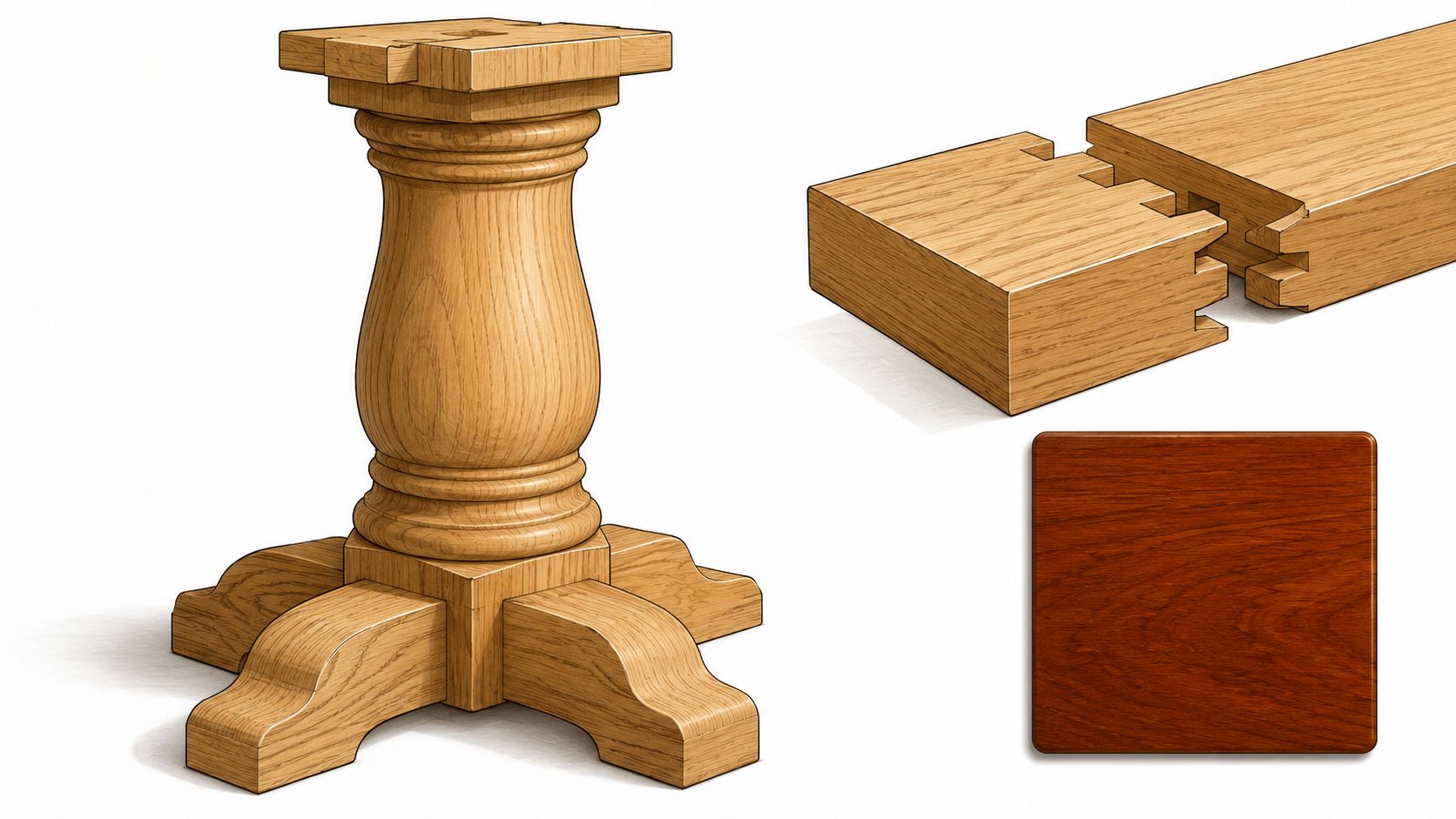
The pedestal and top should begin with solid hardwood, not a surface treatment designed to imitate it. Vinson strictly sells solid hardwood furniture and centers its wood selection on solid cherry, oak, maple, and walnut. Each species creates a different visual and tactile result.
- Solid cherry develops a warm reddish patina and suits traditional or transitional rooms.
- Solid oak offers pronounced grain and a sturdy presence, with red and white oak providing distinct grain expressions.
- Solid maple gives a cleaner, lighter contemporary appearance.
- Solid walnut brings a dark, formal tone with rich visual depth.
The base deserves particular scrutiny because every opening cycle places stress on the joint between the column and the platform. Mortise-and-tenon joinery creates a mechanical interlock, with the tenon fitting into a matching mortise and reducing reliance on metal fasteners that can loosen or rust. An explanation of mortise-and-tenon furniture joinery describes why this traditional method remains important in durable hardwood construction.
Finish and customization belong together
A conversion varnish finish offers a durable sealed surface suited to regular dining use, while a hand-rubbed oil finish gives the wood a warmer, more tactile character and can be selected for a particular maintenance preference. Heat, spills, water rings, and repeated pressure near the extension seam all make finish quality relevant.
Vinson's Custom Order Program allows buyers to specify species, stain, edge profile, sheen, and leaf coordination rather than accepting a fixed combination. The program supports brands such as Canadel, handcrafted in Quebec, Mavin, Amish-made in Ohio, and Smith Brothers of Berne, made in Indiana. Digital 3D visualizers help homeowners review the proposed table and coordinate dining chairs, living-room pieces, or bedroom furnishings before construction.
The same attention to surface care should extend to the surrounding room. Homeowners protecting hardwood floors can consult premium hardwood floor polishing for maintenance context, especially when a heavy pedestal table will remain in place for years. For a closer look at structural options, Vinson's guide to various wood joints gives useful language for discussing construction with a design consultant.
Sizing, Clearance, and the Honest Small-Space Trade-Off
A round table saves corner space, but it doesn't eliminate the need for circulation. A homeowner should measure the table in its largest configuration, place chairs around the perimeter, and account for the paths people use to reach a doorway, buffet, or adjacent room.
Furniture planning guidance identifies 36 inches of chair clearance as a practical rule, while a 48-inch round table can already feel tight in a small room when chairs surround it. Small-space dining table planning supports the essential test: the closed table may fit comfortably, but the expanded version can turn the room into a bottleneck.
| Table Diameter | Seats Without Leaves | Seats With Leaves | Minimum Room Size | Notes |
|---|---|---|---|---|
| 36 inches | Qualitative, compact everyday seating | Depends on leaf design | Must be measured around chairs | Best for a very limited footprint |
| 48 inches | Four adults can feel close | Expansion may improve hosting capacity | Confirm chair and doorway clearance | A common compact starting point |
| 60 inches | More comfortable everyday seating | Depends on leaf count and size | Requires broader circulation | Better for regular family use |
| 72 inches extended | Not applicable as a closed compact size | Larger gathering configuration | Needs a room that absorbs the full footprint | Measure before ordering |
These ranges should guide a floor test, not replace one. Painter's tape can mark the closed circle, the open oval, and every chair position. A second tape line should represent the path behind a pulled-out chair, because a table that fits on paper may still obstruct the room during a meal.
Room test: If the expanded outline forces a guest to turn sideways to reach a seat, the table is too large for that dining room.
A complimentary consultation at the Easton showroom can apply the same exercise to the homeowner's measurements and seating count. The honest recommendation is simple. Choose the largest configuration the room can handle comfortably, not the largest configuration the product page can advertise.
Why Buying Through Vinson Fine Furniture Changes the Experience
A long-term dining table needs more evaluation than an online checkout can provide. The buyer must confirm the open diameter, leaf storage, chair approach, base proportions, finish, and delivery path. A local design appointment lets the homeowner test those decisions before the order becomes a permanent part of the dining room.
Vinson Fine Furniture operates as a family-owned business serving Central Ohio, formerly known as Kitchen Tables & More, with a focus on North American manufacturing and Amish-made excellence. Its Easton Town Center location includes an In-Store Design Studio where complimentary design consultations address measurements, traffic patterns, finish coordination, and seating needs.
The financial and service details
The Low Price Guarantee provides a 110% refund of the difference when a lower local price for the same item is verified within 30 days, under the published policy. Vinson's customer advantages also provides context for comparing service, customization, and delivery rather than looking only at an initial ticket.
For immediate clearance savings, the Clearance Gallery offers savings up to 70% on floor samples, overstocks, and seasonal closeouts. Synchrony financing can provide predictable payment terms for qualified buyers, subject to the account terms and conditions. The important point is that financing shouldn't replace room planning, but it can help a homeowner organize a considered investment.
White-glove delivery should also be defined clearly. The service typically includes in-room placement, professional assembly, unpacking, and removal of packaging materials, as described in this explanation of white-glove delivery. For a pedestal table, the delivery team should place the base, assemble the top, level the leaves, and clear the packaging before departure. That final setup matters because a table that isn't level can make a carefully fitted extension feel defective.
The same showroom can support related rooms without losing the central dining decision. The Custom Order Program covers fabrics, finishes, and 3D visualizers for Smith Brothers, Canadel, and Mavin, while premium motion options include top-grain and performance leather sectionals, motorized reclining, swivel chairs, rockers, and gliders. Those categories belong in a whole-home plan, but the dining table still deserves its own sit-test.
Bringing It All Together at the Easton Showroom
The strongest next step is a physical evaluation at the Easton showroom. A homeowner should bring the dining room measurements, door and hallway dimensions, ceiling height, chair count, and the largest gathering planned for the table.
During the appointment, the buyer should ask to compare a 48-inch round, a 60-inch round, and a fully extended 72-inch configuration where available. The evaluation should include more than appearance:
- Test the base: Check knee clearance and how firmly the foot sits beneath the open top.
- Open the mechanism: Watch whether both halves travel evenly and whether the seam closes flush.
- Confirm storage: Determine whether the leaf stores inside the table or needs a flat, climate-controlled location.
- Review the finish: Compare solid cherry, oak, maple, or walnut samples under showroom lighting.
- Plan delivery: Confirm assembly, leveling, in-room placement, and packaging removal.
The In-Store Design Studio and Complimentary Design Consultations give the homeowner a place to connect those physical tests with a final hardwood, finish, leaf count, chair fabric, and delivery plan. The result should be a table that works for four on a Tuesday and expands responsibly for a holiday, without asking the room to sacrifice movement.
Vinson Fine Furniture offers solid hardwood dining tables, custom finishes, leaf configurations, and in-store design guidance for homeowners evaluating a round pedestal dining table with leaves. Visit Vinson Fine Furniture at Easton Town Center to sit-test the proportions, discuss storage and delivery, and build a table plan around the room's everyday life.