Live Edge Slab Tables: A Buyer’s Guide for 2026


Most advice about live edge slab tables starts with appearance. That's backwards. A striking edge can't rescue a table with wet wood, weak joinery, poor proportions, or a finish that ignores seasonal movement. Columbus homeowners choosing an heirloom piece should judge the slab as furniture first and sculpture second.
The category has matured. Serious buyers now look beyond the familiar blue resin river toward wider slabs, walnut, parota or guanacaste, darker resin, restrained finishes, and movement management. At Vinson's Easton Town Center showroom, the useful question isn't whether live edge still feels fashionable. It's whether the table has been built carefully enough to remain relevant and serviceable through years of Ohio living.
Why 2026 Buyers Are Choosing Live Edge Differently
Live edge isn't a passing rustic novelty. Its documented roots reach back to early American settlement practices in the 1600s, when settlers used unfinished wood slabs to make furniture quickly and affordably. The form gained new design authority in 1946, when George Nakashima began incorporating natural wood edges into his work, helping transform a practical method into a recognized movement that spread globally. The history of live edge furniture makes the larger point clear: natural edges have survived because they connect useful construction with the character of a tree.
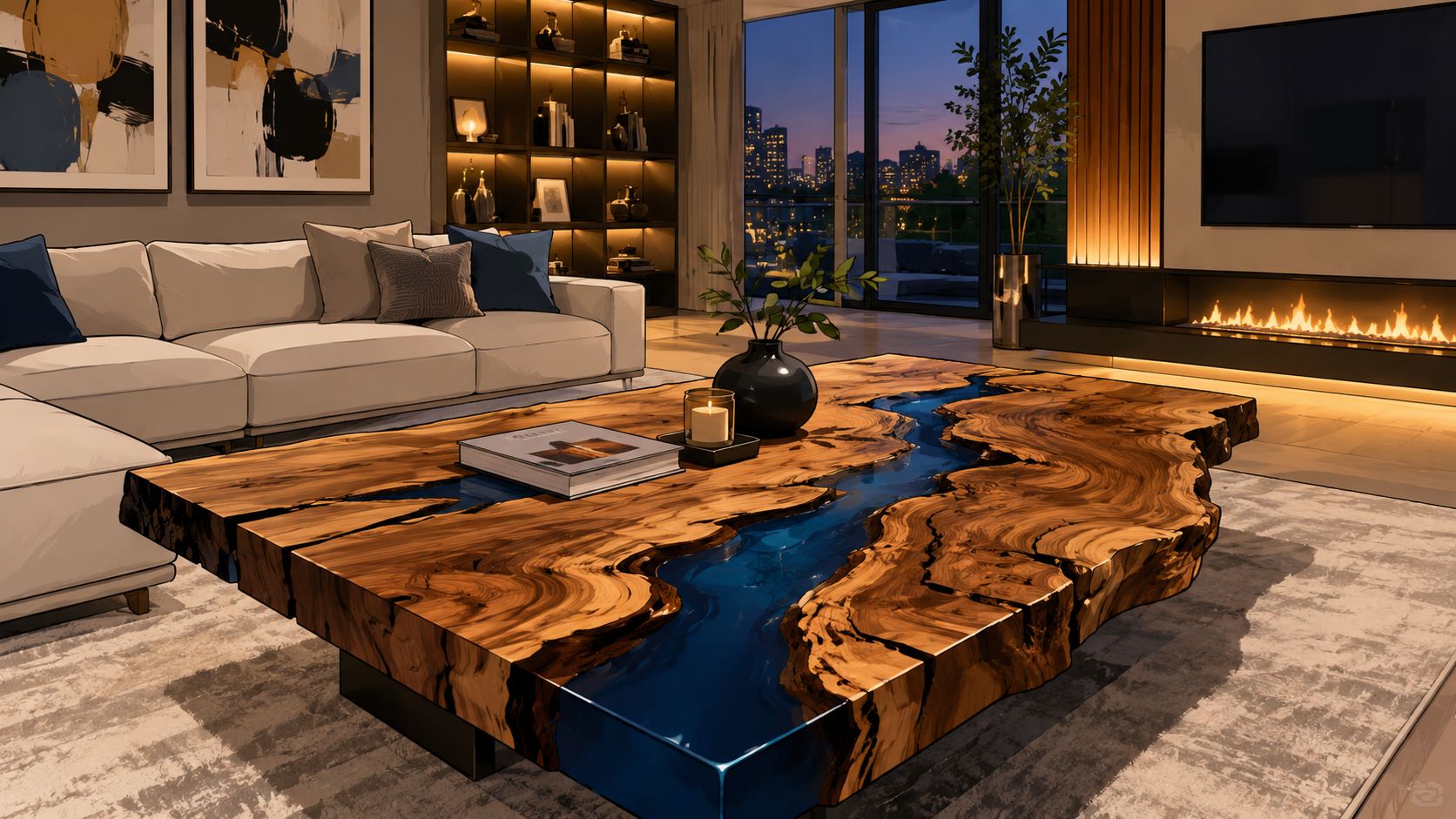
The familiar bright-blue river table still has visual impact, but it can dominate a room and date quickly. Current design direction favors smoked or matte black resin, more organic edges, bolder grain, and broad slabs in species such as walnut and parota or guanacaste. Recent live edge trend coverage for 2026 points toward a quieter, more architectural interpretation of the category.
The premium buyer's new filter
A mature live edge purchase should answer four questions:
- Does the slab have presence? Wider boards and expressive grain should support the room rather than overwhelm it.
- Does the palette have longevity? Walnut, natural maple, cherry, oak, smoked resin, and matte black resin generally integrate more easily than novelty colors.
- Has movement been engineered? Fasteners, finish coverage, and base design must allow the wood to respond to humidity.
- Does the table suit the home? A slab that looks exceptional under showroom lighting can feel oversized in a tight dining area.
Wood remains central to the category. One industry report estimates that wood represented more than 70% of live edge table market value in 2024, reinforcing that solid-wood slab construction, not synthetic styling, defines the market. The 2024 live edge table market analysis supports a practical buying conclusion: the slab still matters more than the novelty attached to it.
For an investment homeowner in Columbus, restraint is the advantage. A well-drawn edge, sound hardwood, and proportionate base will age with the house. A loud effect chosen only for a social-media moment may not.
What Makes a Table a True Live Edge Slab
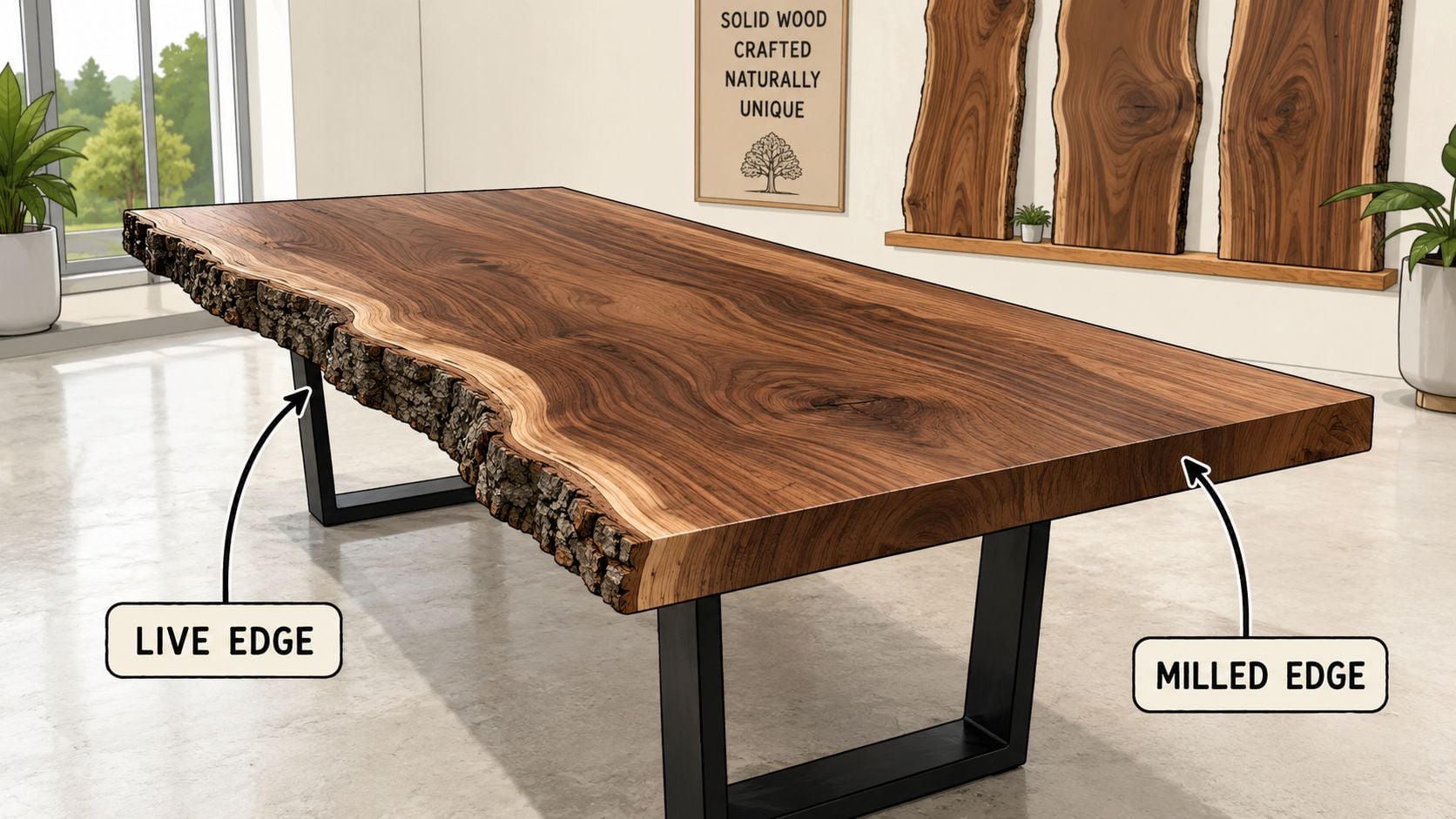
A true live edge table starts with a solid hardwood slab that keeps one or both natural contours of the tree visible. The edge may be cleaned, stabilized, and sealed, but it hasn't been milled into a perfectly straight profile. That irregular line is the defining feature, not a decorative strip attached after the fact.
The top may come from one broad slab or from carefully matched slabs. In a book-matched design, two adjoining cuts open like mirrored pages, creating visual symmetry while preserving the tree's grain direction. Sequential cuts can offer a related effect across a larger top. The important question is whether the pieces were selected and joined as a coherent composition.
What buyers should inspect
A showroom inspection should focus on construction, not just the silhouette:
- Follow the edge. The contour should look intentional and continuous. Excessive filling, aggressive sanding, or a manufactured profile can reduce the natural character.
- Study the top. Grain should flow logically across the surface. Book-matched tops should show deliberate alignment rather than an abrupt visual interruption.
- Ask about the pith. The tree's center can contribute dramatic figure, but it can also be more vulnerable to checking. The builder should explain how that area was treated.
- Check the thickness and support. A broad slab needs a base designed for its mass and span, not merely a fashionable silhouette.
- Look underneath. Hardware should support the top while allowing movement. Rigid fastening across the grain can create stress.
The tradition is broader than a rustic farmhouse look. Early American makers used unfinished slabs for practical reasons, while George Nakashima's mid-century work brought natural edges into refined studio furniture. That heritage gives today's buyer a better standard than “does it look organic?”
Live edge also belongs in a wider conversation about solid surfaces and daily use. For readers evaluating natural-material counters as part of a related renovation, Boca Raton countertop guidance offers useful context on matching surface choices to lifestyle and maintenance expectations.
The strongest table has one clear focal piece. Its edge should invite touch, its grain should reward a closer look, and its construction should remain understandable when the buyer turns the table over.
Choosing the Right Wood Species for Ohio Homes
Columbus buyers often start with color, then discover that grain, light exposure, hardness, and slab availability matter just as much. The showroom's current local preference is wormy maple, whose ambrosia streaking gives a pale slab an energetic, organic pattern. Cherry and oak are also returning to favor, while walnut remains the most assured choice for a modern room that needs depth.
No hardwood eliminates movement in Ohio. Wood is hygroscopic, so it expands or shrinks as it seeks equilibrium with the surrounding humidity. Species selection helps determine how a table looks and wears, but correct moisture preparation and fastening matter more than choosing a species marketed as “stable.”
Live edge slab wood species comparison
| Species | Grain & Color | Janka Hardness | Movement in Ohio Humidity | Typical Slab Price Tier |
|---|---|---|---|---|
| Wormy maple | Pale ground with distinctive ambrosia streaking | Confirm the specific board with the builder | Requires normal seasonal movement planning | Mid to premium, depending on width and figure |
| Cherry | Warm red-brown tone that deepens with age | Confirm the specific board with the builder | Requires careful acclimation and movement allowance | Mid to premium |
| Oak | Pronounced open grain with a lighter, grounded appearance | Confirm the specific board with the builder | Requires normal seasonal movement planning | Mid to premium, with wide slabs commanding more |
| Walnut | Rich brown color, flowing grain, and strong modern presence | Confirm the specific board with the builder | Requires careful acclimation and movement allowance | Premium, especially in wide slabs |
A buyer seeking solid wood furniture in Ohio should ask to see the actual slab, not rely only on a species name. Wormy maple suits rooms with linen, woven texture, and lighter floors. Cherry works for traditional dining rooms because its color develops with time instead of demanding an immediate dramatic contrast. Oak brings structure to transitional interiors. Walnut makes the strongest statement in a restrained modern room, particularly when paired with a black or dark metal base.
Wide walnut and oak slabs typically carry greater value because the material is harder to source and yields fewer uninterrupted surfaces. Maple and cherry can offer broader selection, which gives the designer more flexibility in matching length, edge character, and grain direction. The right choice depends on whether the table should blend into the room or anchor it.
For a deeper explanation of durability, appearance, and hardwood selection, consult this guide to choosing wood furniture for longevity and style. The recommendation remains straightforward: choose the species that fits the room's light and architecture, then insist on a slab whose individual character is acceptable before production.
Sizing, Bases, and Joinery That Actually Last
A live edge table has to work during a crowded dinner, not just look balanced from the doorway. Room measurements should include chair pull-out space, walking paths, door swings, stair turns, and the route from the entry to the final placement. A slab wider than 42 inches can become difficult in narrow doorways or rooms with standard ceiling proportions, so the delivery path deserves attention before the slab is selected.
Start with the room, then choose the base
Dining clearance is practical geometry. A homeowner should plan roughly 36 inches behind each chair for comfortable movement and about 24 inches per person along the table edge. An overhang of 12 to 16 inches helps keep knees clear, especially when a pedestal or substantial apron changes the usable footprint.
| Measurement | Recommended | Notes |
|---|---|---|
| Clearance behind each chair | Roughly 36 inches | Allows chair pull-out and passage |
| Personal table-edge space | Roughly 24 inches per person | Supports comfortable place settings |
| Knee-friendly overhang | 12 to 16 inches | Confirm against the base and chair dimensions |
| Slab width warning point | Wider than 42 inches | Verify doorways, turns, and room scale |
| Rug planning | Extend beneath the chair zone | Chair legs should remain on the rug when pulled out |
The base changes the entire character of the table. A steel X-base feels open and graphic. Trapezoid plates create a sculptural stance without visually closing the room. A single pedestal preserves legroom but demands careful engineering beneath a broad top. A traditional solid-hardwood trestle brings more visual weight and connects naturally with Amish-made dining sets.
Movement belongs in the joinery
A long slab shouldn't be locked rigidly to its base. Steel mounting plates with slotted bolt holes let the top expand and contract across its width without concentrating stress around fixed fasteners. Breadboard ends can help control the appearance and behavior of long tops, but they must also be attached in a way that respects cross-grain movement.
Butterfly keys may stabilize a check or reinforce a vulnerable area, yet they're not automatically structural. A builder should identify whether each key is preventing a crack from advancing or adding a visible craft detail. Mortise-and-tenon joinery remains a particularly strong choice for hardwood bases because it creates broad wood-to-wood contact and resists racking through seasonal use. A closer look at mortise-and-tenon furniture joinery explains why the method remains common in durable tables and other solid-hardwood furniture.
For Columbus rooms, the right base is the one that supports traffic flow, chair placement, and the slab's movement. Buyers comparing options can review live edge table leg styles before visiting, then test the actual knee clearance in the showroom.
Pricing, Value, and Where the Money Goes
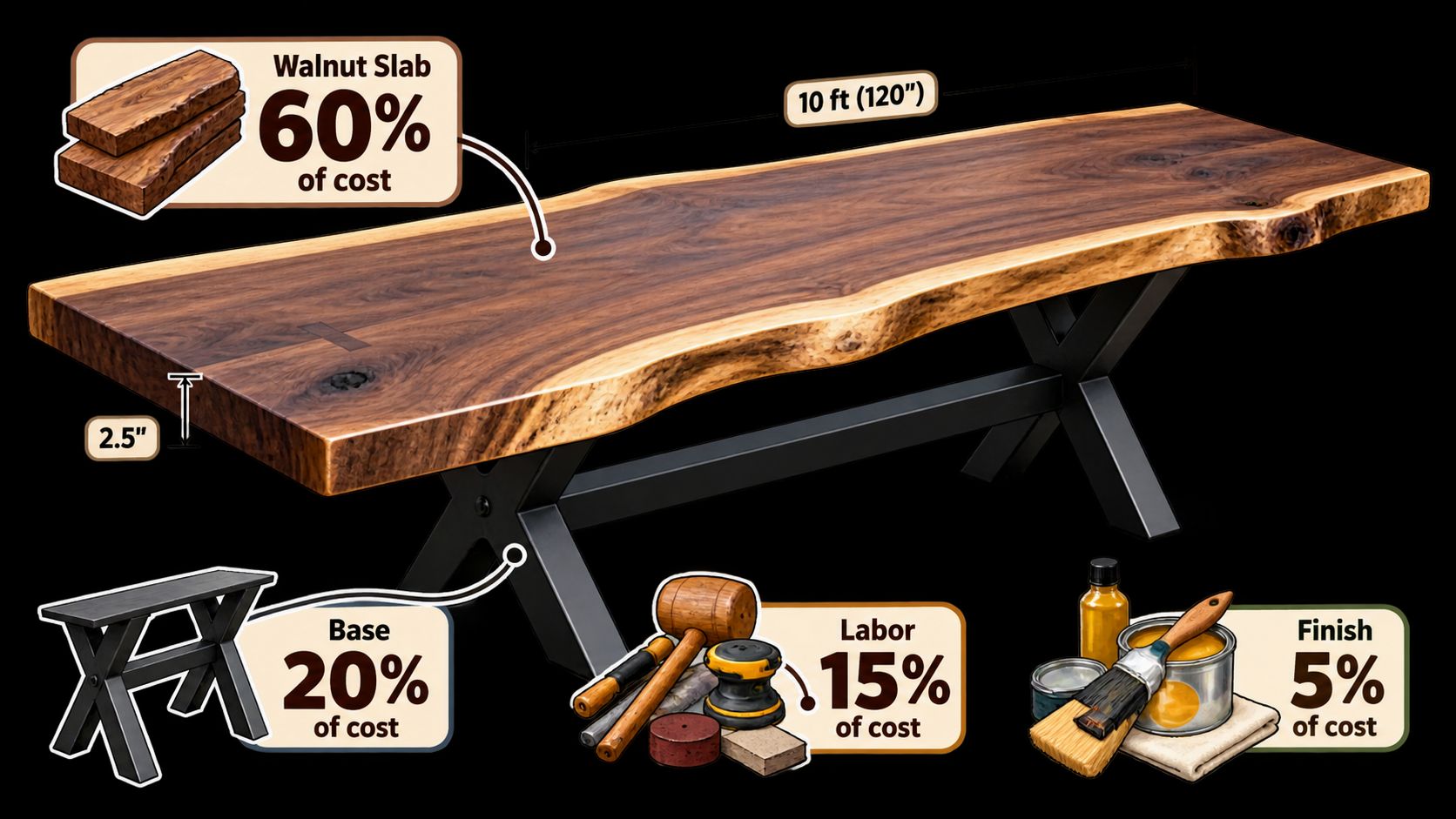
Price begins with the slab, but it doesn't end there. A wide, thick walnut board requires more material, more drying control, and more careful yield management than a narrower maple top. The final figure also reflects how much of the original board survives milling, whether the grain needs a book-matched arrangement, and how much handwork the edge requires.
What changes the final price
- Slab species and width: Walnut and unusually wide oak usually require a larger material investment than more readily available pieces.
- Drying and preparation: Properly dried stock takes time and monitoring before milling and finishing.
- Base construction: A substantial steel base or bench-made hardwood trestle costs more than a light, undersized support.
- Edge treatment: A naturally sealed edge, eased edge, and heavily filled edge each require different labor.
- Resin work: Dark, restrained resin can be useful for stabilization or design, while large decorative pours add material, labor, and risk.
- Finish system: A catalyzed varnish demands controlled preparation and careful application, but it provides a practical surface for daily dining use.
A budget around $2,500, $5,000, or $8,500 can point toward very different builds, but those figures shouldn't be treated as universal price promises. The actual result depends on species, dimensions, slab availability, base, resin, finish, and customization. Buyers should request a written specification rather than compare a number attached to an entirely different table.
Value test: Spend on dry, properly prepared hardwood, sound movement hardware, an appropriately scaled base, and a durable finish. Be skeptical of decorative resin volume that adds drama without improving the table.
Money is often wasted when a builder compensates for weak design with excessive resin or pairs a heavy slab with inadequate steel. A table intended to move between homes should be built as a long-term asset, not as a disposable room accessory. Buyers considering the broader question of how long quality furniture should last should evaluate the frame, joinery, finish, and repairability along with the top.
Vinson's value structure also gives Columbus shoppers two practical routes. The Low Price Guarantee provides a 110% refund of the difference when its qualifying conditions are met, while the Clearance Gallery offers savings up to 70% on selected floor samples, overstocks, and closeout pieces. Those options matter when a homeowner wants premium construction but doesn't need every dimension or finish customized.
Designing Your Slab in the Vinson Studio
A slab appointment should settle design decisions, not create more guesswork. At the In-Store Design Studio, Columbus homeowners can compare cherry, oak, maple, and walnut samples with base finishes, chair fabrics, flooring tones, and room photographs. Complimentary Design Consultations connect the preferred slab to dimensions that suit the room, the seating plan, and the way the table will be used.
Start with the table's job. A dining table used for frequent family meals needs an edge, finish, base, and seating arrangement suited to daily wear. A formal table used occasionally can take a different approach. Bring doorway widths, stair turns, rug dimensions, and the locations of nearby vents or fireplaces. Those details prevent an attractive slab from becoming a difficult delivery or placement problem.
The studio should also test whether the design will age well. Wider slabs, darker resin details, and parota or walnut can create a stronger 2026 look than the familiar bright blue river effect. Keep the resin subordinate to the wood, then choose a base that gives the slab visual support without making the room feel crowded.
What the Custom Order Program changes
The Custom Order Program lets shoppers configure fabrics, finishes, and dimensions for partner lines including Smith Brothers of Berne, Canadel, and Mavin. Smith Brothers is made in Indiana, Mavin is Amish-made in Ohio, and Canadel is handcrafted in Quebec. This North American range supports coordinated dining, living room, and bedroom planning without forcing every piece into one visual language.
A furniture visualizer can display custom fabrics, finishes, and dimensions through photorealistic 3D rendering on a device. Furniture visualization technology supports a preview of the configured table before production. Use that preview to judge length, base weight, edge profile, and the relationship between the slab and surrounding chairs.
The production handoff should document the selected slab, grain and figure approval, and finishing milestones. Custom work changes the material, dimensions, base, edge, and finish, so the deposit terms and schedule must be written clearly. A 6 to 10 week window can be normal for a kiln-dried, hand-finished piece, but the seller should confirm the timeline in writing.
The same studio process can guide related purchases, from a Mavin bedroom piece to Smith Brothers furniture for Easton living rooms, including top-grain leather sectionals with motorized motion, swivel chairs, and rockers or gliders.
Delivery, Acclimation, and Long-Term Care
A slab table's first season in the home matters. Wood moisture for indoor live edge furniture is typically targeted around 6% to 10% before installation, and builders often treat slabs above roughly 12% as too wet for indoor furniture. Live edge builder guidance on furniture moisture supports the practical rule that a moisture meter should be used before milling, finishing, or assembly.
The home itself also needs reasonable conditions. Independent guidance commonly places indoor relative humidity around 40% to 55% or 45% to 55%, depending on the recommendation. Home humidity and live edge care guidance addresses the buyer concern that many general care pages leave vague: a table can move normally, but extreme or rapidly changing conditions increase the chance of visible checking, cupping, joint stress, and slight lift in resin-filled areas.
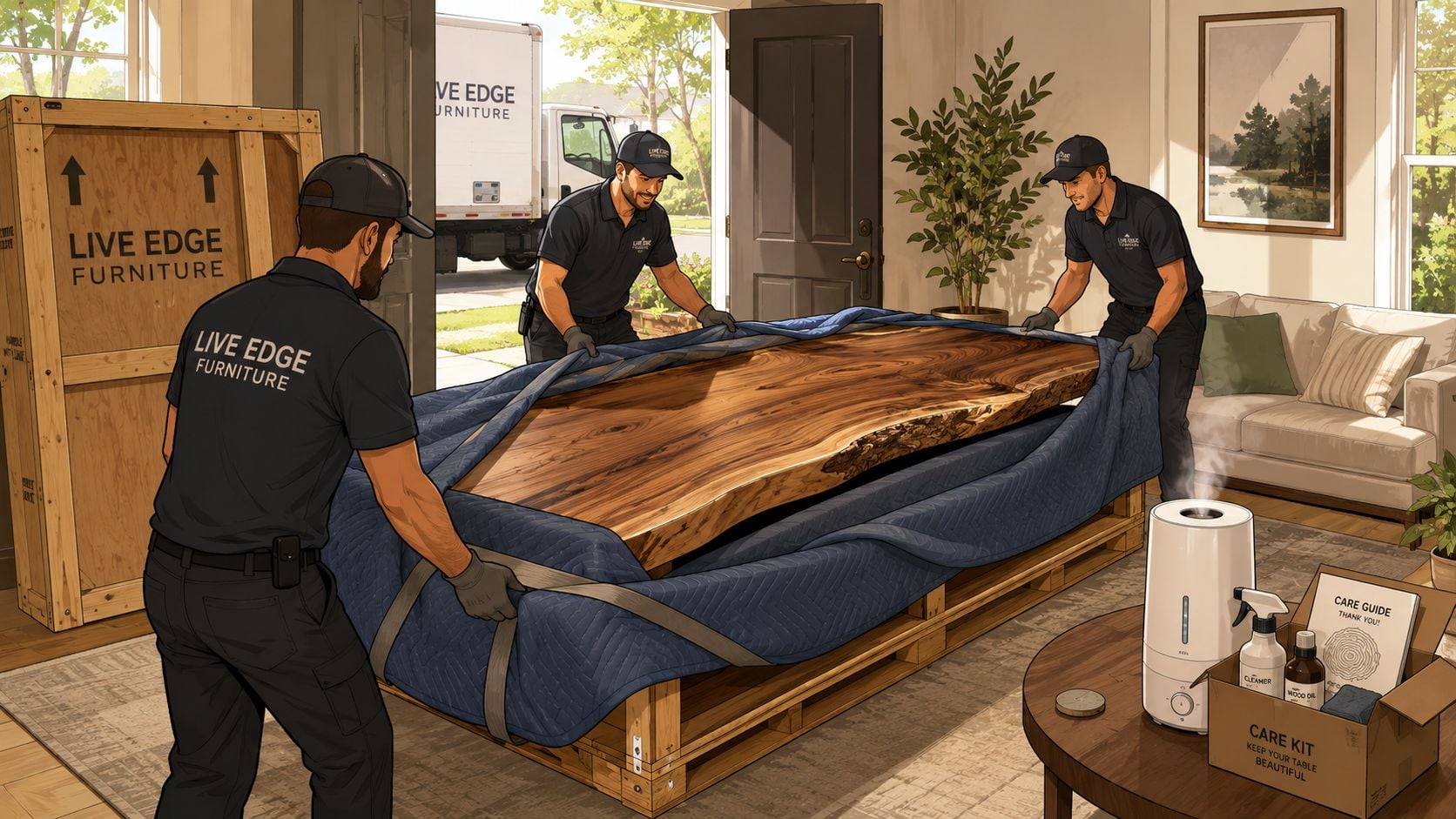
Delivery should protect the finished piece
White-glove delivery means more than leaving a carton at the front door. Premium service typically includes in-home placement, assembly, packaging removal, and inspection, with some providers adding a multi-point check before delivery. White-glove furniture logistics defines the service in concrete operational terms.
The delivery crew should bring the table to its intended room, level the base, and verify that the slab sits flat without racking. Buyers should point out narrow passages, stair turns, delicate flooring, and low-clearance areas before the crew arrives. A well-planned installation is usually straightforward, but the route still deserves attention when the top is broad or heavy.
Care for a catalyzed varnish finish
Vinson's live edge tables use a catalyzed varnish, so oiling isn't part of the maintenance routine. Everyday care requires only:
- Soft dusting: Use a soft, dry cloth.
- Light cleaning: Follow with a damp cloth, then dry the surface.
- Stubborn residue: Use a mild, non-detergent soap sparingly.
- Product avoidance: Skip silicone polishes, harsh detergents, and ammonia-based sprays.
The wood furniture care guide provides a useful reference for maintaining finished hardwood. Direct HVAC airflow, fireplaces, and intense south-facing glass should be avoided because they can create uneven drying. A homeowner should monitor room humidity with a simple hygrometer and use humidification or dehumidification when conditions become extreme.
Some seasonal movement is normal. The Lancaster guidance reports a rule of thumb of roughly 1/8 inch of movement per foot of slab width, so a 36-inch-wide top may move about 3/8 inch across seasonal humidity cycles. Live edge movement and fastening guidance recommends finishing both faces evenly and using slotted or C-channel hardware. Hairline checks along end grain can be part of that natural response. Sudden splitting, severe cupping, persistent rocking, or hardware stress deserves a professional inspection.
Putting It All Together Before You Visit Easton
A prepared showroom visit turns a beautiful search into a focused design decision. The buyer should arrive with room measurements, doorway and stair-turn dimensions, a photograph of the dining or living area, and flooring or fabric swatches. Those details let a designer judge the slab's scale and finish against the room instead of evaluating the top in isolation.
A short planning list keeps the conversation efficient:
- Seating requirement: Decide whether the table must accommodate a fixed number of diners or occasional larger gatherings.
- Expansion needs: Determine whether leaves are necessary or whether a single slab should remain visually uninterrupted.
- Room role: Identify whether the table anchors a formal dining room, an open-plan space, or a hardworking family area.
- Aesthetic direction: Choose between light wormy maple, warm cherry, structured oak, deep walnut, or a restrained dark resin treatment.
- Budget range: Give the designer a realistic range so the conversation can include available slabs, base construction, and custom work.
- Delivery route: Bring measurements for every point the table will pass through.
The In-Store Design Studio can then translate the brief into an actual configuration. Through the Custom Order Program, the shopper can review solid hardwood options, base styles, edge profiles, finishes, and coordinated seating. The visualizer provides a room-based preview before production, which is especially valuable when a live edge contour makes the table feel larger than its straight-line measurements suggest.
Vinson's Low Price Guarantee, including its 110% refund structure under qualifying conditions, gives buyers a specific value question to ask about comparable builds. The Clearance Gallery, with savings up to 70% on selected pieces, offers another route when an in-stock table meets the room's requirements. Buyers should request a written quote, a digital rendering, the selected slab identification, the expected timeline, and the delivery scope before approving the order.
The same visit can solve more than the table. Solid hardwood dining furniture, Mavin bedroom furniture, Smith Brothers living room seating, premium top-grain and performance leather, power reclining sectionals, swivel chairs, rockers, and gliders can be evaluated through an actual sit-test. That tactile comparison is more useful than judging scale, comfort, or finish from a screen.
A successful Easton appointment ends with clarity. The homeowner knows which slab is being considered, how the base will support it, how the finish will be maintained, how the table will enter the home, and why the selected design deserves a place there for years.
Vinson Fine Furniture offers solid hardwood live edge tables, custom design support through its In-Store Design Studio, and complimentary consultations for Columbus homeowners planning a lasting dining or living space. Visit Vinson Fine Furniture at Easton Town Center to inspect slabs in person, test seating and motion options, and develop a table that fits the room rather than chasing a short-lived trend.