Sectional vs Sofa and Loveseat: A Room-by-Room Guide

A Columbus homeowner can spend weeks choosing a fabric, finish, and coffee table, then discover that the main seating arrangement blocks the kitchen route or points the television at an awkward angle. The choice between a sectional and a sofa and loveseat isn't primarily a style decision. It's a decision about how the room functions, how carefully the furniture fits, and how much flexibility the household needs later.
For a family in Worthington or Hilliard, the right answer may be a lounge-ready sectional for movie nights. For a homeowner with a conversation-focused room, frequent guests, or an upcoming move, separate pieces may serve the house better. The most reliable approach is to measure the room, identify the dominant activity, and test the furniture in person at a showroom such as Vinson Fine Furniture near Easton Town Center.
The Living Room Decision Most Buyers Get Wrong
A homeowner standing in an empty living room often sketches two options on a notepad. One side shows a traditional sofa and loveseat, while the other shows an L-shaped sectional tucked into a corner. Both look appealing on paper. The mistake happens when appearance becomes the deciding factor before traffic flow and daily habits enter the discussion.
The sectional vs sofa and loveseat decision should begin with three filters:
- Room purpose: Does the space support binge watching, big-game gatherings, reading, or face-to-face conversation?
- Physical fit: Can the chosen pieces preserve walking paths, doorways, vents, and access to adjoining rooms?
- Household habits: Do people stretch out, move furniture, host guests, relocate often, or need easy-clean upholstery?
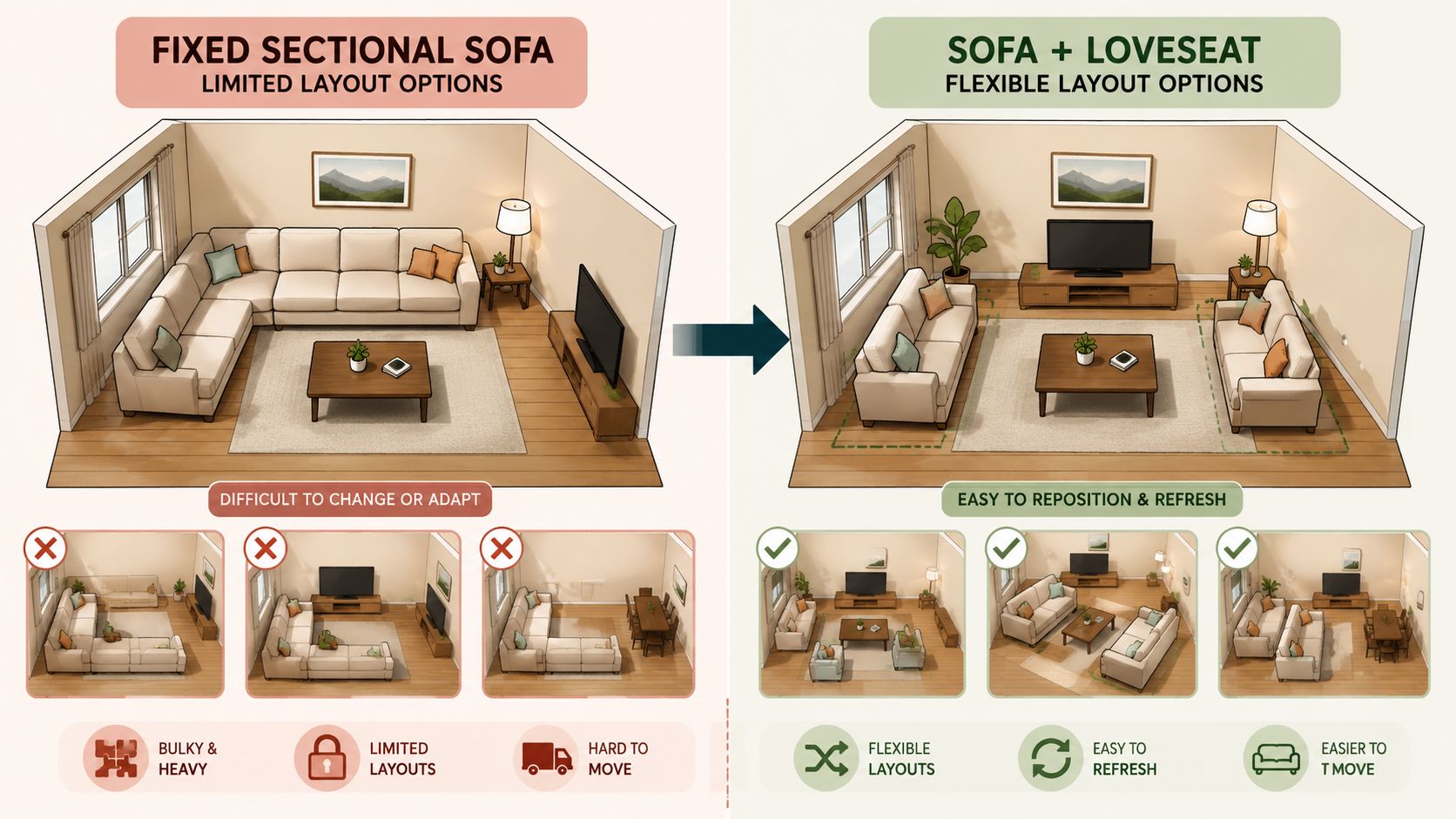
A sectional creates a fixed layout. Its connected form gives the room a strong anchor, but the chaise and corner determine how people enter, where the coffee table sits, and which direction the television faces. A sofa and loveseat create a flexible layout, with separate pieces that can be angled, separated, or moved into another room.
Historical context reinforces the distinction. Furniture histories generally trace early loveseats to the late 17th and 18th centuries, when wide seats accommodated the large dresses of the period. Sectional sofas are generally associated with the 19th century and became common in American homes during the 1930s and 1940s, a later response to modern interior needs such as flexibility and apartment living. Furniture history provides useful context for the different origins of loveseats and sectionals.
Practical rule: The configuration should serve the room's most frequent activity, not simply fill the largest available wall.
A homeowner researching low-maintenance interiors may also benefit from easy living room designs Chennai, particularly for ideas about circulation and practical room planning. The principle applies in Columbus as well. Furniture should leave the room easy to enter, cross, clean, and live in.
How You Actually Use the Room
A Tuesday movie night reveals the sectional's strongest advantage. Family members lie sideways, stretch their legs onto a chaise, and move between the corner and the outer seat without breaking up the group. A well-sized sectional gives everyone a shared view of the television and creates one continuous lounge zone instead of a collection of separate perches.
A tightly cushioned Smith Brothers sectional can make that setup feel refined rather than oversized. Performance fabric, top-grain leather, and optional power motion can support a room that handles long viewing sessions and regular family use. A motorized headrest or reclining seat adds controlled movement without turning the entire room into a row of theater chairs.
Saturday brings a different scene. An Ohio State watch party may have guests moving between the kitchen and living room, carrying plates, greeting one another, and shifting between the television and conversation. A sofa and loveseat create two distinct seating zones, while a swivel chair can turn toward the game or toward the person standing near the kitchen. The arrangement keeps traffic moving past the seating rather than through the middle of it.
A quiet evening with coffee and a friend points in another direction. Two separate pieces can face one another across a coffee table, producing a more intimate conversation circle. One large L-shape can accommodate both people, but its corner often pulls the arrangement toward lounging side by side instead of talking across from one another.
Three household scenes
- The movie household: Choose a sectional when stretching out and shared television viewing dominate the room.
- The hosting household: Choose a sofa and loveseat when guests circulate, mingle, and use more than one part of the living area.
- The conversation household: Choose separate seating when face-to-face interaction matters more than one continuous lounge surface.
The strongest predictor isn't square footage alone. It's the pattern of use repeated every week. A modest room dedicated to home theater and reading may need a sectional, while a larger room used for conversation may benefit from a sofa, loveseat, and swivel chairs.
Sectional vs Sofa and Loveseat Side by Side
A sectional combines multiple connected components into one seating system. A sofa and loveseat separate the same general seating function into two independently usable pieces. That structural difference affects circulation, visual weight, moving logistics, and the room's ability to change later.
| Feature | Sectional | Sofa and Loveseat |
|---|---|---|
| Seating experience | Continuous, lounge-oriented seating with a corner or chaise | Separate seating zones with a more traditional rhythm |
| Room role | Anchors one area and often defines the focal point | Supports multiple arrangements and conversation groupings |
| Traffic flow | Can narrow entry and exit points around the L-shape | Makes it easier to preserve paths behind or between pieces |
| Reconfiguration | Orientation may remain fixed unless the design is modular | Pieces can be angled, separated, or moved independently |
| Best use | Movie nights, family lounging, and shared television viewing | Conversation, entertaining, and rooms that may change |
| Delivery considerations | Connected sections may require careful handling and setup | Separate pieces can be handled independently |
A sectional often uses an underused corner efficiently, particularly when the room has a clear focal point and open sides. Design guidance commonly uses a minimum room size of roughly 11 by 13 feet, with at least 36 inches of clear walking space on open sides. The sectional should also be sized so neither arm extends beyond about two-thirds of its wall length. This sectional planning guide explains practical clearance and proportion checks.
A sofa and loveseat can make a square or rectangular room feel lighter. The sofa may face the television while the loveseat turns toward a fireplace, window, or central table. That arrangement creates more than one visual destination, which helps a multipurpose room feel composed rather than dominated by one oversized form.
The sectional buying guide from Vinson Fine Furniture can help buyers evaluate orientation, scale, and configuration before visiting the Easton showroom. The important distinction remains simple: sectionals prioritize continuity, while separate pieces prioritize adaptability.
Measuring Your Room Before You Fall in Love
Furniture measurements should begin at the doorway, not the wall. A piece can fit along a wall and still fail at the entry, hallway turn, stair landing, elevator, or path to the kitchen island. In Columbus subdivisions built during the 1990s and 2000s, many living rooms have wall lengths between 12 and 16 feet, a range where a sofa and loveseat can preserve space for a media console or passage. Open-concept great rooms, common in newer Dublin and New Albany homes, generally absorb a sectional more comfortably.
Use painter's tape to mark the outer edges of each configuration on the floor. Include the arm depth, chaise projection, coffee table, and walking route. A practical planning guide recommends 30 to 36 inches of clear traffic space, while another layout reference places the coffee table about 18 inches from the sofa or loveseat for comfortable movement. This room-measurement guide offers a useful furniture planning process.
| Configuration | Typical Length | Minimum Wall Width | Walk-Behind Clearance | Best Room Size |
|---|---|---|---|---|
| Sofa and loveseat | Sofa and loveseat vary by frame, with loveseats often around 60 to 72 inches | Measure both walls and preserve a clear passage | 30 to 36 inches | Small to medium rooms with more than one usable wall |
| Compact sectional | Often around 72 to 96 inches overall | Confirm both the long side and return | At least 36 inches on open sides | Compact rooms with an available corner |
| Larger sectional | Requires a substantially larger footprint | Check long wall, return wall, and chaise projection | At least 36 inches on open sides | Open great rooms and dedicated family rooms |
A side table needs its own breathing room. Planning guidance commonly allows about 24 inches for a side table, while coffee-table spacing often falls between 14 and 18 inches, depending on the table depth and seating profile. These are planning benchmarks, not substitutes for the exact product dimensions.
The tape test
- Mark the footprint: Tape the arms, back, chaise, and corner.
- Walk the route: Test the path from the entry to the kitchen, hallway, and adjoining rooms.
- Check fixed features: Keep return-air vents, radiators, outlets, and doors accessible.
- Photograph the result: Bring the floor plan, room photo, and measurements to a design appointment.
Exact dimensions should be checked before ordering. Smith Brothers sofas and sectionals displayed through Vinson's Easton showroom provide product-specific measurements, allowing buyers to verify fit before white-glove delivery begins.
The Hidden Tradeoff Between Fixed and Flexible Layouts
Sectionals don't automatically save space. They often use a corner well, but they also commit the room to a particular orientation. The chaise dictates where people stretch out, the return determines the main traffic opening, and the L-shape often fixes the television and coffee table relationship.
A sofa and loveseat offer a different kind of efficiency. The pieces can sit together as a compact grouping, separate to flank a fireplace or picture window, or rotate to open a doorway when guests arrive. In a long, narrow Columbus living room, that breathing room can matter more than the sectional's continuous silhouette.
Where permanence helps
A sectional's fixed quality becomes an advantage when the room has one clear focal point. A square great room with a media wall, fireplace, or large window can benefit from a strong seating anchor. The furniture gives the room architectural definition, especially when the seating zone needs to feel separate from a dining or kitchen area.
The same permanence becomes a liability when the next home may have a different doorway, wall arrangement, or traffic pattern. Modular sectionals reduce that commitment, but buyers still need to confirm how pieces connect and whether the orientation can change without ordering new components.
A sofa and loveseat carry their own risk. They need coordinated height, arm shape, cushion firmness, and upholstery. If those details don't align, the room can look like two unrelated purchases rather than one deliberate seating group. A matched collection solves much of that issue, while a custom-order program can coordinate the remaining details.
For practical arrangement principles, the living room layout guide from Vinson Fine Furniture can help buyers test focal points and circulation before committing.
Design judgment: Choose a sectional when the room benefits from permanence. Choose separate seating when the household values options more than a single sculptural form.
Modular and reconfigurable seating has gained attention as homeowners seek furniture that can adapt to moves, hybrid living rooms, and multipurpose spaces. A 2025 industry analysis reported that modular sofa searches peaked in November 2024 and remained high into May 2025, while a 2026 design roundup described modular sofas as a top request. The modular sofa trend coverage documents this shift toward adaptability.
Matching the Configuration to Your Household
Furniture should solve the household's recurring problems. A family with young children and pets may value a connected seating surface with fewer gaps, while an entertainer may need open circulation and seating that turns toward more than one activity.
Households with children and pets
A tightly cushioned Smith Brothers sectional in performance fabric can create one contained lounge zone. Crypton performance fabric is one possible upholstery direction, while a protected leather such as the Oakdale line offers a smooth surface that can be wiped and conditioned according to the manufacturer's care guidance. The corner seat can also act as a practical boundary between the seating area and the rest of the room.
Kid-friendly decisions still require attention to cushion construction, seam placement, arm height, and cleaning instructions. The kid-friendly and pet-friendly furniture guide helps households evaluate those details before selecting a fabric or leather.
Frequent entertainers
A household hosting Buckeyes watch parties, holiday gatherings, or regular dinners may prefer a sofa and loveseat paired with a swivel accent chair. Guests can turn toward the television, face the sofa, or rotate toward the kitchen without forcing the entire seating plan into one direction.
A Mavin solid-wood occasional table can complement the arrangement with durable visual weight, while a swivel chair, rocker, or glider adds movement without crowding the primary walking lane. The configuration feels more like a conversation room than a single-purpose media zone.
Small-space owners
German Village condos and downtown lofts often need furniture that works hard without swallowing the floor. A compact sofa paired with a loveseat can preserve more usable pathways than a large L-shape, especially when the entry, windows, and kitchen route interrupt the seating walls.
The question isn't just how many people can sit. It's whether people can stand, turn, carry a drink, and reach the door without navigating around a chaise.
Frequent movers
Relocating professionals who expect to spend only a few years in Columbus should look closely at transport and future fit. Two separate pieces can be easier to stage in a different room or adapt to a new home than one large sectional with a fixed return. Premium sectionals may involve heavier handling, more complex delivery, and a narrower resale audience when the next floor plan doesn't match.
For broader staging principles, staging a house for sale Texas offers useful context on keeping rooms open and visually understandable, even though the regional housing context differs.
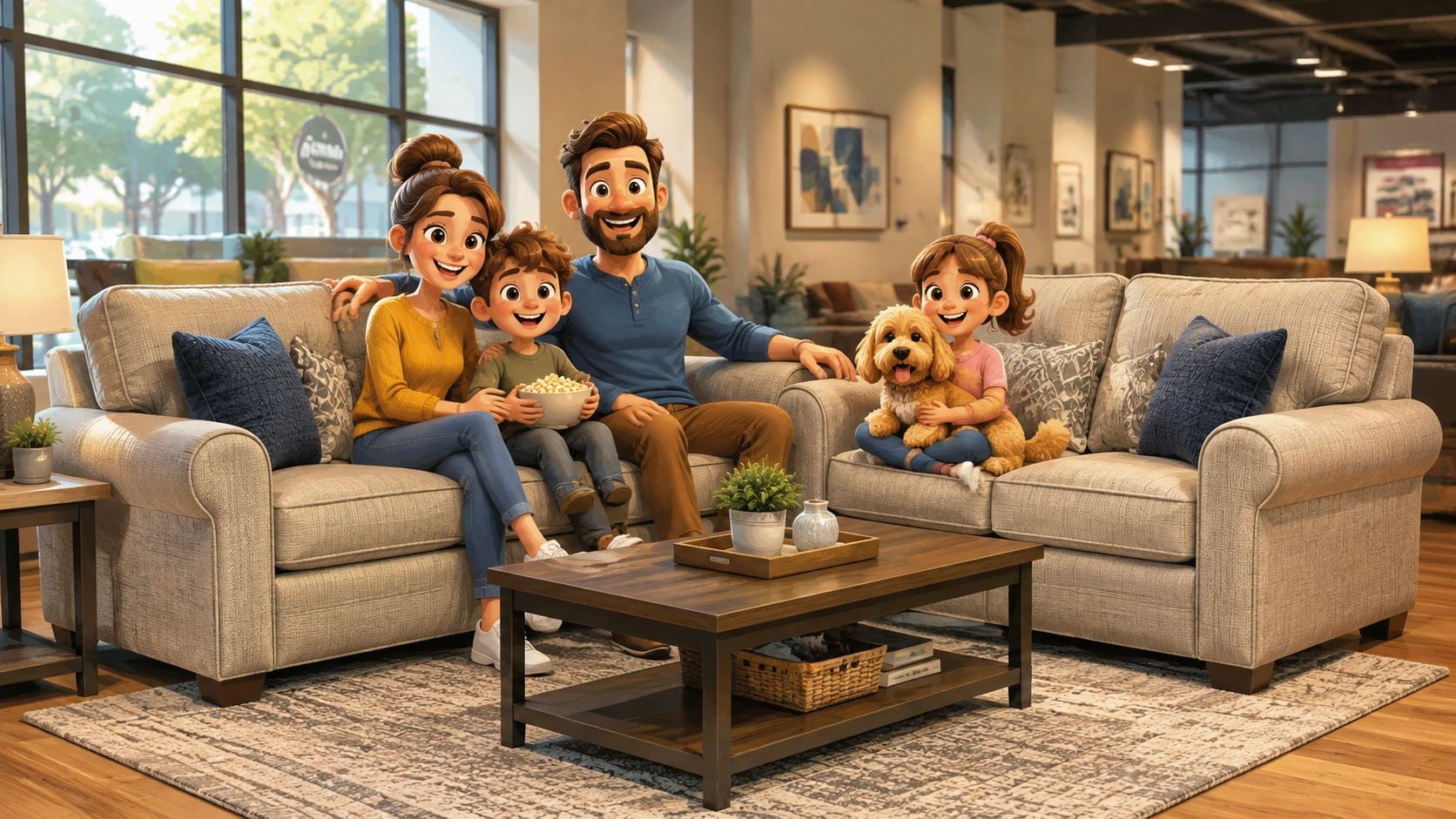
Bring room measurements, a doorway photo, and a description of the household's daily routine to the In-Store Design Studio. Complimentary Design Consultations can help match the configuration, upholstery, motion features, and scale to the actual room.
Custom Order, Quality, and Long-Term Value
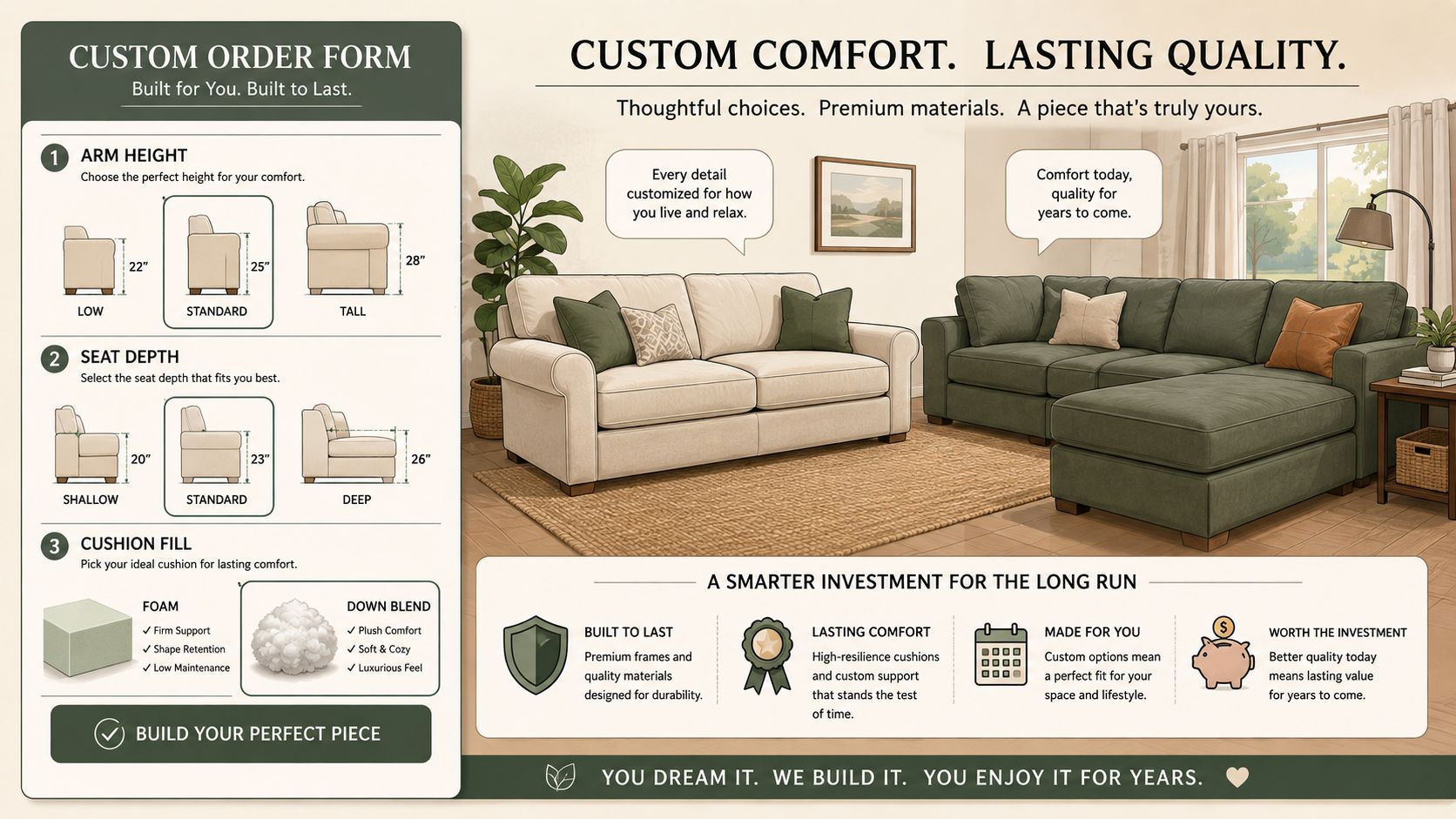
A sectional and a sofa-and-loveseat set can both serve for years when you choose construction and comfort before appearance. The right purchase should match the room's use, the household's posture preferences, and whether you want a fixed layout or pieces you can reposition later. Custom ordering lets the seating fit those decisions instead of forcing the room around a showroom silhouette.
The Custom Order Program offers fabric, finish, and 3D visualization choices for Smith Brothers, Canadel, and Mavin. Smith Brothers of Berne is made in Indiana, USA. Mavin is Amish-made in Ohio, USA. Canadel is handcrafted in Quebec, Canada. These lines give Columbus homeowners access to American-made and broader North American craftsmanship across different room needs and product categories.
Details that shape daily comfort
- Seat depth and arm height: Choose support for upright conversation or room to stretch out during movie nights.
- Cushion fill: Foam provides a more structured sit, while a down blend feels softer and more relaxed.
- Upholstery: Top-grain leather develops character. Performance leather and performance fabric suit different maintenance routines.
- Motion: Motorized reclining, power headrests, swivel bases, rockers, and gliders add movement where the seating plan benefits from it.
- Finish coordination: Leg finish, nailhead trim, and wood accents help separate pieces read as one coordinated group.
Construction deserves the same scrutiny. Vinson's hardwood standard centers on solid cherry, oak, maple, and walnut furniture, with solid hardwood construction rather than promoted alternatives. Solid wood by itself does not establish quality. Species, joinery, frame preparation, and construction methods determine how the piece performs over time. This solid-wood standards guide explains why the label alone isn't enough.
Ask about kiln-dried hardwood frames, reinforced joinery, and eight-way hand-tied springs when evaluating upholstered seating. Those questions apply to a sofa, loveseat, reclining sectional, or custom leather sectional in Columbus. A sit-test at Vinson can also reveal whether the cushions recover well, the arms support your position, and the configuration works for actual conversation or lounging.
Vinson's Low Price Guarantee provides a 110% refund of the difference when its conditions are met. The Clearance Gallery offers savings of up to 70% on eligible floor samples, overstocks, and closeouts. Financing through Synchrony may help qualified buyers choose the construction and upholstery that fit the home, rather than settling for the fastest available purchase.
Choosing, Buying, and Living With Your Decision
The decision can be made with a short, practical visit.
- Bring the room evidence: Measurements, doorway widths, a room photograph, and a rough floor plan prevent showroom preferences from outrunning the space.
- Sit in both configurations: Test upright conversation, deep lounging, corner support, cushion recovery, arm height, and reclining movement.
- Check the upholstery: Request fabric swatches and compare performance fabric, top-grain leather, and performance leather under the room's lighting.
- Ask about future fit: Confirm sectional orientation, modular options, delivery access, and whether separate pieces can serve another room later.
- Review the purchase path: Compare custom order, in-stock options, financing through Synchrony, clearance savings, and white-glove delivery.
White-glove delivery is more than curbside drop-off. The service commonly includes a scheduled appointment, trained handlers, interior placement, assembly or installation when needed, unpacking, and packaging removal. This furniture delivery explanation outlines the practical difference between white-glove and standard freight service.
Delivery timing is typically similar for a sofa, loveseat, or sectional when the pieces share the same order status. The choice should therefore follow room use and fit, not an assumed delivery advantage. Industry delivery coverage has also cited white-glove shipments as reducing damage rates by 30% compared with standard shipping, with more than 150 million specialized shipments globally by 2023. The furniture-delivery explainer provides that industry summary.
For additional purchasing questions, this sofa buying guide can support the showroom conversation.
FAQ
- How long will delivery take? Sofa, loveseat, and sectional delivery is typically comparable when order status is the same.
- What financing minimum applies? Financing terms and minimum purchase requirements should be confirmed with the showroom because they depend on the current Synchrony offer and account approval.
- Can buyers take fabric swatches home? The design team can identify available swatches for the selected frame and upholstery category.
- Does Vinson offer trade-in guidance? Buyers should ask the team about current trade-in or removal options, since availability depends on the item and service conditions.
For most movie-focused households, the recommendation is a sectional. For conversation rooms, frequent entertainers, small spaces, and likely moves, a sofa and loveseat usually make the stronger long-term choice.
Vinson Fine Furniture offers an Easton Town Center sit-test, an In-Store Design Studio, Complimentary Design Consultations, custom ordering for brands such as Smith Brothers, Canadel, and Mavin, solid hardwood furniture, premium leather and motion seating, white-glove delivery, and clearance savings. Bring the room measurements and visit Vinson Fine Furniture to test both configurations before ordering.