How to Arrange Living Room Furniture for a Flawless Flow


The secret to a beautifully arranged living room isn’t just about having great furniture; it’s about starting with a smart, thoughtful plan. Before you move a single heirloom-quality piece, it's essential to get to know your room's unique character. Think of it as creating a blueprint for a space that feels both welcoming and perfectly suited to your life, an investment in your home's comfort and style.
The Foundation of a Great Living Room Layout
Arranging a living room comes down to a few key ideas: finding a focal point, creating cozy spots for conversation, making sure people can walk through easily, and balancing the size of your furniture. When you get these right, your room goes from just a collection of items to a place that truly feels like home.
This all starts with the basics. You'll want to take note of the room's total dimensions, where the windows and doors are, and how you naturally walk through the space. Most importantly, you need to find your focal point. This is the star of the show—it could be a gorgeous fireplace, a big window with a view, or a beautiful, hand-finished entertainment center.
Your Pre-Arrangement Planning Checklist
Before you start shuffling furniture, taking a few minutes to gather this information will save you a ton of time and effort. This simple checklist covers the essential first steps for any investment homeowner.
| Action Item | Why It's Important | Pro Tip |
|---|---|---|
| Measure Room Dimensions | Ensures your furniture will physically fit and helps you visualize the scale. | Don't forget to measure wall space between windows and doors! |
| Note Window & Door Locations | Prevents you from blocking natural light or creating awkward entryways. | Sketch a quick floor plan on paper. It doesn't have to be perfect. |
| Identify Your Focal Point | Gives the room an anchor and a natural direction for your layout. | If you don't have one, you can create one with a large piece of art or a solid-wood media unit. |
| Map Out Traffic Flow | Keeps pathways clear so the room feels open and is easy to move through. | Walk from one doorway to another. That's your primary traffic path to protect. |
Getting these details down on paper first gives you a clear, practical blueprint to work from, turning a potentially overwhelming task into a manageable project.
Building Your Blueprint
A great layout is all about supporting how you actually live. Is your living room the spot for lively get-togethers, cozy movie nights, or a little bit of both? Your answer will guide every single placement decision you make. The goal is to create "conversational groupings"—arrangements that naturally encourage people to interact.
A well-planned layout does more than just look good; it feels right. By considering flow and function from the start, you create a space that invites relaxation and connection, making your home a true sanctuary.
Imagine walking into a room that feels instantly relaxing and makes sense—that's the power of smart furniture arrangement. One of the simplest tricks we use is placing the main sofa against the longest wall, often facing the focal point. This one move can make many living rooms feel significantly larger and more intentional.
And don't forget about breathing room! For good traffic flow, try to maintain at least 18-24 inches of space between your coffee table and sofa, and create clear walkways around your furniture groupings. A cramped room is an uncomfortable room.
From Plan to Perfection
Once you have your blueprint, you can start choosing pieces that bring your vision to life. This foundational step ensures you select furniture that not only looks beautiful but also functions perfectly within your space. Exploring our collection of living room essentials can give you plenty of inspiration for anchoring your space with just the right pieces.
At Vinson Fine Furniture, our goal is to help you build a space that lasts a lifetime. If you're feeling a little stuck or just want a second opinion, a Complimentary Design Consultation at our Easton Town Center showroom can provide that expert guidance. Our designers are here to help you translate your blueprint into a stunning reality, ensuring your investment serves your family for generations to come.
Placing Your Anchor Pieces
You've got your measurements in hand and you’ve figured out your room's focal point. Now for the fun part: placing your big-ticket items, what we call the anchor pieces.
This is usually your sofa or sectional—the largest piece that really sets the tone for the entire room. Getting this one right is everything. The shape of your room is your best guide here.
Think about it: a long, narrow room can easily start to feel like a bowling alley if you’re not careful. To avoid that, try placing your main sofa against one of the shorter walls to visually widen the space. A square room, on the other hand, often begs for a more balanced, symmetrical setup, like placing two sofas directly across from each other.
Finding the Right Arrangement for Your Space
The best layouts always feel like they were planned with a specific purpose in mind. Are you aiming for a cozy spot where family can gather and talk, or are you designing the ultimate hub for movie nights? Where you put that first piece of furniture dictates the rest of the flow.
Here are a few classic layouts that just plain work:
- The Face-to-Face: This is exactly what it sounds like—two sofas, or a sofa and two chairs, positioned directly opposite each other. It’s an incredibly inviting and sophisticated setup that’s perfect for conversation. This arrangement naturally pulls everyone's attention toward the center of the room, making it a great choice if your focal point is a fireplace or a gorgeous coffee table.
- The L-Shape: A go-to for a reason, this layout works in almost any room, big or small. By placing two sofas (or a sofa and a loveseat) at a right angle, you create a natural corner for conversation. It's also a fantastic way to define a living area within a larger, open-concept home.
- The Entertainment Hub: If your living room is all about the screen, then the layout should be too. All your main seating needs to have a clear, comfortable view of the TV or media unit. A big, comfy sectional is often the hero of this setup, offering plenty of seating for the whole crew.
Getting the foundation right is a simple, three-step process. Once you nail these, the rest of the room falls into place.
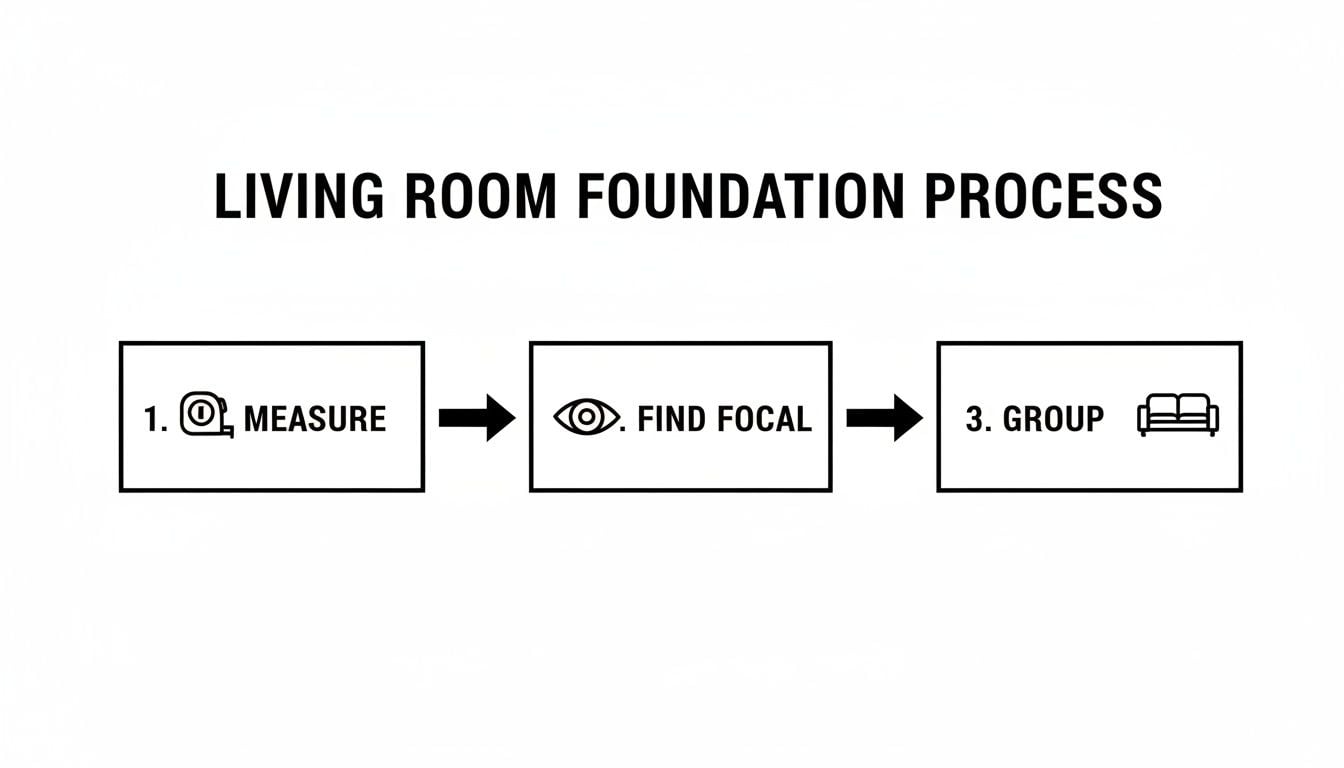
It all comes down to being methodical. Start with the room's real dimensions, and you'll end up with a furniture grouping that just feels right.
Customizing Your Anchor Pieces for a Perfect Fit
Picking the right layout is one thing, but having furniture that’s actually the right size for that layout is another. This is where a little extra thought goes a long way. An overstuffed sectional can swallow a small room whole, just as a petite sofa can feel completely lost in a huge, open space.
The most important decision is your first one—the anchor piece. A perfectly scaled and placed sofa or sectional acts as the gravitational center of your living room, pulling the entire design together.
This is exactly why our Custom Order Program is a game-changer. Our Custom Order Program allows you to personalize your seating with hundreds of premium fabrics and performance leathers, ensuring your piece is as unique as your home. Need a massive sectional with the chaise on the left side for your L-shaped layout? Or a custom dining set built to the exact inch? You can design it to fit your home, not the other way around.
At our Easton Town Center showroom, we take it a step further. Our In-Store Design Studio allows you to use 3D visualizers to test-drive different layouts with the actual furniture you’re considering. It’s a complimentary service we offer to make sure your investment in quality, solid wood furniture Ohio families love is a perfect fit.
For a deeper dive into choosing that crucial anchor piece, our guide on what you should know before buying a sectional is a great next read. Our goal is to help you find furniture that isn’t just beautiful, but is truly built for your life.
Mastering Scale, Proportion, and Traffic Flow
Once your main pieces are in place, the real art of arranging a living room begins. It’s all about balance. A truly successful layout is one where every piece feels like it belongs, creating a cohesive look rather than just a random collection of furniture.
It's a common misstep we see all the time: furniture that's either way too big for the room, making it feel cramped, or so small it gets completely lost. Imagine a beautiful, substantial top-grain leather sofa. If you pair it with a tiny, delicate end table, the table will look comically out of place. The same goes for placing bulky armchairs next to a petite loveseat—it just throws off the whole visual harmony.
Give Your Furniture Some Breathing Room
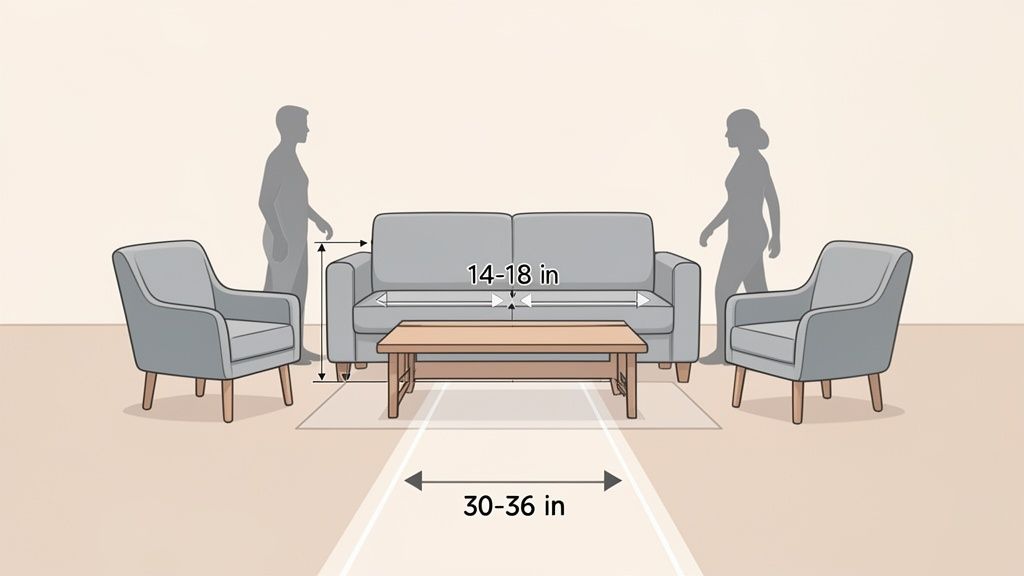
The secret to a space that feels open, inviting, and easy to live in is what designers call "breathing room." This is where thinking about traffic flow becomes so important. You need to be able to walk through your living room without sidestepping tables or squeezing past chairs.
Here are the key numbers to live by for a comfortable layout:
- Main Pathways: You'll want at least 30 to 36 inches for any major walkway, like the path from the hall into your seating area. This makes moving around feel natural, not like an obstacle course.
- Coffee Table Spacing: The sweet spot between your sofa's edge and the coffee table is 14 to 18 inches. It’s just close enough to set down your coffee, but gives you plenty of legroom.
While these measurements are a fantastic starting point, nothing beats the real thing. Our showroom is the best furniture store Columbus Ohio has for experiencing scale firsthand.
The absolute best way to get a feel for scale is to do a 'sit-test.' An image online can be deceiving, but sitting in an accent chair or on a sofa in our showroom gives you a true sense of its real-life presence and comfort.
Putting Your Plan into Action
When you visit us at our premier Easton Town Center location, you can experience the difference firsthand. Feel how a 20-inch seat depth compares to a 24-inch one, or see exactly how that solid-wood end table you've been eyeing actually looks next to a sofa. This hands-on approach takes all the guesswork out of choosing pieces that are perfectly proportioned for your home.
Even better, our designers can help you map out these critical details during a Complimentary Design Consultation.
Once your selections are made, our White-Glove In-Home Delivery service ensures your vision comes to life perfectly. Our team doesn't just drop boxes at your door; they'll place and assemble every piece according to your plan, guaranteeing the ideal spacing and flow you designed is flawlessly recreated in your home.
Layering Lighting and Textiles to Complete the Look
You’ve done the hard work—the measuring, the planning, and the heavy lifting. Your furniture is perfectly placed, and the traffic flows just right. But what takes a room from simply functional to truly finished? It’s the final layers: the lighting, rugs, and textiles that infuse your space with warmth and personality. This is where the magic really happens.
The Power of Layered Lighting
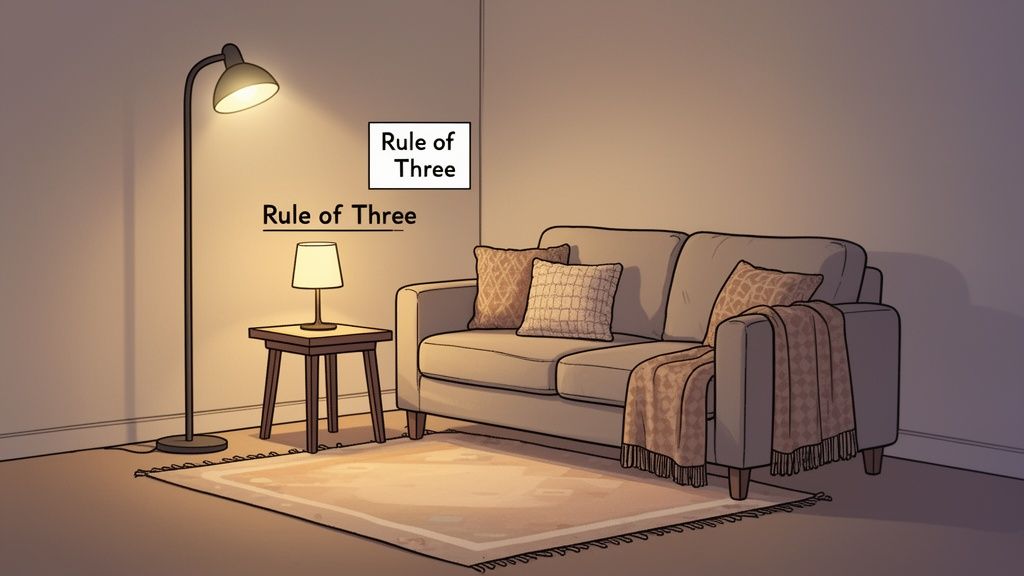
Nothing impacts the mood of a room quite like good lighting. A single overhead fixture just won't cut it. The secret is to create a layered effect using three distinct types of light. It’s a foundational design principle.
- Ambient Light: This is your general, all-over illumination—think ceiling fixtures or recessed lighting. It’s the foundation.
- Task Light: This is your focused, functional light. It’s the floor lamp beside your favorite reading chair or a small lamp on a console table for sorting mail.
- Accent Light: This is the character layer. It’s the directional light you use to highlight something you love, like a piece of art, a beautiful textured wall, or an interesting architectural feature.
A good mix to aim for is roughly 60% ambient, 30% task, and 10% accent lighting. This combination effectively balances most rooms, getting rid of those harsh shadows that can make a space feel cramped and unwelcoming.
With a few thoughtful choices, you can put your living room in the best light. A great rule of thumb is to place lamps about 5-6 feet apart to create an even, inviting glow without any dark corners.
Anchoring Your Space with the Right Rug
One of the most common mistakes we see is a rug that’s too small for the space. A little "postage stamp" rug floating in the middle of the floor does nothing for a room. Your rug needs to be large enough to properly anchor your main seating arrangement.
Think of your area rug as the foundation of your conversational grouping. Ideally, at least the front two legs of every piece of seating—from your sofa to your accent chairs—should rest comfortably on the rug.
This simple rule is a game-changer. It pulls all your furniture together, making the entire setup feel cohesive and intentional.
Getting the size just right can feel tricky, but this simple guide for common layouts can help point you in the right direction.
Rug Sizing for Common Seating Arrangements
| Seating Arrangement | Minimum Rug Size | Ideal Rug Size |
|---|---|---|
| Sofa & Two Chairs | 8' x 10' | 9' x 12' |
| Sectional Sofa | 9' x 12' | 10' x 14' |
| Apartment-Sized Sofa | 5' x 8' | 6' x 9' |
| Large, Open-Concept Room | 10' x 14' | 12' x 15' |
Choosing a rug that allows your main furniture pieces to sit on it (even just partially) creates a defined zone that feels grounded and complete.
Weaving in Texture and Personality
Now for the final, personal touch: textiles. This is your chance to really let your personality shine through with throw pillows, blankets, and window treatments that add softness, color, and pattern.
Don’t be afraid to experiment here. Bring in a mix of rich velvets, chunky knit throws, or patterned linens to create visual interest and a cozy, lived-in feel. This is what makes a house a home.
Our Custom Order Program makes this step incredibly personal and fun. You can choose from hundreds of hand-finished fabrics and top-grain leathers to create pillows that perfectly coordinate with your new sofa. Even a beautifully crafted Amish-made console table shines when styled with the right lamp and a few personal objects.
And if you’re looking for that one-of-a-kind final piece, our Clearance Gallery is a hidden gem. You can find unique accessories and accent pieces at savings up to 70%, perfect for adding that last layer of affordable luxury without compromising on quality.
Common Arrangement Mistakes and How to Fix Them
Have you ever arranged your living room, stood back, and felt like something was just… off? You can’t quite put your finger on it, but the room feels awkward instead of inviting. It happens to the best of us.
More often than not, the culprit is one of a few classic design missteps. The good news? These are incredibly easy to spot and fix, often with just a few simple adjustments that can completely change the feel of your space.
One of the most common habits is pushing every single piece of furniture right up against the walls. It might seem like the logical way to maximize open space, but it can leave a room feeling cold, stiff, and impersonal—almost like a doctor's waiting room. The fix is surprisingly simple: pull your furniture away from the walls. Even giving your sofa a few inches of breathing room creates intentional, cozy groupings and makes the whole room feel more thoughtfully put together.
The Problem of Scale and Proportion
Another issue we see all the time is a mismatch in scale, especially when it comes to area rugs. A tiny rug floating in the middle of the floor can make your beautiful furniture look like it's lost and adrift at sea.
- The Mistake: Using a rug that’s too small for the space, where all the furniture sits completely off of it. This visually shrinks the room and does nothing to define your seating area.
- The Fix: Always choose a rug that's large enough for at least the front two legs of your sofa and chairs to rest on. This one change instantly anchors the entire arrangement, pulling all the pieces together into a grounded, cohesive unit.
This same idea of scale applies to the furniture itself. A huge, overstuffed sectional paired with tiny, delicate end tables will always feel unbalanced and awkward. If you're struggling with this, take a look at our practical tips to solve clutter issues once and for all.
Forgetting Function and Flow
Finally, a beautiful room that doesn't work for your actual life is a design failure. We've all seen it: a tall bookcase that blocks the best natural light, or a coffee table placed so poorly that you have to navigate an obstacle course just to sit down. These are mistakes that get in the way of enjoying your home every single day.
A successful arrangement is a conversation between your furniture and your lifestyle. The costliest mistake isn't buying the wrong color; it's investing in a piece that doesn't truly fit how you live in your home.
This is where getting an expert eye can make all the difference. Our Complimentary Design Consultation at the Easton Town Center showroom can help you sidestep these common pitfalls from the very beginning. Our designers are experts at selecting perfectly scaled, hand-finished pieces that work with your room's flow, not against it. And with our Low Price Guarantee (offering a 110% refund on the difference), you can be confident you’re making a wise investment in timeless quality and exceptional value—preventing the costly error of bringing the wrong furniture home in the first place.
Your Living Room Arrangement Questions Answered
Even with all the rules and guidelines, every living room has its own quirks. We get it. Our design consultants hear all sorts of questions from homeowners across Central Ohio, so we've put together answers to a few of the most common ones we encounter.
How Do I Arrange Furniture with a TV and a Fireplace?
Ah, the classic design puzzle: the TV vs. the fireplace. What do you do when you have two focal points? It really just comes down to how you live in the room.
If your family gathers for conversation and cozy evenings, make the fireplace the star. Arrange your main seating to face the hearth, creating an inviting conversation pit. The television can then find a home on a different wall, perhaps on a beautiful, Amish-made furniture media console that adds its own character to the space.
But if movie nights are sacred in your house, let the TV take center stage. You can place it on the same wall as the fireplace—either beside it or mounted above it—and orient your primary seating, like a big comfy sectional, to face that direction.
Our Pro Tip: An L-shaped sectional is often the perfect peacekeeper in this design debate. With our Custom Order Program, you can configure a sofa that elegantly addresses both the TV and the fireplace. Swing by our Easton showroom, and our designers can even mock up a 3D layout to show you exactly how it would look.
What Is the Best Way to Arrange Furniture in a Small Living Room?
In a smaller living room, the name of the game is creating a sense of openness while making every inch count. It's all about smart choices. Start by looking for apartment-sized sofas and accent chairs that have visible legs—letting you see the floor underneath instantly creates a feeling of more space.
And please, don't feel like you have to shove everything up against the walls! Pulling your sofa out even just a few inches creates breathing room and makes the layout feel much more intentional. Instead of one big, bulky coffee table, think about using a set of nesting tables for more versatility. You can find perfectly scaled pieces and some incredible deals on affordable luxury in our Clearance Gallery, a must-see for value-conscious homeowners.
How Much Space Should I Leave Between Furniture Pieces?
Getting the spacing right is what separates a cramped, awkward room from one that just flows. It’s the secret sauce of good design. Here are the magic numbers you’ll want to remember:
- Major Walkways: You need clear paths to move around easily. Keep at least 30 to 36 inches open for any main traffic routes.
- Coffee Table Distance: Leave 14 to 18 inches between your sofa's edge and the coffee table. That's the sweet spot—close enough to set down a drink, but with plenty of legroom.
- Conversation Distance: For chairs and sofas in the same seating group, aim for no more than 8 feet between them. Any further, and you’ll find yourselves shouting across the room.
When you use our Complimentary Design Consultations, we map all of this out with precision. And once you've found the perfect pieces with flexible financing options available, our White-Glove In-Home Delivery team will place everything exactly where it needs to go, bringing that perfect plan to life right in your home.
At Vinson Fine Furniture, we believe a well-designed living room is the true heart of the home. Visit our showroom to get started on yours.