Leather Sectional Sofa Macys


A Columbus homeowner often starts the same way. A few tabs are open, coffee is getting cold, and the search for a Leather Sectional Sofa Macy's option looks promising because the photos are polished and the sale tags feel urgent.
Then significant questions surface. Will the leather soften beautifully or dry out and crack. Will the frame stay square after years of movie nights, kids, pets, and guests. Will that sectional fit the room, or just fit the product photo. For a first major furniture purchase, those are the questions that matter more than the banner promotion. Helpful context lives in this sofa buying guide for your living room, especially for shoppers trying to separate short-term appeal from long-term value.
Table of Contents
- Your Search for the Perfect Leather Sectional
- The Department Store vs The Furniture Specialist
- Decoding Leather Quality and Sofa Construction
- The Perfect Fit Customization vs Off-the-Rack
- Comparing the Investment A Tale of Two Sectionals
- Understanding True Value Price Sales and Longevity
- Your Columbus and Central Ohio Decision Checklist
Your Search for the Perfect Leather Sectional
The leather sectional usually becomes the anchor of the room. It's where family relaxes after daily activities, where guests gather, and where a living room either feels finished or still unsettled. That's why this purchase carries more weight than a quick decor update.
Many homeowners searching for a Leather Sectional Sofa Macy's listing run into the same tension. The online presentation looks easy. The colors are attractive, the dimensions seem straightforward, and the discount language creates momentum. But a sectional isn't a handbag or a lamp. It's a large, hardworking piece that has to perform every single day.
The first mistake most shoppers make
The common mistake isn't choosing the wrong color. It's shopping from the top down instead of the inside out.
A shopper sees:
- The silhouette that matches the room
- The leather finish that looks rich on screen
- The price tag that feels within reach
What the shopper often doesn't see:
- The leather grade and how it will age
- The frame build and how long it will stay stable
- The seat support and whether comfort will hold up after daily use
A sectional can look expensive in a photo and still be built for a much shorter life than the room around it.
That's where furniture shopping becomes less about impulse and more about discernment. A homeowner in Columbus comparing national-chain options with a local showroom experience usually isn't just buying seating. That buyer is deciding whether the home's main gathering spot will be a temporary solution or a lasting piece of the household.
The Department Store vs The Furniture Specialist
A department store sells many things at once. Apparel, cosmetics, gifts, bedding, housewares, and furniture all sit under the same business umbrella. That model can be convenient, but it also shapes how furniture gets bought, displayed, and supported.
A leather sectional in that environment is usually one category among many. It has to compete for floor space, marketing attention, and inventory dollars with every other department. That doesn't automatically make the sofa poor quality. It does mean the furniture business often serves a broader retail strategy rather than standing at the center of it.
What retail strategy means for a sofa shopper
That business reality matters. According to reporting on Macy's store sales and downsizing strategy, Macy's sold 13 stores across seven states for $155.3 million, part of a broader effort to reshape its physical footprint. For the furniture shopper, that signals something important. Assortment depth and consistency can change as a retailer reallocates capital and space.
The practical result is simple. One market may have a stronger home presentation than another. One store may carry more furniture floor samples than the next. Clearance opportunities can appear unevenly, and service continuity can depend heavily on how a location is operating.
What a furniture specialist does differently
A furniture-focused showroom works from a different premise. The business rises or falls on seating comfort, construction quality, room planning, and after-purchase satisfaction. Staff members tend to spend more time discussing seat depth, suspension, leather feel, frame materials, and room layout because those aren't side topics. They are the work itself.
That difference shows up in the shopping experience:
- Curation over breadth. Fewer random choices, more intentional ones.
- Construction discussion. More attention to what's under the cushions.
- Room planning. More focus on fit, traffic flow, and scale.
- Long-term ownership. More thought given to serviceability, care, and whether the piece still makes sense years later.
For Columbus homeowners, that specialist approach usually feels slower at first. But slower can be useful when the purchase is large, visible, and expected to last.
Decoding Leather Quality and Sofa Construction
The word leather sounds specific. In furniture shopping, it often isn't.
That's one of the biggest frustrations in mass-market upholstery. On many category pages and listings, the shopper gets style, color, and sale language, but not a clear, standardized explanation of leather grade or frame build. Macy's leather sectional listings illustrate that gap, where shoppers can struggle to compare leather type and construction details in a simple, consistent way, as reflected on Macy's leather sectional category pages.
What leather terms usually mean
A few basic terms can keep a shopper from overpaying for surface appearance.
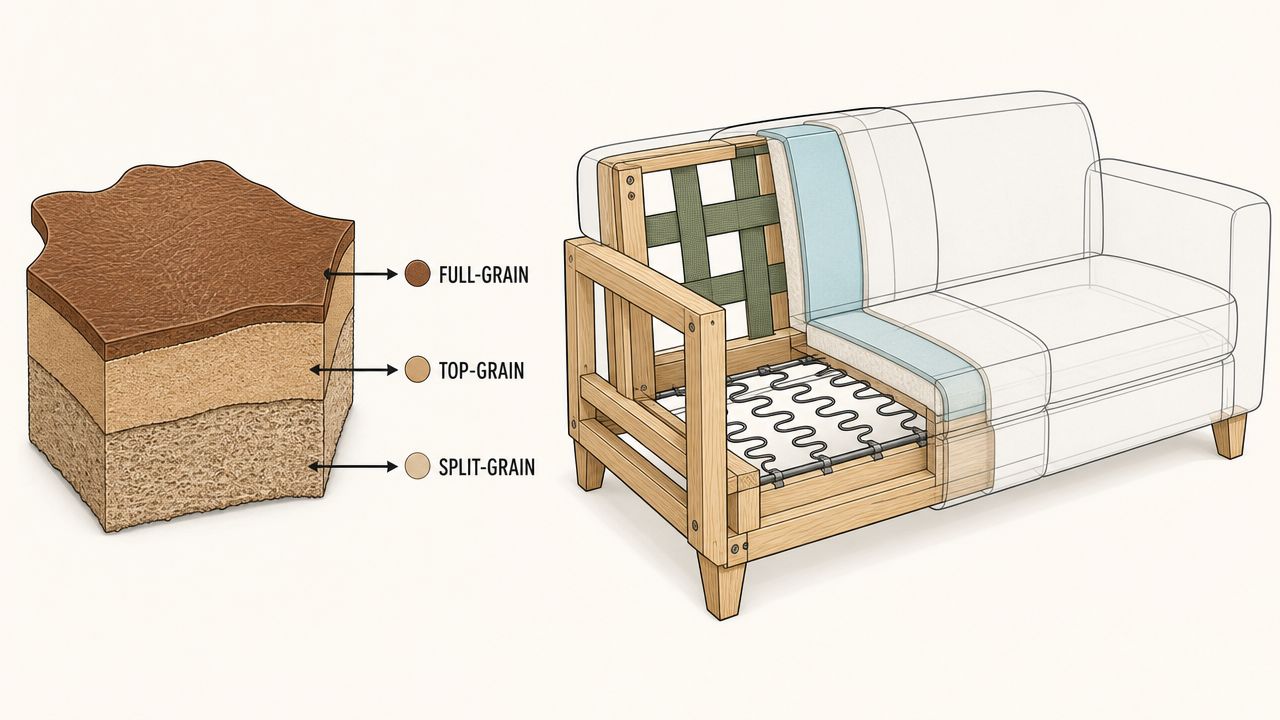
- Full-grain leather keeps the natural grain most intact. It often shows character and develops a patina over time.
- Top-grain leather is still high quality, but it has usually been corrected or refined for a more uniform appearance.
- Split leather comes from a lower layer of the hide. It can look appealing, but it doesn't usually wear like stronger top layers.
- Bonded or heavily processed leather alternatives can work for certain budgets, but they don't age the same way and often change the value equation.
For readers who want a straightforward explanation of the difference between the top two categories, this guide to top-grain and full-grain leather is a useful primer. For shoppers also weighing alternatives and maintenance concerns, this resource on buying faux leather sofas in Australia offers a practical outside perspective on what synthetic options can and can't do.
Practical rule: If the listing highlights color and softness but stays vague about leather grade, the shopper should slow down and ask harder questions.
What matters under the leather
The upholstery gets attention, but the frame determines whether the sofa remains solid. A sectional can wear handsome leather on top and still disappoint if the structure underneath flexes, loosens, or sags.
Shoppers should look for discussion around:
- Solid wood framing, especially when manufacturers identify origin and wood type
- Joinery details, not just generic claims of durability
- Seat suspension, because cushion comfort alone doesn't carry the load
- Replaceable components, especially on larger sectionals and reclining pieces
A well-made frame gives the leather a chance to age well. A weak frame makes even good leather feel temporary.
The Perfect Fit Customization vs Off-the-Rack
Most sectional regrets aren't about color. They're about fit.
A homeowner finds a handsome leather sectional online, measures one wall, and assumes the room can handle it. Delivery day arrives, and the piece dominates the floor, clips a traffic path, or puts the chaise on the wrong side for the room's natural movement. That's a common off-the-rack problem.
Why fixed sectionals create room problems
Some mass-market sectionals come in large, predetermined layouts that don't bend much to real homes. On Macy's product pages, one example is the Daisley 6-piece leather L-shaped sectional with dimensions of approximately 148"W x 117"W x 42"D x 32"H, and the listing also points to similarly large leather sectional formats, as shown on the Daisley leather sectional product page. That size can work beautifully in the right room, but many living rooms in Central Ohio need more nuance than “very large L-shape.”
Typical layout issues include:
- Blocked walkways between the seating area and adjoining spaces
- A chaise in the wrong direction for doors, windows, or fireplaces
- Over-scaled arms that eat up useful seating width
- Reclining components that need more clearance than the room comfortably gives
For readers planning room size carefully, Room Sketch 3D's sizing advice is a helpful reference for understanding how sofa dimensions affect circulation and proportion.
What customization changes
Customization isn't only about luxury. It solves practical problems.
A more customizable process can let a shopper adjust:
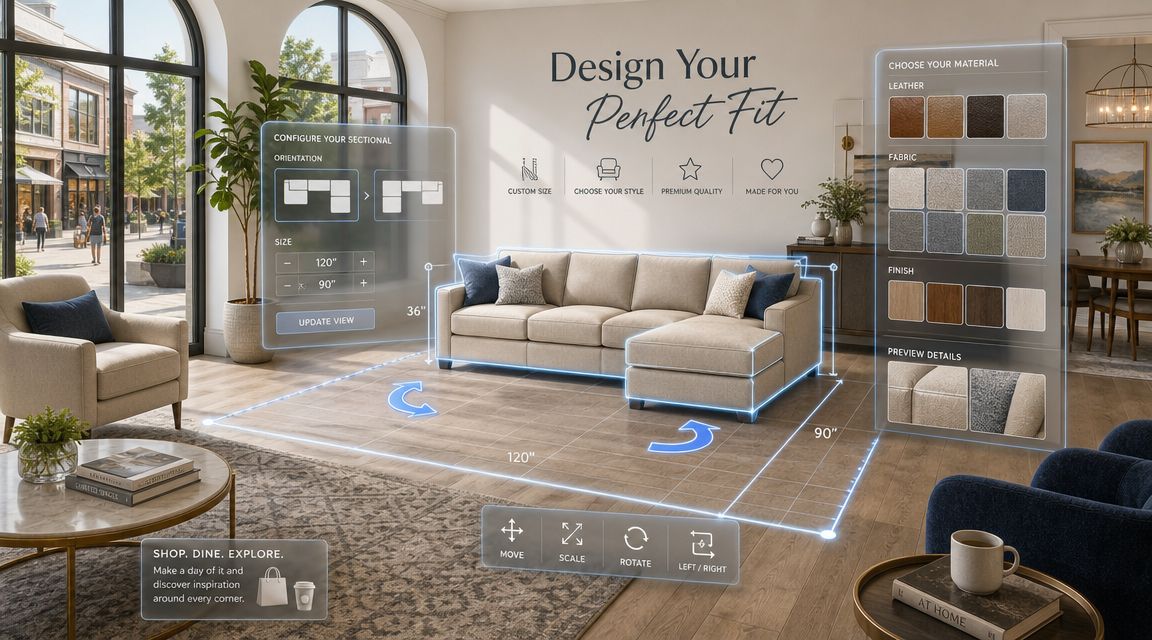
- Configuration, such as left-facing, right-facing, chaise, wedge, or sofa-plus-corner layouts
- Dimensions, so the sectional fits the room instead of overrunning it
- Leather or fabric choice, based on pets, children, sunlight, and daily habits
- Seat feel, from firmer support to a more relaxed sit
- Finish details, so the piece works with existing wood tones and flooring
In Columbus, one local route for that process is this sectional buying guide and customization resource, paired with an in-store design studio, complimentary design consultations, and 3D visualizers through a custom order program. That approach helps a homeowner test whether the sectional fits the room on paper before it becomes a costly mistake in the house.
The right sectional should shape itself to the room and the household. The room shouldn't have to apologize to the sectional.
Comparing the Investment A Tale of Two Sectionals
A leather sectional can be judged in two very different ways. One method asks, “How does it look today?” The other asks, “How will it live five, ten, or twenty years from now?” The second question leads to better buying decisions.
Leather Sectional Comparison Department Store vs Vinson Fine Furniture
| Feature | Typical Department Store Sectional | Vinson Custom Sectional (e.g., Smith Brothers) | Long-Term Impact |
|---|---|---|---|
| Leather information | Often broad or limited in the listing | More detailed material discussion during selection | Better clarity about aging, feel, and maintenance |
| Frame construction | May not be explained clearly | More emphasis on build details and structural quality | Greater confidence in stability over time |
| Configuration | Fixed layouts with fewer adjustments | Built to room-specific layouts and preferences | Better fit, fewer traffic-flow compromises |
| Size flexibility | Shopper works around standard sizes | Shopper can often tailor scale and orientation | Less wasted space and fewer fit mistakes |
| Design support | Basic product browsing | In-store design studio and complimentary consultation | Better coordination with the rest of the room |
| Visual planning | Limited to photos and dimensions | 3D visualizers through the custom order process | Easier decision-making before purchase |
| Price presentation | Promotion-led and event-driven | More focused on material and construction choices | Value is easier to judge beyond the sale tag |
| Delivery experience | Varies by listing and market | White-Glove In-Home Delivery available | Lower stress on delivery day |
| Payment options | Standard retail financing may vary | Flexible financing through Synchrony HOME | Easier budgeting for a long-term purchase |
The clearest difference isn't just quality. It's visibility. A shopper can only judge what a seller makes easy to understand.
With a more typical department-store sectional, the appeal often starts with the finish, the silhouette, and the event price. With a custom-built path, the discussion tends to start earlier in the chain. Leather type, seat support, room dimensions, and long-term serviceability get attention before the order is placed.
That shift matters because long-term comfort usually traces back to hidden choices:
- A stronger frame stays quieter and steadier
- Better leather selection tends to age more gracefully
- Smarter dimensions make the room function better every day
- More serviceable design can reduce headaches later
A sectional doesn't have to be flashy to be valuable. Often the valuable one is the piece that still feels composed after years of use.
Understanding True Value Price Sales and Longevity
The sale price gets attention first. It shouldn't get the final vote.
For leather sectionals, true value is the relationship between price, materials, service life, comfort retention, and fit. A lower number on the tag can still become the more expensive choice if the sofa ages poorly, wears unevenly, or has to be replaced far sooner than expected.
Why a sale price can hide the real cost
Promotional retailing can make furniture feel like a limited-time opportunity. That strategy becomes easier to understand when the home category is viewed inside a broader business picture. According to Home Textiles Today's reporting on Macy's home segment, the home segment represented 15.2% of total merchandise revenue in the prior year, and home sales were described as declining by double digits. In practical terms, that kind of environment can push a retailer toward promotions and closeout-style movement rather than a steady, thoroughly explained assortment.
That doesn't mean a shopper can't find a good piece in a sale. It means the shopper should separate discount language from construction value.
Questions worth asking include:
- Is this collection likely to remain available if a matching piece is needed later?
- Are replacement parts or service details easy to understand?
- Does the lower price reflect a temporary event, or lower-grade materials?
- Will the leather care routine preserve the finish long enough to justify the buy?
Practical maintenance becomes part of value too. This guide on how to protect leather furniture gives shoppers a sense of what ownership requires after the sectional arrives.
Where value becomes easier to see
Value usually becomes clearer when the shopper steps back from the event pricing and asks a different question. What does this piece cost per year of satisfying use.
That's also where a more transparent local showroom model can help. A family comparing options around Easton Town Center may decide that a custom order, a low price guarantee with a 110% refund of the difference, or a clearance gallery with savings up to 70% makes more sense than chasing rotating promotions because those routes connect price to product quality and room fit more directly.
A leather sectional earns its keep slowly. Comfort that lasts, leather that wears well, and a layout that still works years later are what make the math come out right.
Your Columbus and Central Ohio Decision Checklist
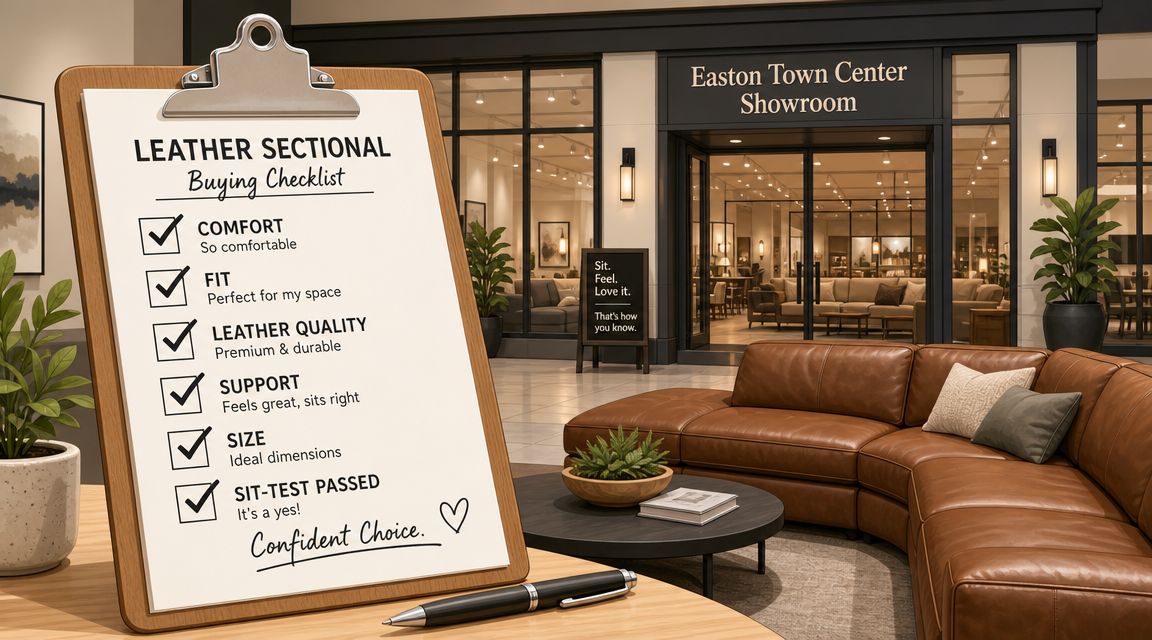
A good checklist keeps a shopper from getting distracted by finish names and sale banners. For Columbus and Central Ohio homeowners, the best decision usually comes from careful measuring, honest lifestyle questions, and an in-person sit test.
What to ask before buying
- What kind of leather is this, exactly. If the answer stays vague, the shopper doesn't yet know enough.
- What is the frame made from. Strong structure matters more than decorative stitching.
- Does this configuration fit the room's walkways. A sectional should support movement, not interrupt it.
- Will this seat depth work for daily posture. Deep lounge seating isn't ideal for every household.
- Can individual components be serviced or replaced. That matters more on large or reclining designs.
- How will pets, children, and sunlight affect this upholstery. The prettiest leather may not be the wisest leather.
- Does the delivery team place and assemble the piece. Large sectionals are hard enough without extra hassle.
One of the simplest ways to avoid a sizing mistake is to use a room-measuring checklist before shopping. This guide on how to measure furniture helps a buyer think beyond wall width and account for pathways, corners, and entry points.
Why the showroom still matters
Online shopping is useful for narrowing the field. It can't fully replace touch, scale, and seat feel.
A showroom visit lets a homeowner evaluate:
- How the leather feels against the hand
- Whether the seat has proper support
- How high or low the back really sits
- Whether the arm height works for lounging
- How the sectional looks from across the room, not just from the front angle
For shoppers near Easton Town Center, the showroom experience also helps with the practical side of ownership. Complimentary design consultations can make room planning easier. Flexible financing through Synchrony HOME can spread out the investment. White-Glove Delivery can reduce the risk and strain of getting a large sectional into place.
A leather sectional is one of the most used pieces in the home. It deserves more than a fast click and a hopeful guess.
For shoppers weighing a Leather Sectional Sofa Macy's option against a longer-term furniture investment, Vinson Fine Furniture offers a different path at Easton Town Center, with an in-store design studio, custom order options, complimentary design consultations, flexible financing, white-glove delivery, and a clearance gallery for value-minded buyers who still care about craftsmanship.