Home Office Furniture in White: A Buyer’s Guide for 2026


A surprising number of home offices still start the same way. A spare bedroom gets a leftover desk. A dining chair stands in for task seating. Cords collect underfoot, paperwork creeps across every surface, and the room never quite feels finished.
That setup made sense when working from home felt temporary. It doesn't now. The remote-work surge that began in 2020 changed how households use their space, and an ergonomics review summarizing Pew Research noted that the share of people working from home rose from 20% before the COVID-19 pandemic to 71% by December 2020, while nearly 25% of home-based workers reported difficulty finding adequate workspace, a major reason lighter furniture finishes gained traction in compact rooms (ergonomics review with cited remote-work data).
White furniture answers that problem well, but only when it's chosen intelligently. The right white desk, storage piece, or bookcase can make a room feel cleaner and calmer. The wrong one can show every scuff, yellow unevenly, and look tired far too fast. That's the real conversation homeowners should be having.
This guide focuses on the part most style articles skip. Not just why white looks good, but how to choose home office furniture in white that still looks composed after years of use. For homeowners furnishing a long-term workspace, that distinction matters.
Table of Contents
- Imagining Your Ideal Workspace
- The Enduring Appeal of White Office Furniture
- Beyond Color Choosing Durable Materials and Finishes
- Designing Your Space Layouts and Color Palettes
- Your Custom Office at Vinson Fine Furniture
- Maintaining the Beauty of Your White Furniture
Imagining Your Ideal Workspace
A better office usually starts with a familiar irritation. The desk is too deep for the room, or too shallow for real work. Storage doesn't match. The chair blocks the walkway. By late afternoon, the space feels dim and crowded even when it's technically tidy.
White often enters the conversation because the room needs relief. A white desk with a simpler profile, a cabinet with cleaner lines, or a bright bookcase along one wall can pull visual weight out of the room. The office starts to feel edited instead of improvised.
That shift is easier to see before anything is ordered. Homeowners sorting through layout ideas often benefit from a visual planning process, especially when they're deciding between open shelving, file storage, or a return desk. A useful example is this look at a practical sketch to 3D for brands, which shows how rough concepts become something spatial and concrete.
A home office shouldn't feel like furniture was pushed into a corner. It should feel planned, proportioned, and calm.
The strongest white office schemes don't chase a trend. They solve a set of real problems. They bring brightness to a room that feels boxed in. They make mixed-use spaces feel less chaotic. They create a backdrop that looks finished on a video call and organized at the end of a workday.
For homeowners collecting ideas before they buy, this guide to creating an inspiring home office offers a useful starting point. It helps translate vague preferences into decisions about scale, storage, and mood, which is exactly where a white office succeeds or fails.
The Enduring Appeal of White Office Furniture
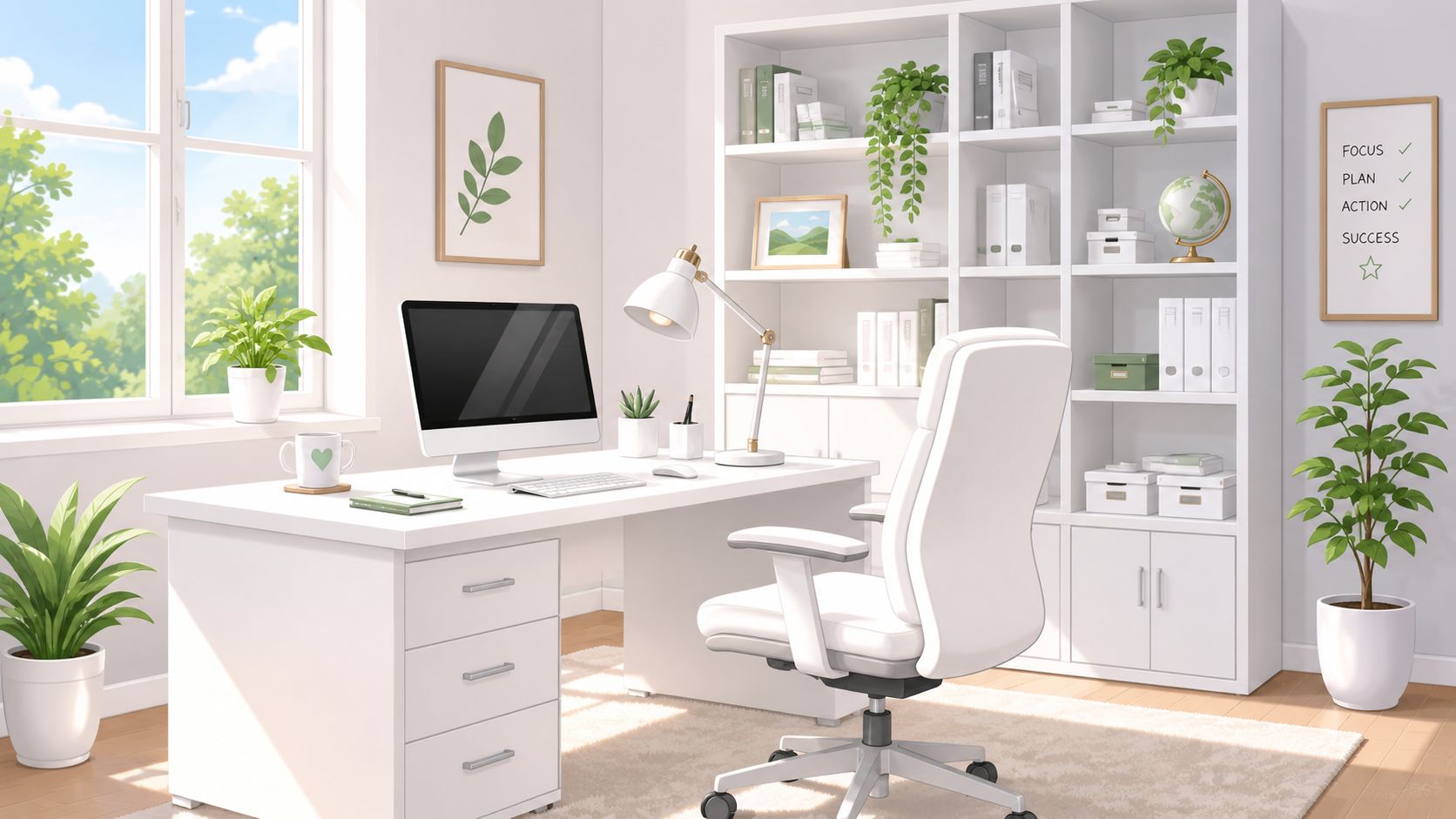
White office furniture lasts because it does more than look neat. It changes how a room reads. In a small office, that matters immediately. In a shared guest room or loft corner, it matters even more.
Why white changes the room
White surfaces reflect more ambient and natural light, which can improve a room's perceived brightness and size. That added illumination is also linked to lower eye strain and fatigue because it reduces visual stress during screen work in a well-lit environment (white office design and light reflection).
That's the practical advantage. A white desk doesn't merely sit in the room. It helps the room feel more open. The edge of a desktop reads lighter. Storage feels less bulky. Even a substantial work surface can seem more restrained when the finish isn't visually heavy.
This is why white works so well in:
- Converted bedrooms where the office sits beside a bed or dresser
- Apartment corners where every piece must earn its footprint
- Narrow studies that need brightness more than contrast
- Multi-use family spaces where the office shouldn't dominate the room
Why white keeps working as styles shift
White also earns its place because it gives a homeowner room to evolve. Matte white can read modern and architectural. A softer white paired with wood feels more relaxed and organic. Add black hardware and the room sharpens. Introduce woven textures and greenery and it softens.
Practical rule: When a room is small, the furniture finish should lighten the architecture, not fight it.
That flexibility matters for investment furniture. A desk shouldn't need replacing just because wall color changes or a room takes on a new use. White can absorb those shifts better than more style-specific finishes.
There is one caution. White only looks elevated when the finish is controlled. Harsh gloss, poor undertones, and mismatched whites can make a room feel clinical or accidental. The goal isn't starkness. It's clarity.
Beyond Color Choosing Durable Materials and Finishes
The biggest mistake in this category is buying white by sight alone. A homeowner sees a pleasing finish online, likes the silhouette, and assumes the rest will follow. It won't. With white furniture, finish quality is the product just as much as the design is.
Color is not the specification
A professional furniture specification defines not just color but material grade, surface finish chemistry, and durability testing standards such as BIFMA. For white furniture, that's critical if the goal is resistance to wear, yellowing, and stains over time (office furniture specification guidance).
That means smart buyers ask different questions. Not “Is it white?” but:
- What substrate sits under the finish?
- What finish system was used?
- Is the sheen matte, low-sheen, or glossy?
- How are the edges finished?
- What testing or compliance documentation is available?
A white piece with weak edge treatment will show breakdown quickly. A white piece with poor coating consistency can telegraph seams, joints, or substrate flaws in ordinary daylight. Dark stains can disguise some sins. White rarely does.
Comparing White Furniture Materials
| Material | Durability | Stain & Yellowing Resistance | Best For |
|---|---|---|---|
| Solid wood with a quality painted or coated finish | High when properly built and finished | Good to very good, depending on finish system and sun exposure | Long-term home offices, heirloom-minded buyers, custom projects |
| Engineered wood with a durable laminate or quality finish | Moderate to high, depending on core and surface construction | Often good on the field surface, but edges deserve scrutiny | Daily-use desks, storage units, streamlined contemporary offices |
| Particle board with thin decorative surface | Lower under repeated use | More variable, often less forgiving at seams and edges | Short-term needs or lightly used secondary spaces |
The distinction between engineered wood and lower-grade panel products matters more than many homeowners realize. This comparison of engineered wood vs particle board is worth reviewing before settling on any white office collection, especially for drawers, credenzas, and shelving that will see steady use.
The finish matters more than most buyers realize
The finish system determines whether white stays crisp or starts looking tired. That's where yellowing, scuff visibility, sheen mismatch, and touch-up headaches usually begin.
A few guidelines help:
- Choose matte or low-sheen when possible. It hides fingerprints and light surface irregularities better than a glossy finish.
- Study the edge details. Sharp, vulnerable edges show wear first. Slightly eased edges generally age better.
- Be careful with mixed whites. Warm white, bright white, and creamy white can clash when sourced from different makers.
- Ask about sunlight exposure. Rooms with strong afternoon light need more finish discipline, not less.
- Treat drawer interiors and hardware as quality signals. If those details are careless, the finish system often is too.
The right white finish doesn't ask to be babied. It asks to be specified properly.
For homeowners who want home office furniture in white that still looks refined years from now, the safest route is simple. Buy construction first, finish second, and color third. When that order gets reversed, regret usually follows.
Designing Your Space Layouts and Color Palettes
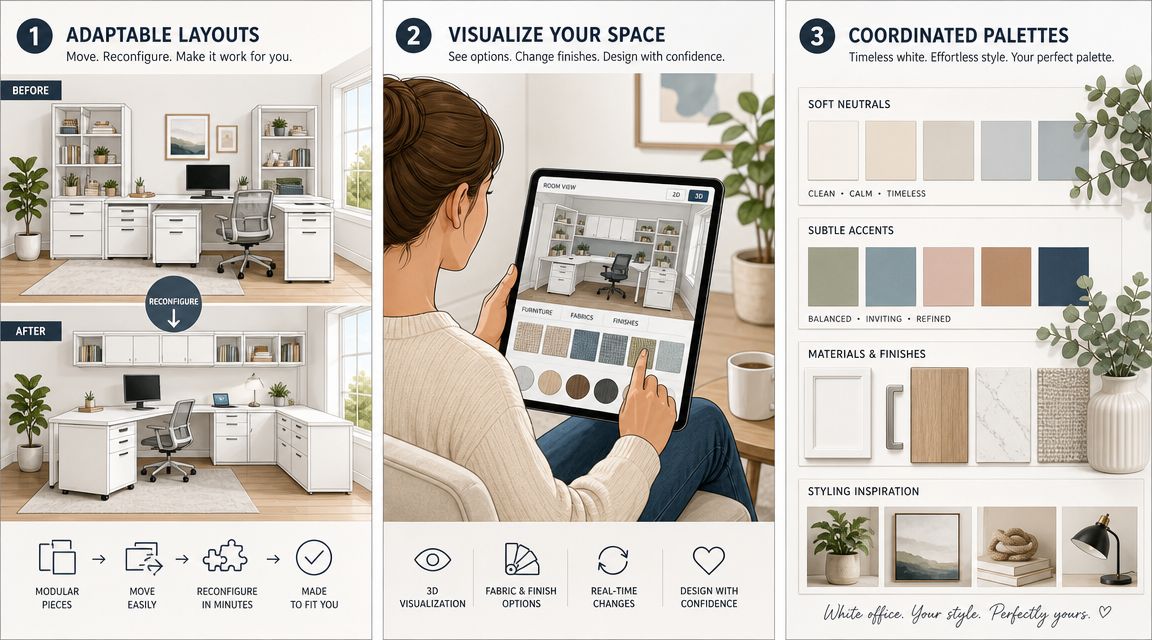
A white office works best when the layout supports it. Bright furniture can't rescue a room with poor circulation, awkward storage, or a desktop placed where glare becomes constant. The plan has to carry the finish.
Layouts that work in real homes
A dedicated office has the easiest path. The desk should command the primary wall or sit where natural light supports the work surface without hitting the monitor directly. Storage belongs where it can be reached without forcing the chair to pivot into a walkway.
Smaller homes require more discipline. A white writing desk in a bedroom should stay visually open, with enclosed storage elsewhere in the room to keep the work zone from sprawling. In a living room corner, a narrower desk with vertical shelving usually performs better than a bulky all-in-one piece.
A few layout rules hold up well:
- Leave breathing room around the desk. Even beautiful furniture feels oppressive when packed tightly.
- Use vertical storage before adding width. Height usually steals less visual space than deeper case pieces.
- Keep the background intentional. What appears behind the desk matters for daily comfort and video calls.
- Control glare early. White surfaces need smart lamp placement and window awareness.
For room planning ideas that translate well to actual homes, this guide to home office furniture layout gives a practical framework for desk placement, storage zones, and circulation.
Three palettes that make white look intentional
Color finishes the room. White alone can feel refined, but it needs surrounding tones that tell the eye what kind of office it is.
A useful reference on boosting focus with workspace colors can help homeowners think through mood before they commit to paint, textiles, or accessories.
Monochromatic and serene
Soft whites, pale taupes, muted grays, and brushed metal create a quiet office with very little visual noise. This is ideal for concentrated work and rooms that need a calm presence.
High contrast and refined
White furniture with charcoal, black, or deep navy accents feels crisp and architectural. The contrast sharpens the lines of the desk and shelving, which suits more modern interiors.
Warm and grounded
White paired with natural oak, walnut tones, woven textures, and greenery produces a more residential office. It feels lived in, not corporate. For many households, this is the sweet spot.
White furniture looks strongest when the palette around it is deliberate. Otherwise, it can drift from elegant to unfinished.
Your Custom Office at Vinson Fine Furniture
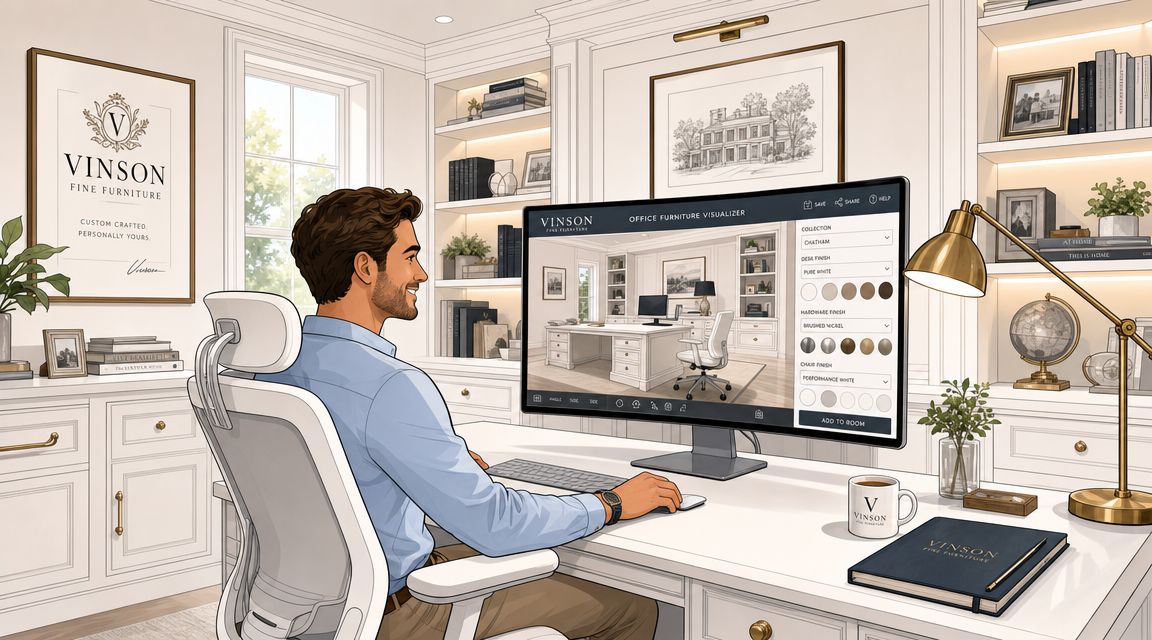
The homeowners who are happiest with a white office rarely buy off instinct alone. They test proportion, compare finishes in person, and think through use before placing an order. That process matters most when the room needs to look polished and wear well.
What customization actually solves
Customization isn't about novelty. It solves practical problems. A desk may need a slightly different scale, a warmer white, a different hardware finish, or a storage configuration that suits paperwork instead of decor. Those aren't minor details. They determine whether the room functions gracefully.
At Vinson Fine Furniture's custom-made office furniture options, homeowners can explore a more customized route that includes the Custom Order Program, finish choices, configuration flexibility, and digital visualizers that help narrow decisions before production.
This is also where Amish-made furniture and solid wood furniture Ohio shoppers often seek out become especially relevant. A white office built on sound construction has far more long-term credibility than a trend piece with a thin decorative skin.
The buying experience should be as considered as the furniture
A design purchase of this kind deserves more than a product page. The stronger path is a showroom visit, especially for Columbus homeowners who want to compare undertones, sheen levels, drawer function, and scale in person at Easton Town Center.
Several factors make that process smoother:
- Design services matter because floor plans, finish samples, and palette decisions are easier to resolve in an In-Store Design Studio than in isolation.
- Value protection matters because a Low Price Guarantee with a 110% refund of the difference, if a lower local authorized-dealer price is found within the required time frame, gives buyers clearer confidence in the investment.
- Clearance access matters because the Clearance Gallery can offer savings of up to 70% on select floor samples, overstocks, and closeouts.
- Ease of purchase matters because Flexible Financing through Synchrony HOME and White-Glove In-Home Delivery remove much of the friction from a whole-room upgrade.
For readers searching terms like Furniture store Columbus Ohio, Amish-made furniture, and solid wood furniture Ohio, the strongest advice is simple. Don't choose white furniture from a thumbnail. Sit with the finish. Open the drawers. View the piece under light. That's how an office starts to feel permanent.
Maintaining the Beauty of Your White Furniture
White furniture stays attractive when maintenance is steady and boring. That's good news. It doesn't require elaborate care. It requires disciplined habits.
Daily habits that prevent visible wear
Most visible damage on white desks comes from ordinary behavior, not major accidents. Pens roll uncapped. Coffee cups leave damp rings. Bags drag across corners. Sunlight hits one side of the room harder than the other.
The easiest prevention steps are straightforward:
- Use a desk pad where active writing happens. It prevents scuffs and ink transfer.
- Keep coasters within reach. Water marks are easier to prevent than remove.
- Lift accessories instead of sliding them. White finishes show abrasion sooner.
- Rotate decor occasionally. That reduces uneven light exposure on the surface.
- Dust with a soft cloth. Grit under a rough wipe can dull the finish.
Cleaning by finish, not by guesswork
The wrong cleaner can do more harm than the stain. White laminate, painted wood, and coated solid wood don't all respond the same way, so the care method should match the finish.
For broader wood-care principles, this guide to protecting wood furniture from scratches and stains is a helpful companion.
A sound approach looks like this:
- Laminate surfaces usually do well with a soft microfiber cloth and a mild cleaner appropriate for finished furniture surfaces.
- Painted or coated wood should be wiped gently and dried promptly so moisture doesn't linger at seams or edges.
- Glossier finishes need extra care because aggressive rubbing can create dull spots that show under light.
- Any finish should be protected from abrasive pads, harsh solvents, and all-purpose sprays used without checking compatibility first.
Good white furniture isn't fragile. But careless cleaning can make durable furniture look neglected.
When a homeowner chooses home office furniture in white with the right material and finish, upkeep becomes simple. The room stays bright, the desk keeps its definition, and the office continues to feel considered instead of high-maintenance.
A well-designed office should support work every day and still look like it belongs in the home for years to come. Readers who want to compare finishes in person, explore custom configurations, or schedule a design consultation can start with Vinson Fine Furniture, then visit the Easton Town Center showroom to refine the details that make a white office feel lasting rather than temporary.