Engineered Wood vs Particle Board: A Guide to Smart Furniture Choices


The core difference between engineered wood vs particle board is category versus subtype: engineered wood is a broad family of wood composites that includes plywood, MDF, OSB, and particleboard, while particle board is one specific panel within that family. Engineered wood combines wood fibers, strands, veneers, or particles with adhesives under heat and pressure. Particle board is made from wood particles pressed with resin; its performance depends on the panel, support, exposure, and construction.
Your Guide to Choosing Smart Furniture Materials
No, engineered wood is not the same material as particle board, but the terms are not opposites either. Engineered wood is the category; particle board is one subtype. This distinction can get lost when a furniture label says only "manufactured wood," a broad term that may describe different panels.
For homeowners in Columbus and across Central Ohio, the useful question is not "Which is stronger?" It is "Which panel is inside this specific piece, and where will it carry weight?" In furniture shopping, I look beyond the label: the panel edge, underside, joints, and planned load help indicate whether construction suits the intended use.
Quick Comparison: Engineered Wood vs Particle Board
This comparison distinguishes the umbrella category from its particleboard subtype; performance varies by panel type.
| Attribute | Engineered Wood | Particle Board |
|---|---|---|
| Composition | Wood veneers, fibers, strands, or particles bonded with adhesive | Wood particles pressed with resin |
| Strength | Varies by panel type; plywood generally offers stronger screw holding | Often less effective at holding fasteners, especially near edges |
| Durability | Varies by panel type, grade, thickness, and construction | Can swell with moisture and may sag under unsupported loads |
| Aesthetics | May have a real-wood veneer or another finish | Commonly covered with laminate or melamine |
| Cost | Varies by panel and finish | Often selected as a lower-cost panel |

The terminology causes confusion because manufacturers and retailers sometimes use "manufactured wood," "engineered wood," and "wood composite" as broad labels. Engineered products include plywood, MDF, OSB, and particleboard: plywood uses veneers, MDF uses refined fibers, OSB uses strands, and particleboard uses smaller particles. To understand the difference between engineered wood and particle board, identify the specific panel rather than relying on a general label.
A specification sheet naming the exact product is more useful than a broad marketing description. In the United States, the EPA's formaldehyde rule covers hardwood plywood, MDF, and particleboard and establishes emission limits under Title VI. Emissions compliance does not by itself show that one panel will last longer than another, but it provides a regulated measure for comparing composite-wood products.
Ultimately, the right material comes down to your priorities: budget, how you plan to use the furniture, and how long you expect it to last. For more buying fundamentals, see our guide on how to shop for furniture smartly.
How We Evaluated Engineered Wood vs Particle Board
This comparison considers seven practical criteria: composition, density, fastener holding, moisture behavior, refinishing potential, expected lifespan, and suitability for common furniture uses. We focus on whether a panel suits its intended load, fastening needs, and likely exposure, rather than assuming that every product within a broad category performs alike.
Real-world failure modes help make the comparison practical: shelf sag across unsupported spans, screw withdrawal during reassembly, edge damage, swelling following spills, and whether a damaged surface can be repaired. I recommend checking the edge, joints, and underside instead of relying on a product label. A laminated panel may conceal a low-density core, while a well-supported, fully edged panel may be appropriate for a modest application.
How It's Made and Why It Matters: Composition and Structural Strength
A piece of furniture's performance starts with its core composition. To understand engineered wood vs. particle board, look at how each is constructed.

Manufactured Wood Is an Umbrella Term
"Manufactured wood" is not a single panel that competes separately from particle board. It is an umbrella description for wood-based products made by combining wood materials with adhesives, heat, and pressure. Particle board, MDF, OSB, and plywood all belong to this broader family. So, is manufactured wood the same as particle board? No: particle board is one manufactured wood product, while plywood and MDF are others.
The family shares a manufacturing approach, not a uniform performance level. A review of wood-based composite panels describes products made from wood fibers, particles, strands, veneers, or layers. Particleboard's composition and properties differ from those of other panels; moisture and fastener performance depend on the specific product and construction.
The Deliberate Construction of Engineered Wood
Engineered wood products combine wood components—such as thin veneers, strands, or finely ground fibers—with adhesives under heat and pressure. The resulting panel is made for particular construction and furniture uses.
- Plywood: Plywood is made by layering thin sheets of wood veneer, with the grain of each layer running perpendicular to the one below it. This cross-graining helps limit dimensional movement.
- Medium-Density Fiberboard (MDF): MDF is made from wood fibers combined with binder and pressed into panels. Its dense, uniform surface can suit painted or routed details.
- Particleboard: Particleboard is made from wood particles and resin pressed into a panel. Its performance depends on panel quality, thickness, support, and how it is finished and fastened.
Plywood is often a suitable choice when a shelf, desk, or frame needs to resist fastener pullout. MDF can suit a smooth, stable painted panel, although its edges and fastener performance need consideration. A useful example of layered construction in another application is flooring; see Flacks Flooring for an explanation of engineered hardwood flooring.
The Simpler Makeup of Particle Board
Particle board is made by pressing wood particles, such as chips and shavings, together with resin. Compared with panels made from veneers or refined fibers, its structure is different, and the appropriate use depends on the panel's support, finish, and load.
Key takeaway: Particle board is one type of engineered wood, not a synonym for the entire category. Its suitability depends on the demands of the furniture and the way the panel is used.
Particleboard may be less suitable where furniture needs strong fastener retention, especially at edges or after repeated assembly. Joints can loosen if fasteners damage the panel, so the material, joint design, and assembly method all matter.
A long shelf made from a panel with insufficient stiffness or support can bow under sustained weight. Check the panel specification and the span rather than assuming the same result for every engineered product.
Strength, Failure, and Reassembly Performance
The differences are easiest to assess through possible failure modes:
- Shelf sag: Panel stiffness, thickness, and support affect sag. Plywood is often used where a shelf needs structural support; MDF and OSB performance also depends on grade, thickness, and support.
- Screw withdrawal: Fastener holding varies by panel and location. Plywood can be a better choice for structural joints than a low-density particleboard edge; MDF may also require care near edges.
- Edge damage: Particle board can crumble if an edge is chipped or drilled. Edge banding can protect the exposed edge but does not change the core material.
- Moisture swelling: Particle board can expand when exposed to water. Plywood, MDF, and OSB can also be affected by moisture, so exposed panels need appropriate protection and spills should be cleaned promptly.
- Reassembly: Reused fasteners may not hold as well if a panel or hole has been damaged. Correct hole sizing and suitable fasteners can help, but the panel type and joint design remain important.
Particle board can work when it is laminated, fully supported, and protected from moisture. A drawer bottom seated in a groove, a cabinet back held against a frame, or a short closet shelf may not need the same spanning or fastening performance as a bookcase.
To see how material selection affects furniture design, explore our guide to choosing the best table construction.
Durability and Lifespan: What to Expect in the Real World
How furniture holds up day to day is an important factor in a purchase. When comparing engineered wood with particle board, consider the panel type, finish, support, and exposure to moisture, including the humidity fluctuations common in Ohio.
If a drink spills on furniture, prompt cleanup and protected edges matter. Particle board can swell if water reaches its core; a finished surface may slow exposure but cannot make the panel waterproof. Other engineered panels also need suitable protection. I assess a piece by looking at the finish, exposed edges, and the likelihood of spills in its intended location rather than assuming the category name guarantees moisture resistance.
Performance Against Wear, Tear, and Weight
Consider the constant stress of daily use as well as occasional spills. A panel's ability to support weight depends on its type, thickness, span, and joinery. Plywood may suit a bookcase or media console when its construction matches the load; a properly specified MDF or other panel may suit a different application. Particle board is more likely to be unsuitable when a panel must span a long distance without support.
Moving furniture also tests its joints. Repeated assembly can damage fastener holes in some panels, so construction, fastener choice, and careful handling matter. Before buying, I check whether a piece is likely to be moved and whether its joints and panel edges appear suited to that use. For more on material selection, see our guide to choosing the right hardwood for longevity and style.
Protecting Furniture During Delivery
A well-built piece should be handled carefully during delivery to protect its finish and structure. Vinson Fine Furniture offers White-Glove In-Home Delivery, including bringing furniture inside, placing it in the requested location, and handling assembly. Confirm delivery and assembly details when arranging your purchase.
A Tale of Two Surfaces: Aesthetics and Customization
Furniture materials affect both function and appearance. Engineered panels may be finished with real wood veneer, paint, laminate, or another surface, while particleboard furniture is often covered with laminate or melamine.
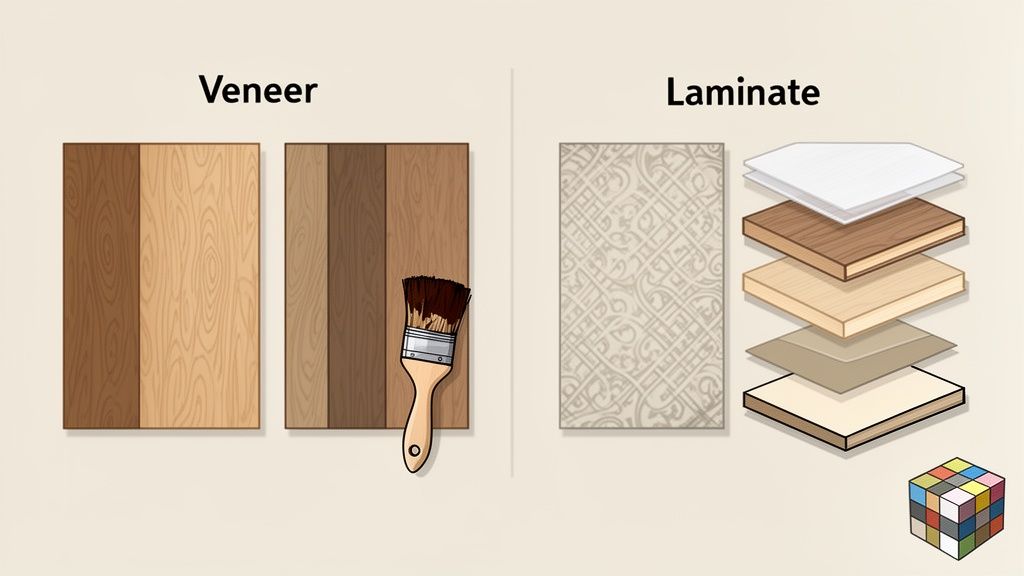
A real wood veneer is a thin slice of hardwood applied over a core. It provides a genuine wood surface and grain, although the core beneath it may be plywood, MDF, or another panel. A veneer can be stained or sealed, subject to its thickness and finish.
The Look and Feel of the Finish
Particle board is often covered with laminate or melamine. These manufactured surfaces can provide a consistent pattern and are not the same as a real wood veneer. A deep scratch or chip may expose the core and be difficult to repair invisibly.
A veneer may allow limited refinishing, depending on its thickness and condition. Laminate generally cannot be sanded and refinished like solid wood. When choosing, inspect the surface and ask what is underneath it; the visible finish alone does not identify the core.
Customization Options
Available finishes and customization depend on the retailer and product. Vinson Fine Furniture's Custom Order Program offers choices for seating fabrics and leathers. To learn about the process, learn more about our approach to making custom furniture simple.
Analyzing Cost Against Long-Term Value
When deciding on furniture, the price tag is only one consideration. The engineered wood vs. particle board comparison also involves expected use, maintenance, and replacement needs.
Particle board can have a lower upfront cost, but the value depends on whether its construction can handle the intended load and conditions. If a panel swells, sags, or loses its fastener grip, repair or replacement may be needed. A higher-priced panel is not automatically a better value either: match the material to the furniture's expected use.
Comparing Cost and Useful Life
Engineered wood is a broad category, so its cost and performance vary. Plywood, MDF, OSB, and particleboard have different constructions and suitable applications. Compare the specific panel, finish, support, and joinery rather than assuming all engineered wood offers the same durability or value.
Instead of asking only "What's the cheapest option?" consider: "Does this construction suit my home, planned use, and expected period of ownership?"
Retailer Policies and Purchase Planning
Before buying, review the retailer's current policies and compare the exact product, finish, and construction. Vinson Fine Furniture describes a Low Price Guarantee for qualifying items and offers a Clearance Gallery with floor models and overstock pieces; check current terms and availability directly with the retailer. Flexible financing options may also be available, subject to their terms.
Making the Right Choice for Your Home
Choosing between engineered wood and particle board comes down to what the furniture needs to do and how long you expect to use it. A closet organizer and a dining table have different load, support, and exposure demands. Start by identifying the panel and then checking whether its construction fits the job.
Practical Material Choices by Use
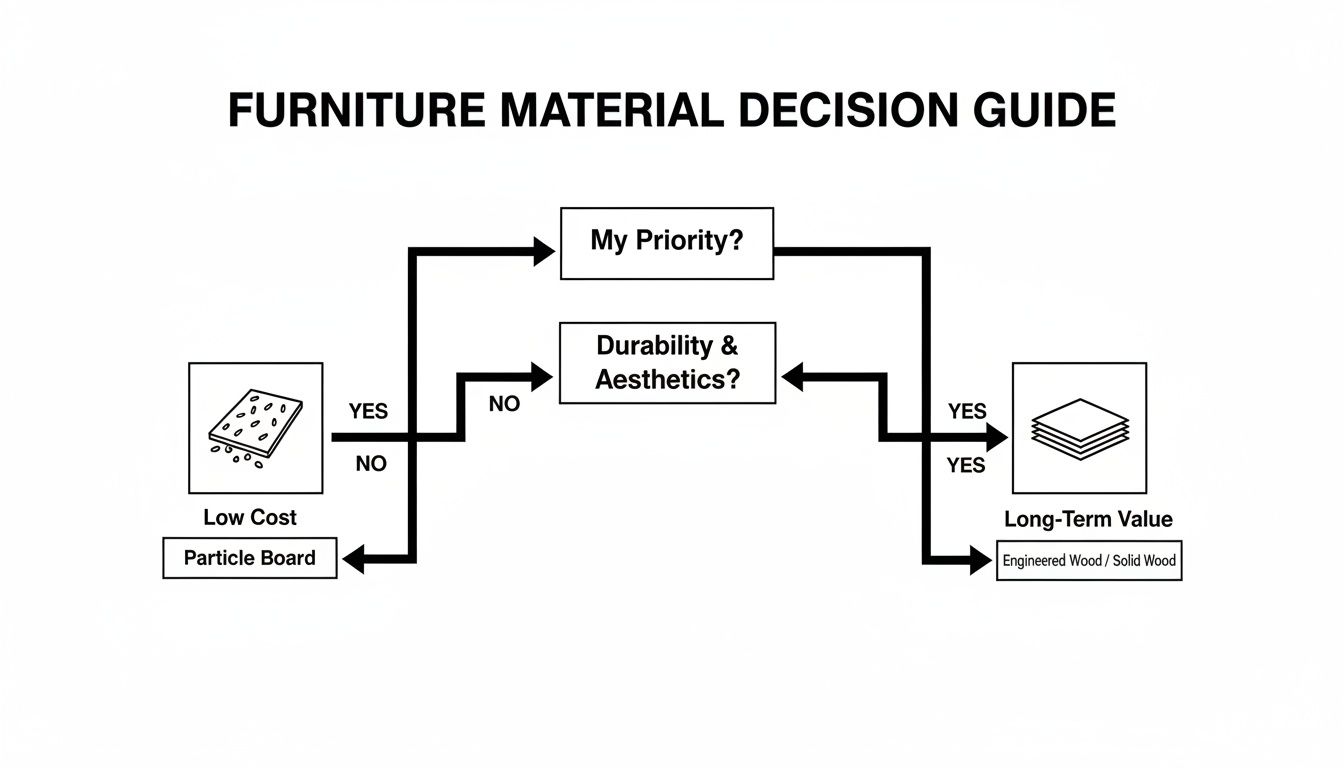
Use this matrix as a starting point, then confirm construction and exposed surfaces with the seller.
| Use | Best fit | Reason |
|---|---|---|
| Bookshelves | Plywood or solid wood | Can provide better resistance to fastener pullout and sag across long spans when appropriately constructed |
| Desks | Quality plywood or well-built engineered wood | The specific panel and joinery should suit the daily load |
| Bed frames | Solid wood or plywood | Fasteners and repeated movement make stable construction important |
| Cabinet boxes | Plywood or fully supported laminated particle board | Enclosed, supported panels may suit this use when assembled well |
| Drawer bottoms | Laminated particle board or plywood | Typically supported and used for modest loads |
| Closet organizers | Plywood or MDF | Panel stiffness and secure fastening matter, especially in tall units |
| Low-use accent furniture | Laminated particle board can be sufficient | Limited use and protected edges reduce demands on the panel |
Is Particle Board Strong Enough for Furniture?
Yes, for some uses, if its role matches its limitations. Particle board can be sufficient for supported, low-stress applications such as drawer bottoms, cabinet backs, or short, fully supported shelves. It may be less suitable for wide unsupported spans, heavy loads, exposed edges, frequent moving, or damp locations. Plywood or another panel may better suit those demands.
When assessing strength, I start with the planned load, shelf span, and how often the furniture will be moved. I also check the edge, underside, and joints. Those details are more useful than a broad label such as "manufactured wood."
When Particle Board Might Make Sense
Particle board may be a practical choice for items that will see limited use, little moisture, and modest loads. Examples can include temporary shelving, non-structural drawer dividers, or other fully supported components. The panel should still be protected and suited to its intended use.
Why Engineered Wood Can Be a Suitable Choice
Engineered wood is not one uniform material, so assess the panel against the job. For bookshelves, the use-case matrix recommends plywood or solid wood; for desks, it recommends quality plywood or well-built engineered wood. Check the panel specification, span, support, fasteners, finish, and exposure before deciding. For care advice, see our guide on how to care for wood furniture.
Considering Solid Wood
Solid wood is another option to compare for pieces that will see regular use. The best choice depends on the furniture, construction, finish, and budget. To assess a piece in person, inspect its surface and joinery and ask how it is made. Vinson Fine Furniture invites customers to visit its Easton Town Center showroom for a design consultation.
Frequently Asked Questions
Is Engineered Wood the Same as Particle Board?
No. Engineered wood is a broad category of wood composites, including plywood, MDF, OSB, and particleboard. Particle board is one type within that category. The specific panel determines important properties such as fastener holding and moisture behavior.
Is Manufactured Wood the Same as Particle Board?
No. "Manufactured wood" is an umbrella term for products made from wood materials. Particle board is one kind of manufactured wood, as are plywood, MDF, and OSB. Ask for the specific panel name when a label uses only a broad category.
Is Engineered Wood Considered Real Wood?
Engineered wood products are made from wood components such as veneers, fibers, strands, or particles. Their construction differs from solid lumber, and the surface may be a wood veneer or another finish. The core and finish should be checked separately.
Can You Refinish Engineered Wood Furniture?
It depends on the surface. A genuine wood veneer may allow limited refinishing, depending on its thickness and condition. Laminate or melamine generally cannot be refinished like solid wood; damage may expose the core and be difficult to conceal.
Is Particle Board Strong Enough for Furniture?
It can be strong enough for supported, low-stress uses such as drawer bottoms, cabinet backs, and short shelves. It may not suit wide unsupported spans, heavy loads, exposed edges, frequent moving, or damp locations. Match the panel to the load and construction.
What Are the Disadvantages of Engineered Wood?
Engineered wood covers different panel types, so limitations vary. Veneers can chip, MDF edges can be damaged, and composite panels can be affected by prolonged moisture. Ask for the core and surface specifications rather than assuming all engineered panels have the same durability.
What Are the Disadvantages of Using Particle Board?
Particle board may have limited edge strength and fastener retention, can swell when exposed to moisture, and may sag if used across an unsuitable span. These concerns depend on the panel and are less demanding in fully supported, protected applications.
What Is Better, Engineered Wood or MDF?
This compares a category with one of its members: MDF is engineered wood. MDF provides a smooth, consistent surface that can suit painted furniture. Plywood may be preferable where the construction calls for stronger fastener holding. The right choice depends on the use and specifications.
What Is a Particle Board Called Now?
It is commonly called particleboard or particle board. Retailers may use broad labels such as "manufactured wood" or "engineered wood," so ask which specific panel is used.
How Does Ohio Humidity Affect These Materials?
Humidity and spills can affect wood-based panels, particularly where edges are exposed or the finish is damaged. Particle board can swell if water reaches its core; other panels also need appropriate protection. Consider the room, finish, and expected exposure when choosing furniture.
What Is the Main Advantage of Engineered Wood Over Solid Wood?
There is no single advantage shared equally by every engineered panel. Depending on the type and construction, engineered panels can offer a consistent surface or a particular combination of stability, cost, and appearance. Compare the specific panel with solid wood for the intended furniture use.
Ready to compare furniture options in person? Visit Vinson Fine Furniture to explore available pieces and request a design consultation.
Explore our showroom and services at VinsonFineFurniture.com