Curio Shelves Wall: A Buyer’s and Design Guide


You open a closet looking for one holiday platter and find a different kind of inventory. Your grandmother’s porcelain bird. A small clock from your first apartment. Stones your children insisted on bringing home from a lake trip. They’re all still meaningful. They’re also still in boxes.
That’s usually the moment a homeowner starts thinking differently about display. Not as decoration alone, but as placement. Where do these pieces belong so they feel protected, visible, and worthy of the life around them?
A well-chosen curio shelves wall arrangement does more than fill blank square footage. It turns memory into part of the architecture of the room. The wall stops being empty space and starts carrying family history, travel, craft, and collection. If you choose carefully, the shelf itself becomes a long-term furnishing, not a temporary accessory.
From Shoeboxes to Showpieces The Art of Display
A curio wall shelf often begins with an emotional problem, not a furniture problem. People don’t usually wake up wanting more shelving. They want a better home for the pieces they can’t throw away and don’t want hidden.
I’ve seen this happen in living rooms, dining areas, and front hallways. A homeowner inherits a few delicate objects. They set them on a console for a while. Dust collects. One piece gets bumped. Another disappears behind a lamp. Soon the whole arrangement feels accidental.
That’s where a dedicated display piece changes the conversation.
Why treasured objects need a real home
A keepsake has different needs than a stack of novels or spare baskets. It needs visibility. It often needs protection from dust, traffic, and daily handling. Most of all, it needs context. A child’s first clay sculpture looks more important when it’s given breathing room and light.
A curio display also helps you edit. Instead of scattering meaningful things across every flat surface, you choose what belongs together.
Your home feels calmer when your most personal objects are gathered with intention instead of spread out as background clutter.
One wall can hold a family story beautifully. If you’re already thinking about how display works within a larger room composition, this guide to a perfectly balanced accent wall is a helpful next step.
Display is a form of curation
The best curio shelves wall designs don’t try to show everything you own. They select the right pieces and give them presence.
That might mean:
- A family collection arranged by material, such as ironstone, pottery, or carved wood
- Travel objects grouped by place, color, or scale
- Milestone pieces like awards, heirlooms, and gifts that deserve a quieter presentation
When you think of a curio shelf as part furniture, part framing device, your decisions get better. You stop asking, “What can I put here?” and start asking, “What deserves this wall?”
Understanding the Curio Wall Shelf
A curio wall shelf isn’t just a shelf attached to a wall. It’s a presentation piece designed to put objects on view while giving them more protection and visual importance than an open ledge can offer.

A standard bookshelf is built for storage first. A floating shelf is built for simplicity first. A curio shelf is different. It’s built for display first.
What makes it different
Most curio wall shelves include features that support visibility and preservation.
- Glass-front design helps shield collectibles from everyday dust and stray hands
- Open sightlines keep the focus on the objects rather than the frame
- Optional mirrored backs can help smaller pieces read more clearly
- Integrated lighting adds depth and drama, especially in dim corners
That combination gives cherished items what I often call a home within the home. They’re still part of daily life, but they’re not vulnerable in the same way they would be on an exposed mantel or open bookcase.
When a curio shelf makes more sense than open shelving
Open shelves work well for casual styling. They’re flexible, airy, and easy to change. But they aren’t always the right answer.
Choose a curio shelf when your display includes:
- Fragile objects that shouldn’t be handled often
- Small collectibles that get visually lost on broad open shelves
- Heirloom pieces that deserve a more formal presentation
- Collections with a story that benefit from being grouped in one dedicated place
A curio wall shelf gives everyday rooms a gallery instinct. It tells the eye, “These objects matter.”
Think of it as furniture, not wall decor
Many buyers get confused, treating a curio shelf like a decorative accessory and shopping only by appearance. That usually leads to disappointment.
A better approach is to treat it as a furnishing with architectural impact. It changes wall balance, circulation, lighting, and how a room feels from across the space. If it’s chosen well, it won’t just hold objects. It will frame them, protect them, and make the room feel more complete.
A Guide to Materials and Construction Quality
A curio shelf can look polished online and still disappoint in person. The difference usually comes down to materials, joinery, and the quality you can feel when you open the door, adjust a shelf, or place weight inside.
Start with the frame
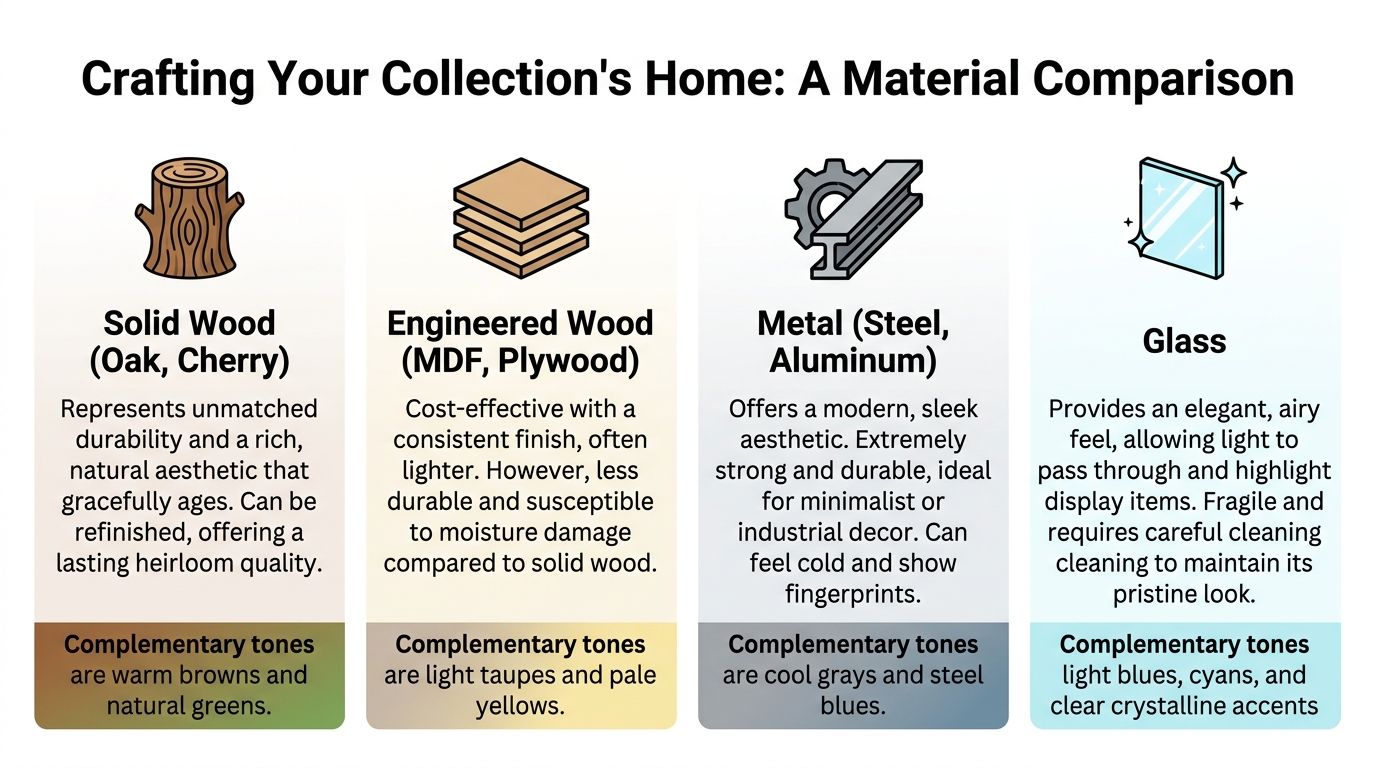
For a long-term piece, the frame matters most. It carries the visual tone of the shelf and much of its structural integrity.
Solid wood remains the benchmark for many investment homeowners because it ages well and can often be refinished. If you’re comparing wood-based construction methods, this overview of engineered wood vs particle board helps clarify what you’re buying.
Here’s a simple comparison of wood choices often seen in higher-quality display furniture.
| Wood Type | Hardness & Durability | Grain Pattern | Best For |
|---|---|---|---|
| Oak | Strong and durable for daily long-term use | Prominent, visible grain | Traditional rooms, rustic spaces, heirloom looks |
| Cherry | Durable with a refined aging character | Smooth, elegant grain | Formal dining rooms, classic interiors |
| Maple | Dense and dependable with a cleaner appearance | Subtle, even grain | Transitional homes, custom modern spaces |
Glass isn’t just about looks
In a curio shelf, glass does visual work and safety work. That’s why tempered glass matters.
According to Displays2go’s wall-mounted curio cabinet specifications, tempered glass is four to five times stronger than standard glass, and a typical 0.11-inch thick tempered shelf can support 25 lbs per shelf. If failure occurs, it breaks into small granular pieces rather than sharp shards, reducing injury risk by up to 99% per ASTM C1048 standards (Displays2go tempered glass curio cabinet details).
That one material choice tells you a lot about the overall seriousness of the piece. Good display furniture protects what’s inside and the people around it.
Adjustable shelving adds lasting flexibility
Collectors rarely keep displaying the same objects forever. That’s why fixed shelves can become frustrating.
Adjustable systems let the shelf adapt as your collection changes. A tall vase one year may become a group of smaller ceramics the next. Versatility is part of quality.
Look for these signs:
- Cleanly drilled shelf positions that look even and intentional
- Stable supports that seat firmly without wobble
- Smooth adjustment that doesn’t scrape or loosen the cabinet interior
Construction details worth checking
Some quality signals are easy to miss in a showroom or product photo.
Look closely at movement
Open and close the door several times. It should feel controlled, not loose or abrupt. Hinges, magnetic catches, and frame alignment tell you whether the piece was built with care.
Check corners and edges
The finish should feel deliberate, not rushed. Interior edges matter too, especially in a display piece where light exposes everything.
Practical rule: If the inside of the cabinet feels neglected, the unseen structure often is too.
Think beyond the first room
A strong curio shelf should still make sense if you move it from dining room to study, or from hallway to home office. Lasting furniture has enough integrity to survive changing layouts and evolving taste.
The best pieces don’t rely on trend. They rely on material honesty, sound construction, and a finish that gets better as the home around it matures.
Finding the Perfect Fit Measuring and Placement
The right curio shelf can still look wrong if the scale is off. Most sizing mistakes happen for one of two reasons. The cabinet is too small to hold visual weight on the wall, or too large for the room’s circulation and surrounding furniture.
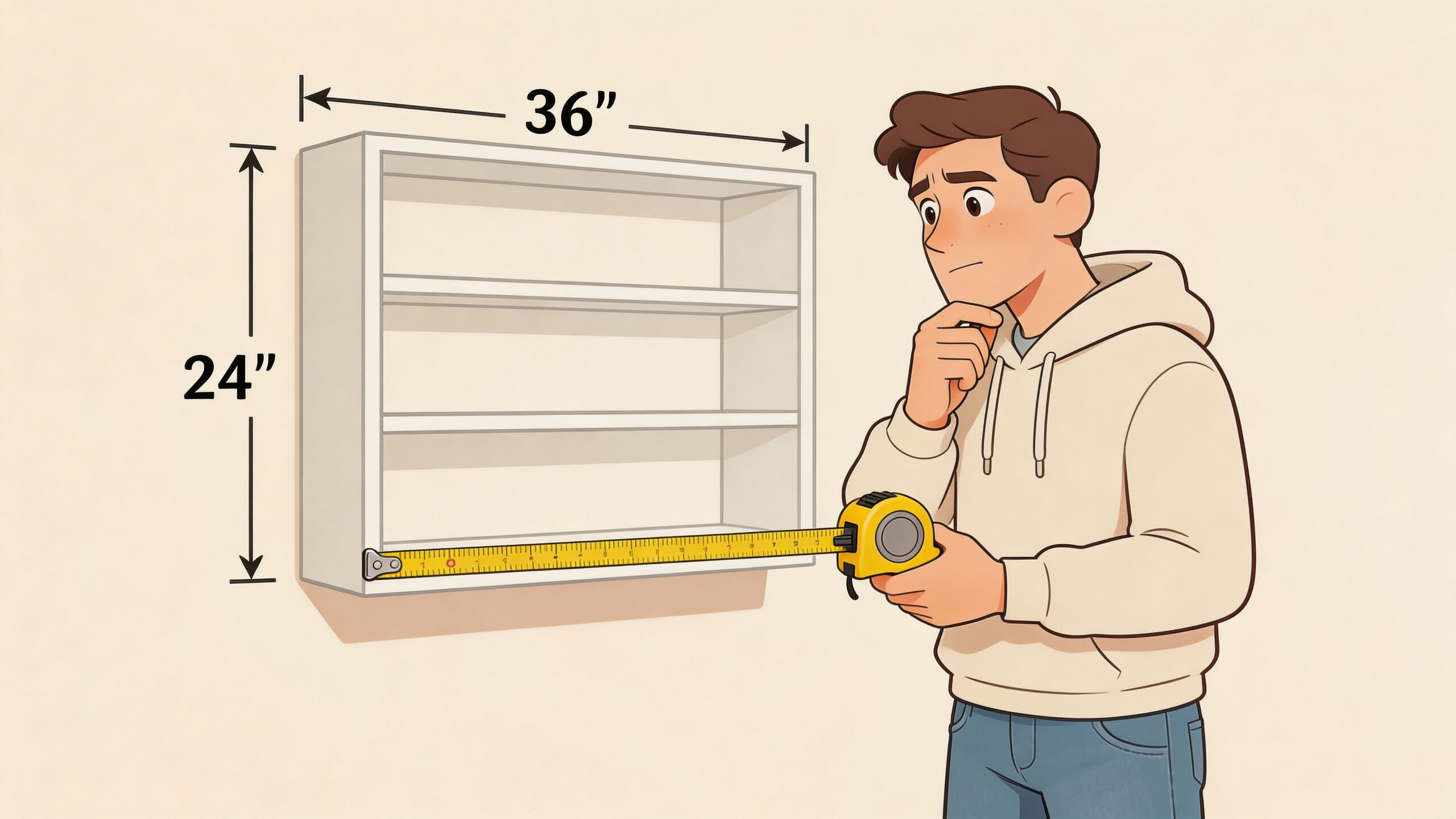
Measure the wall first, not the shelf first
Start with the wall and everything around it.
Use this order:
- Measure the full wall width and height
- Note nearby obstacles like vents, switches, sconces, or door swing
- Mark adjacent furniture such as a sideboard, desk, or bench below
- Step back and evaluate sightlines from the room entry and main seating positions
If you need a reliable measuring checklist before shopping, this guide on how to measure furniture is useful.
Placement by room type
A curio shelves wall installation should feel anchored to the life of the room.
In a dining room
This is often the most natural placement for china, crystal, and inherited serving pieces. Position the cabinet where it visually relates to the dining table or sideboard, rather than floating alone on an unrelated wall.
In a living room
A curio shelf works well beside a fireplace, above a low cabinet, or on a wall that needs more personal character than art alone can provide.
In a hallway or transition space
These placements can be beautiful, but only when projection and traffic flow are considered. If the passage is tight, choose a profile that doesn’t make the corridor feel pinched.
Don’t overlook adjustable interiors
Shelf spacing affects placement more than buyers expect. A cabinet may fit the wall but fail the collection if the interior can’t adapt.
According to Streamdale’s product specifications, peg-and-hole adjustable shelving systems can offer 12-24 height positions, and improper pre-drilled alignment can increase shelf deflection by 40% (Streamdale adjustable curio shelf details). That matters when you’re displaying objects with different heights and weights.
A designer’s test for balance
Stand in the doorway and ask three questions:
- Does the piece feel centered in the wall composition
- Does it relate to the furniture below or beside it
- Will the display be visible without forcing people to crowd it
If a display piece has to be explained to feel intentional, it probably needs a better location.
Good placement always feels calmer than expected. The shelf should look like it belongs to the house itself, not like it was squeezed in after the fact.
Secure Mounting for Lasting Peace of Mind
A wall display isn’t successful until it’s safely mounted. This is the part many style guides skip, and it’s the part that matters most once glass, wood, and cherished objects are all involved.

A curio shelf should be treated like a semi-permanent installation. Not a casual wall accent. Not a weekend shortcut.
Why drywall alone isn’t enough
Once loaded, a curio cabinet can become far heavier than people expect. The cabinet itself has weight. Glass has weight. Your collection adds more.
A YouTube source focused on wall-mounting notes that a loaded curio shelf can weigh over 100 lbs. It also states that standard drywall alone is insufficient, and that toggle bolts or hollow-wall anchors rated for at least 75 lbs are necessary. For solid wood Amish cabinets, mounting directly into wall studs is the gold standard, with shear resistance that can exceed 200 lbs (wall-mounting guidance for curio shelves).
That’s the difference between “hung” and “secured.”
Match the hardware to the wall
Not every wall asks for the same method.
- Drywall needs the right anchors when studs aren’t in the ideal position
- Stud-mounted installation is the preferred route for heavier solid wood pieces
- Plaster walls require extra care because they can crack if treated like drywall
- Masonry calls for different fasteners and drilling tools altogether
Many homeowners get tripped up at this point. They buy a beautiful cabinet, then assume the included hardware solves every wall condition. It usually doesn’t.
Don’t guess at alignment
Use a stud finder, level, and measured layout marks. Then check them again. Even a small installation error can create visual tilt, door swing problems, or uneven stress on the frame.
For anyone who wants cleaner alignment principles before hanging any wall piece, this article on hanging your picture with precision offers helpful basics that also apply to display furniture.
Secure mounting protects more than the shelf. It protects the objects, the wall, and everyone walking past it.
Professional installation is part of the investment mindset
There’s no prize for improvising with a heavy wall cabinet. If you’re dealing with solid wood, glass shelves, and valuable contents, professional installation is often the wisest decision.
Think of mounting as part of the furniture purchase, not an afterthought. The safest display is the one that disappears into the room visually because the structure behind it is doing its job correctly.
Styling Your Curio Shelves A Designer’s Approach
The best styling doesn’t make a curio shelf look full. It makes it look considered. A display should feel edited enough that each object can be seen, but layered enough that the whole cabinet has rhythm.
That balance is harder than it looks.
Start with anchors, not filler
Many people begin with the smallest objects because they’re the most sentimental. That often leads to a busy display with no visual rest.
Start with larger anchors first. A vase, framed object, covered jar, or sculptural piece gives the eye structure. Then add medium-scale items. Place the smallest pieces last.
A few reliable combinations:
- Tall and grounded with one vertical object paired with a lower rounded piece
- Material-driven using wood, ceramic, metal, or glass as the unifying thread
- Theme-based such as travel keepsakes, family heirlooms, or monochrome pottery
Leave breathing room
A curio shelf isn’t a storage challenge. It’s a presentation challenge.
If every shelf is full edge to edge, nothing stands out. Negative space gives importance to what remains. This matters even more behind glass, where reflections already add visual activity.
A strong display often comes from removing one object, not adding one more.
Light changes everything
Lighting is often the difference between a shelf that disappears and one that shapes the mood of the room. Soft integrated light can sharpen silhouettes, reveal texture, and make glass or ceramics feel warmer at night.
Modern display furniture also increasingly overlaps with smart-home planning. According to the Etsy market summary provided in the verified data, customizable systems can include hidden channels for wiring and integrate Philips Hue-compatible lighting for automated, energy-efficient displays controlled by voice or app (smart lighting trend for curio displays).
That’s especially useful when a curio shelf is part of a home office, study, or mixed-use living area where lighting needs to do more than one job.
Style for the room, not just the cabinet
A curio display shouldn’t feel disconnected from the rest of the interior.
Ask yourself:
- Does the finish relate to nearby furniture
- Do the objects echo colors already in the room
- Is the mood formal, rustic, collected, or minimal
- Will the lighting compete with lamps and artwork nearby
If you want more shelf-styling inspiration that applies across rooms, this article on how to decorate shelves in any room is worth saving.
The most beautiful curio shelves wall displays feel lived with, not staged. They reveal restraint, memory, and taste all at once.
Bringing Your Vision Home with Vinson Fine Furniture
A family settles into a new home, opens a few old boxes, and finds the pieces they have carried from place to place for years. The question is no longer where to set them for now. The question is where they belong for the long run. That is the point where a curio shelf stops being a small decorating purchase and becomes part of the house itself.
A well-planned display wall works like built-in trim or a fireplace surround. It shapes how the room feels, supports the architecture, and gives treasured objects a setting that feels permanent. That kind of decision benefits from more than a quick retail purchase. It calls for guidance on scale, finish, proportion, and installation, especially when the goal is to create something secure and lasting.
Why a full-service approach matters
Homeowners in Central Ohio can work through those choices with the team at Vinson Fine Furniture. The In-Store Design Studio gives you room to compare finishes, study proportions, and consider how a curio shelf will relate to flooring, millwork, nearby casegoods, and the daily flow of the room.
The Custom Order Program is especially helpful when a standard option feels close, but not quite right. A shelf can be crafted to suit the wall more precisely, echo surrounding furniture, and read as a natural extension of the home rather than a decorative afterthought.
That distinction matters.
If you are furnishing beyond one wall, the display piece should belong to a larger composition. Dining storage, office furniture, and living room casegoods all speak to one another. When their scale and finish are considered together, the room feels settled and well built.
Value should include confidence
Long-term furniture buyers usually judge value by more than the tag on the floor. They are weighing material quality, construction, service, and whether the piece will still feel right years from now.
Vinson supports that with a Low Price Guarantee. If you find the same item for less at a local authorized dealer within 30 days, Vinson will refund 110% of the difference. That policy gives buyers confidence while they focus on workmanship and fit.
There is also a Clearance Gallery, where shoppers can find premium pieces with savings of up to 70%. For homeowners who care about quality and are willing to wait for the right opportunity, that can be a smart way to buy well.
The process should feel easy
Good furniture service protects the investment after you choose the piece.
Vinson offers:
- Complimentary design consultations for planning and decision support
- Flexible Financing through Synchrony HOME for qualified buyers
- White-Glove In-Home Delivery so pieces are placed, assembled, and handled with care
That level of support matters even more when a display shelf is being treated as a fixed feature of the room. Safe placement, careful handling, and professional setup help the finished wall feel considered from the start. For shoppers seeking a Furniture store Columbus Ohio experience, Solid wood furniture Ohio, Amish-made furniture, Custom dining sets, or the Best mattresses Easton Town Center, Vinson has become a trusted part of the process.
A curio shelf often begins with keepsakes that have never had a proper home. Chosen well and installed with care, it becomes part of the home’s story for years to come.