Solid Wood Modern Dining Table Guide for Columbus Homes


The dining room feels nearly finished, but the table still isn't right. A Columbus homeowner may love the clean outline of a modern design, then wonder whether its substantial top will overwhelm the room, whether the chairs will tuck beneath it, and how the surface will handle everyday meals.
Choosing a solid wood modern dining table means answering those practical questions alongside the aesthetic ones. The most satisfying purchase brings material, construction, room planning, and long-term care into the same conversation, preferably with a finish sample in hand and an actual chair pulled up to the table.
Why a Solid Wood Modern Dining Table Is a Long-Term Choice
Consider a household replacing a dining set after a renovation. The new room has open sightlines and uncluttered finishes, but family life hasn't become minimalist. There are shared meals, visiting relatives, papers spread across the tabletop, and chairs that move constantly.
A table selected only for its photograph may disappoint in that setting. A sculptural base might interrupt foot placement, while a dramatic top could feel too imposing beside everyday seating. The stronger starting point is the household's routine, followed by the design that supports it.
Modern Design With Lasting Purpose
Solid hardwood offers more than a wood-colored surface. Visible grain, relationships between individual boards, and the feel of a finished edge give the piece its character. Repair and refinishing potential also belong in the conversation, although the appropriate treatment depends on the particular finish, damage, and construction.
A useful distinction is between accepting evolving character and accepting preventable damage. An owner may appreciate a surface that develops a lived-in appearance without wanting water marks, unstable joints, or an unsuitable coating. Long-term ownership requires both thoughtful selection and realistic care.
Vinson's stated hardwood standard centers on solid cherry, oak, maple, and walnut, rather than promoting substitute wood constructions. Its custom dining-table information connects that material focus with configurable furniture, making the table a considered purchase rather than an interchangeable room accessory.
What the Guide Helps You Decide
| Decision | What to evaluate | Why it matters |
|---|---|---|
| Hardwood selection | Actual boards, finish samples, and acceptable variation | The finished table should suit the room and the owner's preferences |
| Construction | Top attachment, joints, and extension hardware | Hidden details affect everyday performance |
| Room fit | Chairs, circulation, and base placement | A beautiful table still needs comfortable access |
| Ownership | Care requirements, service, and delivery | The purchase continues beyond the showroom |
The regional connection matters, too. Vinson is a family-owned business formerly known as Kitchen Tables & More, serving Central Ohio from Easton Town Center with an emphasis on North American manufacturing and Amish-made craftsmanship, as described in its company history.
For homeowners researching solid wood furniture Ohio options, that showroom setting offers something a photograph can't: the opportunity to feel an edge, inspect an underside, and compare the table's proportions with a seated person. Heirloom-quality furniture is an aspiration supported by those details, not a promise established by appearance alone.
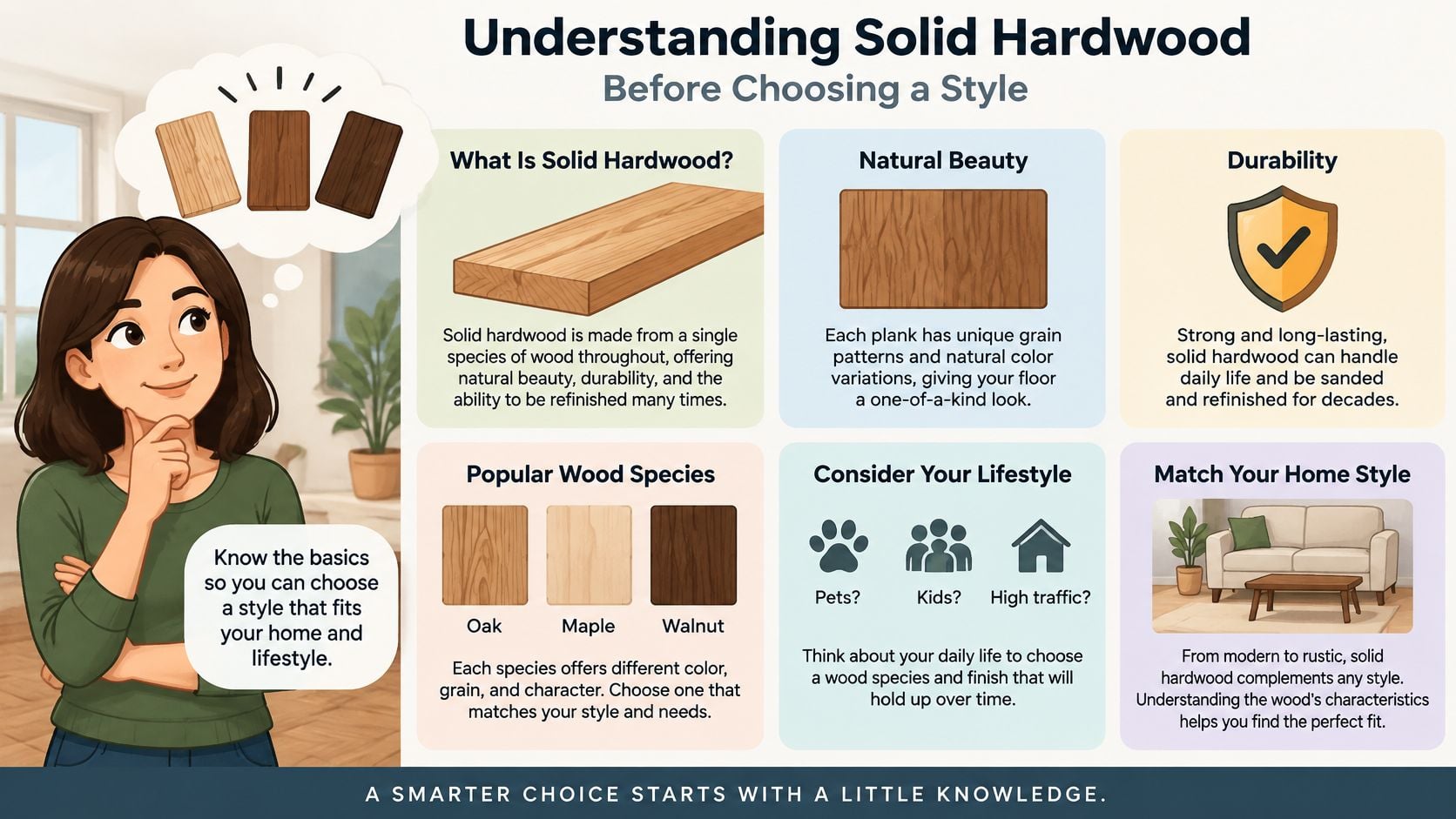
Understanding Solid Hardwood Before Choosing a Style
Solid hardwood is a natural material, not a motionless surface. A helpful analogy is a well-fitted wooden door: the material can respond to its surroundings even when the craftsmanship is careful. Furniture makers must account for that response rather than assume the wood will remain unchanged.
This guide concentrates on solid cherry, oak, maple, and walnut, the hardwood choices central to Vinson's stated standard. Species names provide a useful starting vocabulary, but they don't describe the complete table. Board selection, finishing, proportions, and assembly remain separate decisions.
Read the Material Description Carefully
A precise specification should identify the wood used in the top and supporting components. A broad description such as wood finish doesn't answer that question. Vinson's explanation of solid-wood terminology provides useful background before a showroom discussion.
A tabletop assembled from joined solid boards can still be solid hardwood. The meaningful inspection concerns how those boards relate visually and how the maker accommodates the material's behavior, not whether the top looks like an uninterrupted sheet.
During browsing, several observations help turn an attractive surface into an understandable specification:
- Board relationships: Follow the visible boundaries and decide whether contrasting areas feel balanced or distracting.
- Surface character: Compare a quiet-looking sample with a more expressive one rather than assuming every table in a species will look identical.
- Component descriptions: Request clear information about the top, apron, legs, and base.
- Finish influence: Compare the wood's identity with the effect created by stain, sheen, and surface preparation.
Natural Variation Versus a Defect
Variation should be discussed before ordering, not discovered after delivery. A homeowner who prefers a consistent-looking surface may need a different board-selection conversation from someone who enjoys pronounced contrasts.
The right question isn't whether natural variation exists, but which variations the order permits. Samples can establish direction, while photographs or representative showroom pieces can help clarify the range.
Showroom principle: A sample establishes a design direction. A written specification establishes what the customer is ordering.
The same precision applies to terminology such as bench-made or mortise-and-tenon. Those descriptions should correspond to the actual piece under consideration. Attractive language is useful only when a consultant can connect it to identifiable materials and construction.
Compare Solid Cherry Oak Maple and Walnut
No hardwood deserves a universal first-place ranking. The better choice depends on the desired visual effect, the available finish, and the owner's willingness to live with the character of the actual boards.
Descriptions alone can mislead. A shopper may associate a species with a particular color, then discover that the selected finish creates a very different impression. The most reliable comparison places finished samples beside the intended chair material and room photographs.
Solid Hardwood Species at a Glance
The following comparisons are design starting points, not performance rankings or promises about every board.
| Species | Visual character | Modern pairing | Buyer question |
|---|---|---|---|
| Solid cherry | Consider for a warm, cohesive-looking scheme | Restrained profiles and softly coordinated seating | Does the actual finish provide the warmth the room needs? |
| Solid oak | Consider when visible grain is part of the appeal | Architectural bases and tactile fabrics | Does the sample's grain feel expressive or too busy? |
| Solid maple | Consider for a visually quiet direction | Clean edges and simplified chair silhouettes | Does the finished sample have enough character for the room? |
| Solid walnut | Consider for a deeper-toned focal point | Open bases and lighter surrounding upholstery | Does the finished top feel balanced in the available light? |
Compare the Samples, Not the Reputation
Cherry belongs on the sample tray when the homeowner wants warmth without relying on elaborate ornament. A useful test places the sample beside existing cabinetry or nearby wood furniture. The goal isn't necessarily an exact match, but a relationship that looks intentional.
Oak is worth considering when the buyer wants to notice the material's grain. Rather than treating expressive grain as automatically rustic, the homeowner can compare it with a crisp edge and uncomplicated base. The combination may provide the desired contrast between natural texture and modern form.
Maple invites a different conversation: how quiet should the surface appear? A homeowner considering a restrained finish should examine a larger representative area, not just a small swatch. Vinson's walnut and maple comparison offers an additional starting point for that showroom discussion.
Walnut can be evaluated as a deeper visual anchor rather than selected for perceived prestige. In a room with dark chairs or nearby cabinetry, the homeowner should assess the whole grouping. The appealing sample in isolation may produce a heavier composition once everything is together.
Let Touch and Care Refine the Choice
Tactile preference belongs alongside color. With permission, a shopper can run a hand along the finished edge and compare the surface treatment of the actual candidates. The experience should include the chair arms and the place where forearms naturally rest.
Maintenance shouldn't be assigned by species alone. The homeowner needs the maker's care instructions for the chosen coating, including approved cleaning products and repair procedures. A favored wood with an unsuitable care routine is a weaker choice than a compatible wood-and-finish combination.
The final decision should read like a specification: preferred species, approved finish, acceptable board variation, and representative sample. That vocabulary gives a design consultant much more useful direction than a request for something modern.
Choose a Modern Profile That Fits the Room
A modern table doesn't have to look severe. A rounded edge, a restrained base, and a thoughtfully selected finish can create a welcoming composition without decorative excess. Conversely, a visually simple table can feel imposing if its top and base dominate the room.
Shape, edge, base, and seating should be judged together. None offers a complete answer on its own.
Modern Profile Decision Guide
| Design direction | Visual effect | Consider before ordering |
|---|---|---|
| Rectangular top with an uncomplicated leg base | Defined and orderly | Whether legs conflict with the intended chair positions |
| Round top with a pedestal | Centralized and sculptural | Whether the pedestal permits comfortable foot placement |
| Oval top with softened edges | Flowing and less angular | How chairs relate to the curved ends |
| Substantial top with a recessed base | Strong material emphasis | Whether the base still provides usable knee space |
| Slender-looking edge with restrained supports | Visually lighter | Actual apron depth and seated comfort |
Match the Profile to a Real Room
In an open-plan Columbus home, the dining table may be visible from the kitchen and living room. An owner can evaluate the table from those approaches rather than only from the dining-room doorway. A base that looks elegant head-on may appear visually crowded beside the surrounding seating.
A narrower dining room creates a different problem. The homeowner might prefer an oval outline, but the appealing curve doesn't automatically resolve chair placement. The table's usable seating positions still need to align with its supports.
For a room with a frequently used route between doorways, the everyday footprint deserves priority. A shape that preserves that route may be more appropriate than the largest top the room can physically contain. The household shouldn't have to reorganize normal movement for every meal.
Separate Visual Lightness From Physical Access
A pedestal can remove corner-leg conflicts, yet its lower structure may occupy the space where someone wants to place their feet. A thin-looking top may conceal an apron that interferes with chair arms. Those are reasons to conduct a seated trial, not reasons to reject either design category.
- View the outline: Compare the table from the room's actual entry points.
- Check the edge: Assess the profile where a seated person rests their arms.
- Inspect below: Look at supports from chair height, not only standing height.
- Pair the seating: Test the intended chairs rather than a conveniently available substitute.
The refined choice is often less dramatic than the first favorite. Its appeal comes from proportion and usability together, not from an architectural gesture that the household must work around.
Evaluate Construction and Finish Quality
The underside of a table can answer questions that its polished top cannot. Hardware, joints, and attachment points show how the maker has approached a natural material that changes with its environment.
An inspection doesn't require woodworking expertise. It requires a consultant who can explain the actual construction without substituting general assurances for specific answers.
Start With Moisture and Top Attachment
The U.S. Forest Products Laboratory states that furniture, cabinetry, and millwork lumber is typically dried to approximately 6–8% moisture content, a target intended to approximate indoor service conditions in its technical wood guidance.
The engineering issue is straightforward: wood can lose or absorb moisture after fabrication. Changes across the grain are greater than changes along its length, so a wide tabletop needs connections that accommodate that response. Protective coatings can slow moisture exchange, but they can't prevent dimensional change.
A useful analogy is allowing room for a natural material to respond rather than locking every part rigidly in place. Elongated fastener holes, figure-eight fasteners, or another compliant attachment may serve that purpose. The consultant should identify the method used on the selected table.
- Drying target: Ask what moisture target the manufacturer uses and whether moisture is checked before assembly.
- Top attachment: Request an explanation of how the base connection permits seasonal movement.
- Board assembly: Examine edge-glued joints and discuss grain orientation.
- Surface coverage: Ask how the underside and other less-visible surfaces are finished.
A table can feel rigid during a showroom visit and still need movement-aware connections for long-term service.
Inspect Joints and Operating Parts
Joint names are useful when they describe an actual connection. A mortise-and-tenon joint, for example, should be discussed in relation to its location and purpose, rather than treated as a decorative badge of quality. Vinson's guide to wood joints can help homeowners prepare more specific questions.
With staff assistance, inspect where the legs or pedestal meet the supporting structure. Look for an orderly fit and ask how the connections are serviced. If the table extends, operate the mechanism and examine how the opened components align and lock.
Ask What the Finish Does and Doesn't Promise
Solid wood doesn't automatically mean low-emission furniture. A review of furniture emissions identifies substrates, paint films, adhesives, temperature, humidity, and ventilation as relevant influences.
Practical questions concern the finish and adhesive products, curing guidance, any available emissions documentation, and recommended ventilation after delivery. A water-based label or natural-sounding description shouldn't replace product-specific information.
Surface care deserves equally precise answers. The buyer should ask about approved cleaners, heat protection, spill response, and whether repair requires professional attention. Finish performance should never be inferred solely from sheen or smoothness.
For a future candle-wax mishap, J.G. Carpet Cleaning LLC's hardened wax removal steps can serve as a supplementary reference. The table manufacturer's finish-specific instructions should remain the deciding guidance before any removal method is attempted.
Size the Table for Real Life
A seating-capacity label describes only part of the dining experience. It doesn't show a chair pulled back, a person serving food, or a mobility device approaching the table.
The useful measurement is the occupied dining arrangement, not the tabletop. Homeowners should bring room dimensions, chair information, and photographs of the room's connections to the consultation.
Establish the Everyday Footprint
Begin by recording fixed features: walls, doorways, windows, the sideboard, and routes people use through the room. Include anything that changes the available space, such as an opening cabinet door or a nearby seating area.
Then mark the proposed tabletop outline on the floor. Place actual chairs around that outline where possible, or record the intended chairs' full dimensions. Chair arms, projecting backs, and the way a person sits can change the arrangement substantially.
- Test the seated position: Check knee space and the relationship between chair arms and the apron.
- Pull chairs back: Reproduce the movement required to sit down and stand up.
- Walk the service route: Carry an empty tray through the proposed arrangement to identify awkward turns.
- Open nearby furniture: Confirm that storage remains usable during a meal.
- Repeat with extensions: Evaluate the expanded arrangement separately from the everyday setup.
Vinson's dining-space and seating-arrangement guide offers another reference for comparing shapes against the room rather than choosing by seat count alone.
Include Accessibility Before It Becomes Urgent
Accessibility research identifies ease of use, low operating effort, and adequate accessible space and size as priorities for users evaluating wheelchair-accessible dining tables in its study of accessible dining-table criteria.
Those priorities translate into practical showroom checks. A wheelchair user should be able to assess the actual approach, knee clearance, reach to the tabletop, and position of the base. A household anticipating changing mobility needs can make those checks before access becomes difficult.
Consider a compact room with a sculptural, splayed base. The top may fit the floor outline, but the supports could occupy the easiest approach. A less expressive base may provide a more usable arrangement without changing the preferred hardwood or finish.
Future-use check: The intended user should test the approach and seated position whenever possible. A drawing can't reproduce every movement.
Rehearse the Larger Gathering
An extension mechanism should be tested by the person likely to operate it. Ask where leaves are stored, how they are handled, and what effort the process requires.
For occasional entertaining, MODERN LYFE's resource on planning large group table layouts provides an additional planning reference. The room's actual obstacles and the household's everyday arrangement should remain the basis for the final choice.
Understand Pricing Value and Savings
A solid hardwood table's value cannot be read from its dimensions alone. The purchase combines material selection, construction, finish, configuration, service, and the household's ability to use the piece comfortably.
An attractive price doesn't resolve a poor fit. Equally, a higher price doesn't remove the need for clear specifications and careful inspection. Value is strongest when the buyer understands what is included and what remains optional.
Compare Complete Purchase Proposals
A useful proposal identifies the species, finish, size, base, chairs, extension arrangement, and service terms. Comparing that complete configuration prevents an apparent saving from resting on an omitted feature.
Customization should also solve a defined need. A different base may improve access, while another finish may coordinate with existing furniture. An option selected only because it's available may add complexity without improving daily use.
| Value consideration | Evidence to request |
|---|---|
| Materials and construction | Written species and construction specifications |
| Customization | Approved selections and confirmation of available options |
| Service | Consultation scope and delivery arrangements |
| Ownership | Care instructions and applicable service policies |
North American manufacturing and Amish-made dining sets can be meaningful selection criteria, but buyers should still evaluate the individual piece. Geographic origin establishes where a product comes from, not whether its exact configuration suits a particular home.
Distinguish the Guarantee From Clearance Savings
Vinson's Low Price Guarantee provides a refund of 110% of the qualifying price difference when the exact same item is found at a lower price from another qualifying local authorized dealer within 30 days of purchase, subject to its published guarantee conditions. That is a refund calculation based on the difference, not a refund of the purchase price.
The Clearance Gallery follows a different value path, with savings of up to 70% on eligible floor samples, overstocks, and seasonal closeouts, as described alongside the retailer's custom-order and clearance information. Availability and discount depth depend on the merchandise.
A clearance shopper should inspect the particular piece, confirm its condition, and verify delivery and service terms. A custom-order shopper should instead concentrate on getting the specification right before production.
White-Glove Delivery belongs in either purchase discussion. The buyer should confirm the included handling, assembly, placement, and packaging removal rather than assume that every delivery arrangement provides identical service.
Plan Customization Care and Delivery
A strong custom order starts before the first finish sample is opened. Bring room photographs, wall and doorway measurements, chair dimensions, and notes about who uses the table, how often it hosts guests, and whether homework, laptops, or serving platters share the surface. Style preferences matter, yet the table has to behave like part of a daily system: it must clear the walkway, accept the right chairs, resist the finish wear your household creates, and arrive through a real entry route.
Vinson's Custom Order Program can include fabrics, finishes, configurations, and digital or 3D visualizers across partner offerings. Treat those tools like a fitting room rather than a promise. Confirm which options apply to the exact dining table under consideration, because one collection may offer different bases, edge profiles, leaves, or finish schedules than another.
Keep Brand Origins and Product Roles Clear
Describe the partner mix as North American crafted, spanning U.S. Amish workshops, a U.S. upholstery maker, and a Canadian dining workshop. Origin tells you where a piece is produced, so verify the specific model rather than assuming every product shares one country, one workshop method, or one lead time.
Whole-home planning can branch into solid-wood bedroom storage, upholstered seating, or occasional tables. Keep those conversations adjacent to the dining plan so they support it without blurring the table's species, finish, size, base, and extension choices.
Living-room coordination may involve top-grain or performance leathers, motorized reclining seating, swivel chairs, accent chairs, rockers, and gliders. Availability, upholstery choices, and operating features need confirmation for each model.
Turn Preferences Into an Approved Order
The In-Store Design Studio and Complimentary Design Consultations give structure to decisions that are easy to jumble together: room dimensions, circulation space, seating habits, chair clearances, fabric coordination, and finish selection. Use the visualizers to narrow the field, then let physical samples and a showroom sit-test settle what screens cannot, such as how a tabletop reflects afternoon light or how an edge feels under a forearm.
Approval works best as a final read-through. Confirm species, finish, dimensions, base, seating count, and extension details; compare the approved sample with the natural variation you are willing to accept; review manufacturer care instructions and compatible cleaning products; and walk the delivery path from truck to room, including stairs, tight turns, placement, packaging removal, and White-Glove Delivery arrangements.
Care should be planned as an ownership routine, with sunlight, heat, spills, and seasonal humidity treated as normal conditions rather than surprises. Vinson's wood-furniture care guidance offers a starting reference, while the maker's instructions govern the selected finish.
For handling during a household move or renovation, a complete furniture care guide can supplement product-specific directions. Before arrival, verify the care documents, prepare the room, and agree on how delivery concerns will be recorded.
For homeowners comparing a solid wood modern dining table, Vinson offers hardwood choices, custom-order planning, and complimentary design assistance at Easton Town Center. A visit to Vinson Fine Furniture with room measurements and chair details allows the household to compare finishes, complete the sit-test, and discuss White-Glove Delivery before placing an order.