Solid Wood Oak Dining Table Size and Build Guide


The dining room looked generous on a quiet Tuesday. Then six chairs slid back at once, a serving dish needed a landing spot, and the walkway to the kitchen turned into a shuffle. That is the moment a solid wood oak dining table stops being a picture and starts being a floor plan, a joinery problem, and a finish that has to survive real meals.
A thick oak top feels like an heirloom the first time a hand runs across it. Weight, grain, and a bench-made edge all suggest permanence. Permanence still depends on three quieter things: room for the top to move with the season, joints that can be taken apart and repaired, and a surface that can be spot-fixed or fully refinished. Species choice comes after the room is measured. Style comes after the seats and the walkway are honest.
Central Ohio houses make that order obvious. A Columbus dining room can be a square 10 by 10, a narrow room off a galley kitchen, or an open plan where people pass the table on the way to the family room. The same 72-inch top that looks correct in a showroom can steal the path at home. Tape on the floor, then a sit-test, keeps the purchase tied to the house rather than to a catalog photo.
Dining Table Sizes That Actually Fit
Start with clearance, not with a favorite base. Three rules settle most Columbus rooms before anyone debates white oak or red oak.
Edge per diner: Plan about 24 inches of table edge for each person. Less than that and elbows collide, especially when platters stay on the top through the meal.
Chair pull-out: Leave at least 36 inches of clear floor behind a pulled-out chair. That space is the chair's depth plus enough room to stand up without hitting a wall, a buffet, or another chair.
Passing traffic: Where people walk past the table, not merely sit, hold 42 to 48 inches. A 36-inch gap is enough to pull a chair. It is tight when someone carries a roasting pan behind a seated guest.
Under the top, leave roughly 12 inches of knee room between the seat and the apron. A deep apron on a farmhouse frame can erase that space even when the top size looks right on paper.
A size lookup that matches the room
| Top size | Usual seats | Best room use | Floor to reserve |
|---|---|---|---|
| 36 in round | 2 to 4 | Breakfast nook | About 6 to 8 ft across, with 36 in behind chairs on the open sides |
| 42 to 48 in round | 4 | Small dining room | About 9 to 10 ft across once chairs are pulled out |
| 54 in round | 4 to 6 | Square room, no corners to bump | About 10 by 10 ft |
| 60 by 36 in rectangle | 4 to 6 | Narrow room | About 11 ft long by 8 ft wide with end chairs out |
| 72 in rectangle | 6 | Standard dining room | About 12 ft by 9 ft |
| 84 in rectangle | 6 to 8 | Longer family meals | About 13 ft by 9 ft |
| 96 to 108 in rectangle | 8 to 10 | Holiday seating with a clear pass-through | About 15 to 16 ft by 10 ft, using 42 to 48 in on the traffic side |
A 36-inch round belongs in a breakfast nook for two, or four if two people sit on a bench. A 42- to 48-inch round seats four in a small dining room without unused corners. A 54-inch round seats four to six in a square room of about 10 by 10 feet because there are no corners to bump. A 60-by-36 rectangle does the same job in a narrow room where a round top would block both walls.
Standard dining height is about 30 inches, paired with chairs. Counter height near 36 inches is for stools and short stops, not for long meals. People perch. They don't settle.
Measure every leaf twice, stored and open. A 72-inch everyday top that grows to 96 or 108 inches changes the walkway, not just the guest list. If the leaf parks in the table, confirm the apron still clears knees. If the leaf lives in a closet, confirm the closet is on the same floor. A guide to table shapes and seating arrangements helps when the choice is round versus rectangle rather than inches alone.
Practical rule: Tape the footprint on the floor at home, including chair pull-out and the path people actually walk, before any Easton sit-test.
Oak's place in the wider market is easy to overread. Dataintelo valued the global solid wood dining table market at $12.4 billion in 2025, with oak accounting for 31.2% of that market. Share of a global category doesn't tell a Powell or New Albany household which top fits the room. The tape measure does.
White Oak Red Oak and Neighboring Hardwoods
Solid oak means oak boards through the thickness of the top, the leaves, and the structural parts that are sold as oak. Grain that only exists as a picture on another core is a different product. Vinson Fine Furniture keeps the hardwood standard on solid cherry, oak, maple, and walnut, which is the right set to compare when the goal is a dining top that can be sanded again years from now.
What the white oak numbers describe
Eastern white oak (Quercus alba) is the dense, closed-pore oak buyers picture when they want a heavy daily table. The Northwest Hardwoods species guide reports a Janka hardness of approximately 1,350 pounds-force, a specific gravity of 0.68, a weight of about 3.94 pounds per board foot, and a modulus of rupture of roughly 14,380 pounds per square inch. Janka is the force needed to embed a steel ball in the wood. Plates, chair bumps, and a dropped serving spoon have to work harder to dent that surface than they would on a softer hardwood. The bending strength supports wide tops and load-bearing aprons. The weight is why a finished top feels planted rather than hollow.
White oak heartwood has closed pores and a long record in barrels, boats, floors, and furniture. It machines, sands, glues, and finishes well, which is why shaped edges and consistent films are realistic on a bench-made top. Quarter-sawn boards show medullary ray fleck, those pale ribbons across the grain. That figure is a look, and it also signals boards cut for calmer movement across the width. Hardness is not immunity. A soft film, a wet glass, or a hot pan still marks the surface. Finish quality and moisture care decide whether the 1,350-pound rating shows up at dinner.
Red oak, grades, and the neighbors
Northern red oak is the oak most Ohio furniture shops have built with. USDA Forest Service research identified red oak as the most commonly used species among the Ohio furniture firms studied, with local hardwood suppliers used extensively. Open pores, a pinker cast, and a Janka hardness near 1,290 make it a practical bench wood. Stain sinks evenly. Grain reads clearly across a long top. It is not a lesser white oak. It is a different pore structure and a different color.
Grade is a separate choice from species. FAS and Select favor long, clear cuts for a quiet top. No. 1 Common and character grades keep knots and color shifts. Those marks read as warmth when the finish is even, and as distraction when the stain skips. Ask which grade is on the show top, not only which species.
| Wood | What you see | Dining trade-off |
|---|---|---|
| Eastern white oak | Closed pores, ray fleck if quarter-sawn | Hard, heavy, strong for wide tops |
| Northern red oak | Open pores, pink-brown grain | Common Ohio furniture oak, takes stain evenly |
| Hard maple | Fine, even, pale grain | Harder surface, quieter figure |
| Black cherry | Smooth grain that deepens with light | Rich color, marks sooner |
| Black walnut | Dark heartwood, straight to wavy grain | Formal look, needs a tougher finish |
Hard maple sits near 1,450 on the Janka scale. The surface is harder than white oak, the figure is quiet, and the color stays pale unless a stain is added. Black cherry is near 950. Color deepens with light, which is why a cherry top looks different after a few summers beside a window, and why dents show sooner. Black walnut is near 1,010. The dark heartwood carries a formal room, and the softer surface wants a tougher film if the table is the everyday homework desk as well as the holiday table.
A side-by-side look at oak and white oak is worth doing under the same light, because photos flatten the pore difference.
Match the species to the room, not to a trend. White oak fits heavy daily meals and anyone who wants fleck. Red oak fits an even stain and the grain most solid wood furniture Ohio makers already know how to finish. Maple fits a pale, hard top. Cherry or walnut fits when color matters more than dent resistance. None of them is the heirloom by itself. The next question is whether the top is allowed to move.
Joinery That Lets an Oak Top Move
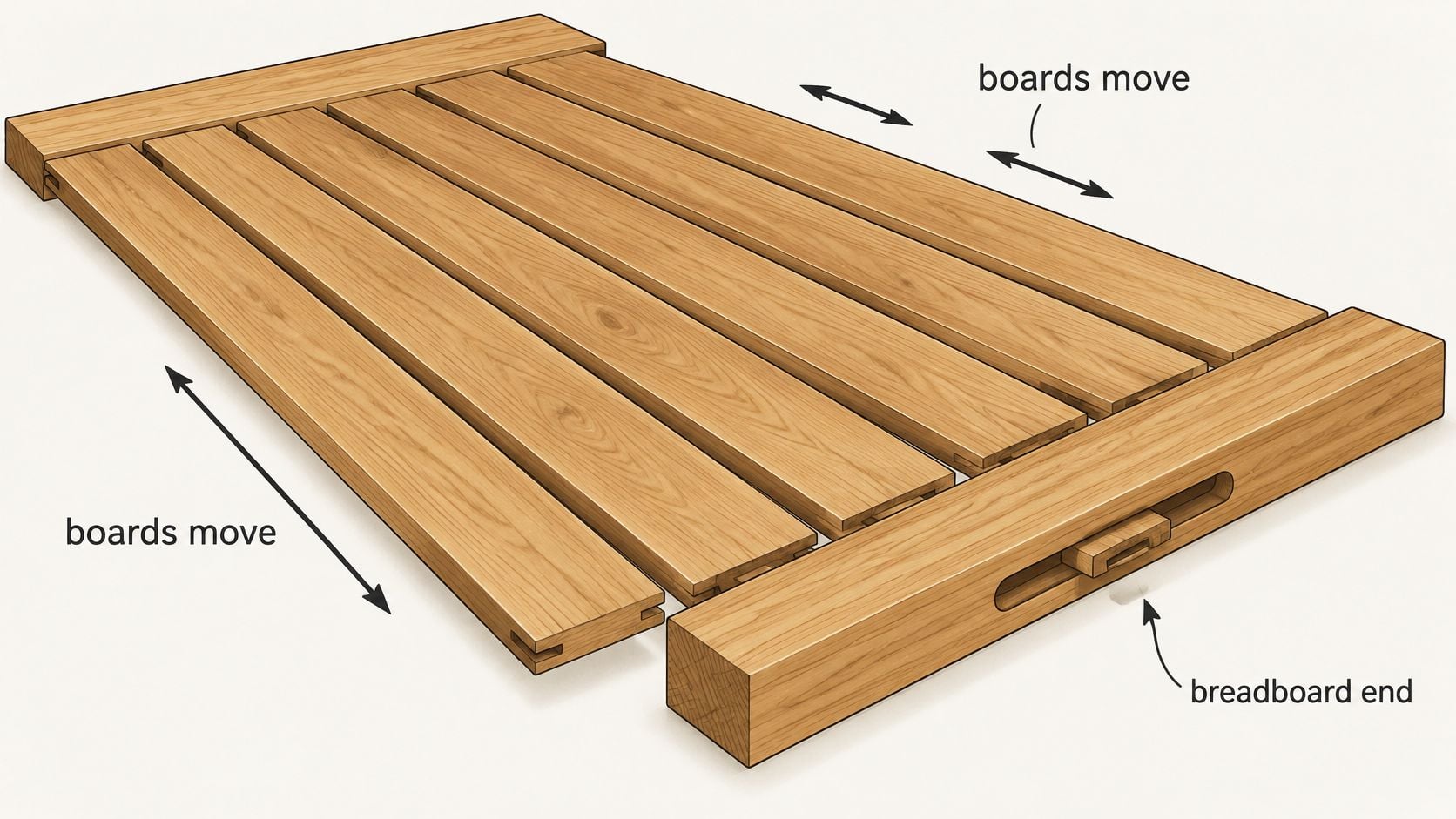
A solid oak top behaves more like a deck of boards than a stone slab. Each board swells and shrinks across the grain as indoor humidity changes. Along the grain, movement is small. Across the grain, it is the whole engineering problem.
Published wood-property data on white oak gives radial shrinkage of about 5.6% and tangential shrinkage of approximately 10.5% from green wood to oven-dry. Tangential movement, the direction around the log, is nearly twice radial movement, the direction through the radius. A wide top is mostly tangential movement. Lock that panel tight to a frame and the wood still moves. The result is cupping, a split, or joints that take the stress instead of the air.
At typical furniture moisture content the same density, a specific gravity near 0.68, works out to about 47 pounds per cubic foot. That mass is why the table feels rigid. It doesn't stop the top from responding to a dry January furnace or a humid July. Kiln-drying sets a sensible starting moisture level. It doesn't freeze the wood.
Fasteners that allow the panel to breathe
Sound bench work fastens the top so it can expand across its width while the base stays square. The usual hardware is simple once someone looks under the apron.
- Wooden buttons sit in grooves on the inside of the apron and screw up into the top. The button can slide as the panel widens.
- Figure-eight fasteners recess into the apron and pivot slightly as the top moves.
- Slotted screw holes let the screw travel instead of tearing the wood.
- A breadboard end caps the end grain, keeps the ends looking straight, and uses an elongated joint so the field can move behind the cap.
Mortise-and-tenon and dowel joints are excellent in legs and aprons. They are the wrong idea if they clamp a broad solid panel on all four sides like a picture frame. Strength without a slip joint is how a beautiful top cracks in its third winter.
Leaves, hardware, and what can actually be fixed
On an extension table, the slides, the leaf alignment, and the leaf itself matter as much as the main top. Leaves should be solid oak of the same species and a compatible cut, not a thinner afterthought that stains a different color. Open the top in the showroom. Watch whether the seam stays flush and whether the slides rack when one side is pulled first.
A thick top alone is not heirloom performance. Replaceable leaves, legs, and hardware, plus a finish that can be spot-repaired or fully refinished, are what make dents, sun fade, and a tired edge fixable.
Ask how the top is fastened, then look. Slotted holes or wooden buttons under the apron are the evidence. Glued blocking with no slip is a warning. The same logic applies to a cracked mortise later. A joint cut so it can be drawn apart can be re-glued. A joint buried under a finish that can't be stripped locally turns a small repair into a full refinish. Photos of wood joints used on solid tables make that difference easier to see before the table is flipped in a driveway.
Acclimation still belongs in the schedule. A top that leaves a dry shop and lands in a freshly plastered, humid house will move more in the first season than it will in a settled dining room. That movement is normal. Trapped movement is the failure.
Styles Leaves and Custom Solid Tops
Say a Worthington household has already taped a 72-inch everyday footprint and a 96-inch holiday footprint. The base is the next constraint, because the floor plan doesn't care how handsome the leg is if a shin hits it.
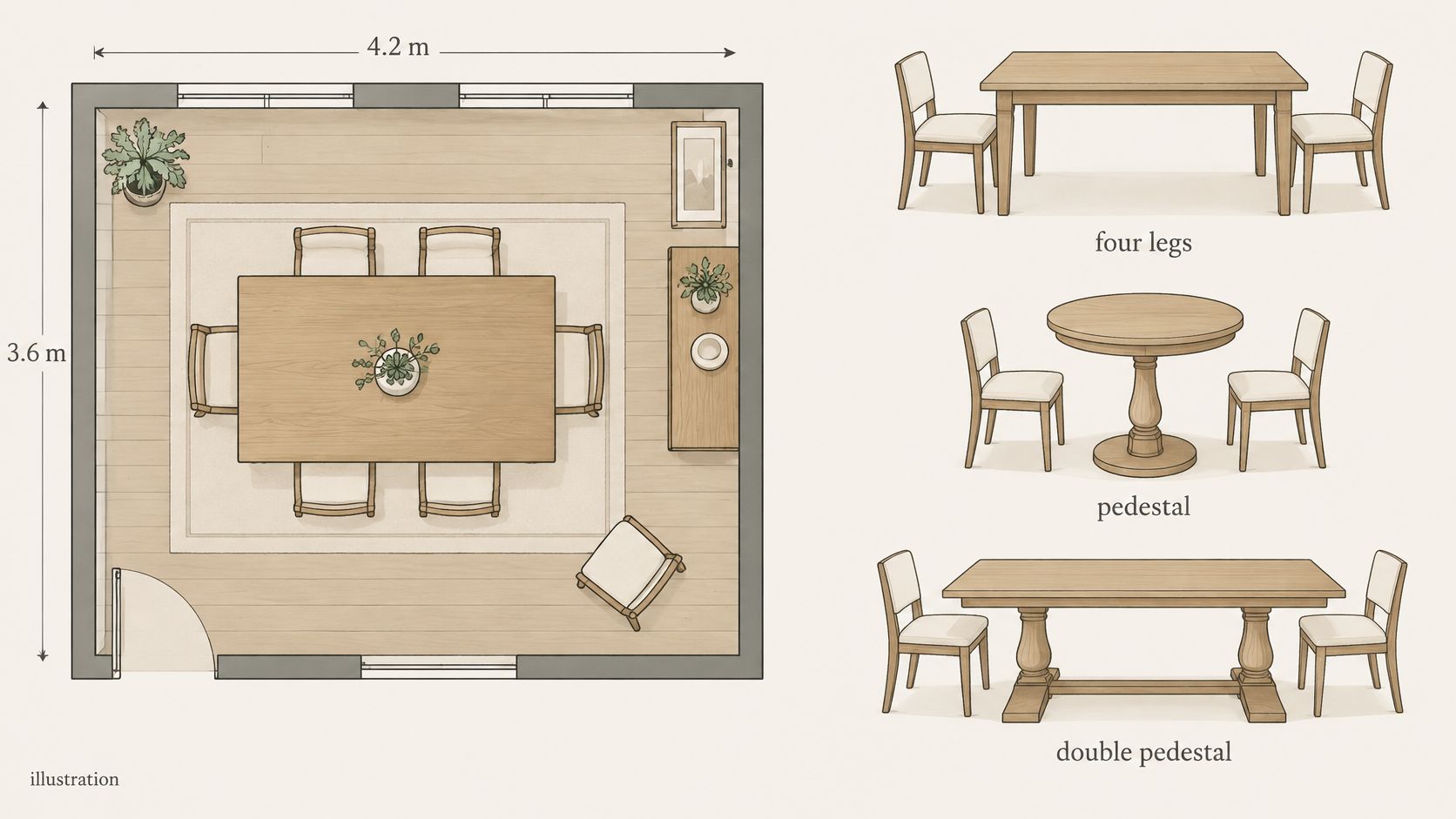
Four legs with an apron seat people cleanly along the sides. A corner chair often fights the leg. That base suits a rectangle in a room where guests sit on the long edges and the ends stay open for serving.
A pedestal or double pedestal frees knees and works on a round or oval top. The 54-inch round in a square room is the classic case. Nobody inherits a table leg at the corner. A double pedestal on a long top keeps the middle open for a person who has to slide past.
A trestle gives the long farmhouse line. The check is the stretcher. If it crosses where feet and shins live, the table looks right and sits wrong. A higher, set-back stretcher, or two pedestals, solves that without giving up the solid oak top.
Extension tables earn their keep when the closed size matches weeknights and the open size matches the tape. Counter-height tops swap the chair for a stool. They are a poor default for long meals, homework, and the kind of evening that runs past an hour.
North American lines, not a single national label
Custom work is where a solid oak top becomes specific to the taped room. Edge profile, leaf count, height, and finish are decisions, not leftovers.
Through the Custom Order Program, Canadel, handcrafted in Quebec, builds North American dining tops and bases across a wide range of sizes, edges, and finishes. A 3D visualizer previews the combination before the bench starts, which matters when a stain on oak looks nothing like the same stain name on maple. Canadel belongs in a North American crafted conversation. It doesn't belong on an American-made-only list.
Mavin, Amish-made in Ohio, is the local solid-hardwood path for dining and for Mavin bedroom furniture when the same finish should continue down the hall. A buyer who wants the server, the bed, and the table in one cherry or oak tone can keep that decision in one shop conversation instead of hoping two catalogs match.
Seating can be ordered with the table. Top-grain leather shows natural character and takes a patina. Performance leather trades some of that patina for easier cleanup when children eat at the table every night. Chairs are only part of the seating plan. Smith Brothers of Berne, made in Indiana, is the American-made line for custom leather sectionals Columbus households add in the living room, including whisper-quiet power motion. Swivel chairs, rockers, and gliders belong in that same seating conversation when a corner of the dining room or family room needs a chair that turns toward the table without a visual fight. Smith Brothers furniture Easton shoppers can sit those motion pieces rather than guessing at motor noise from a product page.
Call the mix North American crafted: Indiana, Ohio, and Quebec, each named for where the bench is. Everyday seat count sets the closed size. Holiday count sets the leaf. The base is whatever still leaves the walkway clear after the chairs are out.
Finishes Care and Indoor Air Questions
The wood and the film on the wood are different materials. Hardness resists dents in the fiber. The finish is what a sponge touches. A durable, repairable film is also what keeps a tired top in the house instead of on a replacement list.
Choose the wear layer before the color
| Finish | What it does | When to choose |
|---|---|---|
| Catalyzed lacquer or conversion varnish | Harder film that wipes clean | Nightly family meals |
| Oil or oil-varnish blend | Open feel, visible grain, more renewal | Buyers who will maintain the surface |
| Stain | Sets color and is not the wear layer | Only under a protective film |
| Unnamed finish, no cure guidance | Cannot judge repair or indoor-air claims | Ask the maker before ordering |
Catalyzed lacquer and conversion varnish build a harder film. They suit families who eat at the table every night, wipe sauce, and don't want to renew an oil every few months. The hand-feel is smoother and more “closed.”
Oil and oil-varnish blends feel more open, show grain, and need more renewal. They suit buyers who like that satin touch and will maintain it. They are a poor match for a household that wants to wipe and forget.
Stain sets color. It is not the wear layer. A dark stain under a thin film still shows a white ring when moisture sits in the coating. Order the color, then ask what film goes over it. Questions about food-safe wood finishes belong in that same conversation, especially when the top is also the place where dough gets rolled out.
Daily care that matches how oak moves
Care stays plain. Use coasters and trivets. Wipe spills promptly. Don't leave standing water, including a vase that sweats. Keep indoor relative humidity in a middle range so the top isn't cycling from very dry heat to a humid summer. Felt on chair feet prevents a sanding project that starts as a scratch.
Sun fade is gradual and often even across the top. A rug or a runner that sits for years will leave a lighter patch when it finally moves. Rotate objects if the table sits in a south window.
A white ring is often moisture trapped in the finish, not a crater in the oak. Some rings can be addressed without stripping the whole top. A deep dent in bare oak can sometimes be steamed so the fibers swell, then the film is rebuilt over that spot. Both repairs assume the maker can name the finish. An unnamed coating with no cure guidance leaves a repairer guessing which solvent is safe.
What to ask about indoor air
Solid oak is not a blank check labeled non-toxic. UK government technical guidance states that formaldehyde is naturally released in small quantities by solid wood, including oak, and that reliable long-term data on emissions from furniture over several years remain limited. Separate lab summaries have detected formaldehyde from unheated wood, with oak relatively high in one comparison, while those emissions are impermanent and fall quickly below relevant standards. That is not a reason to call an oak table unsafe. It is a reason to skip claims like chemical-free or zero-VOC.
The finish, the stain, fillers, and any adhesive in the build can matter as much as the lumber. Useful questions are specific.
- What is the finish name, not just the color name?
- How long should it cure before the table is used hard?
- Should the room be ventilated for a few days after delivery?
- Will the maker share any testing or compliance notes they have?
Buyers with children, asthma, allergies, or a house that was just painted and floored need those answers more than a marketing label. A repairable film also means the table is less likely to be discarded when the surface tires, which is a practical form of keeping materials in use. Households that want a separate step for room air after delivery sometimes look at EcoQuest Purifiers living air products as one more tool beside open windows, not as a substitute for knowing what was sprayed on the oak.
How to Inspect Ohio Bench-Made Oak
Ohio isn't a rustic backdrop for Amish-made dining sets. It is a manufacturing state. A Forest Resources Association report states that Ohio ranked first in the nation for hardwood furniture production and that wood-furniture production generated approximately $3.5 billion in total economic impact for the state in 2019. Sawmills turn logs into boards for nearby makers. Craftspeople shape, assemble, and finish by hand. Amish makers can bend parts with controlled heat, steam, and pressure, then kiln-dry them so the curve stays. That sequence is the standard behind a bent apron or a continuous arm, not a style label pasted on a showroom tag.
Solid wood furniture Ohio buyers can use that chain as a checklist. Nearby boards, hand assembly, and a kiln step after forming are visible in the piece if someone knows where to look. A poorly engineered base or a sticky slide can still retire a beautiful top early. Research on furniture circularity has found that dining tables and other massive-wood furniture are repaired more often than composite furniture, while poor material quality and design remain barriers to repair. The inspection is how a buyer finds out which side of that line a table is on.
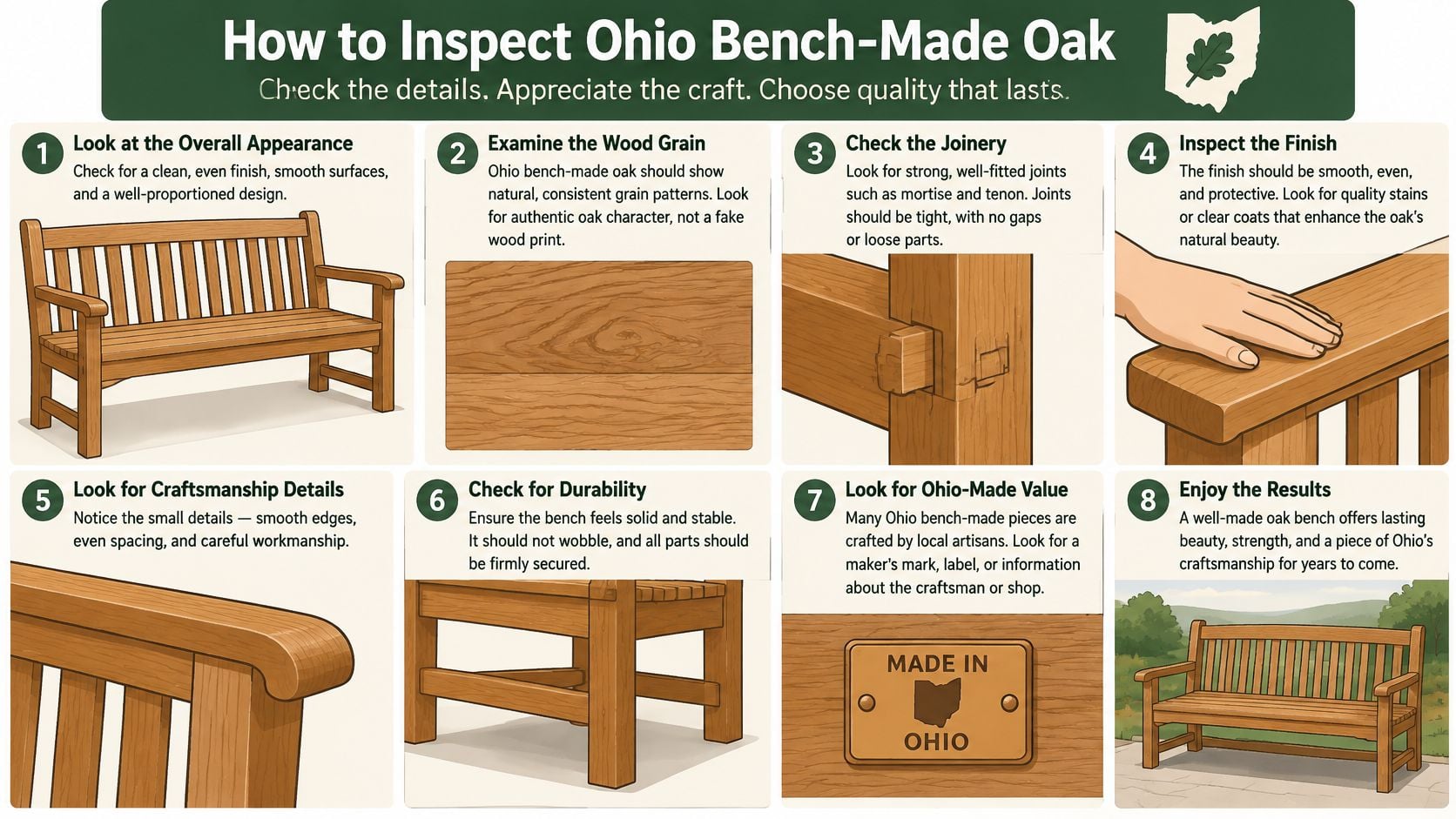
Eight checks, each with a reason
Sight down the top. Flatness and matched grain show whether the panel was glued from boards that belong together. A twist that shows only at eye level will show every time a platter of water sits on it.
Confirm the species through the parts. Top, leaves, and legs should be solid hardwood of the stated oak, or an intentional second species that is named. End grain on a leaf is the honest view.
Look under the apron. Buttons, figure-eights, or slotted holes are the movement hardware. Their absence on a wide solid panel is the question to ask out loud.
Rock a joint. A mortise-and-tenon or dowel that clicks at the leg isn't going to tighten itself after delivery.
Open the leaf once. Slides should travel without a jump, and the seam should land flush. Do it twice if the first pull felt lucky.
Ask what can be replaced. Leaves, legs, and hardware that can be ordered again are what make a later repair ordinary. A one-off slide with no source is a future dead end.
Ask whether the finish can be refinished. Spot repair for a ring, full refinish for a tired top. If the answer is neither, the surface is a wear item, not a keeper.
Check levelers and the path into the house. Feet that adjust save a floor that isn't perfect. Measure doorways, turns, and stairs against the closed top and the base, not against a wish.
The sit-test catches wobble, knee knock, and finish feel that photos hide. Keep home office and small decor out of this decision. The dining room is the point. A bedroom finish can be matched later if the same stain should continue down the hall. It shouldn't drive the table's joinery.
Sit-Test the Table at Easton Before You Order
A screen can't tell a buyer whether 36 inches behind a chair feels like a walkway or a squeeze. Vinson Fine Furniture, family-owned and formerly Kitchen Tables & More, is at Easton Town Center in Columbus. The showroom is built for that sit-test, and the In-Store Design Studio offers complimentary design consultations for space planning, finishes, and the seating that has to live with the table.
Bring the taped footprint, the everyday and holiday seat counts, and the species choice. Then work in order.
- Sit and pull a chair. Test the 36-inch clearance and the knee room under the apron on the actual base, not on a similar one.
- Open a leaf. Feel the slide and look at alignment in room light.
- Look under the apron for movement hardware before anyone talks about stain names.
- Ask for the finish name and whether a white ring or a worn edge can be repaired.
Preview the specification in the Custom Order Program visualizer, whether that is a Canadel dining top, a Mavin solid-hardwood piece, or top-grain and performance leather chairs. Vinson Fine Furniture offers custom bedroom and dining lines by Mavin and custom dining by Canadel, so the same appointment can keep a finish consistent without turning the visit into a tour of unrelated categories.
Price, clearance, and how the table gets home
The Low Price Guarantee refunds 110% of the difference if a local authorized dealer shows a lower price within 30 days. The Clearance Gallery lists floor samples and closeouts at savings up to 70%, which is the right place to look when a bench-made oak set is already on the floor and the footprint matches. Qualified buyers may use the Synchrony HOME Credit Card, often with no-interest plans. Financing doesn't change the joinery. It only changes when the table can move.
White-glove delivery includes a multi-point inspection, placement, assembly, packaging removal, and a check of route, level, and later service access. That last item matters for a heavy oak top. The crew should know the turn at the stair and which levelers the floor needs. Call (614) 476-5858 ext. 3 to set the Easton visit. Shoppers comparing handcrafted wood furniture near Columbus still need the chair under them before an order is real.
Order after three things are true. The footprint fits with chairs out. The joinery and finish can be repaired. The table has been sat at, not only viewed from the end of the aisle.
Vinson Fine Furniture builds the Easton visit around solid hardwood dining, including solid oak tops, custom finishes, and seating meant to stay in a Central Ohio house for decades. A complimentary Design Studio consultation is the practical way to check size, movement hardware, and a refinishable surface before anything is ordered. Plan a sit-test at Vinson Fine Furniture with the taped footprint in hand.