Solid Wood Dining Table for 10: Best Picks for 2026


A family in Columbus may want a dining room that can hold ten adults for holidays, milestone dinners, and long Sunday meals. The difficulty appears when the chairs are pulled out. A table that fits neatly on an empty floor can leave no room to pass, block a door swing, or turn the route between the kitchen and living room into a bottleneck.
A solid wood dining table for 10 has to be judged as part of the whole room, not as an isolated rectangle. Table length, tabletop width, chair dimensions, extension leaves, leg placement, and circulation all affect whether guests can sit comfortably. The right choice also depends on how the table is built, how its wood responds to humidity, and whether its finish and proportions suit the home for years to come.
Planning for Generous Gatherings
The desire for a large dining table often begins with a room that feels ready for a more generous life. A Columbus homeowner may see an underused dining area beside the kitchen and imagine ten place settings, serving bowls moving from hand to hand, and enough space for conversation. Then the practical test begins. Chairs occupy more floor area than their seat widths suggest, guests need room to stand, and someone still has to reach the patio, pantry, or powder room.
That tension makes the dining room a functional ecosystem. The tabletop is only the center of it. A successful layout accounts for the occupied chairs, the path behind seated diners, sideboards, door swings, lighting, and the direction in which people naturally move through an open-plan home.
A well-planned table can support a relaxed meal without making the room feel staged. The table should have enough visual weight to anchor the space, but its footprint shouldn't force every other piece of furniture into a narrow perimeter. A narrower top may preserve circulation, yet it can reduce elbow room and leave less space for serving dishes. A longer table may solve the seating problem while creating a traffic problem.
Practical rule: Measure the room while considering the chairs in use, not only the tabletop shown on a showroom floor.
The room matters as much as the table
The most useful first step is a temporary floor plan. Painter's tape can mark the tabletop, while additional tape marks the chair pull-out zone and the routes people use to enter, sit, serve, and leave. This simple test reveals problems that a product photograph can't show.
A rectangular table remains the most efficient shape for ten adults in many rooms because it offers two long seating sides and two ends. An oval can soften the visual mass and reduce sharp corners, but its curved ends may change where chairs sit. An extension table can provide a compact everyday footprint, although the extended configuration must be tested before purchase.
For a broader layout discussion, Columbus homeowners can use this guide to maximize dining space through table shapes and seating arrangements. The useful question isn't whether ten chairs technically fit. It's whether ten people can eat, converse, and move without turning the room into a series of obstacles.
Hosting is also a design decision
A generous gathering benefits from restraint. A table should leave enough visual breathing room for the food, glassware, chairs, and people to feel intentional rather than crowded. Guidance on a curated dinner from Lello Store's advice for entertaining with taste and restraint is useful here because the best dining experiences depend on preparation and flow, not just on adding more objects to the table.
In the Columbus and Easton Town Center area, a showroom sit-test adds information that measurements alone can't provide. Sitting in the actual chair, reaching toward the center of the table, and checking leg clearance exposes issues before a custom order is placed. The investment homeowner should treat that visit as part of the design process, not as a final formality.
Understanding Table Dimensions and Room Flow
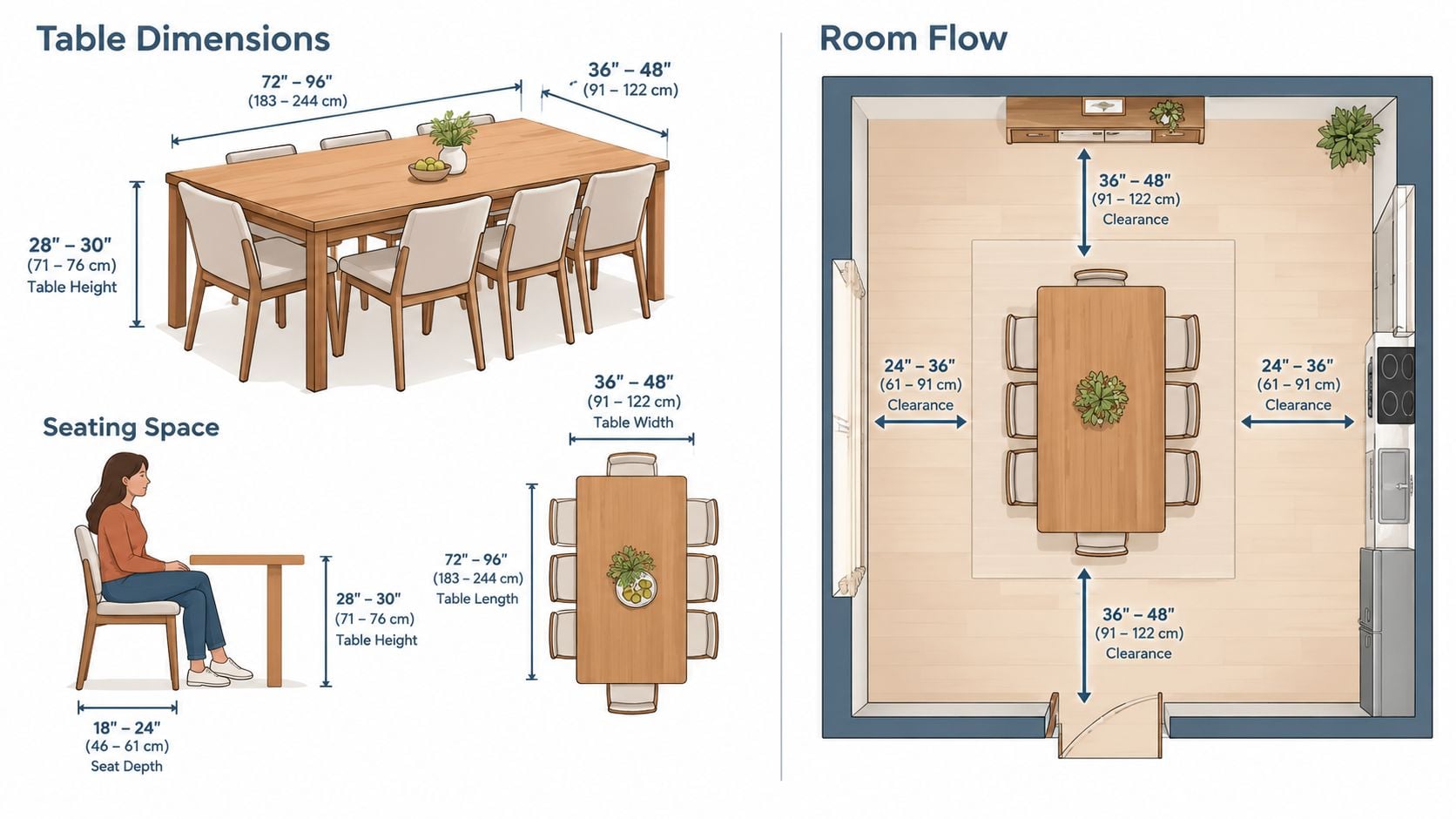
A ten-person table can fit on a plan and still fail in a real Columbus dining room. A rectangular design generally needs about 240 to 300 cm in length and 100 to 110 cm in width, according to this dining table size guide. Another accepted planning range is approximately 96 to 120 inches long and 40 to 48 inches wide, as outlined in dining room table dimensions for ten. Treat these figures as starting points. Chair width, armrests, apron depth, leg position, and the seating layout determine how much of that surface remains comfortable to use.
Allow roughly 60 cm, or 24 inches, of table edge per diner. That provides room for a place setting and ordinary elbow movement. A 240 cm table can seat ten efficiently, usually with four people along each long side and one at each end. A 300 cm table gives wider chairs, serving dishes, and long meals more breathing room. The difference is noticeable when guests are passing plates or standing up together.
Clearance turns a rectangle into a usable room
The tabletop is only part of the footprint. Allow approximately 90 cm, or 35 inches, of clearance between the table edge and walls or other furniture so chairs can move back and people can pass behind seated guests. A tighter clearance of around 36 inches may handle basic movement, while 42 to 48 inches feels more comfortable beside an active walkway. These ranges follow standard dimensional guidance for dining layouts.
Using the larger planning allowance, a 240 by 100 cm table needs roughly a 420 by 280 cm room envelope. A 300 by 100 cm table may require about 480 by 280 cm. Add space when a sideboard, doorway, kitchen route, or patio opening shares the room. In a Columbus home, circulation often matters more than the nominal table size. A route that looks acceptable on paper can become awkward once chairs, people, and serving dishes occupy it.
| Tabletop | Practical implication |
|---|---|
| 240 by 100 cm | Seats ten with efficient placement, but personal space is more compact. |
| 300 by 100 cm | Allows more generous spacing and room for serving pieces. |
| 96 inches long | Can work with compact seating, including two diners at each end. |
| 108 to 120 inches long | Better suited to larger chairs and relaxed entertaining. |
Measure the chairs, not the catalog promise
Chair dimensions are often the hidden constraint. An armchair, broad back, or thick upholstery can consume more lateral space than a simple armless chair. Measure the finished chair, then check that measurement against the table legs and apron. A claimed ten-seat capacity means little if a leg blocks a guest's knees or forces chairs into the walking path.
Mark nearby door swings and the sideboard footprint with tape. Test the route while carrying a tray or serving dish. A table can fit centrally yet obstruct a cabinet door or make someone turn sideways near a hot meal. Vinson's dining room table sizing guidance helps establish the dimensions, while a taped floor plan and an in-person sit-test reveal whether the design suits the particular Columbus home. Solid construction also affects placement, since a substantial hardwood table is difficult to shift after delivery. Test circulation before ordering, not after the piece arrives.
Selecting Heirloom Hardwood Species
Vinson's Hardwood Standard is direct. The collection centers on solid cherry, solid oak, solid maple, and solid walnut, rather than engineered wood products. For an investment homeowner, the distinction is tactile. A solid-hardwood top has a natural grain under the hand, a visible edge, and the potential to be repaired and refinished as the household changes.
The species should be selected for more than color. Grain direction, figure, surface character, and the way a finish interacts with the wood all influence the table's presence. The right choice depends on whether the room calls for quiet warmth, pronounced texture, pale clarity, or deep visual richness.
Four hardwood directions
Solid cherry begins with a warm, refined appearance and can develop a deeper tone over time. Its grain tends to support a calm, formal dining setting without becoming visually loud.
Solid oak offers a more pronounced grain character. It suits homeowners who want the table to read as substantial and established, particularly in rooms with traditional or relaxed architectural details.
Solid maple has a comparatively clean, restrained grain and a lighter visual presence. It works well when the table should feel bright and carefully finished rather than heavily rustic.
Solid walnut brings depth and contrast. Its darker appearance can anchor a large dining room, though the finish and surrounding upholstery should be chosen so the table doesn't overwhelm the space.
These species stay within a hardwood-only approach that excludes MDF, laminate, particle board, and other engineered materials. The relevant decision isn't just which wood looks attractive on a sample. It's how the species, finish, room light, chair upholstery, and table scale will work together after years of use.
Finish and ownership expectations
A dining table will encounter plates, serving bowls, homework, craft projects, and the occasional spill. A repairable solid-hardwood surface gives the owner more options than a surface that can't be renewed. That doesn't make the wood immune to marks. Coasters, sensible cleaning, and prompt attention to spills still matter.
Solid wood also moves with indoor humidity. The guide to choosing hardwood for longevity and style is useful for comparing visual character and ownership priorities before a finish is selected. The most successful result pairs a species with a finish that allows the grain to remain tactile rather than burying it beneath an artificial-looking surface.
Evaluating Joinery and Extension Mechanics
A large table experiences constant pressure every day. People lean on its edge, shift chairs against the apron, and sometimes use the top as a temporary work surface. Solid-hardwood construction and traditional joinery matter because the connections have to manage those repeated stresses without making the table feel loose or fragile.
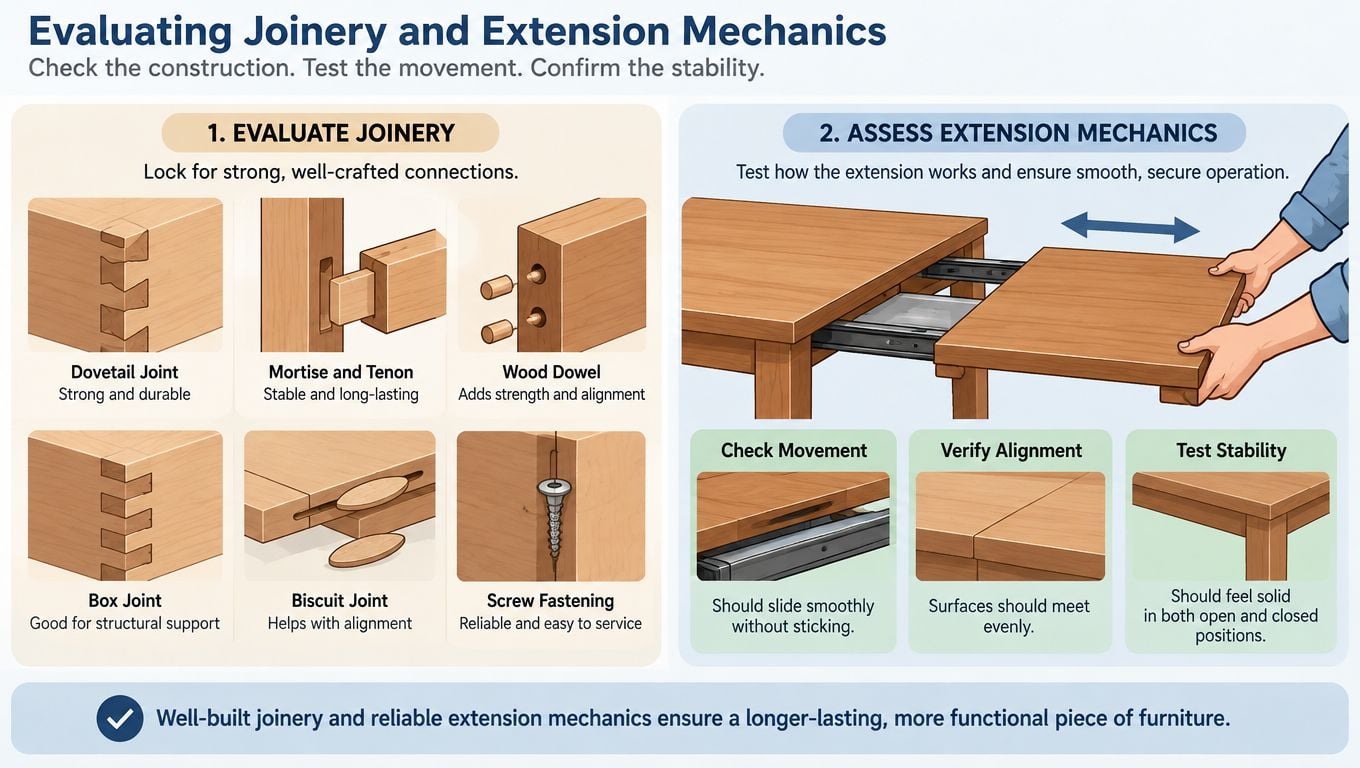
A mortise-and-tenon joint places a projecting tenon into a matching cavity. The connection can be reinforced with adhesive or pins, and its geometry distributes stress across the joint rather than depending on a single fastener. That construction principle is discussed in this guide to custom furniture durability and traditional joinery.
Compare the structure before admiring the finish
The table should be inspected from several angles. A buyer should look beneath the top, examine the apron, check the leg connections, and ask how the top is attached. Properly built solid wood must be allowed to expand and contract across its grain. The U.S. Forest Service furniture wood movement guidance explains that shrinkage begins below the fiber-saturation point, roughly 28 to 30% moisture content, and that typical green-to-oven-dry movement is approximately 0.1 to 0.2% longitudinally, 2 to 6% radially, and 7 to 12% tangentially.
Tangential movement presents the larger risk for a wide tabletop. Sound construction may use elongated screw holes, figure-eight fasteners, or tabletop clips that hold the top securely while permitting cross-grain movement. End-grain breadboard ends, when used, should also allow the central panel to move rather than being glued rigidly across the entire width.
The following checks are more useful than a decorative description:
- Joint integrity: Look for tight, aligned connections without unexplained gaps or rocking.
- Top attachment: Ask how the hardware allows seasonal cross-grain movement.
- Leg placement: Confirm that the legs won't interfere with end seating or chair knees.
- Surface preparation: Run a hand across the top and edges to find roughness, abrupt transitions, or finish flaws.
- Extension alignment: Check whether the leaves meet cleanly and whether the top remains stable when fully extended.
Extension leaves must work in both lives of the table
An extendable table can resolve the conflict between a comfortable daily footprint and occasional entertaining capacity. A single leaf commonly adds 40 to 50 cm, or 16 to 20 inches, often creating room for approximately two additional place settings. Larger double-leaf mechanisms can add about 1 metre, or 39 inches, potentially converting a six-person table into a ten-person table, as described in this extending dining table guide.
A representative progression is a 180 by 95 cm table seating six to eight people when closed and approximately 240 by 95 cm when extended for ten. The 60 cm increase corresponds closely to the planning allowance for added place settings, according to the same guide. The room must be tested in both configurations. A closed table may leave comfortable circulation while the extended version blocks a walkway.
A butterfly mechanism can simplify storage when the leaves fold within the table. Other designs store leaves beneath the top or separately. Each arrangement affects convenience, appearance, and long-term usability, so the buyer should operate the mechanism several times before ordering and confirm where the leaves live when they aren't needed.
For a closer look at construction options, review different wood joint methods and ask a design consultant to explain which connections suit the table's size and intended use.
Utilizing Digital Customization Tools
Customization is most useful when it removes uncertainty. A homeowner shouldn't have to approve a finish from a small sample while guessing how it will look across a long tabletop, beside upholstered chairs, or under the lighting in a Columbus dining room.
A 3D furniture configurator gives the design process a more concrete reference point. Shoppers can rotate and zoom the model, then change dimensions, finish, wood grain, fabric, or leather in real time. The material mapping updates the visual model as selections change, as explained by this overview of 3D furniture configurators.
Proportion should be settled before production
For a table intended to seat ten, customization may involve more than selecting a species. The homeowner may need to decide between a compact everyday length and an extended entertaining length, compare a narrower top with a wider one, or adjust leg style to preserve end seating. The visualizer helps the household see how those choices relate to the chairs and surrounding room.
Vinson's Custom Order Program supports selections for brands such as Smith Brothers, Canadel, and Mavin, with design consultants helping coordinate finishes, fabrics, and proportions. Smith Brothers of Berne is made in Indiana, Mavin is Amish-made in Ohio, and Canadel is handcrafted in Quebec. Together, these lines support a North American approach to furnishing the dining room, living room, and bedroom while preserving distinct regional identities.
The same process can extend beyond the table. Top-grain and performance leathers, upholstery colors, and premium motion options can be coordinated for nearby seating. Motorized reclining, swivel chairs, rockers, and gliders each change how the surrounding room functions, so the table shouldn't be chosen without considering how guests will sit before and after a meal.
A consultant catches the mismatch early
The In-Store Design Studio at the Easton Town Center showroom gives Columbus homeowners a place to compare wood tones, chair proportions, upholstery, and room layouts in person. Complimentary Design Consultations can add practical scrutiny to the digital preview, especially when the finished table will be paired with a sideboard, a large sectional, or a connected living area.
The useful goal isn't customization for its own sake. It's a dining room where the table scale, chair comfort, finish, and circulation agree with one another. A digital preview can't replace a physical sit-test, but it can expose a poor proportion before materials are ordered and production begins.
Ensuring Value and Safe Delivery
The value of a large dining table includes more than its listed price. It includes the quality of the hardwood, the joinery, the extension mechanism, the finish, the advice received before ordering, and the care taken when the piece enters the home. A heavy table that arrives with a damaged edge or gets forced through a doorway has not received the treatment its construction deserves.
White-glove delivery makes the final stage specific. The described Vinson process includes a multi-point inspection before delivery, careful in-home placement, assembly where required, and removal of packaging afterward. Those steps matter for a large solid-wood table because weight, narrow doorways, finished floors, and tight corners can all create handling risks.
The white-glove furniture delivery service should be understood as an installation process rather than curbside transportation. The delivery team needs to place the table where it can be inspected in its intended setting, confirm that the piece is stable, and leave the room clear of packing materials.
Value protection should have conditions
A price policy is useful when its terms are clear. Vinson's 110% Low Price Guarantee requires the lower price to be found at a local authorized dealer within 30 days. It isn't an unrestricted promise, and the qualifying conditions should be checked before purchase.
The calculation differs from an ordinary price match. If an eligible dealer advertises the same item for $2,000 while the customer paid $2,200, the difference is $200, and a 110% refund of that difference is $220, producing a net effective price of $1,980. Those figures illustrate the policy mechanics and are defined in the stated guarantee terms.
For shoppers prioritizing immediate availability, the Clearance Gallery includes floor samples, overstocks, and seasonal closeouts with savings of up to 70%. Clearance can be a practical route to a well-finished dining piece when the available dimensions, wood, and condition suit the room. The buyer still needs to inspect the surface, verify the seating plan, and confirm that the table's footprint works at home.
A solid-hardwood table becomes an heirloom through a chain of decisions. The wood must suit the room, the joints must support the load, the extension system must function smoothly, the top must be allowed to move naturally, and delivery must protect the finished piece. A showroom visit at Easton Town Center allows the homeowner to sit, measure, compare finishes, test mechanisms, and discuss the surrounding room before committing to a table for ten.
Columbus homeowners can visit Vinson Fine Furniture at Easton Town Center for a sit-test, complimentary design consultation, and guidance on a solid wood dining table for 10. The In-Store Design Studio, Custom Order Program, 110% Low Price Guarantee, Clearance Gallery, and white-glove delivery service provide practical support from room planning through safe installation.