White Glove Furniture Delivery: What It Is and Why It


You've chosen a solid hardwood dining table, a custom leather sectional, or a bedroom set intended to anchor your home for years. Delivery day arrives, but the crew leaves the furniture at the threshold, the assembly remains unfinished, and cardboard still covers the entryway. That isn't white glove furniture delivery. It's a premium promise broken at the point where accountability matters most.
True white glove service should carry the piece from the truck into the correct room, through unpacking and assembly, to a documented inspection and a clean handoff. For an investment-minded homeowner in Columbus, the question isn't whether delivery costs more. It's who owns the result when placement, installation, and cleanup don't happen together.
What White Glove Furniture Delivery Actually Includes
A homeowner orders a solid-maple dining table for a formal room. The expectation is straightforward: the table arrives safely, enters through the planned route, receives its final assembly, and sits exactly where the room requires it. No lifting team needs to be recruited, no foam needs to be hauled away, and no unfinished installation should remain for the homeowner.
White glove furniture delivery is an end-to-end service built around that finished-room outcome. The core sequence normally includes:
- Inside placement: The crew brings the furniture into the home rather than leaving it at the curb.
- Room-of-choice positioning: The piece goes into the designated room and is placed according to the homeowner's instructions and access conditions.
- Unpacking: Cardboard, foam, plastic wrap, corner protection, and related materials are removed from the furniture.
- Assembly or installation: Items that arrive in components, such as dining tables, bed frames, and modular sectionals, are assembled when the service agreement includes setup.
- Debris removal: The crew takes away delivery materials so the room is left with the furniture, not a second project.
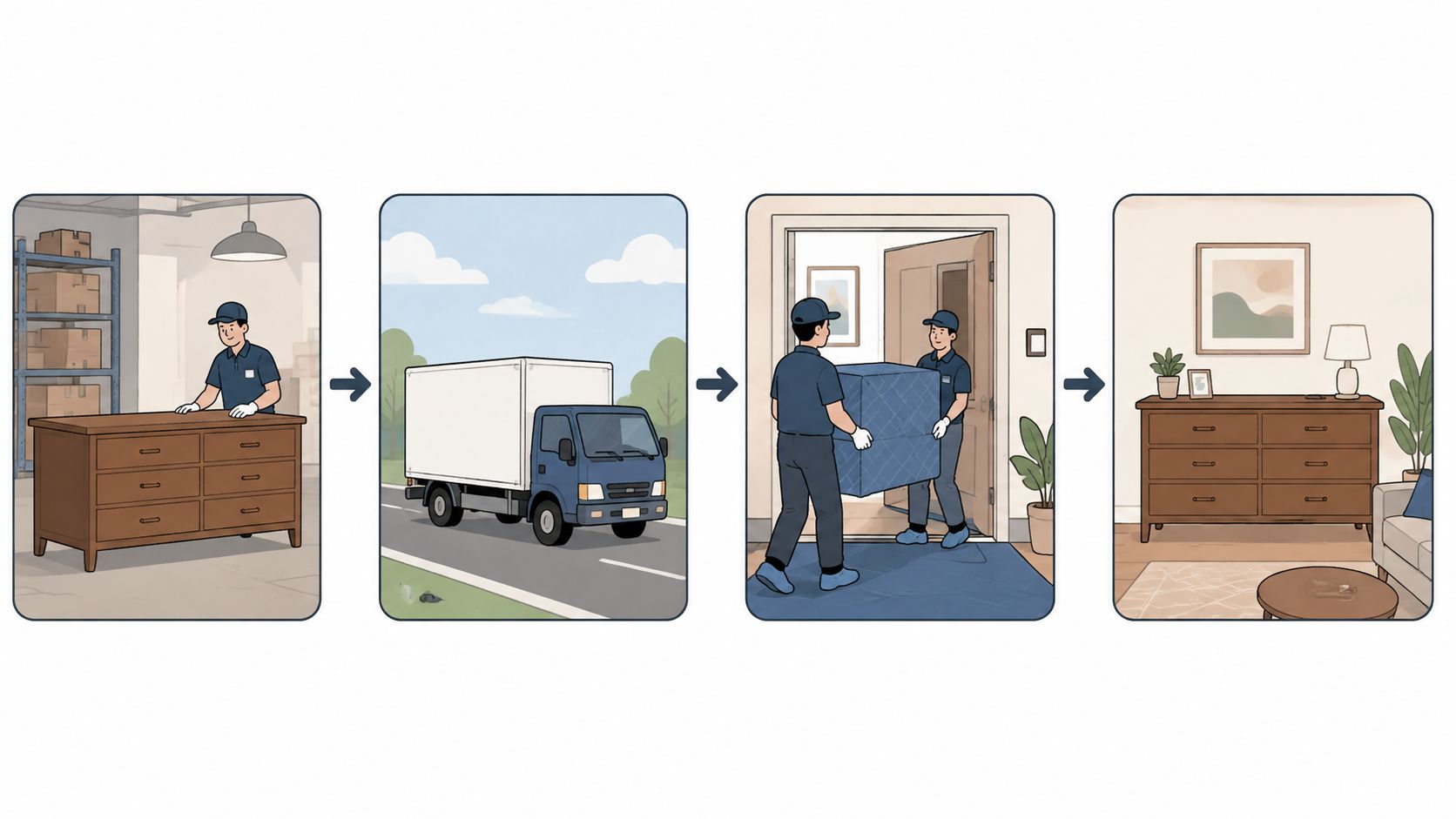
The exact scope still needs to be confirmed before purchase. Some providers define assembly narrowly, while others include complete setup for qualifying pieces. Packaging removal can also depend on the service agreement, so homeowners should ask whether the crew will remove cardboard, foam, plastic wrap, corner guards, pallets, and every other material associated with the delivery.
Practical rule: A white glove quote should describe the finished condition of the room, not just the arrival of the truck.
The same principle applies to other oversized household goods. Homeowners coordinating multiple moves can also browse furniture storage delivery options when timing, renovation work, or temporary storage affects the delivery plan. For mattresses and bedroom furnishings, the specific white glove mattress delivery service should likewise be reviewed for its placement and removal details.
White Glove Delivery Versus Curbside and Threshold Service
The service level changes the homeowner's responsibilities. Curbside delivery generally ends outside the home. Threshold delivery moves the item to an entry point or first accessible area. White glove delivery takes responsibility further, into the room and through the final setup.
| Service Feature | Curbside | Threshold | White Glove |
|---|---|---|---|
| Where the item is left | At the curb or exterior delivery point | At the threshold or first accessible area | Inside the home, in the room of choice |
| Unpacking | Usually handled by the homeowner | Usually handled by the homeowner | Included when defined in the service scope |
| Assembly | Homeowner responsibility | Homeowner responsibility unless separately arranged | Completed on site when included |
| Packaging debris | Left for the homeowner | Left for the homeowner | Removed according to the agreement |
| Damage exposure | More lifting and handling remains after drop-off | Some access work remains | A controlled handoff includes inspection and professional handling |
| Best fit | Small, easy-to-manage items | Accessible furniture with simple setup | Solid hardwood, large case goods, dining sets, and custom motion seating |
For a solid cherry dining table, the difference isn't cosmetic. Dense hardwood furniture can require careful maneuvering through doorways and tight turns, while a custom leather sectional may arrive in several pieces that need coordinated positioning. A standard drop-off can leave the homeowner managing the most physically demanding part of the purchase.
White glove service became especially important for high-value furniture because it combines transport with handling, placement, assembly support, and packaging removal. One industry summary reports that white glove deliveries reduce damage rates by 30% compared with standard shipping, and that the sector handled over 150 million specialized shipments globally by 2023. Furniture represented 49% of white glove services in 2023, equal to 74 million shipments requiring in-home assembly and placement, according to the same industry delivery overview.
Those figures clarify why the upgrade matters for an investment homeowner. The service isn't merely about avoiding a trip to the curb. It creates a more controlled handoff for furniture that carries substantial material, design, and replacement value. Homeowners comparing service terms should also review what assembled-on-delivery furniture service includes before finalizing an order.
The Vinson Fine Furniture White Glove Process
A reliable delivery process has a beginning, a controlled middle, and a documented finish. The crew should know what is arriving, how it must move through the home, and what condition the furniture is in before installation starts.
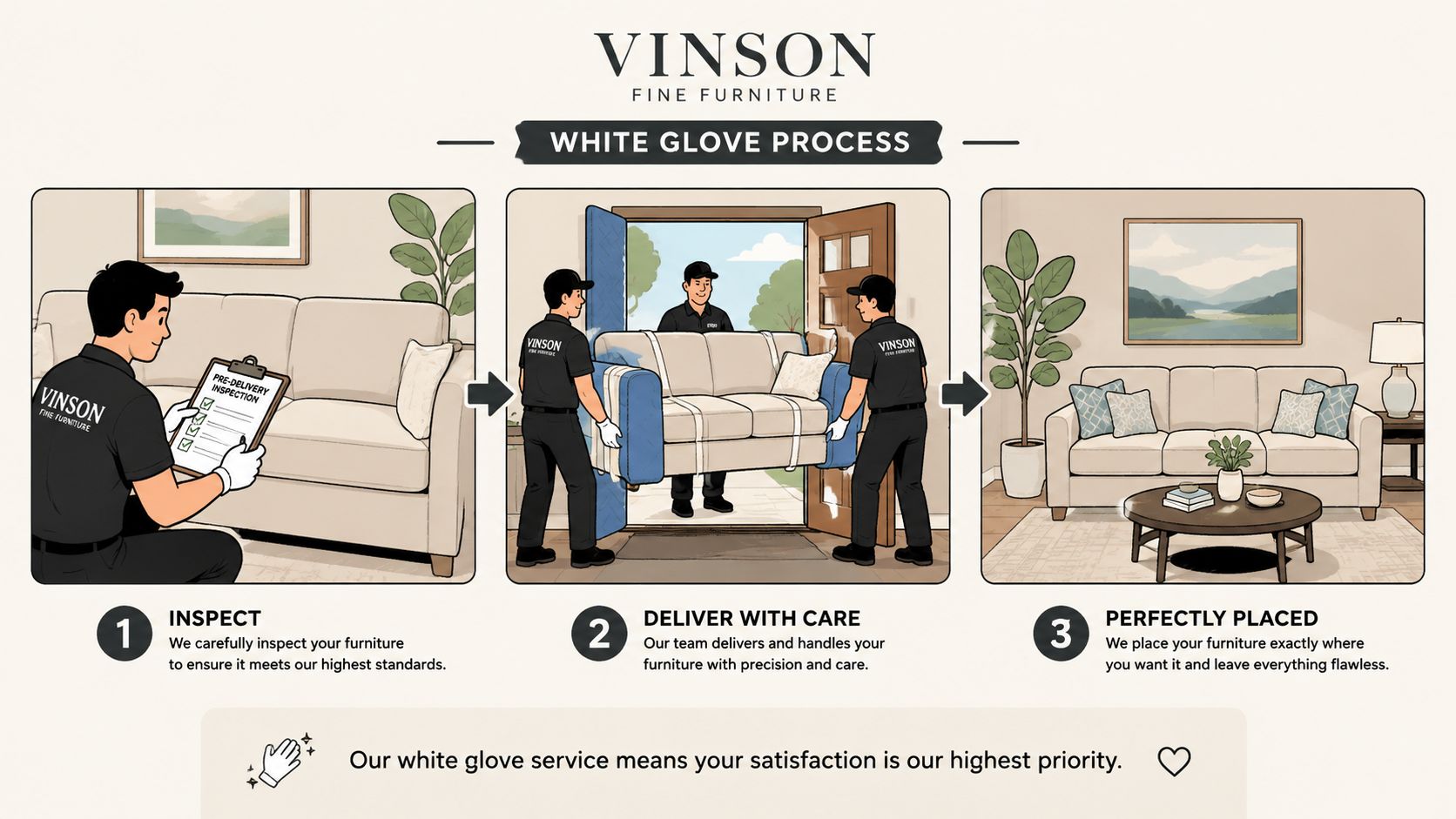
Inspection comes before installation
The first step is a multi-point inspection. The delivery team checks visible surfaces, corners, upholstery, finish areas, hardware, and major components before or during placement. Any visible exception should be recorded before assembly changes access to the piece.
That inspection protects both sides. It gives the homeowner a clear opportunity to identify a concern, and it gives the delivery team a defined record of the item's condition at handoff. This matters for a solid oak table, a walnut bedroom case, and a top-grain leather sectional because each surface responds differently to contact, pressure, and movement.
Placement follows the room plan
Once the item passes inspection, the crew moves it through the prepared route and places it in the room of choice. Placement requires more judgment than just putting furniture indoors. A sectional may need its chaise aligned with the room's circulation path, while a dining table must sit squarely in relation to lighting, chairs, and surrounding clearance.
Vinson's Columbus-area delivery workflow is designed around bringing furniture inside, placing it, assembling qualifying pieces, and clearing the delivery materials. Homeowners planning other complex moves can also review guidance on how to prepare your piano for moving because the same principles apply, clear access, careful route planning, and early communication about constraints.
Assembly and cleanup complete the handoff
Assembly should happen on site for pieces that arrive in multiple components. That can include dining tables, bed frames, and custom sectionals. The team should confirm that connections are secure, panels and legs are aligned, motion features operate correctly, and the furniture sits level before the appointment ends.
Cleanup is part of the service outcome, not a courtesy afterthought. Cardboard, foam, plastic wrap, corner guards, and pallet materials should leave with the crew when those materials fall within the agreed scope. Homeowners can review the Vinson delivery process before scheduling so the inspection, placement, assembly, and removal expectations are clear.
Typical Costs and What Drives the Price
White glove delivery pricing follows the physical demands of the item. A single chair has fewer components, fewer touchpoints, and less assembly than a bedroom set. A large case piece introduces more weight, more surface area, and greater access risk.
Typical industry guide ranges include:
| Furniture type | Typical white glove cost |
|---|---|
| Single chair or side table | $150 to $300 |
| Dining table | $250 to $500 |
| Large case piece | $300 to $600 |
| Bedroom set | $400 to $800 |
These ranges come from an industry guide to premium white glove shipping costs. They're planning references, not automatic quotes, because the final fee depends on the service scope, delivery route, item configuration, and distance.
Why larger orders cost more
A bedroom set can involve several separate pieces, multiple assembly stages, and a longer placement sequence. A dining table may require careful handling around corners, followed by leg or base installation. A motorized sectional adds component coordination and a need to verify that power and reclining functions remain accessible after placement.
Distance also matters. The same guide notes that distance surcharges are often added beyond 50 miles, so a home outside the immediate Columbus metro area may receive a different quote than a nearby Easton Town Center delivery. The reason is operational, not arbitrary. Longer routes consume more travel time and can require additional scheduling coordination.
Price should be judged against failure exposure
The sticker price is only one side of the decision. A failed delivery can create rescheduling work, damage disputes, unfinished assembly, and the need to arrange separate labor. For high-value solid hardwood furniture or premium leather seating, the homeowner should compare the delivery fee with the work and risk that remains if the service stops at the threshold.
Ask for the full scope in writing. A clear quote should identify room placement, assembly, inspection, debris removal, access limitations, and any distance-related charge.
Preparing Your Home for a Seamless Delivery Day
White glove crews can manage substantial furniture, but they can't make an oversized piece pass through an opening that's too narrow. Preparation starts with the route, not the furniture showroom.
Measure the complete path
Measure the front door, interior doors, hallways, staircases, elevator openings, ceiling height at turns, and the narrowest point along the route. Compare those measurements with the packaged dimensions, not only the assembled dimensions. A solid walnut bedroom case may fit the room comfortably yet fail at a stair landing because the packaging changes the turning radius.
The route should account for:
- Door swing: Confirm that the door can open far enough for the item and crew.
- Tight turns: Measure corners where a table, case piece, or sectional must rotate.
- Stair and railing clearance: Check both width and overhead clearance.
- Elevator rules: Confirm reservations, loading procedures, and building requirements.
- Floor protection: Move rugs and fragile objects away from the path.
Clear the room before the appointment
Remove small tables, lamps, artwork, and movable seating from the entry and destination room. If an existing sofa, bed, or dining set must leave, arrange that separately unless the delivery agreement specifically includes removal. The crew needs a clean working area to place, assemble, and inspect the new furniture.
Access advice: Send photos of narrow entries, staircases, low ceilings, and unusual turns before delivery day. A written description can miss the one obstruction that changes the entire plan.
Confirm the appointment details
Review the delivery window, building access, parking restrictions, elevator arrangements, and the person who must be present. Share the exact room of choice and identify any floor, doorway, or wall-protection concerns before the crew arrives.
A structured home-furnishing plan can help coordinate furniture dimensions, room priorities, and delivery timing. The 10-step home furnishing checklist offers a practical reference for organizing those decisions before a major purchase.
The Hidden Accountability Gap in Premium Delivery
The most important question is often left out of the sales conversation: who owns the problem when the delivery team can't finish the job?
A premium appointment may involve dispatch, a carrier, an installation crew, and a separate customer-service team. Each group can control one part of the experience, yet the homeowner experiences only one event. If the sectional arrives but the connecting pieces aren't installed, the customer doesn't have a partial success. The room remains unfinished.
The same problem appears when placement is completed but debris removal is excluded unexpectedly, or when a delivery crew identifies an access issue after arriving and sends the furniture back without a clear rescheduling owner. Premium fees create a reasonable expectation of one coordinated visit. Fragmented responsibility creates the opposite result, repeated explanations, unclear escalation, and uncertainty about who will correct the issue.
Ask ownership questions before booking
A homeowner should ask direct questions rather than accepting the label alone:
- Single point of responsibility: Which team owns the appointment from dispatch through final inspection?
- Incomplete assembly: If installation cannot be finished, who schedules and pays for the return visit?
- Damage documentation: Who records visible exceptions, and when must the homeowner report them?
- Placement limits: What happens if the requested room becomes inaccessible?
- Debris removal: Which materials leave with the crew, and which remain?
- Escalation path: Who handles a complaint after the delivery crew departs?
The delivery-and-installation handoff gap matters more as large-item online purchasing expands. A 2026 market source reports that UK large-item online sales rose 14.7% year over year in January 2026, while online retail share reached 28.2% in February 2026. Those figures are UK-specific and don't describe Columbus demand, but they illustrate the broader service pressure created when more large furniture purchases depend on precise final-mile execution. The underlying accountability issue is also discussed in recent white glove delivery handoff analysis.
A provider that can't explain ownership before the sale won't become clearer after a failed appointment. The strongest arrangement gives the homeowner one accountable retail contact and a written definition of what “complete” means.
Choosing a Trusted White Glove Provider in Central Ohio
Central Ohio homeowners should evaluate white glove delivery as part of the furniture purchase, not as a detachable shipping add-on. The provider should understand local access conditions, coordinate the appointment, inspect the furniture, complete the agreed setup, and remain reachable after placement.
Vinson Fine Furniture operates as a family-owned retailer serving Central Ohio from Easton Town Center, formerly under the name Kitchen Tables & More. Its service model connects showroom guidance with delivery logistics, which is useful when a custom order involves a specific finish, upholstery selection, motion configuration, or multi-piece room plan.
The retailer's broader offering includes:
- Solid hardwood furniture: The collection centers on solid cherry, oak, maple, and walnut construction.
- Custom Order Program: Homeowners can select fabrics and finishes and use 3D visualizers for lines such as Smith Brothers of Berne, Mavin, and Canadel.
- Design support: The In-Store Design Studio provides Complimentary Design Consultations for space planning, fabric coordination, and finish selection.
- Motion and leather seating: Options include top-grain and performance leathers, power sectionals, reclining seating, swivel chairs, rockers, and gliders.
- Value options: The Low Price Guarantee provides a 110% refund of the difference when its conditions are met, while the Clearance Gallery offers savings of up to 70%.
- Regional craftsmanship: Smith Brothers of Berne is made in Indiana, Mavin is Amish-made in Ohio, and Canadel is handcrafted in Quebec, Canada.
A local showroom also gives homeowners an advantage that online measurements can't provide. The sit-test reveals whether a sectional supports the body correctly, whether a rocker has the desired motion, and whether a leather finish feels appropriate for daily use. For a broader look at furniture stores in Columbus, Ohio, the same evaluation should apply: clear delivery terms, documented inspection, complete assembly, debris removal, and a real post-delivery contact.
Vinson Fine Furniture combines solid hardwood dining, living room, and bedroom furniture with custom ordering, an In-Store Design Studio, Complimentary Design Consultations, and coordinated white glove delivery in Central Ohio. Homeowners can visit Vinson Fine Furniture at Easton Town Center to sit-test premium motion and leather seating, review finishes and fabrics, and confirm exactly who owns the delivery from showroom selection through final placement.