
Wood Finishes Food Safe: Heirloom Furniture Protection

The loudest advice about food-safe wood finishes is usually the least useful. A label can sound reassuring and still tell a homeowner almost nothing about the finish's chemistry, its cure state, or whether the surface is fit for real kitchen use. The safer approach is simpler, check the formulation, confirm full cure, and match the finish to the way the piece will live in the home.
What Food Safe Really Means for Wood Finishes
A “food safe” label on a can of finish doesn't mean there's a universal government certification behind it. The U.S. FDA's approach is ingredient and condition based, tied to rules such as 21 CFR 175.300, not a simple stamp that says every consumer wood finish is approved for every kitchen task. Fine Woodworking's summary of that approach notes that approved ingredients often include common solvents, hardeners, driers, oils, and resins, and that finish safety depends on whether it has fully cured, with 30 days commonly used as a rule of thumb before food contact. Read the guidance on food-safe finish considerations
The label is not the test
That distinction matters because the term food-safe is often used as a marketing phrase, not a formal promise that a surface is ready for a cutting board, a serving tray, or a dining table. A finish can be marketed well and still need proper cure time before it belongs anywhere near food. The baseline is the combination of chemistry, film formation, and cure state.
Practical rule: a finish that smells like solvent or still feels soft should be treated as not ready.
A helpful consumer habit is to look for product disclosures and curing instructions instead of treating a single label as the whole answer. For people who want to spot greenwashing in products, the language around third-party testing can be a useful filter, especially when a finish sounds safer than its details support. spot greenwashing in products
Wood itself has a strong record
The wood substrate isn't the enemy here. A major research review of food-contact wood, based on 86 references, found that wood had not been found responsible for any food-borne outbreak and concluded that wood is suitable for direct food contact. That's a meaningful correction to the old assumption that wood is automatically less sanitary than plastic, stainless steel, or glass.
For homeowners, that means the issue is usually not whether a solid cherry board, oak table, maple butcher block, or walnut serving piece can ever touch food. The primary question is whether the finish has cured and whether the use case matches the coating.
Dry-to-touch is only the beginning. A surface can look finished and still be chemically active underneath, which is why cure time and use pattern matter more than the marketing phrase on the label.
Penetrating Oils Versus Film-Forming Coatings
Wood finishes used on food-contact surfaces fall into two technical families, and they behave very differently once they're in the home. Penetrating oils soak into the fibers, while film-forming coatings build a protective layer on top. The right choice depends less on preference and more on how hard the piece gets used.
How the two families perform
Penetrating oils, such as mineral oil and tung oil, are favored where a surface gets cut on, wiped down, or refreshed often. They don't build a brittle skin, so there's less risk of flaking. Film finishes, such as shellac or polyurethane, are chosen when the priority is wipeability, moisture resistance, and a harder surface that stands up better to everyday dining.
The tradeoff is straightforward. Oils are easier to renew, but they usually need more frequent upkeep. Film finishes are more durable once cured, but they require better prep and a more patient cure window before the surface should see food.
| Finish Type Performance Comparison | Finish Type | Cure Time | Water Resistance | Maintenance Level | Best Use Case |
|---|---|---|---|---|---|
| Penetrating Oil | Mineral oil | Immediate use after wiping excess | Moderate | Higher | Cutting boards, spoons, refreshable boards |
| Penetrating Oil | Tung oil | About 14 to 21 days | Excellent | Moderate | Serving pieces, bowls, moisture-prone items |
| Film-Forming Coating | Water-based polyurethane | Food-safe status only after full cure | Excellent | Lower once cured | Dining tables, islands, high-use surfaces |
| Film-Forming Coating | Shellac | Full cure required | Good | Moderate | Decorative food-contact surfaces, light-use pieces |
A practical comparison for a kitchen remodel can help. A homeowner planning a clean-lined surface may benefit from the visual continuity of a cured film finish, while a board that sees knives every day usually does better with an oil that can be refreshed without sanding the whole piece. For design inspiration tied to modern kitchen finishes, the planning ideas in North Colorado kitchen design show how finish selection often follows function, not just color.
Matching finish to the task
Cutting boards and butcher blocks are a different category from dining tables. A knife-friendly surface needs a finish that won't chip where blades contact it, which is why penetrating oils and oil-wax blends remain common there. Dining tables, by contrast, face spills, plate heat, and cleaning cloths, so a cured film can make more sense.
For a broader look at how finish appearance, repairability, and use case affect decision-making, Vinson's Natural Wood Finish guide aligns with the same basic principle, choose the finish for the job, not the slogan on the label.
Verifying Safety Through Proper Curing
A finish can feel dry long before it is ready for food contact. That difference is the heart of the safety question, because drying is mostly surface feel, while curing is the chemical process that leaves the coating stable enough for real use. A piece that still smells like finish or solvent should not be treated as ready.
What to check before food contact
The first checkpoint is time. Multiple woodworking guidance sources point to about 30 days as a conservative cure benchmark for many modern finishes before food use. That isn't a magic number for every product, but it's a practical baseline when the manufacturer's instructions point in the same direction.
After time, check the surface itself. A cured finish should no longer feel tacky, and the odor should be faint or gone. If a finish still gives off a strong smell, it's usually telling on itself.
If the finish still smells active, it's too early for food.
A simple water-drop test can also be useful on finished furniture, though it's not a substitute for manufacturer directions. If water beads cleanly, the surface is generally more sealed than one that immediately darkens or absorbs. If the finish softens, clouds, or prints under light contact, more time is needed.
The key caution is this, uncured solvent-based coatings can still release volatile components even when they look finished. That's why cosmetic dryness is not enough on a board, countertop, or serving surface that will touch food.
A practical cleanup checklist
A homeowner bringing home a custom dining table or butcher block can work through a short list:
- Confirm the finish type. Know whether it's an oil, wax blend, shellac, polyurethane, or another film.
- Read the cure guidance. Follow the product's full cure window, not just the recoat time.
- Check for odor. Strong smell usually means the coating isn't ready.
- Test lightly with water. Beads are a better sign than absorption.
- Use it for the right task. Occasional food contact is different from repeated knife work.
For a broader care baseline on preventing scratches and stains after cure, this furniture protection guide is a useful companion because safety and surface preservation usually rise or fall together.
Choosing the Right Finish for Your Furniture
The right finish depends on the piece in front of you, not on a label that sounds reassuring. A cutting board, a dining table, a serving tray, and a countertop all take different abuse, so the finish has to match the intended use. That is why the finish that works on a kitchen tool is often the wrong choice for heirloom furniture.
Use case first, finish second
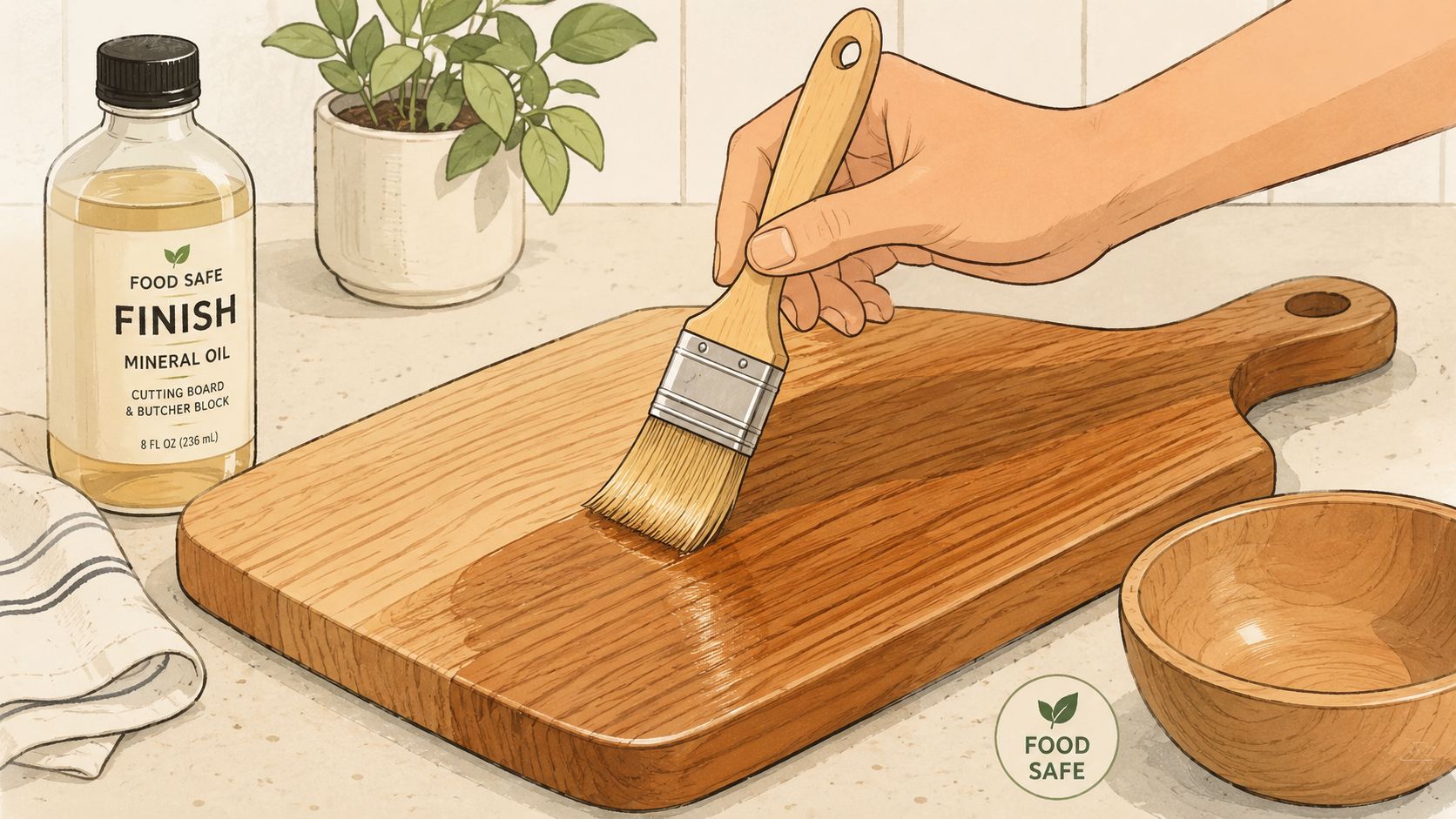
Mineral oil stays in the wood and is easy to renew, which makes it a practical match for cutting boards and utensils that get washed often. It does not build a hard shell, so it is not meant to do the job of a countertop coating. Beeswax and oil-wax blends add a softer protective layer, but that softness is also why they need reapplication.
Tung oil brings better water resistance once fully cured, which gives it an edge on serving pieces and some counters where moisture protection matters more than frequent knife contact. Polyurethane belongs in a different lane. It suits surfaces that need stronger cleanability and better wear resistance after cure, especially family dining tables that see spills, wiping, and daily traffic.
| Finish choice | Works well for | Tradeoff |
|---|---|---|
| Mineral oil | Cutting boards, spoons, charcuterie boards | Needs regular renewal |
| Beeswax blends | Light-use bowls, decorative serving pieces | Soft, less durable under heat and scrubbing |
| Tung oil | Bowls, tables, moisture-prone wood surfaces | Longer cure window |
| Cured polyurethane | Dining tables, islands, high-use furniture | Must cure fully before food contact |
For a broader look at how finish appearance, repairability, and use case affect the decision, Vinson's Natural Wood Finish guide follows the same basic principle.
That same logic applies to the wood species. Solid cherry, oak, maple, and walnut all take finishes well, but each species behaves a bit differently in color, pore structure, and daily wear. On American-made pieces from Smith Brothers and Mavin, or on North American-crafted dining pieces from Canadel, the finish choice should follow how the furniture will be used, cleaned, and lived with over time.
For homeowners comparing solid-wood dining options, Vinson's best solid wood dining tables page gives a good sense of how the substrate and finish strategy work together in real homes.
For a deeper look at stain and surface preparation decisions before finishing, Painters North Shore wood stain is a useful reference point because color work and topcoat choice often need to be planned together.
Maintenance and Revitalizing Your Wood Surfaces
Even the most appropriate finish won't stay food-ready forever without maintenance. On kitchen surfaces, the main enemy is repeated washing, abrasion, heat, and time. Good care keeps the finish both attractive and functional.
How to maintain different finish types
Penetrating oils are the easiest to refresh. A cutting board that starts looking dull or drinking in water needs another coat, and a piece used often may need attention on a routine schedule. The goal is to keep the wood hydrated enough that it doesn't dry out and split at the edges.
Film finishes need a different kind of care. They're not usually re-oiled, but they do need gentle cleaning so the surface doesn't wear through prematurely. Harsh scrubbers, soaking, and aggressive cleaners will shorten the life of the coating far faster than normal family use.
Clean gently, dry fully, and don't let water sit where the finish is already thin.
Heat deserves special caution. Hot food can soften some finishes, and hot pans are harder on wood than many expect. If a surface starts showing dull rings, light clouding, or rough spots, the finish may be telling the owner it needs attention before the damage becomes permanent.
Simple routines that protect the finish
- Wash with mild soap. Harsh detergents strip protective oils and can dull film finishes.
- Dry right away. Standing water is the fastest way to stress a wood surface.
- Re-oil when absorption returns. If water stops beading, the oil layer is fading.
- Keep utensils and boards out of the dishwasher. Heat and detergent are rough on wood.
- Avoid soaking. Long water exposure invites swelling and finish breakdown.
For owners who want a longer care roadmap, how to care for wood furniture gives a practical framework for preserving both appearance and finish performance.
Maintenance is the hidden difference between a piece that stays useful and one that starts looking tired too soon. On heirloom hardwood, a little routine care protects far more than appearance, it protects the finish's ability to keep doing its job.
Investing in Quality Solid Hardwood Furniture
Food-safe finish talk often misses the larger truth, the quality of the wood and the build matter just as much as the coating. A well-made solid hardwood table with a thoughtful finish will outlast a rushed piece with a marketing-friendly label every time. That's why serious buyers should start with the furniture, not the slogan.
Why the base material matters
Solid cherry, oak, maple, and walnut provide a stable foundation for furniture that needs to age well in a family home. They accept proper finishing, they can be maintained over time, and they don't rely on a surface skin to carry the whole structure. When joinery is sound and the finish is matched to the use case, the result is a surface that's both practical and elegant.
That's where the right showroom process matters. Vinson's In-Store Design Studio and Complimentary Design Consultations help homeowners think through finish choice, room use, and long-term care before a purchase is locked in. The Custom Order Program also gives buyers control over fabrics, finishes, and 3D visualizers on lines such as Smith Brothers, Canadel, and Mavin, which is useful when the finish needs to fit both the room and the way the family lives.
The buying experience matters too. Vinson's Low Price Guarantee includes a 110% refund, and the Clearance Gallery can offer savings up to 70% on select floor samples, overstocks, and closeouts. For homeowners balancing investment quality with value, that combination changes the conversation from chasing labels to choosing the right piece.
Choose the piece, then choose the finish
For shoppers comparing Smith Brothers furniture Easton, Mavin bedroom furniture, or Amish-made dining sets, the best next step is usually a sit-test and a real conversation about use. A dining room set that will host weekly dinners asks for a different finish strategy than a casual serving piece or a high-traffic table in a busy household.
White-Glove Delivery finishes the process cleanly, but the bigger advantage is decision quality before the truck ever arrives. The right finish on a properly built solid hardwood piece is what turns a purchase into a long-lived household fixture.
Vinson Fine Furniture helps Columbus homeowners choose solid hardwood pieces that fit real life, from dining tables and bedroom sets to custom seating with finishes selected for durability and everyday use. Visit Vinson Fine Furniture to explore the Easton showroom, compare finish options in person, and talk through a custom order that matches your home and your routine.