How to Choose Upholstery Fabric for Sofa: A Buyer’s Guide


A homeowner stands in a showroom holding two swatches that look almost identical. One costs noticeably more, carries a much higher rub count, and feels a little stiffer. The other feels right immediately, matches the rug at home, and comes with a cleaning code the household can live with. Choosing between them is where decisions about upholstery fabric for a sofa succeed or fail.
The wrong move is chasing the biggest number on the spec sheet. The right move is matching measurable abrasion resistance to the household's real failure risks, including sun, pets, reclining, body weight, and cleaning habits. A bench-made sofa is a long-term investment, and upholstery is the part touched every single day.
Match the Rub Count to How the Sofa Really Gets Used
A household with two children and a dog may use the same cushion for homework, naps, and evening lounging. A formal sitting room used occasionally has a different wear pattern. Start by matching the sofa's expected use to a sensible abrasion rating, then weigh whether the fabric can handle the household's other risks.
A Wyzenbeek double rub measures one complete back-and-forth pass of abrading material across fabric. As a practical guide, 3,000 to 9,000 double rubs, everyday living-room seating at 9,000 to 15,000, and heavy-use seating at 15,000 or more. For contract settings, the Association for Contract Textiles sets benchmarks of 15,000 for general contract and 30,000 for heavy-duty use. Household ratings help narrow options, while fabric durability guidance for everyday seating can help put those ranges in context.
Abrasion Rating by Household Profile
| Household profile | Wyzenbeek double rubs | Martindale cycles | How to read it |
|---|---|---|---|
| Occasional or formal sitting room | 3,000-9,000 | Lower-traffic only | Screening range. Hand and color can matter as much as the number |
| Everyday adult living room | 9,000-15,000 | 20,000 | ACT lower-traffic benchmark is 15,000 Wyzenbeek |
| Family with children or pets | 30,000+ | 30,000-40,000 | Heavy-duty range. Start here for a primary sofa |
| Daily reclining or motorized sectional | 30,000+ | 30,000-40,000 | Motion adds seam and cushion stress. Test the recline area |
| Above 100,000 double rubs | Not shown to add reliable life | No reliable added-life claim | Don't pay extra for the number alone |
For a primary family-room sofa used for snacks, homework, and nightly lounging, begin with the heavy-use range. A formal room or bedroom sitting area with lighter traffic may call for a lower rating. Daily reclining deserves extra attention at the seat and seams, where repeated motion puts stress on the construction.
Practical rule: Use the rub count to screen fabric options, then judge each sample against how the sofa will be used and cared for.
Higher ratings do not automatically make a better household choice. Results above 100,000 double rubs have not been shown to reliably indicate longer fabric life, so paying more for an extreme rating may mean choosing a stiffer, commercial-feeling fabric without gaining extra years at home.
Three questions can clarify the right range:
- Who uses the sofa daily: How many adults, children, and pets rely on it as a primary seat?
- How is it used: Does it recline each day, host naps, or mainly serve guests?
- How is it cleaned: Will the fabric face frequent spot cleaning, vacuuming, or pet-hair removal?
Bring those answers to the showroom and use them to narrow the swatches. A clear household profile makes it easier to compare practical options and discuss priorities before choosing a fabric.
Read the Test Method Before Trusting a Number
Two sofas both listed at 30,000 can still be different fabrics. One number may come from Wyzenbeek, the other from Martindale, and those figures aren't interchangeable.

Wyzenbeek, ASTM D4157, mounts fabric under controlled tension and rubs it with cotton duck in warp and filling directions, reporting double rubs. Martindale, ASTM D4966, rubs fabric in a figure-eight motion with worsted wool at specified pressure, reporting cycles until an objectionable appearance change occurs. The Association for Contract Textiles sets lower-traffic benchmarks at 15,000 Wyzenbeek double rubs or 20,000 Martindale cycles, and high-traffic benchmarks at 30,000 double rubs or 40,000 cycles.
The Four Step Spec Sheet Check
- Name the use profile: Identify occupants, pets, reclining frequency, and whether this is the primary seat.
- Ask for the method: Request the test method and specimen conditions, not just a marketing number.
- Compare within one method: Never convert Martindale to Wyzenbeek, since abradants, motions, pressures, and endpoints differ and no correlation exists between results.
- Inspect the cloth: Check weave, nap, and surface appearance under real light after the number checks out.
ASTM cautions that abrasion tests are most useful when performance differences are large. When two samples sit close together, don't treat a small gap as a precise lifespan prediction. Decide on feel, cleanability, and color instead.
Pick the Fiber and Weave for Daily Wear
A rub count can't describe softness, wrinkling, or how a spill behaves on a Sunday morning. Fiber and weave determine much of that daily experience.
Blends earn their place in family rooms because fiber blends can minimize shrinking or stretching and improve abrasion resistance, while a tightly woven, textured, or heathered surface conceals crumbs, pet hair, and minor wear better than a pale smooth solid. Natural fibers offer desirable hand and character, but they're not automatically the durable choice for a primary sofa.
Fiber and Weave Trade-offs for Sofa Upholstery
| Fiber or construction | Strength | Watch-out | Best fit |
|---|---|---|---|
| Solid cotton | Soft hand, breathable | Stains, wrinkles, can shrink | Formal sitting room |
| Cotton-polyester blend | Dimensionally stable, resists everyday abrasion | Less natural feel | Everyday family living room |
| Linen | Textured, airy character | Wrinkles and slubs easily | Calm, low-traffic room |
| Wool | Resilient. Natural crimp hides light wear | Higher investment. Cleaning code matters | Busy living room with a larger budget |
| Polyester or solution-dyed performance yarn | Resists fading and moisture | Can pill. Check the pilling rating | Sunny room, pets, frequent spills |
| Tight-weave or heathered surface (any fiber) | Hides crumbs, pet hair and minor wear | Pattern must suit the room | Households with pets or children |
Read the table from formal to family-proof. Solid cotton and linen suit calmer rooms where appearance matters more than recovery from daily friction. Blends, wool, and performance yarns suit sofas that can't take a day off.
Weave deserves equal attention, since construction changes both texture and snag risk. Shoppers comparing plain, twill, and pile constructions can compare fabric weave types before narrowing samples. Then examine a performance fabric sectional option alongside top-grain and performance leather, so both are judged by touch and sit-test rather than by labels alone.
Check Cleaning Codes and Stain Treatments Before You Order
A spill on a sofa is only manageable if the fabric's care instructions match the cleaners you can use. Performance fabric is not a cleaning specification. Check the code on the tag or spec sheet before ordering, then compare it with the stain products you keep at home.
Cleaning Codes Explained
| Code | Cleaning method allowed | Best for |
|---|---|---|
| W | Water-based cleaners | Households that spot-clean spills with water |
| S | Solvent-based cleaners only | Households comfortable with solvent cleaning. Avoid for water spots |
| WS | Water-based or solvent cleaners | Mixed cleaning habits and the most flexibility |
| X | Vacuuming or professional cleaning only | Formal rooms with little spill risk |
W allows water-based cleaners, S requires solvents, WS allows either, and X generally limits care to vacuuming or professional cleaning. If you reach for a damp cloth after a spill, choose W or WS. An X fabric requires vacuuming or professional cleaning, which may be an impractical fit for a sofa used every day.
Stain resistance can come from the fiber itself, a topical finish, or another treatment. Those options may differ in how they respond to cleaning, so ask what gives the fabric its resistance and which products the manufacturer permits. Do not assume a stain-resistant label means every cleaner is safe.
PFAS have been used in some stain- and water-resistant treatments. Before you commit, request a written statement on restricted substances, whether PFAS are intentionally added, and the approved cleaning products. Without a specific manufacturer disclosure or regulation to cite, avoid assuming that a treatment is PFAS-free or that one option is safer. Weigh care requirements and chemical disclosure alongside how long you expect to keep the sofa.
Check the manufacturer's instructions against upholstery stain removal guidance by cleaning code before ordering. At the Clearance Gallery, ask staff to confirm the care code on any floor sample or closeout. A lower price is less useful if the fabric cannot be cleaned with the methods your household will use.
Match the Fabric to Pets, Sunlight and Daily Lounging
A west-facing window can fade a bold sofa, while a dog's claws can snag a loose weave. Reclining every evening puts repeated pressure on seams and cushions. Choose fabric around the household's likely wear, not just its rub count.
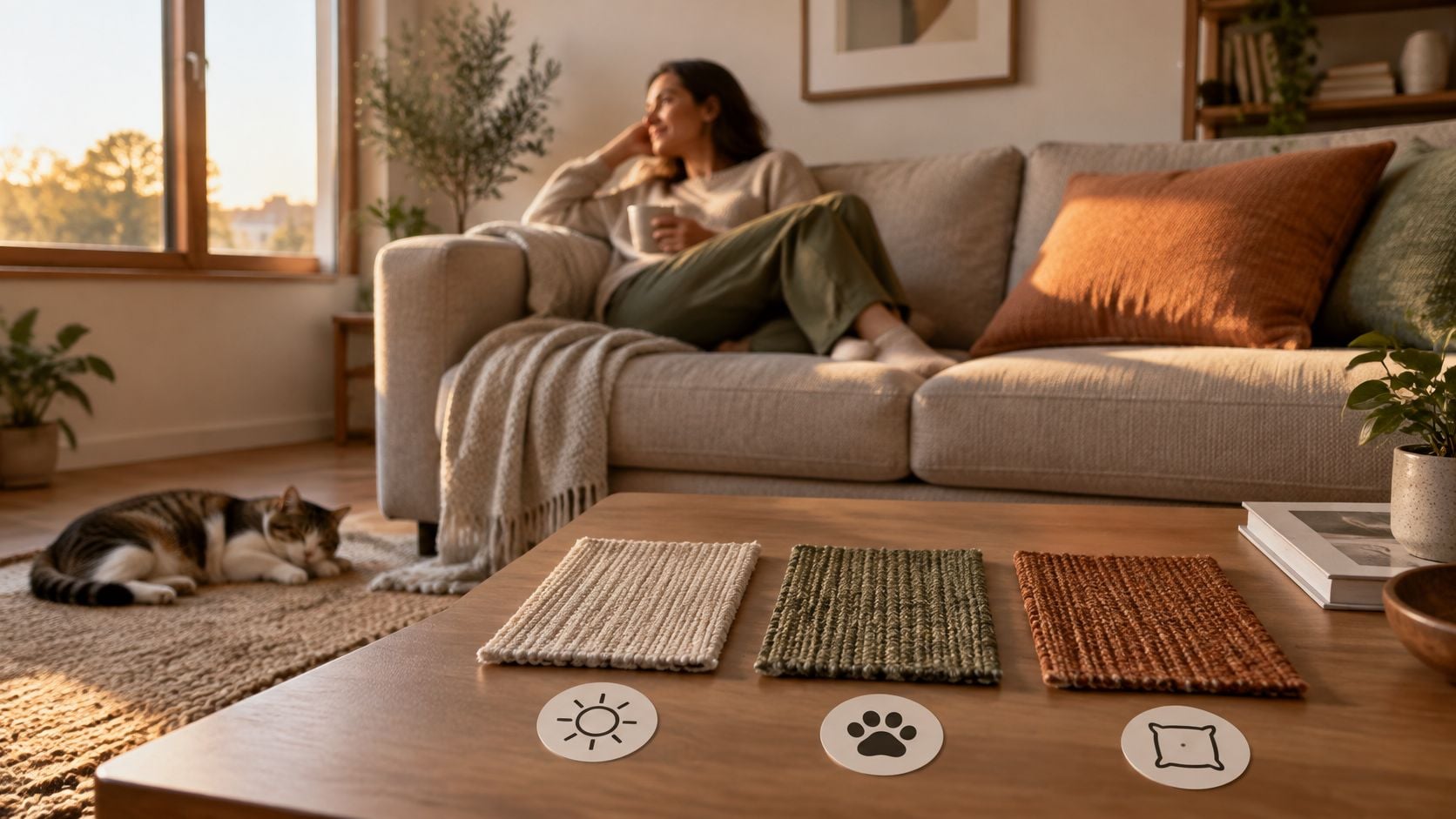
Household Stress and the Fabric Feature to Request
| Household stress | Fabric feature to ask for | Spec sheet item to request |
|---|---|---|
| Direct sun or west-facing window | Fade resistance | Lightfastness rating |
| Dogs or cats with claws | Tight weave and snag resistance | Pilling and snag results |
| Daily lounging or power recliner | Resilient seam and cushion construction | Seam strength and cushion design details |
| Young children and frequent spills | Heathered or patterned surface with a suitable cleaning code | Cleaning code and stain-treatment limits |
| Formal, low-traffic room | Hand, texture and color | Rub count for occasional use (3,000-9,000 Wyzenbeek) |
Start with the room's two biggest risks. Match each to a fabric feature, then ask for the corresponding test result and warranty exclusions. For a sunny room, check lightfastness; for pets, ask about snag resistance; for a recliner, examine seam and cushion specifications.
Pet owners should favor tight construction and review pet-friendly furniture fabrics for hair and claw resistance before choosing a loose weave. Smooth, tightly woven surfaces can release hair more readily, as explained in this guide to choosing microfiber for pet hair. Consider how often the sofa will be cleaned, too, and confirm that the fabric's care instructions suit the products used at home.
A stable frame supports the cushions and motion mechanism through daily lounging. Ask about frame construction alongside upholstery specifications, especially for a sofa used every day. The sofa fabric guide also outlines household wear factors to consider when comparing options.
Coordinate Color, Pattern and Texture With the Room
Color judged under showroom lighting can shift at home. A warm lamp pushes gray toward beige, while morning daylight can cool the same swatch noticeably. Carry samples home and view them near the window and under evening lighting before ordering.
Run a hand across velvet and other pile fabrics to check directional shading, crushed pile, and raised areas that may show wear. Two fabrics with similar abrasion numbers can age differently in appearance. Martindale testing ends at an objectionable appearance change, and Wyzenbeek evaluation can record color loss and visible wear, so surface character belongs in the durability conversation.
A mid-tone heather hides an ordinary week. A pale solid documents it.
Pattern works as practical camouflage. Small woven designs and heathered surfaces disguise crumbs, pet hair, and minor marks better than uniform light cloth. Reserve smooth pale solids for formal rooms where the surface stays clean and traffic stays low.
Match the sofa to the room's fixed anchors next. Solid cherry, oak, maple, or walnut in a coffee table, dining table, or frame sets a warm or cool undertone the fabric should echo rather than fight. Test two or three candidates against the rug and the paint color planned for the next decade. Reviewing sofa color selection against wood tones and lighting helps keep those choices coordinated.
Keep the large sofa comparatively neutral. Push bolder personality into pillows and rugs, where replacement is simpler and the room can evolve without replacing its main investment piece.
Confirm Your Fabric With a Sit-Test at Easton
A fabric can meet the spec and still feel wrong on your sofa. At the Easton Town Center showroom, test the actual seat, arms, and reclining positions before deciding. Comfort and cushion response are hard to judge from a swatch or a rub count.
Bring the shortlisted fabric names, then sit in the positions you use at home. Try the armrest and seat, and test swivel, rocker, glider, or power-reclining motion if those features matter. For custom pieces, check the available visualizers in the Custom Order Program for Smith Brothers of Berne, Canadel, and Mavin.

Ask the showroom to confirm each candidate's test method, cleaning code, lightfastness, pilling rating, and warranty exclusions. These details help you compare fabrics against the conditions that matter in your home, rather than choosing by the highest rub count alone.
Check the Clearance Gallery and Low Price Guarantee for the applicable terms on floor samples, closeouts, and price adjustments. Ask about White-Glove Delivery if you want the selected piece placed at home.
Set aside time for the consultation and sit-test; contact the showroom to confirm appointment availability and how long to allow. Then make the final choice based on how the fabric feels and fits your home's daily use.