Furniture Fabric Durability: A Practical Guide

The most popular advice about furniture fabric durability is also the least useful: choose the sofa with the highest double-rub number. A large abrasion score can tell a buyer something about repeated rubbing, but it can't predict whether pet claws will catch the weave, sunlight will fade the color, or a neglected spill will permanently mark the cushion.
A better purchase question is direct: durable against what? Homes fail upholstery in different ways. Pets create claws and hair, children create spills and ground-in grime, bright rooms create fading, and formal rooms may barely challenge the fabric at all. The right upholstery matches the dominant threat, the way a solid-maple dining table matches a household that expects years of daily meals rather than occasional display.
Why a Single Abrasion Score Does Not Tell You How Long Your Sofa Will Last
A rub-test number measures one specific action, back-and-forth friction across a fabric surface. It doesn't measure every force that acts on a sofa. A cushion can lose its visual appeal long before the yarns wear through, especially when a household exposes it to claws, grit, body oils, sunlight, moisture, or repeated cleaning.
A 50,000 double-rub rating isn't a lifetime guarantee. It may indicate strong abrasion performance, but it says little about stain release, UV stability, seam slippage, pilling, or how the fabric feels after years of maintenance. The North American reference point remains the Wyzenbeek test, with practical thresholds commonly interpreted as 15,000 double rubs for low-traffic or private residential spaces, 30,000 for high-traffic public spaces, and 50,000 for coated upholstery in high-traffic settings. These benchmarks are explained in Schumacher's guide to fabric abrasion.
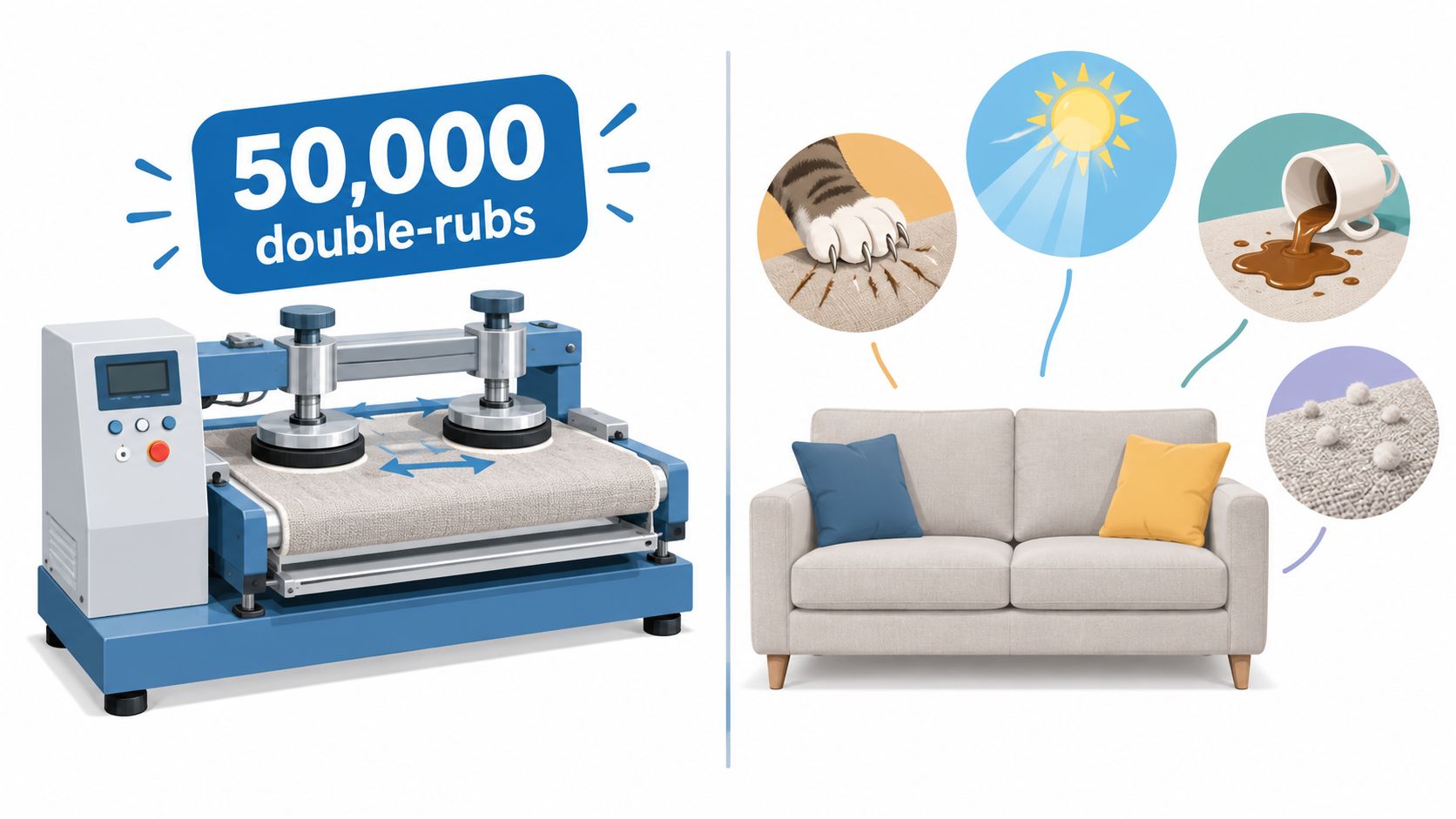
The failure mode matters more than the headline number
Pet claws can pull a loose weave even when the surface resists ordinary rubbing. Pet hair can also settle into textured upholstery, making a fabric look tired and creating a maintenance burden that a lab rating never captures. In a family room, a drink spill may matter more than the difference between two high abrasion scores.
Sun exposure creates another separate problem. Solution-dyed acrylic is commonly positioned for sun and fading resistance, with an estimated 8 to 15 year service life and 5,000 to 10,000 hours of UV exposure in the cited industry guidance, while olefin, polypropylene, and solution-dyed polyester are positioned more strongly for moisture and mildew resistance. High-abrasion knits and engineered jacquards can reach up to 60,000 Wyzenbeek cycles, but that doesn't make them the automatic choice for a bright sunroom. See the failure-mode discussion in furniture standards and materials guidance.
Practical rule: A fabric should be selected for the problem most likely to damage it, not for the biggest number printed on a sample card.
The frame matters, too. Upholstery can remain attractive while a poorly supported frame develops movement, noise, or loosened joints. Vinson's furniture philosophy keeps the conversation centered on solid hardwood construction, including solid cherry, oak, maple, and walnut, because the seating surface and the structure underneath should both suit a long-term purchase.
How Upholstery Durability Is Actually Measured
Three terms appear repeatedly on upholstery specifications: Wyzenbeek double rubs, Martindale cycles, and ACT performance guidelines. Buyers don't need to become textile engineers, but they do need to know which number they're reading and what that number leaves out.
Wyzenbeek is the dominant reference in North America, including the United States and Canada. A fabric is rubbed back and forth against a specified material, and one back-and-forth motion counts as a double rub. Industry guidance commonly treats about 15,000 double rubs as suitable for general domestic use and 30,000 or more as heavy-use or commercial-grade performance, as described in this Wyzenbeek and Martindale overview.
Martindale is widely used in Europe and many global markets. Its rubbing motion differs, so its cycle counts usually look higher for a similar real-world level of performance. Common guidance places 15,000 to 25,000 Martindale cycles in general domestic use, 25,000 to 30,000 in heavy domestic use, and 30,000 or more in commercial-grade use. Kvadrat's upholstery performance guide explains why the systems shouldn't be treated as interchangeable without context.
The practical comparison
The ACT voluntary guidelines provide a useful cross-standard reference for woven upholstery. They map 15,000 Wyzenbeek double rubs to 20,000 Martindale cycles, and 30,000 Wyzenbeek double rubs to 40,000 Martindale cycles, according to the ACT abrasion guidelines.
| Use Case | Wyzenbeek, Double Rubs | Martindale, Cycles | What It Means |
|---|---|---|---|
| Light or private residential use | 15,000 | 20,000 | Appropriate for decorative seating or lighter household traffic |
| Heavy domestic use | 30,000+ | 30,000 to 40,000+ | A sensible target for busy family rooms and regular seating |
| Commercial-grade use | 50,000+ | 30,000+ | Built for demanding environments, often more than a typical home needs |
A separate industry classification lists 3,000 to 9,000 double rubs for light duty, 9,000 to 15,000 for medium duty, 15,000 to 30,000 for heavy duty, and 30,000 or more for extra-heavy-duty settings such as hotels and airports. Those categories appear in this upholstery fabric durability guide.
What the score doesn't measure
Abrasion testing doesn't tell a buyer whether a fabric resists stains, holds color in direct sunlight, sheds pet hair, pills, or keeps its seams intact. It also doesn't explain how a coating responds to repeated cleaning. A specification is useful only when the consultant identifies the test standard and then discusses the other risks separately.
Leather vs Performance Fabric vs Natural Fibers
No material family wins every durability category. Top-grain leather offers a substantial hand, develops character, and makes scratches visible rather than hiding them. Performance fabric usually handles spills and routine cleaning more comfortably, while natural fibers bring breathability and visual softness that synthetic constructions rarely duplicate.
The comparison below is a buying framework, not a universal ranking.
| Factor | Top-Grain Leather | Performance Fabric | Natural Fibers |
|---|---|---|---|
| Abrasion | Strong, with surface character developing over time | Varies by weave and rating, with many options suited to active rooms | Varies widely, often lower unless tightly woven or treated |
| Stain resistance | Spills can often be wiped promptly, but finishes differ | Usually the strongest choice for routine household spills | More vulnerable unless treated and carefully maintained |
| UV behavior | Can fade or dry in strong light without suitable protection | Solution-dyed constructions are better suited to bright rooms | Untreated cotton and linen are more vulnerable to fading |
| Cleanability | Wipe care and approved conditioning are important | Cleaning code and manufacturer instructions control the process | Often requires more cautious spot treatment |
| Visual character | Rich, tactile, and capable of patina | Broad range of textures, colors, and performance finishes | Natural, breathable, and refined |
Choosing by household priority
Pet and kid households generally benefit from a tight-woven performance fabric or protected leather. Performance fabric is often the more forgiving option for spills, while leather can suit a household that prefers wipeable surfaces and accepts visible scratches as part of the material's character.
Formal living rooms with light use can carry treated linen, velvet, or another natural-fiber construction when the homeowner accepts a more deliberate care routine. Coastal or sun-exposed rooms call for solution-dyed acrylics or leather with appropriate UV protection. The fabric's environment matters more than its marketing label.
Microfiber deserves a candid assessment. It can resist stains effectively, but it may also hold lint and pet hair, which increases upkeep. A textured performance fabric can perform well against spills but still frustrate a household that dislikes vacuuming. For guidance on addressing visible surface damage, Evo Dyne Products scratch fix advice offers a useful maintenance resource.
For a fuller look at upholstery categories before visiting a showroom, homeowners can review this guide to upholstery materials. The final choice should reflect the room's light, traffic, pets, cleaning habits, and desired feel, not just a swatch's label.
Real-World Lifespan by Household Scenario
A lifespan estimate only becomes useful after the household identifies what will attack the upholstery. Abrasion, stains, claws, sunlight, and maintenance habits create different replacement timelines, even when two sofas carry similar lab ratings.
| Scenario | Dominant Threat | Best Fabric Families | Realistic Lifespan |
|---|---|---|---|
| Pet household | Claws, hair, and repeated contact | Tight-woven performance fabrics or protected leather | Qualitatively longer than loose-weave natural fabrics when maintained consistently |
| Family with young children | Spills, grime, and frequent cleaning | Treated performance blends and removable washable covers | A durable option can remain serviceable through sustained family use with disciplined care |
| Sunroom or south-facing seating | Fading and heat exposure | Solution-dyed acrylics or pigmented leather with UV protection | Better suited to the setting than untreated cotton |
| Formal living room | Limited traffic and occasional use | Linen, velvet, and refined natural fibers | Can remain attractive for many years when protected from heavy daily wear |
The common mistake is buying for an imagined household rather than the actual one. A quiet sitting room doesn't need contract-grade abrasion performance, while a family sectional near the kitchen deserves more than a delicate loose weave because the color is attractive.
Pets require a surface and a maintenance plan
Claws punish open textures. Hair also makes raised weaves look dirty between cleanings, so the best choice combines a tight construction with a care routine the household will follow. A protected leather surface can work well for some pets, but scratch visibility should be considered before purchase.
The Vinson guide to pet-friendly furniture fabrics helps frame the decision around real household behavior. A fabric that looks beautiful in a sample can be the wrong choice if daily lint removal becomes an annoyance.
Sun and children create different tests
Bright rooms need color stability, not merely abrasion resistance. Families need stain recovery and cleaning compatibility, not merely a high rub count. Those distinctions are why the same upholstery recommendation shouldn't be copied from a formal room into a breakfast nook or a busy open-plan family room.
In-Store Testing Tips and Questions for Your Design Consultant
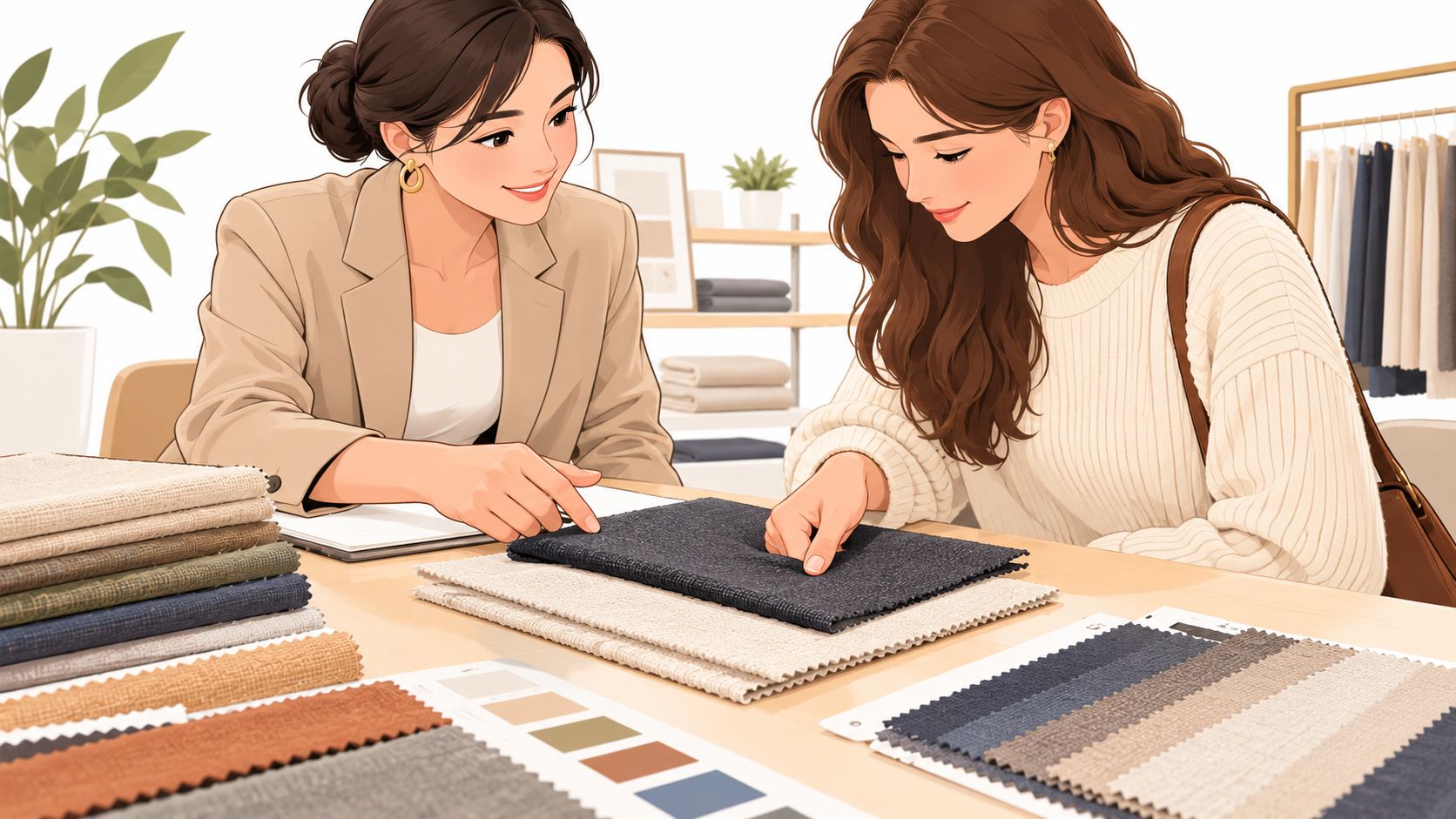
A showroom visit should function as a sit-test and material inspection, not a quick color decision. The floor model reveals support, depth, motion, and cushion behavior that photographs can't show. A swatch reveals texture, scale, and color shifts that a small online image can't communicate.
Start with the fabric in hand:
- Feel the weave: Run a thumbnail across the surface and look for a construction that feels compact rather than loose.
- Check color transfer: Press a dark cloth against a light swatch and ask the consultant about crocking performance.
- Study the light: Hold the sample near a window, then compare it with the room's flooring and solid hardwood finishes.
- Test the posture: Sit sideways, place feet up, and use the sofa as the household will use it.
- Inspect motion seating: Try power reclining, swivel chairs, rockers, and gliders for noise, clearance, and comfort.
Questions that deserve documented answers
A design consultant should be able to identify the abrasion test standard, not just repeat a number. The buyer should ask whether the fabric is treated or solution-dyed, whether protection remains after approved cleaning, which cleaning code applies, and what actions void the warranty.
The sofa buying guide provides useful preparation before a visit. At the Easton Town Center showroom, the In-Store Design Studio brings fabric review, room planning, and furniture testing into one conversation.
A serious evaluation also includes the structure beneath the upholstery. Ask about solid cherry, oak, maple, or walnut construction, joinery, cushion fill, and the available leather or performance-fabric specifications. For larger rooms, test sectionals and motorized power motion pieces in the exact configuration under consideration.
Maintenance Habits That Extend Fabric Life
Good upholstery care starts with removing abrasive grit before it works into the weave. Routine maintenance prevents more damage than aggressive rescue cleaning, and the wrong rescue method can create a permanent mark where a prompt, gentle response would have worked.
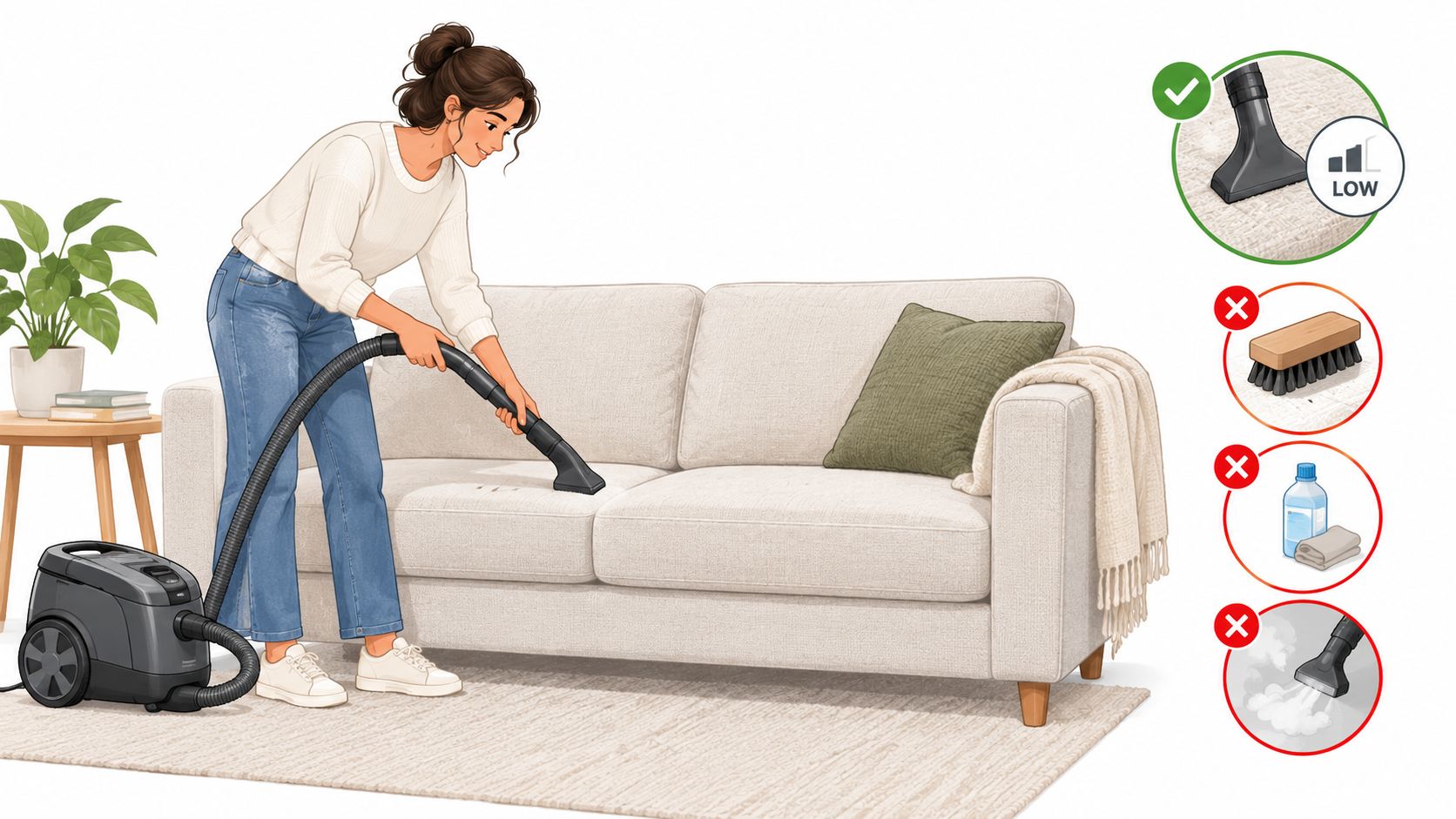
Vacuum weekly with an upholstery attachment at low suction. Rotate and flip reversible cushions every few months so one seat doesn't carry all the household's weight. Blot spills immediately, never scrub them across the surface, and don't saturate the cushion core.
Match the cleaner to the upholstery
The manufacturer's cleaning code controls the next step. Water-based and solvent-based cleaners aren't interchangeable, and an unapproved product can strip protection or affect warranty coverage. A homeowner should test any approved cleaner in an inconspicuous area and follow the fabric maker's instructions rather than improvising with household chemicals.
- Performance fabric: Follow the brand's approved cleaning protocol and renew protection only as directed.
- Natural fibers: Use restrained spot treatment and avoid soaking the fabric or spreading a ring.
- Leather: Keep it out of direct sun, wipe gently, and condition it twice a year with an approved product.
For a practical care reference, Eco Clean Solutions' guide to cleaning and protecting upholstery offers helpful maintenance direction without replacing the manufacturer's instructions.
Avoid the shortcuts that create new problems
Retail protectants can yellow fabric or attract soil when they aren't approved for the specific construction. Strong rubbing can raise the nap, spread a stain, or damage a protective finish. Heat and over-wetting can also leave cushion interiors damp, creating a problem that surface cleaning can't solve.
The Vinson upholstery protection guide gives homeowners another place to review protection considerations before choosing a treatment. The sound approach is simple: vacuum gently, blot quickly, clean according to the code, and keep product choices documented.
Custom Ordering for Households With Non-Standard Demands
Custom ordering becomes a durability decision when an in-stock piece can't match the room's demands. A household with pets sleeping on a deep sectional, a tall user who needs a specific seat height, or a breakfast nook flooded with sunlight shouldn't settle for a fabric and frame combination that merely looks acceptable in the showroom.
The Custom Order Program supports selections for brands such as Smith Brothers of Berne, Mavin, and Canadel. Smith Brothers is made in Indiana, USA. Mavin is Amish-made in Ohio, USA. Canadel is handcrafted in Quebec, Canada. Together, these lines support a North American approach to customized living, dining, and bedroom furniture.
Match the order to the room
A family room might call for a performance-fabric Smith Brothers sectional with motorized power motion. A tall user might prefer a Mavin leather swivel glider sized for a more comfortable posture. A sun-filled breakfast nook could justify a Canadel dining chair finish and upholstery selected with the room's light in mind.
The program can also include fabrics, finishes, and 3D visualizers, allowing the buyer to review a proposed solid hardwood table, bedroom piece, or top-grain leather sectional before production. Large swatches should be approved at home, where daylight, flooring, and adjacent materials reveal the actual combination.
Custom work requires patience and a clear quote. Lead times may be 8 to 12 weeks, and performance upgrades can carry additional charges. The Easton design team consolidates the vendor choices under one consultant, making it easier to compare fabric, finish, size, and motion upgrades on one documented plan.
For a starting point, homeowners can review the performance fabric sectional options. The recommendation remains practical: custom order when the household's needs are specific enough that a standard fabric choice would create a compromise every day.
Bringing It All Together Before You Visit the Showroom
The right upholstery decision starts with the same question that should guide every fabric conversation: what is most likely to damage this piece? Once that answer is clear, the abrasion score becomes useful, but it stops pretending to be the entire purchase decision.
A Columbus homeowner can carry this five-line checklist into the Easton showroom:
- Identify the threat: Pets, children, sun, spills, friction, or light formal use.
- Set a minimum rating: Use the relevant Wyzenbeek or Martindale benchmark, and confirm the test standard.
- Choose the material family: Decide whether top-grain leather, performance fabric, or a natural fiber best matches the room.
- Choose a realistic care routine: Select upholstery that the household will vacuum, blot, and clean correctly.
- Confirm the order details: Review lead time, cleaning code, warranty terms, dimensions, and any motion or finish upgrades.
Photos of the room help the consultant assess light and color. Photos of the pet or the child who will use the furniture can be more revealing than a room staged for a catalog. Doorways, stair turns, and clearance around existing solid cherry, oak, maple, or walnut furniture should be measured before the order is finalized.
The visit should end with printed specifications, not verbal promises. Vinson Fine Furniture's Easton Town Center Design Studio provides complimentary design consultations, while the store's Low Price Guarantee offers a 110% refund of the difference when its conditions are met. The Clearance Gallery also offers savings of up to 70%, giving value-focused buyers another route to premium upholstery and solid hardwood pieces.
Visit Vinson Fine Furniture at Easton Town Center for a hands-on sit-test, fabric and leather review, and complimentary design consultation. The team can help Columbus homeowners compare Custom Order Program options from Smith Brothers, Mavin, and Canadel, then arrange White-Glove Delivery for a carefully selected living room, dining room, or bedroom purchase.