Pet Friendly Furniture Fabrics That Last

A dog settles at the showroom sample, a cat sharpens its claws on the nearest upholstered arm, and the homeowner studies two very different sofas. One has the soft, sculptural texture that suits the room. The other has a dense performance weave that looks less delicate but promises easier maintenance. That decision matters more than most buyers expect. The right pet friendly furniture fabrics should suit the animals, the household routine, and the quality of the furniture beneath them.
For Columbus homeowners investing in a custom sofa, sectional, dining chair, or occasional seat, fabric isn't a decorative afterthought. It determines how the piece handles shedding, claws, drool, muddy paws, odor, and the occasional accident. The most reliable choice comes from examining four details together, fiber type, weave, performance rating, and finish.
Why Choosing the Right Pet Friendly Furniture Fabrics Matters
A homeowner standing in a showroom may see a boucle sectional and a tight-weave performance textile as two style choices. A seasoned consultant sees two maintenance plans. The boucle may bring warmth and dimension to a living room, while the dense textile may release hair more easily and resist repeated claw contact. Neither is automatically right. The household decides.
A sofa frame can often be repaired, cushions can be rebuilt, and a suspension system can be serviced. Upholstery receives the daily punishment. Dogs jump onto the seat with untrimmed claws, cats knead the arms, shedding coats work hair into the surface, and muddy paws leave marks where the family sits. A loose or absorbent textile can begin looking tired long before the homeowner expects.
The real cost of a poor fabric decision
Choosing by color alone can lead to restretching, early reupholstery, and visible pulls that undermine an otherwise well-built piece. Damage also affects how polished a room feels and can reduce the practical value of furniture when a homeowner later changes the room or sells the piece.
The problem isn't durability. A fabric may resist abrasion yet trap every strand of fur. Another may hide hair but absorb drool and odor. A third may clean beautifully but show every scratch because the surface is too smooth or the hide is too soft.
Practical rule: The best fabric is the one that matches the household's dominant problem, not the one carrying the most impressive marketing label.
The pet-friendly upholstery guide Atlanta from Lewis and Sheron Textiles offers useful additional context for homeowners comparing upholstery choices. The essential showroom diagnosis remains straightforward:
- Fiber type determines how the material responds to moisture, oils, heat, and cleaning.
- Weave determines how easily claws catch and how readily hair releases.
- Performance rating indicates resistance to repeated abrasion.
- Finish affects stain response, moisture resistance, and care requirements.
That diagnosis works especially well for a custom-order sofa from Smith Brothers of Berne, made in Indiana, USA, or an Amish-made Mavin piece from Ohio. It also helps buyers evaluate North American options from Canadel, handcrafted in Quebec, Canada, without treating “performance” as a complete answer.
How Performance Numbers Translate to Real Pet Households
A fabric specification card gives two practical clues: abrasion resistance and the cleaning code. Abrasion may be measured with Wyzenbeek double rubs or Martindale rubs. These systems are not interchangeable, so confirm the test method before comparing fabrics.
For frequent-use seating, industry guidance commonly treats 30,000 Wyzenbeek double rubs as a practical minimum. 50,000 or more double rubs suits heavier use. Pet upholstery guidance links higher rub counts with less surface wear, fraying, and pilling from repeated contact. Martindale guidance commonly places busy domestic upholstery around 25,000 to 30,000 rubs, while severe contract fabrics often begin at 40,000 or more rubs under ISO 12947. Martindale rub-test guidance explains the test's role as an international reference.
Use those figures to screen fabrics, not to make the final decision. A loose weave can snag under a lower-clawing cat even with a strong abrasion rating. A dense construction may release dog hair more cleanly and tolerate daily contact. For a heavy shedder, prioritize a tight surface and a suitable care code. For a household dealing mainly with occasional accidents, cleanability deserves equal weight.
Reading the care code
- W permits water-based upholstery cleaners.
- S calls for solvent-based cleaning only.
- W/S allows either water-based or solvent-based products, subject to the manufacturer's instructions.
- X means vacuuming or light brushing only. Choose it only for homes without frequent spills or mess.
| Metric | What It Measures | Pet Household Threshold | Recommended Use |
|---|---|---|---|
| Wyzenbeek double rubs | Repeated surface abrasion | 30,000 as a practical frequent-use reference | Everyday sofas and sectionals |
| Wyzenbeek double rubs | Heavy repeated contact | 50,000+ for demanding use | Multiple pets or high-traffic seating |
| Martindale rubs | Abrasion under the ISO 12947 method | 25,000 to 30,000+ for busy domestic seating | Active family rooms |
| Cleaning code | Approved cleaning method | W, S, or W/S preferred over X | Homes with shedding or accidents |
Before ordering custom upholstery, request the complete specification sheet. Have the consultant confirm the test method, rub count, cleaning code, fiber content, and finish. A sectional chosen through Vinson's performance sectional guidance should be judged by that full record, especially when a design-conscious room needs pet tolerance without looking utilitarian.
Comparing Synthetic, Natural, and Leather Pet Friendly Furniture Fabrics
Three broad families dominate the decision. Synthetic performance textiles prioritize cleanability and abrasion resistance. Natural fibers bring breathability and tactile richness. Leather offers a smooth surface that generally handles wiping and hair removal well, although hide selection changes the result.
Tight-weave synthetics, microfiber, and treated performance textiles are the dependable choice for heavy shedders and active dogs. Dense construction reduces snagging, and short-pile microfiber allows surface hair to release more readily. The tradeoff is that some synthetics can feel warmer and may pill if the construction or finish is poorly matched to use.
Natural cotton, linen, wool, and boucle bring texture and comfort, but open surfaces create more maintenance exposure. Linen and loose tweed can catch claws, while absorbent fibers can hold moisture, odor, and stains without a suitable treatment. Performance-treated natural weaves work better for calm, low-shed pets than for cats that climb and knead.
Finished leather earns a place in design-led homes because hair lifts easily and many spills can be wiped from the surface. Softer hides may show claw marks, which some owners appreciate as patina and others consider damage. Nubuck and suede deserve a firm warning for cat households. Their nap and sensitivity make them poor choices where claws and frequent cleaning are part of everyday life.
| Fabric Family | Examples | Claw Resistance | Stain Cleanup | Best Pet Match |
|---|---|---|---|---|
| Synthetic performance textiles | Microfiber, Crypton, Sunbrella, Revolution | Strong when tightly woven | Usually the most forgiving, subject to code | Heavy shedders and active dogs |
| Natural fibers | Cotton, linen, wool, boucle | Variable, open textures are risky | Depends heavily on treatment | Low-shed, well-trained pets |
| Finished leather | Top-grain and performance leathers | Good, though softer hides may mark | Wipe-clean for many everyday messes | Design-led homes prioritizing a smooth surface |
| Nubuck and suede | Napped leather surfaces | Poor for claw-heavy homes | Demanding maintenance | Generally unsuitable for cats |
A detailed primer on choosing upholstery by construction, feel, and intended use appears in Vinson's upholstery materials guide. The practical recommendation is balanced: choose a tight synthetic blend for heavy shedding, treated leather for a wipe-clean aesthetic, or a performance-treated natural weave for pets with restrained habits.
How Weave and Pile Influence Claw Resistance and Cleanability
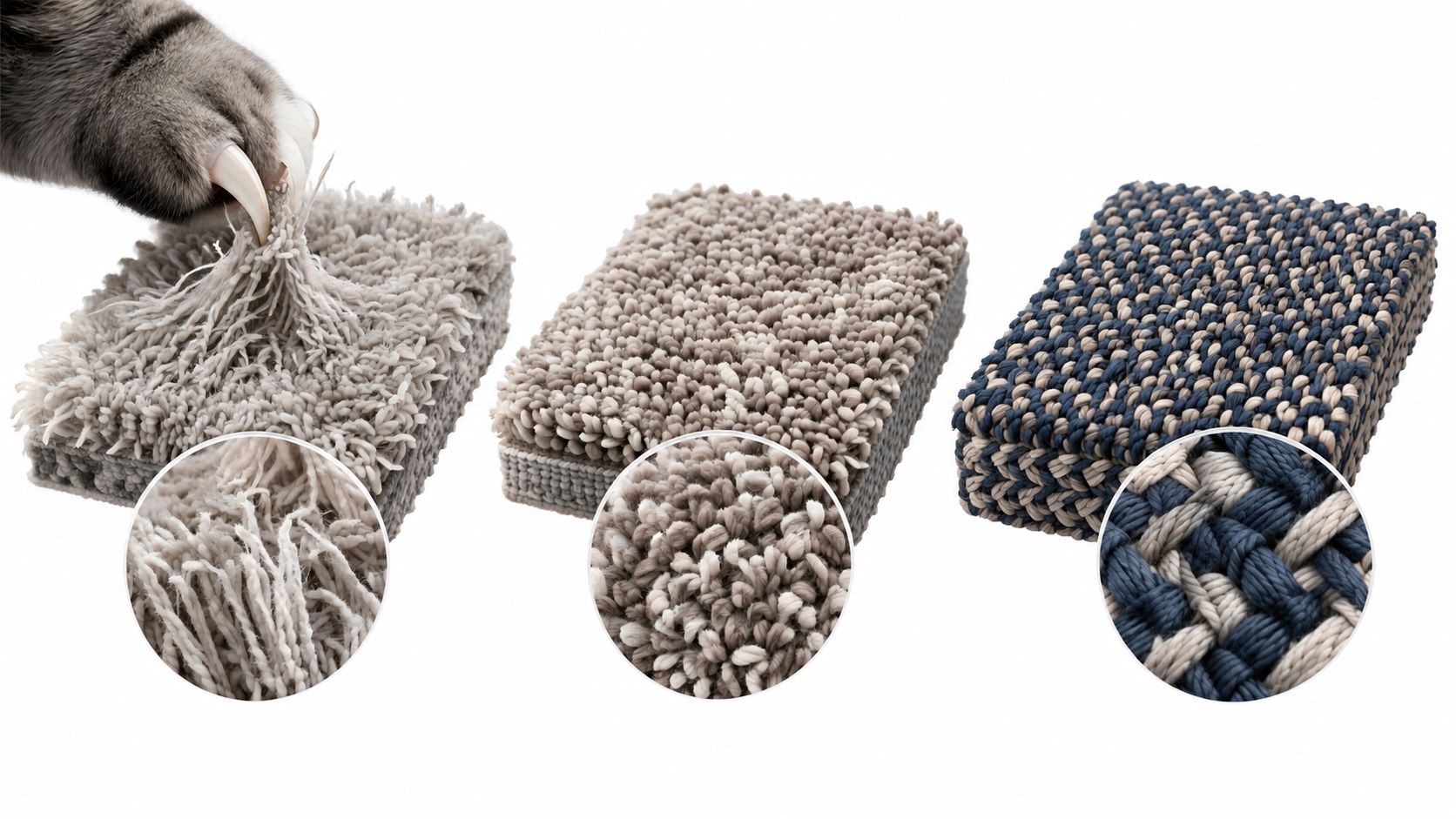
The surface structure often matters more than the color. A dense basketweave, high-twist twill, or flat polyester weave gives claws fewer openings to catch. A loose knit, slub texture, or looped construction gives claws more opportunities to pull yarns from the surface.
Microfiber performs well because its short, dense surface limits snagging and releases hair more readily. Polyester basketweaves and tightly constructed Crypton-twill blends offer a similar logic. Tightly woven olefin bouclettes can provide texture, but the loops must remain compact and stable. A decorative loop that catches a claw is still a risk, regardless of its performance label.
Why pile changes the maintenance routine
Low-pile velvet can work in some pet homes because the surface is dense and smooth, but high-pile velvet, chenille, and shaggy textures tend to hold hair between raised fibers. Long floats and prominent loops also make brushing and vacuuming less efficient. Cats are particularly hard on looped fabrics because kneading and climbing apply concentrated tension to small areas.
Rub testing measures abrasion, not every form of pet damage. It doesn't predict whether hair will become trapped, whether a claw will catch a loop, or whether a stain will sit visibly in a textured surface. Buyers should rub a swatch with a fingernail, brush it with a fabric tool, and inspect the back after gentle stretching.
Color and pattern still have a role. Heathered yarns and small-scale texture can disguise minor shedding, while flat pale solids can reveal every mark. Construction comes first, then the visual strategy. For spot-treatment guidance, Vinson's upholstery stain-removal resource provides a useful reference before a custom fabric is selected.
Protective Treatments and Day to Day Care for Pet Friendly Furniture Fabrics
Protective systems can make upholstery easier to live with, but they don't turn vulnerable fabric into indestructible fabric. Treatments associated with performance upholstery can bond protection to fibers or create a barrier against moisture, staining, and odor. The buyer should ask what the finish protects against, whether it changes the hand, and which cleaning code still applies.
A homeowner should treat Crypton, Nanotex, and GreenShield as distinct protection systems rather than interchangeable labels. The relevant questions are practical: Does the treatment repel liquid? Does it resist oily soil? Can the fabric handle the household's preferred cleaning method? The manufacturer's care sheet controls the answer.
The first ten minutes after a spill
- Remove solids carefully. Mud, food, and vomit should be lifted with a dull edge rather than rubbed deeper into the weave.
- Blot moisture. A clean, absorbent cloth should press against the area without scrubbing.
- Check the code. A W fabric may accept a water-based solution, an S fabric needs the approved solvent, and a W/S fabric offers both routes.
- Test discreetly. Any cleaner should be tested on an unseen area first.
- Dry completely. Airflow helps prevent lingering moisture and odor.
For urine or other organic stains, speed matters because delay gives moisture more opportunity to travel into cushion materials. A resource on pet friendly upholstery cleaning from Top Cleaners offers additional practical cleaning context, but the fabric manufacturer's instructions remain the authority.
| Code | Approved Cleaner | Best For | Avoid |
|---|---|---|---|
| W | Water-based upholstery solution | Food, mud, and many fresh spills | Unapproved solvents |
| S | Approved solvent cleaner | Oil-sensitive situations requiring solvent care | Water saturation |
| W/S | Water-based or solvent cleaner | Households needing flexibility | Mixing products |
| X | Vacuuming or light brushing | Low-contact, low-risk upholstery | Liquid cleaners and wet accidents |
Routine care should include regular vacuuming with an upholstery attachment, cushion rotation where the design allows it, and washable throws in the pet's preferred zone. A homeowner choosing factory protection can review the options through Vinson's furniture fabric protection information. The lasting result comes from pairing that one-time specification decision with a consistent care habit.
Matching Pet Friendly Furniture Fabrics to Your Household Habits
A household with a large dog needs a different answer from a home with two climbing cats. The most useful recommendation starts with behavior rather than breed label or room style. Weight, claw pressure, shedding, moisture, and access to the furniture all shape the choice.
| Pet Profile | Recommended Fabric | Key Metric | Why It Works |
|---|---|---|---|
| Large, active dogs | Flat-weave performance polyester or distressed finished leather | High abrasion rating and a suitable cleaning code | Flat surfaces reduce snagging, while finished leather simplifies hair removal |
| Climbing cats | Tight twill, microfiber, or dense low-pile performance velvet | More than 30,000 Martindale rubs is a useful reference, pet-fabric guidance | Dense, smooth construction gives claws fewer loops to catch |
| Senior pets with accidents | Solution-dyed acrylic or indoor-outdoor performance textile | Cleaning-code compatibility | These categories are selected for cleanability, but the exact cleaner must match the care sheet |
| Design-led households | Textured bouclettes, heathered dense weaves, or leather-grain prints | Performance rating plus a stable surface | Texture can soften the look while dense construction helps mask minor wear |
For the shedding-heavy home
Microfiber and tight basketweaves usually make the best sense for a heavy shedder. Their dense surfaces give hair fewer places to settle, and a regular upholstery vacuum can remove it without aggressive brushing.
For the claw-focused home
Cats that climb and knead need a smooth, tightly woven surface. Open boucle, loose linen, and prominent loops should be rejected early. A low-pile construction can preserve a refined look without presenting loose loops as a scratching opportunity.
For the accident-prone home
A cleaning code matters more than a fashionable fiber name. Senior pets or households managing incontinence should prioritize a fabric whose approved cleaning process matches the care routine. “Bleach-safe” should never be assumed, even for performance or indoor-outdoor textiles.
For the design-conscious home
A pet-friendly room doesn't need to look utilitarian. Heathered yarns, dense low-pile textures, and carefully selected leather grains can bring visual depth while hiding minor surface activity. The sample still needs a claw test and a review of the full specification sheet.
Designing Your Piece During a Vinson Consultation
A productive consultation begins with a household diagnosis, not a stack of color swatches. The design consultant needs to know who uses the furniture, how many pets share the room, whether they shed heavily, whether claws are a problem, and what happened to the previous sofa. Those answers narrow the field quickly.
At the Easton Town Center showroom, the In-Store Design Studio gives Columbus homeowners a place to compare tactile samples in person. Complimentary design consultations can address room dimensions, fabric coordination, finish selection, cushion feel, and the difference between a surface that looks durable and one that is structurally suited to pet use. The Vinson interior design consultation process gives buyers a practical setting for that discussion.
A custom order should answer specific questions
- Upholstery: Which fiber, weave, pile, rub-test method, rub count, and cleaning code suit the pets?
- Comfort: Should the seating use high-resilience foam, a down alternative, or another cushion construction?
- Scale: Will a deep sectional invite the dog onto one cushion, or should the layout distribute use?
- Motion: Would a power recliner, swivel chair, rocker, or glider give the household a separate comfortable seat?
- Finish: Which solid cherry, oak, maple, or walnut finish supports the room's palette?
Vinson's Custom Order Program supports fabrics, finishes, and 3D visualizers for partner brands including Smith Brothers of Berne, Canadel, and Mavin. The 3D furniture configurator concept allows shoppers to view combinations of fabric, finish, and size before purchase, which is particularly useful when comparing a textured upholstery against a smoother option on the same silhouette. 3D configurator guidance describes this real-time visualization function.
The showroom conversation should end with a documented specification, including dimensions, fabric yardage, care instructions, and delivery logistics. That record protects the buyer from selecting a beautiful textile that doesn't fit the household's actual routine.
Building a Sofa or Sectional That Lasts a Lifetime
Pet-friendly upholstery can't compensate for a weak structure beneath it. A sofa that wobbles, twists, or sags forces the fabric to absorb uneven tension. A stable frame keeps cushions aligned and upholstery properly supported during years of climbing, lounging, and repeated sitting.
Vinson's furniture focus is solid hardwood construction, with wood discussions centered on solid cherry, oak, maple, and walnut. Mortise-and-tenon joinery creates broad wood-to-wood contact and resists racking and twisting, which is why woodworking guidance identifies it as a strong choice for frames exposed to repeated use. Mortise-and-tenon furniture guidance explains the structural logic behind the joint.
Upholstery is only one part of the investment
A durable living room configuration may combine:
- A solid hardwood frame that remains stable beneath the upholstery.
- Supportive suspension that limits sagging and helps the fabric stay evenly tensioned.
- High-resilience cushion construction that preserves shape through daily use.
- Performance fabric or top-grain leather selected for the specific pet behavior.
- Motion seating such as motorized reclining, swivel chairs, rockers, or gliders for comfortable separation of human and pet zones.
A solid hardwood piece also offers a repair and refinishing path that disposable furniture doesn't. Independent furniture guidance commonly cites 50 to 100 years for solid hardwood pieces, compared with 10 to 20 years for mass-produced furniture. Solid hardwood longevity guidance provides that comparison.
White-glove delivery is the final quality checkpoint. The service commonly includes inside-room placement, unpacking, light assembly or installation, inspection, and packaging removal, rather than leaving a large sofa at the curb. White-glove delivery guidance describes the multi-step handoff.
Vinson's Low Price Guarantee provides a 110% refund of the difference when the qualifying lower price is found under its stated terms, while the Clearance Gallery offers savings of up to 70%. The result is a clearer long-term value calculation, especially for homeowners comparing Smith Brothers furniture in Easton, Mavin bedroom furniture, Amish-made dining sets, or custom leather sectionals in Columbus.
Vinson Fine Furniture helps Columbus homeowners select pet-friendly upholstery alongside solid hardwood frames, premium leather, motion seating, and custom configurations from Smith Brothers, Mavin, and Canadel. Visit Vinson Fine Furniture at Easton Town Center for a sit-test, complimentary design consultation, and a fabric review based on the pets and habits that shape the home.