
Premium Waterproof Mattress Protector Buying Guide 2026

The word waterproof on a package is a weak promise. A premium waterproof mattress protector can stop a full glass of water and still sleep hot, loud, or chemically opaque, because liquid resistance, vapor release, surface noise, and material disclosure are separate jobs. Rankings that stop at the label miss the trade-offs that decide whether a luxury mattress still feels like itself.
Foam and fiber hold stains, sweat, and biological residue that a surface wipe will not undo. The useful question is which finished-product evidence keeps that interior dry without changing the feel you bought.
The Numbers That Separate Premium Protectors From Basic Ones
A waterproof rating alone cannot tell you how a protector will perform on a luxury mattress. Check the test method, the material being tested, and the finished construction. The cover combines a textile surface with a laminated membrane, commonly polyurethane or thermoplastic polyurethane (TPU). The membrane blocks liquid; the surface affects feel and moisture handling.
Hydrostatic head measures the pressure a water column applies before liquid passes through a material. Higher readings indicate greater resistance to liquid penetration, but the result is useful only when you know what was tested and how. A membrane swatch may perform differently from a finished protector with seams and edges. Ask for the test method and whether the result applies to the complete product.
Moisture-vapor transmission measures how readily water vapor passes through a material. It describes vapor release, not spill resistance. A protector can resist liquid while allowing little vapor to escape, so a high waterproof result does not establish that the sleep surface will feel comfortable.
Why those two results do not travel together
Hydrostatic head and vapor transmission measure different functions. A membrane may block liquid effectively yet retain warmth or moisture against the sleeper. Thin, flexible polyurethane and TPU constructions can reduce stiffness and surface noise compared with rigid barriers, though the finished feel depends on the textile and how the layers are bonded.
| Specification | Basic Protector | Premium Evidence to Request | Why It Matters |
|---|---|---|---|
| Hydrostatic head (liquid resistance) | Often unrated | Test method, result, and confirmation that the finished protector was tested | Indicates resistance to liquid pressure, but not seam or edge performance |
| Moisture-vapor transmission (breathability) | Often unreported | Test method and result for the material or finished product | Indicates how readily vapor can pass through the barrier |
| Seams | Stitched, untaped | Sealed or taped seams, with no open needle holes at the sleep surface | Liquid can pass through unsealed stitch lines |
| Enclosure | Top-only fitted sheet | Full skirt or fitted encasement sized for the mattress depth | Helps cover the sides, where spills may run and moisture can collect |
Treat any rating as incomplete until its test basis is clear. Ask whether a lab measured the membrane alone or the assembled protector, and whether the seams were included. Numbers without that context do not show how the product performs in use. Breathability and noise also need finished-product evidence, since neither follows automatically from a waterproof label.
Construction and washing matter too. A membrane can resist water when new, while repeated laundering may affect its bond or barrier. Look for care instructions and evidence that the stated performance applies after use, rather than relying on a bare rating. These results help compare products, but they are not regulated minimums.
What Premium Protectors Are Made Of and Why the Layers Matter
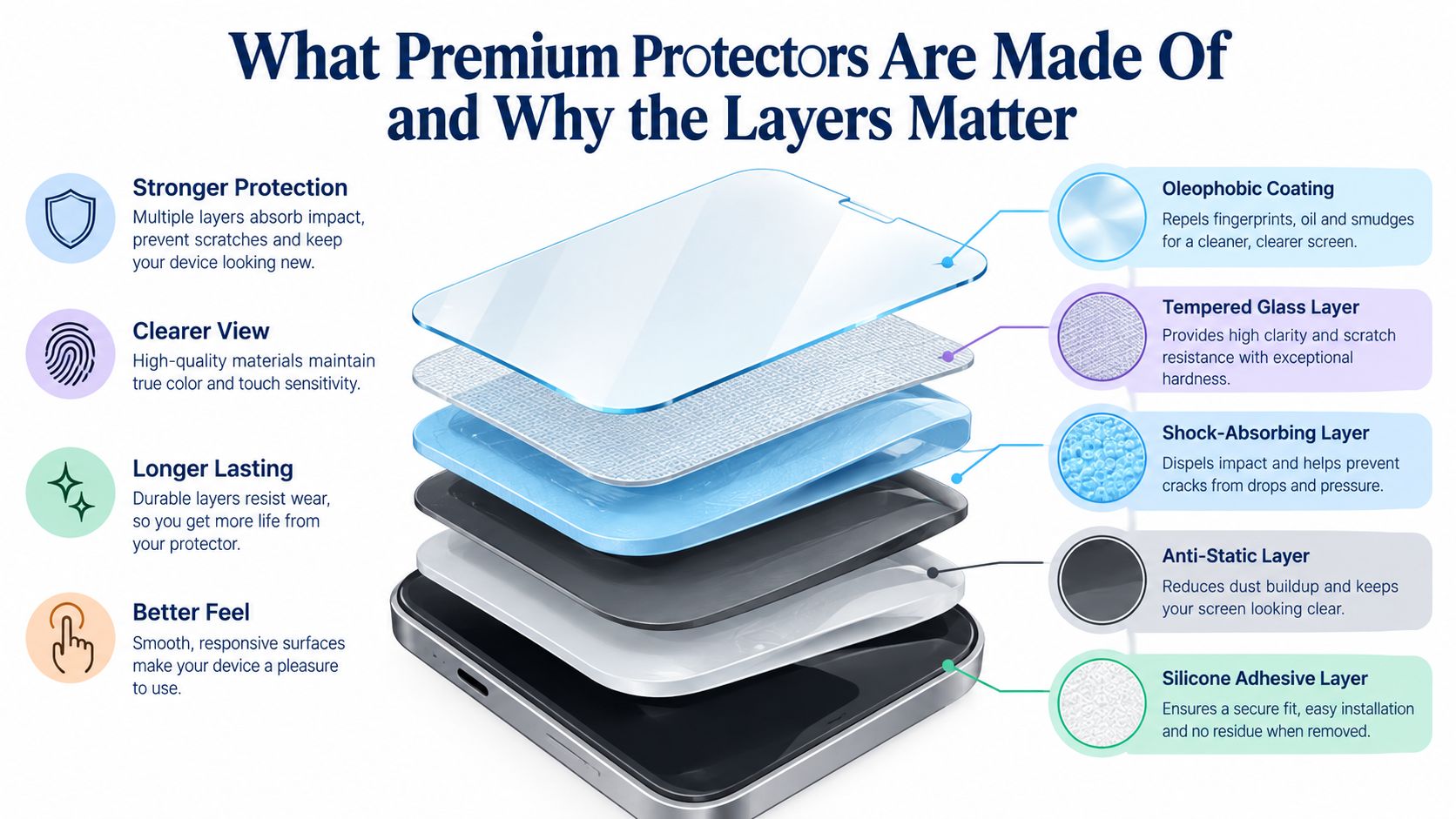
A protector's label cannot show whether its construction works as a finished product. Check how the surface fabric, waterproof membrane, seams, and fitted skirt function together. Each layer has a different job, and a weak point in one can undermine the rest.
From the sleep surface downward, the stack typically includes a textile face, a bonded membrane, and a fitted skirt or full enclosure. The face shapes the hand and handles initial moisture. The membrane blocks liquid. The skirt covers the sides and helps prevent spills from reaching the mattress underneath.
How each material earns its place
| Material | Layer and Role | Main Strength | Main Trade-off |
|---|---|---|---|
| TPU membrane | Liquid barrier bonded to the face | Thin, flexible, and quiet with strong water resistance | Typically priced above basic vinyl covers |
| Polyurethane (PU) laminate | Liquid barrier bonded to the face | Flexible, quiet, and widely used in premium constructions | Continuous coatings can limit airflow if breathability is not tested |
| Vinyl (PVC) barrier | Liquid barrier, often a single sheet | Low cost to produce and strongly waterproof | Crinkle, stiffness, and a plastic feel on a luxury top |
| Organic cotton terry face | Soft textile face controlling moisture at the surface | Natural feel and breathable hand | Absorbs liquid on its own, so it must sit above a membrane |
| Polyester or microfiber blend face | Soft, stretch-friendly textile face | Stretches over pillow tops and holds shape through washing | Synthetic feel for buyers who want natural fiber only |
Organic cotton adds softness; the membrane underneath does the waterproofing. A natural-fiber face does not establish the performance or chemistry of the finished protector. Check the membrane and any coatings or treatments separately.
What to ask about chemistry
Fiber labels reveal only part of the construction. Ask about coatings, adhesives, antimicrobial treatments, and fluorinated stain repellents. An independent product-safety guide identifies formaldehyde, chemical antimicrobial or pesticide treatments, fluorinated stain repellents, and some waterproof coatings as issues to investigate.
In its screening of 229 everyday products, the Environmental Working Group reported PFAS in 68. The organization also said waterproof mattress protectors were among the categories in which PFAS were not found. That category-level finding does not certify the protector you are considering or confirm what is in its finished components.
Practical rule: Ask what was tested, who tested it, and which finished components were included. A manufacturer claim, a third-party certificate, and a batch-specific lab report are different kinds of evidence. Confirm that any certificate covers the membrane as well as the top fabric.
Wash history matters too. Repeated hot washing, detergent residue, and membrane cracking can affect performance, even when the original disclosure was reassuring. Judge the protector by its finished-product evidence, not by the waterproof label alone.
Breathability, Noise and Comfort on a Luxury Mattress
The strongest waterproofing can also reduce airflow, and the finished protector's feel matters as much as its label. A surface may feel dry to the hand yet retain warmth against the sleeper. For hot sleepers, assess the product's complete construction and test its sound and comfort on the mattress it will cover.
A 2024 field study of adults who reported sleeping hot or waking with night sweats reported a 7-minute reduction in objectively measured time to fall asleep after participants used one cooling mattress protector. Participants also reported improved comfort and fewer overheating complaints. The study used a pre-post design rather than a randomized comparison, and tested a single product, so its findings do not establish that premium protectors generally cool a bed. They do show that surface temperature can be assessed, and that a protector may affect sleep onset.
How to hear the membrane
Thin TPU and polyurethane membranes tend to rustle less than vinyl because they flex rather than fold like plastic. Vinyl's crinkle is easy to hear when someone turns. On a pillow top shared by two people, more of the surface moves, making noise more noticeable. A loose cover can also shift toward the edge during a heavy turn.
Test the protector on the mattress, beneath a fitted sheet. Lie down, roll from your back to your side, and listen near your shoulder and hip. A crackle you can hear in a quiet showroom is likely to remain noticeable at home.
For hot sleepers, couples, and thick luxury mattresses, a thinner, well-engineered barrier with a breathable absorbent top can be more comfortable than a thick padded option.
The mattress beneath the protector matters, too. A cooling mattress for hot sleepers may still feel warm if the protector traps heat at the surface. At the Easton Town Center showroom, lie on a demonstration mattress and turn over to check warmth and sound. A quick look while standing will not reveal either issue.
Fitting Protectors to Pillow-Top, Hybrid and Memory Foam Beds
Fit depends on the mattress's measured height and how its edges move. Run a tape from the foundation to the mattress top at each corner and across the middle, including any pillow top. Use the largest measurement, then check that the protector's stated maximum depth leaves enough skirt to tuck its elastic beneath the corners.
A skirt that is too tight strains its seams; one that is too loose can bunch beneath the sheet. Check whether the elastic runs around the full perimeter and whether the fabric can stretch over the mattress edges.
What each construction does to the skirt
| Mattress Type | Profile to Check | Fit Risk | Protector Feature to Check |
|---|---|---|---|
| Pillow-top | Measure the full height, including the pillow top | Corners pull or bunch if depth is underestimated | Deep skirt with stretch knit, sized to the measured height |
| Hybrid (coil and foam) | Measure the coil-and-foam mattress itself | Firmer edges can strain a thin skirt | Stretch fabric with reinforced corner seams |
| Memory foam | Measure the mattress itself and check its edge response | Tight fabric can wrinkle where the foam presses against it | Four-way stretch and a skirt with room to move |
| Adjustable base | Check fit with the mattress flexed at the head and foot | Fabric can crease or tear at the hinge | Flexible knit that stretches in both directions, without rigid seams across the hinge |
A hybrid protector needs enough give to fit over a firmer perimeter without pulling at the seams. The basics of what a hybrid mattress is help explain why its foam-and-coil construction can place added strain on the skirt. Memory foam also presses against a tight weave, which can leave wrinkles around the border. With an adjustable base, check the hinge area while raising and lowering the bed; a rigid seam across the moving section can become a weak point.
Bed frames and foundations affect the height the protector has to cover. A Mavin solid-wood bed frame, Amish-made in Ohio, or an adjustable foundation can change the mattress's position once everything is assembled. Set the bed up first, then measure the mattress from foundation to top. Measure the bed itself, not the brand on the tag.
Allergy and Bedbug Protection Without Overpromising
Judge a mattress barrier by its finished construction and evidence, not by “waterproof” on the label. In a controlled trial of mattress barriers, a nylon barrier reduced dust-mite antigen migration from mattress to sheet surface by 94%, compared with 66% for an ordinary cotton sheet. The reduction remained significant at 2, 4, and 6 months. Separate home measurements reported Der p 1 at 0.4 micrograms per gram of fine dust on impermeable encasements, compared with 19–116 micrograms per gram on cotton, wool, and sheepskin coverings. Mattress dust levels were also far lower beneath impermeable encasements.
Waterproofing and allergen control overlap, but they are tested separately. A protector may stop liquid while allowing fine particles through a weak membrane, seam, zipper, or skirt. Conversely, an allergen barrier may enclose the mattress without being designed for repeated spills.
| Measure | Protector result | Comparison | Notes |
|---|---|---|---|
| Dust-mite antigen migration to sheet surface | 94% reduction with nylon mattress barrier | 66% with ordinary cotton sheet | Reduction held at 2, 4 and 6 months |
| Der p 1 on encasements (micrograms per gram of fine dust) | 0.4 with impermeable encasement | 19–116 on cotton, wool or sheepskin | Home measurements |
| Barrier efficiency of encasement | 98% with intervention cover | 15% with comparison cover | Roughly threefold reduction in mattress allergen levels over 12 months |
Materials and assembly affect barrier performance. A review of impermeable bedding encasings reports 98% barrier efficiency for one intervention cover, compared with 15% for a comparison cover. The review also reports an approximately threefold reduction in mattress Der p 1 and Der f 1 after 12 months. These findings support exposure reduction, not a promise of asthma control or broader health improvement.
Set expectations accordingly: a protector can help preserve the mattress and reduce exposure, but it is not a medical treatment. For bedbugs, a fully enclosed encasement with a secured, flapped zipper can trap bugs already inside and block new entry. It does not eliminate an infestation; pest control remains a separate job.
Check the finished product for four details:
- Full coverage: The mattress sides are enclosed, with no gap at the foundation line.
- Impermeable membrane: A continuous film provides the barrier; a tight weave alone does not.
- Sealed seams: The sleep surface has no open needle paths.
- Secure closure: A zipper, flap, or fitted skirt leaves no mattress exposed.
Room cleaning complements a protector, which cannot cover other dust-holding surfaces. Follow practical steps for keeping a bedroom low in dust and allergens alongside the mattress barrier.
How to Wash and Maintain a Protector Without Losing Its Barrier
The care label sets the limits; repeated heat and detergent residue can wear a membrane faster than routine spills. Follow its instructions before laundering.
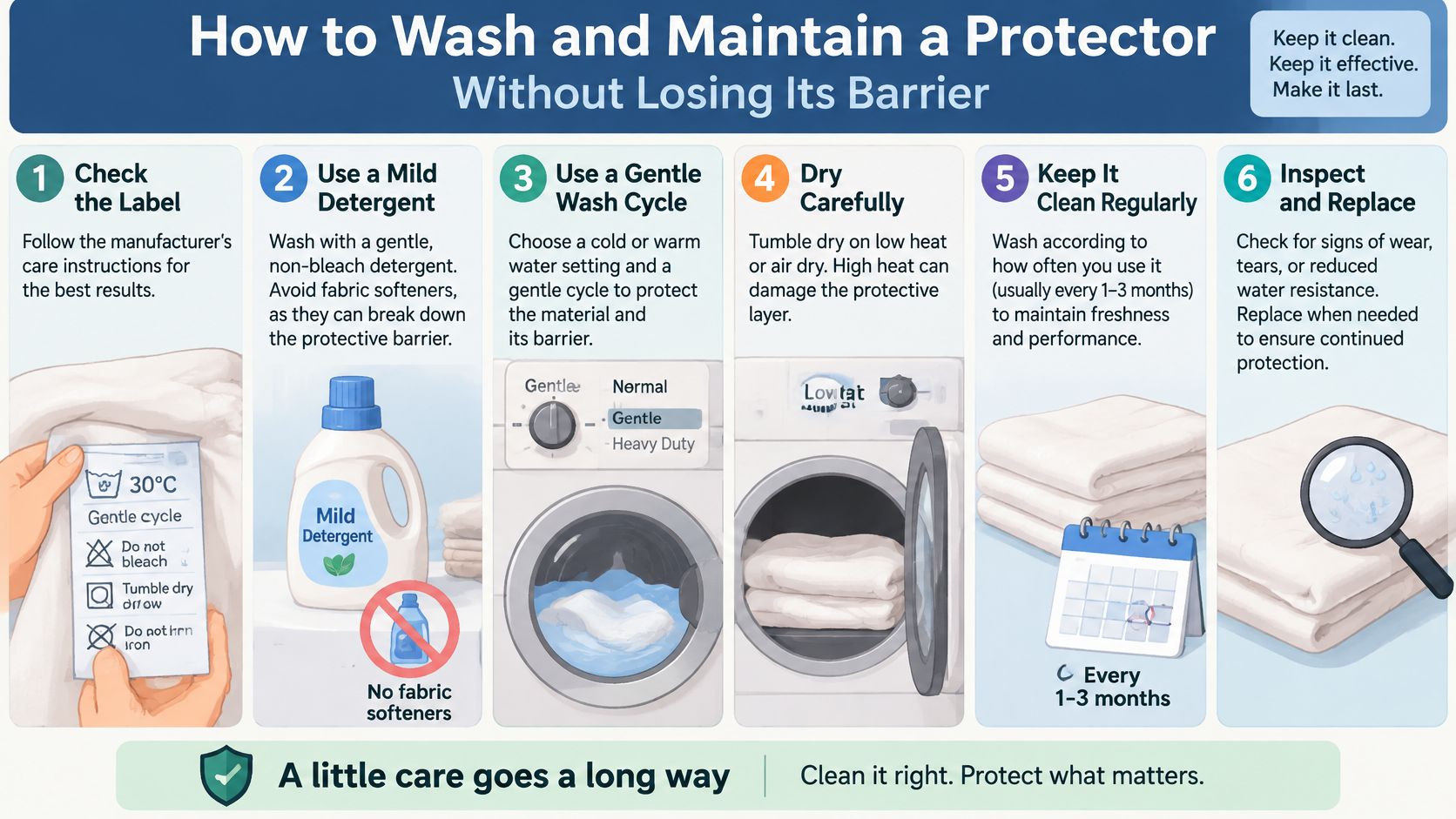
- Check the care label for the maximum wash temperature and permitted drying method.
- Wash the protector alone or with similar items on a gentle cycle, using warm rather than hot water. Excess heat can accelerate cracking and delamination.
- Choose a mild, low-residue detergent and use about half the usual dose. Buildup can affect the membrane's performance.
- Avoid fabric softener and bleach. Softener can coat the surface and reduce breathability, while bleach can damage the film.
- Tumble-dry on low or air-dry until fully dry. Dampness in the skirt can lead to odor.
- Every few months, inspect the fabric in good light and flex it gently. Check seams and edges for cracks, lifting, or a stiff, papery feel.
- Replace the protector if liquid passes through or the membrane turns brittle and loses its stretch.
A well-maintained membrane can last several years if the warranty covers delamination, so check the stated coverage period rather than relying on a general lifespan claim. Keep mattress cleaning habits that protect the warranty on the same care schedule. Cleaning the cover is simpler than trying to remove stains from the mattress beneath it.
Confirm the Specs and Fit Before You Buy in Easton
A protector can meet a waterproof rating and still feel wrong on a luxury mattress. Check the finished cover in person, then confirm that its fit and warranty suit the bed you own.
Bring the mattress dimensions and note its profile, including any pillow-top height. Use this bed and mattress size guide to check the listed size, but compare the actual mattress depth with the protector's pocket range. A size label alone does not confirm that the fitted skirt will stay in place.
At the Easton Town Center showroom, ask to try the protector on a comparable mattress. Lie down and turn as you normally would. Listen for crinkling, notice whether the surface feels warm, and check whether the fabric shifts or pulls at the corners. Those checks reveal comfort trade-offs that a product label cannot.
Ask one warranty question before ordering: does coverage include membrane delamination, and what conditions could void it? Read the terms alongside the care label, since washing and drying limits may affect coverage. Keep the receipt and product details with the mattress paperwork.
If you are planning a wider bedroom update, a complimentary design consultation can help coordinate the protector's fit with the mattress and frame. Keep the decision focused on the bed: a comfortable surface and a secure fit matter more than matching the protector to the rest of the room.
Vinson Fine Furniture at Easton Town Center helps Columbus homeowners assess protector fit alongside their mattress and frame. Bring your measurements and use a showroom sit-test before ordering. Visit Vinson Fine Furniture to arrange a consultation.