
Shaker Style End Table Guide: Design, Sizing and Buying

A shaker style end table is often judged by its clean outline, but that's the least useful test of whether it will serve a home well. A plain profile can conceal loose joints, a top fixed against seasonal wood movement, or proportions that make a sofa-side glass awkward to reach. The better showroom test is tactile: inspect the joints, check how the top is attached, and see whether the table fits the room and the way people use it.
Recognizing a True Shaker Style End Table
In the showroom, a Shaker table should read as spare and balanced, with details that serve its shape and use. Start with these visible markers:
- Straight or tapered legs without turned details.
- A plain apron or rail band without scrolls or applied ornament.
- A modest top overhang balanced against the base.
- A restrained finish that lets the wood show.
- Exposed drawer corner joints, if the table has a drawer.
The Shaker community arrived in America from England in 1774. The classic furniture period is generally dated 1820 to 1840, and the earliest documented Shaker stands date to about 1805, according to the SFO Museum's account of Shaker furniture. Household stands and small tables served practical purposes, while the style's recognizable simplicity rests on proportion, symmetry, and repeatable construction.
A Shaker table's plain lines leave little room to disguise uneven proportions or fussy details. Compare the leg shape, apron, and overhang from several angles, then see how the piece relates to traditional furniture design. These visual cues identify the style; they cannot confirm the quality of its construction.

Look past the outline
A spare silhouette can conceal careful construction or lightweight work. A drawer or lower shelf alone says little about how a table will hold up. The 2025 furniture-industry discussion of quality, customization, and product life also addresses why buyers should consider product quality and life, rather than relying on appearance or labels.
Ask what the top is made of and how it is attached. Find out whether the joints can be inspected and repaired, whether the finish can be renewed, and how the drawer is joined. Check whether replacement hardware is available and whether the maker supports repair or refinishing. Those answers give you a more useful basis for judging the table's expected service and upkeep than its outline alone.
Joinery and Construction Worth Checking First
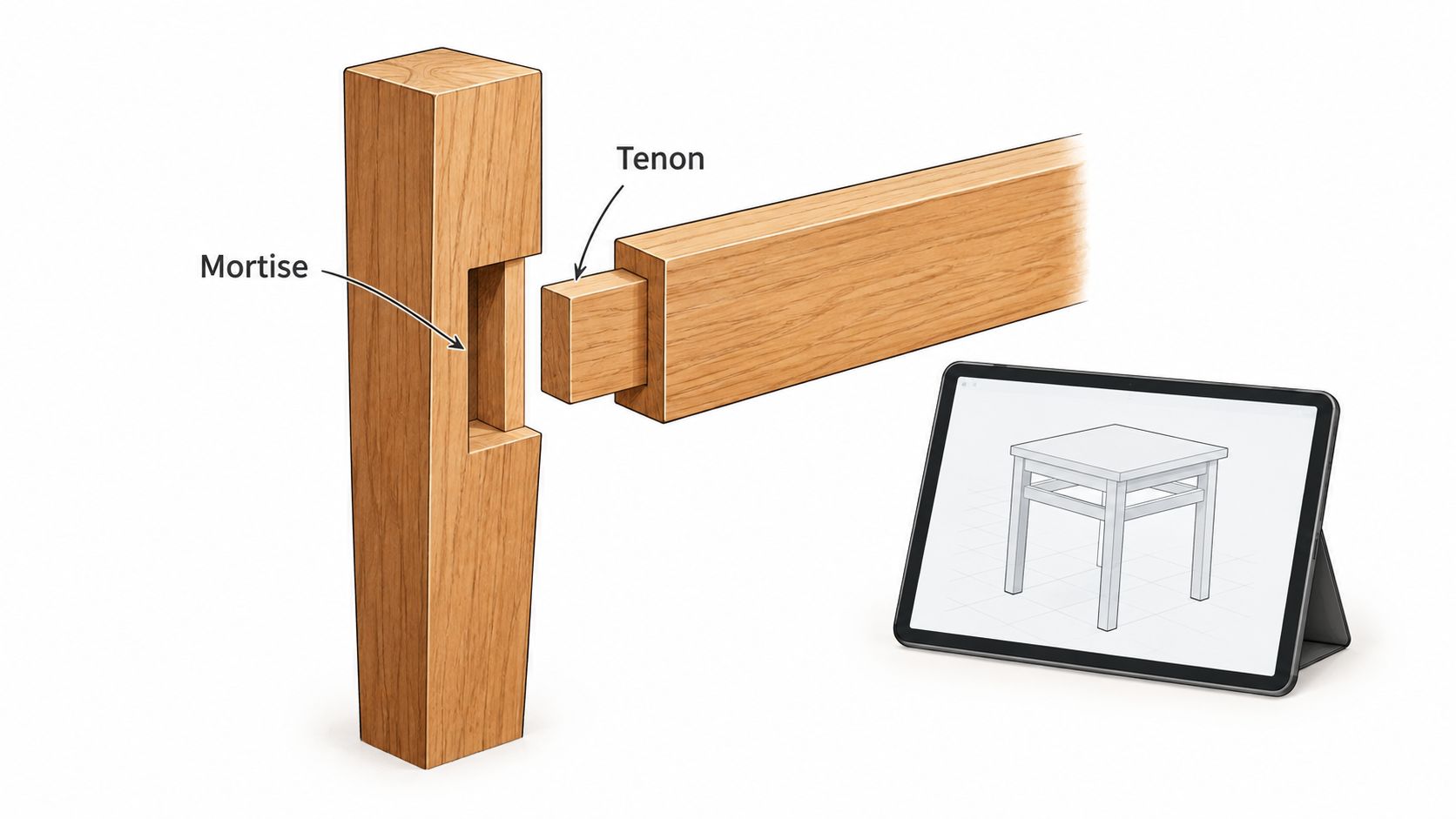
Start at the leg-to-rail joints, where the frame takes force. Mortise-and-tenon joinery creates a broad, interlocking connection. The tenon's shoulder and cheeks transfer force through the joint, rather than relying on screws alone to resist pulling out. Press one corner gently and watch the rail. A sound joint should stay firm, with no gap opening at the shoulder.
Shaker furniture used several joint forms, including mortise-and-tenon, dovetail, rabbet, dado, half-lap, and tongue-and-groove, as described in Britannica's overview of Shaker furniture construction. That variety is practical: a joint should suit the part and the load it carries, not match every other joint in the table.
Check the top attachment next. A solid-wood top expands and contracts across the grain as indoor humidity changes. Figure-eight fasteners or elongated screw slots allow that movement while the base stays square. Screws that lock the top rigidly to the rails can split the top or pull the frame out of alignment. If there is a drawer, pull it out and check for dovetails at the front corners and a solid-wood bottom.
A practical showroom check
Use your hands and eyes, not the outline, to judge the frame. Press each corner gently and watch for rail movement or a joint opening. Lift the top slightly to inspect its fasteners, then sight along the joints under angled light. On a rectangular table, compare the two diagonals; matching measurements indicate a square frame.
| Component | Sound construction | Warning sign | In-store test |
|---|---|---|---|
| Leg-to-rail joints | Mortise-and-tenon with a tight fit in a deep mortise | Gaps at shoulders or rails that shift under pressure | Press each corner and watch the rail for movement |
| Top attachment | Figure-eight fasteners or elongated screw slots | Top screwed rigidly into the rails | Lift the top slightly and inspect the slots underneath |
| Corner blocks or stretchers | Blocks or a stretcher on wider spans | Long span with no bracing | Rock the table gently on each corner |
| Rail connections | Rails glued into true mortises | Butt joints or staples | Sight along the joint line under angled light |
| Drawer joinery | Dovetails at front corners with a solid-wood bottom | Thin glued panels or exposed staples | Pull the drawer out and check each corner |
| Underside finish | Sealed on all faces and edges | Bare or unsealed underside | Turn the table or lift the top to view the underside |
For unfamiliar joint shapes, this wood-joint guide can help you identify what you are seeing. Ask whether the frame is solid hardwood and whether the rails are glued into mortises. Corner blocks and stretchers support wider spans; an open frame can still be sound, but a broad span without bracing deserves a closer look. A firm joint, a top that can move, and bracing suited to the frame matter more than a polished silhouette.
Choosing Solid Wood Species and Finish
Vinson's hardwood standard is specific: its furniture is solid hardwood, with cherry, oak, maple, and walnut among its named species. The practical question is which wood suits the room and its daily use. The Metropolitan Museum of Art's essay on Shaker furniture explains why material and finish matter: solid wood takes on and releases moisture as indoor humidity changes, and it moves more across the grain than along it.
That movement is why a broad top needs room to shift relative to the base. The top-attachment method should accommodate that movement instead of locking the wood in place.
| Solid hardwood | Color over time | Best fit |
|---|---|---|
| Hard maple | Pale and creamy, with gentle darkening | High-contact tops in busy living rooms |
| Cherry | Warms toward reddish-brown with light exposure | Traditional rooms and an evolving, warm finish |
| White oak | Golden to light brown, with visible grain | Everyday tops where open grain suits the restrained design |
| Walnut | Rich brown that deepens gently | A statement piece or deliberate contrast in a lighter room |
Maple is a practical choice where people frequently set down drinks, books, or everyday objects. Cherry's color develops with light, while walnut creates a darker, more deliberate note. White oak's visible grain can add texture without adding ornament. Each species brings a different look, so compare physical samples in the room's actual light rather than choosing from a screen. The hardwood selection guide can help frame that choice.
Protect the wood before and after purchase
Ask whether the stock was properly conditioned and kiln-dried, and check that the top can move independently of the base. Then use these safeguards:
- Before assembly: Let the components acclimate to the indoor environment.
- During finishing: Seal every face and edge, including the underside.
- After placement: Keep the table away from radiators, HVAC outlets, and exterior doors, where conditions can change sharply.
- At inspection: Look for clean finishing underneath and across edges, not just on visible surfaces.
A restrained Shaker profile leaves little to distract from defects. Cupping, open joints, and finish checking show clearly on a plain surface, so inspect it in daylight before purchase. Ask the design team which finish can be refreshed later and whether the maker supports repair. A finish that can be maintained, and a top that can move, matter more than a decorative label.
Sizing and Placing a Shaker End Table
Choose the table by how it fits beside the seat, not by its outline alone. Aim for a tabletop within about 1 to 2 inches vertically of the sofa or chair arm. That keeps a drink, lamp, or phone within easy reach. The horizontal gap is a separate measurement: leave 2 to 4 inches between the table and sofa so the pieces do not crowd each other. Keep the walking route clear, and consider the furniture-stability guidance for the home, particularly where children may climb.
Measure before choosing a shape or finish:
- Measure the seat and arm heights at each intended spot.
- Mark the proposed table footprint on the floor with painter's tape.
- Sit in the seat and compare the tabletop height with the arm. Check that you can reach it without lifting or dropping your shoulder.
- Walk past doors, recliners, and regular circulation paths.
- Confirm that drawers and lower shelves can open without blocking movement.
| Placement | Footprint or height | Clearance to check |
|---|---|---|
| Table height target | Top within about 1 to 2 in vertically of the arm | Reach a glass, lamp, or phone while seated |
| Beside a sofa with 24 to 26 in arms | 18 to 22 in square | Leave a 2 to 4 in horizontal gap from the sofa and keep the walkway clear |
| Corner or narrow wall | Compact footprint sized to the taped floor outline | Preserve a 30 in walking path |
Use this furniture measuring guide to prepare your dimensions before visiting a showroom. In a small apartment, choose storage to suit the way you use the table: a drawer hides remotes and charging cords, a lower shelf holds a basket or reading material, and an open base keeps the piece visually light. Avoid paying for storage that obstructs access or adds a surface you do not need.
Stability matters as much as clearance
On a level showroom floor, place the table where it would sit beside a seat. Press down gently on the top near each edge, then apply light sideways pressure at the top. Rocking, a shifting base, or a joint that moves under that pressure is a reason to ask how the table is assembled and whether it can be corrected. A firm stance matters more than a delicate-looking outline.
Where children may climb, secure a questionable piece with appropriate straps, braces, or wall anchors. A compact table can still rock if its base is uneven, so check that all feet sit flat and the top stays steady under light pressure. Clearance and stability are separate checks, and the table needs to pass both.
Pairing Shaker Tables With Living Room and Bedroom Pieces
Shaker restraint works naturally in transitional rooms because a plain, visible frame sits comfortably beside upholstered furniture. Start with three coordination rules: keep wood tones within one family or contrast them deliberately, limit the room to a small number of distinct wood tones, and let the table finish echo a metal or hardware accent. These choices create a connected room without forcing every piece to match.
In a bedroom, a bedside table in the same wood family as a Mavin piece keeps the setting calm. Mavin is Amish-made in Ohio, so a Mavin bedroom selection can anchor an American-made pairing. Check the bed's height and the bedside table's reach together, and keep the lamp switch easy to access.
For a living room, Smith Brothers of Berne, made in Indiana, offers top-grain leather seating, including power-reclining pieces with quiet motion features. Set the table top close to the recliner's arm height and confirm that the seat can extend without striking the table. The same practical test applies to swivel chairs, accent chairs, rockers, and gliders: check the full range of movement before settling the table in place.
A room that combines those American-made pieces with Canadel, handcrafted in Quebec, is better described as North American Crafted, not American-made. That distinction keeps the origin story accurate while allowing a thoughtful mix of hardwood case goods and upholstered seating.
Coordinate materials before committing
Vinson Fine Furniture's Custom Order Program covers brands including Smith Brothers, Canadel, and Mavin. Customers can select fabrics, finishes, upholstery details, dimensions, and configurations through the Easton Town Center In-Store Design Studio, then use digital or 3D visualizers to review proposed pieces before production, as described in the Custom Order Program overview. Complimentary design consultations can help compare wood samples, upholstery, and room proportions in person.
A swivel accent chair or rocker can soften the straight geometry of a Shaker table. Repeat a wood tone or hardware finish, but let the chair's upholstery provide its own texture. For a gentle finishing touch, create calming spaces with indoor plants without crowding the table's working surface.
Test the Size and Choose Your Buying Path
The Easton Town Center showroom sit-test is the deciding step. A photograph can show the finish and outline, but it can't show how the table feels to lift, whether its height suits the sofa, or whether the frame rocks when pressed. Bring measurements, a photo of the sofa or bed, notes from the joinery checks, and one question for the design team. Complimentary design consultations are available.
| Buying route | Best for | Price protection | What to expect |
|---|---|---|---|
| Custom Order Program | Buyers choosing species, finish, and dimensions | Low Price Guarantee may apply to an eligible lower authorized-dealer price within 30 days | 3D visualizer preview before production; lead time to be confirmed by the design team |
| Regular in-stock order | Buyers who need a table on a set date | Low Price Guarantee applies within 30 days | Sit-test in Easton before ordering; White-Glove Delivery |
| Clearance Gallery | Buyers comfortable choosing from available floor pieces | Clearance savings up to 70%; Low Price Guarantee terms should be confirmed for the specific item | Floor samples, overstocks, and seasonal closeouts; availability varies by piece |
The Low Price Guarantee details specify that after purchase, customers have 30 days to find the same product at a lower price from a local Central Ohio authorized dealer. Vinson states that it will refund 110% of the difference when those conditions are met. The Clearance Gallery is a separate route for immediate availability; its floor samples, overstocks, and seasonal closeouts are individual pieces, so check the specific item and its terms.
For a choice that fits your space, review custom end tables and bring the measurements to the showroom. A custom-order lead time still needs confirmation from the design team, so ask about timing before committing to a date.
Visit Vinson Fine Furniture at Easton Town Center to sit-test a Shaker style end table, inspect its solid-hardwood construction, and compare finishes in person. The family-owned Central Ohio showroom offers complimentary design consultations, customization, White-Glove Delivery, and a Clearance Gallery for shoppers weighing a made-to-order piece against available floor samples.