How to Choose Sofa Color for Your Living Room

You're standing in a showroom, the sofa looks perfect, and the swatch in your hand feels safe. Then it gets home, lands beside your floors, cabinets, trim, and a kitchen you can see from the same sightline, and the color suddenly looks louder, flatter, or just wrong. That mismatch is usually not a sofa problem, it's a fixed palette problem, and the right answer starts there.
Evaluating Your Room's Fixed Palette and Lighting
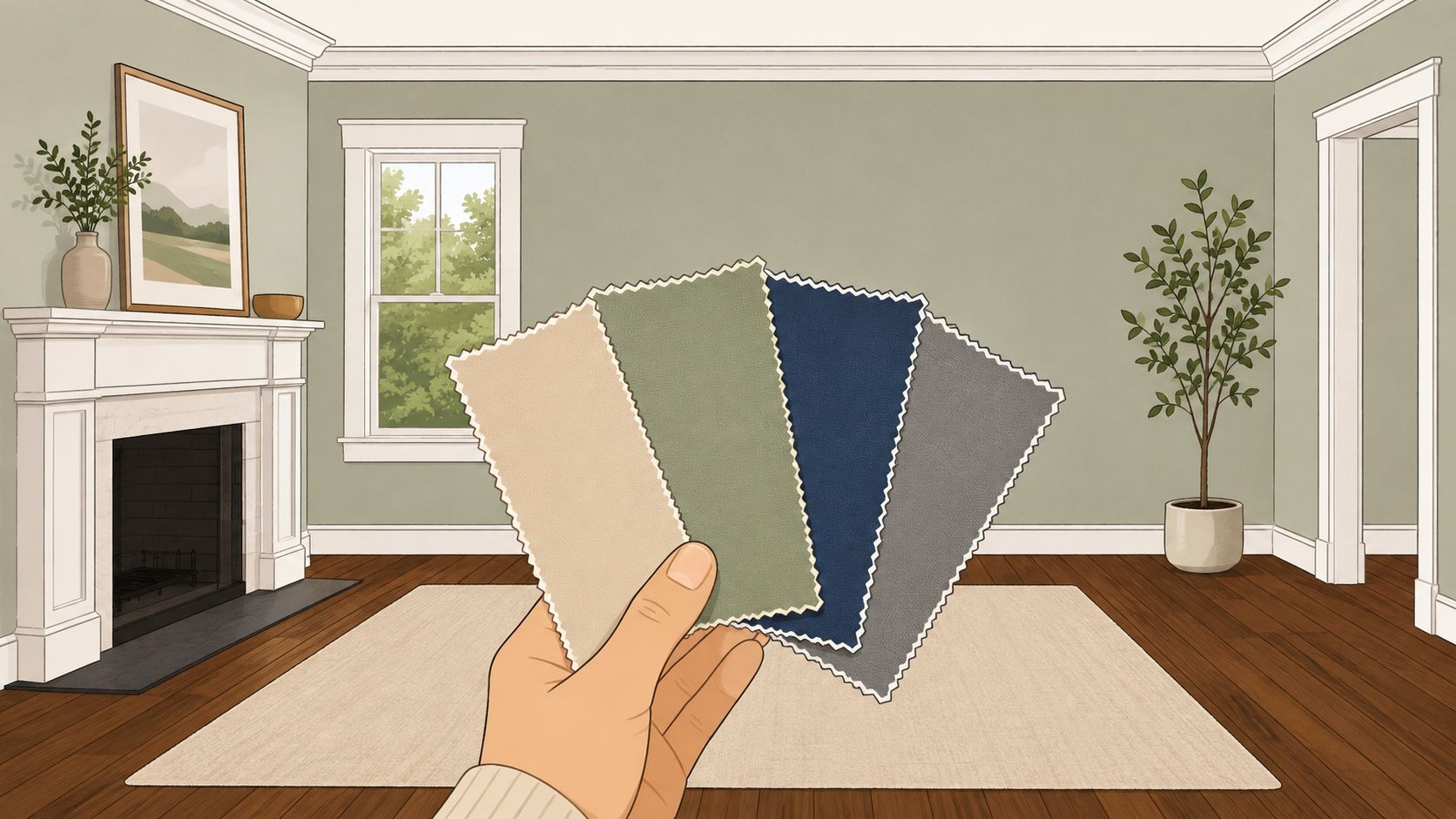
A sofa has to live with what cannot move. Solid hardwood floors, cabinetry, built-ins, trim, and the finishes visible from an open-concept room set the terms long before a throw pillow shows up. The cleanest approach is to treat those permanent surfaces as the anchor, then choose a sofa color that either blends into that structure or bridges two competing finishes without creating visual noise.
Start with the permanent surfaces, not the sofa
A room with warm oak floors and creamy trim wants a different sofa conversation than a space with cooler gray tile and painted cabinetry. The same goes for open-plan homes, where the sofa often has to behave like a connector between a living area and a kitchen instead of matching one wall. That's why a sofa color should be judged against the biggest fixed elements first, then softened or sharpened with accessories later.
Practical rule: when the room already has a strong palette, choose the sofa to unify the largest permanent surfaces, then let pillows and throws provide contrast.
A helpful way to think about this is harmonizing versus bridging. A harmonizing sofa sits within the palette, usually in a neutral with the same warmth or coolness as the room. A bridge color does a little more work, pulling together mixed woods, mixed metals, or a living room that opens into a kitchen with different cabinet tones.
For a simple reference on paint relationships, the logic in choosing home paint colors translates well to upholstery, because undertone discipline matters more than chasing a trendy shade.
Check the room in more than one kind of light
Color changes under daylight, evening lamps, and overhead fixtures. That's not an opinion, it's the everyday reality of metamerism, where a fabric reads one way in the store and another way once it's inside your home. A sofa that looks rich in bright retail light can turn muddy at night, while a pale neutral may look sterile in a dim room.
The most useful pairing for this is a light-based decision. Well-lit rooms can carry darker sofa colors such as navy or charcoal without feeling heavy, while rooms with limited light usually benefit from lighter shades because those colors visually open the space. For a deeper discussion of room brightness and furniture placement, Vinson's guide to put your living room in the best light is worth reading before any final fabric order.
A sofa color decision gets much easier once the fixed palette is named plainly. If the floors, cabinets, and trim already do most of the talking, the sofa should either calm the room or bridge it. If the room is quiet and light, the sofa can take on a little more presence without overwhelming the sightline.
Applying the 60-30-10 Rule to Sofa Selection
A balanced room usually feels finished because one color leads, another supports, and a third accents. The common 60-30-10 rule gives that structure, and the related 70-20-10 rule does the same thing with a slightly more dominant base. In sofa planning, those ratios decide whether the sofa should act as the main anchor or as the secondary layer that keeps the room from feeling flat.
Use the sofa as the dominant anchor when the room needs stability
If the space has bold flooring, visible woodwork, patterned rugs, or nearby cabinetry, the sofa often works best as the dominant large object in the room. That usually means a neutral with enough depth to hold the eye, not a timid pale tone that disappears or a dramatic color that competes with everything else. In a room already rich with detail, the sofa should steady the composition.
A sofa that fills the dominant color role should look calm from across the room and still hold its shape up close.
A neutral sofa does this with less risk. It gives the room a large, reliable base, which makes it easier to change art, pillows, and drapery over time without reopening the whole design. That same logic matters in open-concept homes, where the sofa often has to support more than one visual zone at once.
Use the sofa as the secondary layer when the room already leads elsewhere
Sometimes the walls, rug, or wood tone already carry the strongest color story. In that case, the sofa becomes the 30% layer, a measured counterpoint that adds depth instead of competing for attention. A colored sofa can earn its place in this scenario, especially in a minimalist room that needs one distinctive statement to stop it from feeling underfurnished.
The number-based rule is simple, but the design rule behind it is stronger. The room should still read as controlled, not improvised. A sofa is too large to be treated like an accent pillow, so its color has to be chosen with the whole composition in mind, not as an isolated mood pick.
For a broader framework that supports this kind of palette planning, Vinson's an experts guide to the perfect color palette pairs well with the sofa decision process. Used correctly, these ratios keep the room from drifting into visual clutter while still giving the sofa enough personality to feel intentional.
Testing Swatches Against Permanent Finishes
A fabric sample lying flat on a table is not the same thing as a sofa standing upright beside a floor, a wall, and a cabinet line. That's why the smartest test is not a quick glance, it's a small home study done in the actual room. The swatch has to answer one question, not ten. Does it cooperate with the permanent finishes, or does it fight them?
Run the three-light test
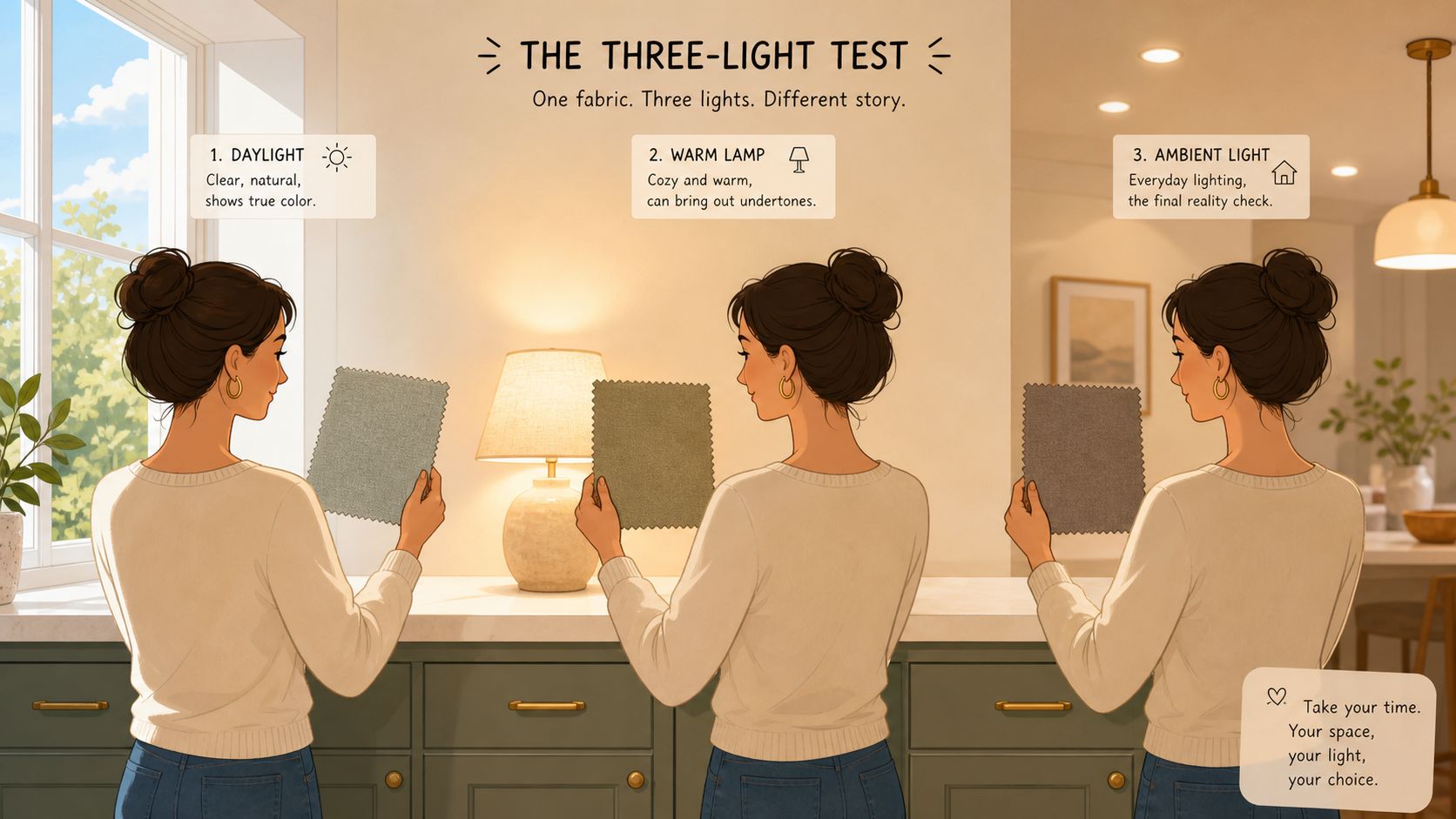
Test the swatch in daylight first, because that shows the clearest base reading. Then check it again under evening lamp light, followed by overhead lighting. Those three conditions cover the most common ways a sofa will be seen, and they reveal whether the color stays clean or shifts in an awkward direction.
The reason this matters is practical. Some neutrals lean yellow in warm light, while others pick up a cool cast once the lamps come on. A gray that feels balanced during the day can look icy at night, and a beige can become richer or flatter depending on the bulb temperature and the surrounding finishes.
A useful habit is to stand back. Swatches often look right only when they're held too close, where the eye can't judge them the way it will judge a whole sofa across the room. Step away, squint a little, and compare the sample to the floor and trim, not just to the upholstery in your hand.
Hold the swatch vertically beside the fixed elements
This is the step most individuals skip. A vertical swatch beside flooring, cabinetry, and wall paint shows how the future sofa will sit in the room, which is much closer to the true reading than a sample lying flat on the counter. It also helps expose undertone clashes sooner, before the order is final.
If a room is being coordinated remotely, it helps to check fabric colors online before purchase as a preliminary filter, but the final judgment still belongs in the home. Online screens are useful for narrowing choices, not for approving them.
For buyers who want a more careful process, Vinson's advice on how to avoid color mismatch when ordering online is a sensible companion to the in-room test. The core discipline is simple. Compare the swatch against the actual room, in the actual light, against the actual finishes.
Balancing Lifestyle Needs with Timeless Materials
A sofa color has to work in real life, not just look polished on delivery day. Homes with children, pets, or regular guests need a finish that hides wear and still feels refined. Medium-value, textured fabrics are usually the safest long-term choice, while very pale solids and extremely dark solids ask for more upkeep than many buyers expect.
Read the material before you read the trend
Neutral upholstery still has the strongest track record. A sales snapshot covering 2020 through 2024 showed gray at 36%, beige or cream at 28%, navy blue at 14%, brown or charcoal at 12%, and all other colors at 10% (source). A separate 2024 survey showed a similar spread, with gray at 34%, beige or taupe at 27%, blue tones at 19%, charcoal or black at 13%, and white at 7%.
That consistency matters because neutral upholstery gives the room room to change around it. Accent pillows, artwork, rugs, and side chairs can shift without forcing a replacement of the largest upholstered piece in the space. It also supports resale appeal, which is why a neutral base remains the safest route when broad compatibility matters.
A third breakdown pointed the same way, with gray at 39%, beige or cream at 31%, navy blue at 17%, brown at 7%, green at 3%, and other colors at 3% (source). The message is plain. Neutrals remain the dominant market standard.
Choose color and texture together, not separately
Another report showed a sharp shift in fabric preferences, with gray fabric sofa purchases falling from 52% in 2019 to 10% last year, while green fabric sofas rose from 1% in 2019 to 18% last year (source). The same report said close to half of sofa sales in 2025 were neutral tones, and that leather held steadier than fabric, with brown making up 53% of leather sofa sales and gray only 11% (source).
That shift is useful. Trend colors can work, but they need restraint if the sofa is meant to stay in place for years. Earthy browns and greens read more credibly in premium upholstery than loud fashion shades, especially in a room that has to stay current after several design cycles.
| Material Type | Best For | Color Longevity |
|---|---|---|
| Performance fabric | Busy households with pets, children, and frequent use | Strong when the color is medium and the texture has depth |
| Top-grain leather | Long-term use with a lived-in patina | Very strong, especially in brown and other grounded tones |
| Light solid upholstery | Formal rooms with low traffic | Moderate, but it shows soil and visual mismatch faster |
| Very dark solids | Larger rooms and dramatic interiors | Moderate, though lint and wear can show more easily |
For a closer look at durability, comfort, and care, Vinson's guide to upholstery materials is a sensible reference. The rule is straightforward. Choose the color that suits the room, then let texture and material carry the daily workload.
Leveraging Customization and 3D Visualizers
Off-the-rack upholstery solves only the easiest version of the problem. A well-appointed home, especially one with an open sightline and a fixed palette, needs more control over fabric, finish, and frame detail. That is where a Custom Order Program earns its keep, because it lets the sofa be built around the room instead of forcing the room to adapt after the fact.
Use customization to align color, finish, and form
Brands such as Smith Brothers, Canadel, and Mavin are useful in this context because they support material and finish choices that can be coordinated before the piece is built. A strong custom order should cover more than the upholstery color. It should also account for leg finish, piping, cushion detail, and how the sofa reads beside wood tones already in the home.
A 3D visualizer makes that process more precise. It allows a shopper to see fabric and finish combinations together before committing, which is especially helpful when the sofa has to bridge two design zones in an open layout. That kind of preview doesn't replace judgment, but it gives the buyer a much clearer picture than memory or a tiny swatch ever will.
The right custom order should look inevitable in the room, not merely acceptable.
For shoppers who want to start that process cleanly, Vinson's getting started with custom order is a practical entry point. One of the few times a showroom experience really matters is at the sit-test stage, because color and comfort should be judged together, not separately.
Make the showroom visit do real work
A sofa color can look polished in a visualizer and still feel wrong once the scale changes in person. That's why the in-store chair-sit, arm height check, and fabric comparison still matter. The eye can approve a color, but the body decides whether the piece belongs in a home for the long term.
Vinson Fine Furniture offers this kind of guided selection through the In-Store Design Studio, and it keeps the process grounded in the actual room instead of a guess. In a serious furniture purchase, that mix of customization and physical testing is not extra. It's the point.
Finalizing Your Choice at the Easton Showroom
At the finish line, the decision should feel calm, not risky. The best sofa color will respect the fixed palette, follow a clean color ratio, survive the room's light, and fit the household's daily rhythm without asking for constant protection. If the choice still feels uncertain, that usually means the swatch hasn't been tested hard enough against the actual finishes.
A visit to Easton Town Center gives the process the scale it needs. The showroom setting lets a shopper compare sofa colors beside solid hardwood furniture, premium motion seating, and carefully chosen leather and fabric options while getting a complimentary design consultation. That combination is useful because the choice isn't just color, it's the visual weight, texture, and long-term behavior of the whole piece.
The smartest final checklist is short. Confirm the undertone, check the light, compare against fixed finishes, and trust the room's larger structure before leaning on accessories for rescue. Then use the sit-test to make sure the sofa feels as good as it looks, because heirloom-quality furniture should deliver both presence and comfort.
Vinson Fine Furniture helps homeowners coordinate sofa color with real rooms, real light, and real finishes, not just a showroom sample. Visit Vinson Fine Furniture to explore custom options, design support, and pieces built to work with an open-concept home for years, not just for the season.