Set Perfect Height of Light Over Dining Table

You’ve chosen the table. Maybe it’s a solid-wood piece that anchors the room. Maybe it’s the first dining set that feels worthy of holidays, weeknight dinners, and the everyday living that happens in between. Then comes the question that stalls a lot of otherwise confident homeowners: what’s the right height of light over dining table?
The answer starts with a rule, but it shouldn’t end there. Good lighting has to do two jobs at once. It needs to make the table usable, and it needs to make the room feel settled. When either side gets missed, you notice it immediately. The fixture blocks conversation, throws glare into someone’s eyes, or floats so high above the table that it feels unrelated to the furniture below.
A well-placed dining light looks natural because the proportions are doing quiet work. That’s what makes the room feel finished.
The Foundational Rule for Dining Light Height
Most homeowners want the same thing here. They want a dining room that looks composed and feels easy to live with. The clearest starting point is also the one designers return to most often: hang the bottom of the fixture 30 to 36 inches above the tabletop for a standard 8-foot ceiling.
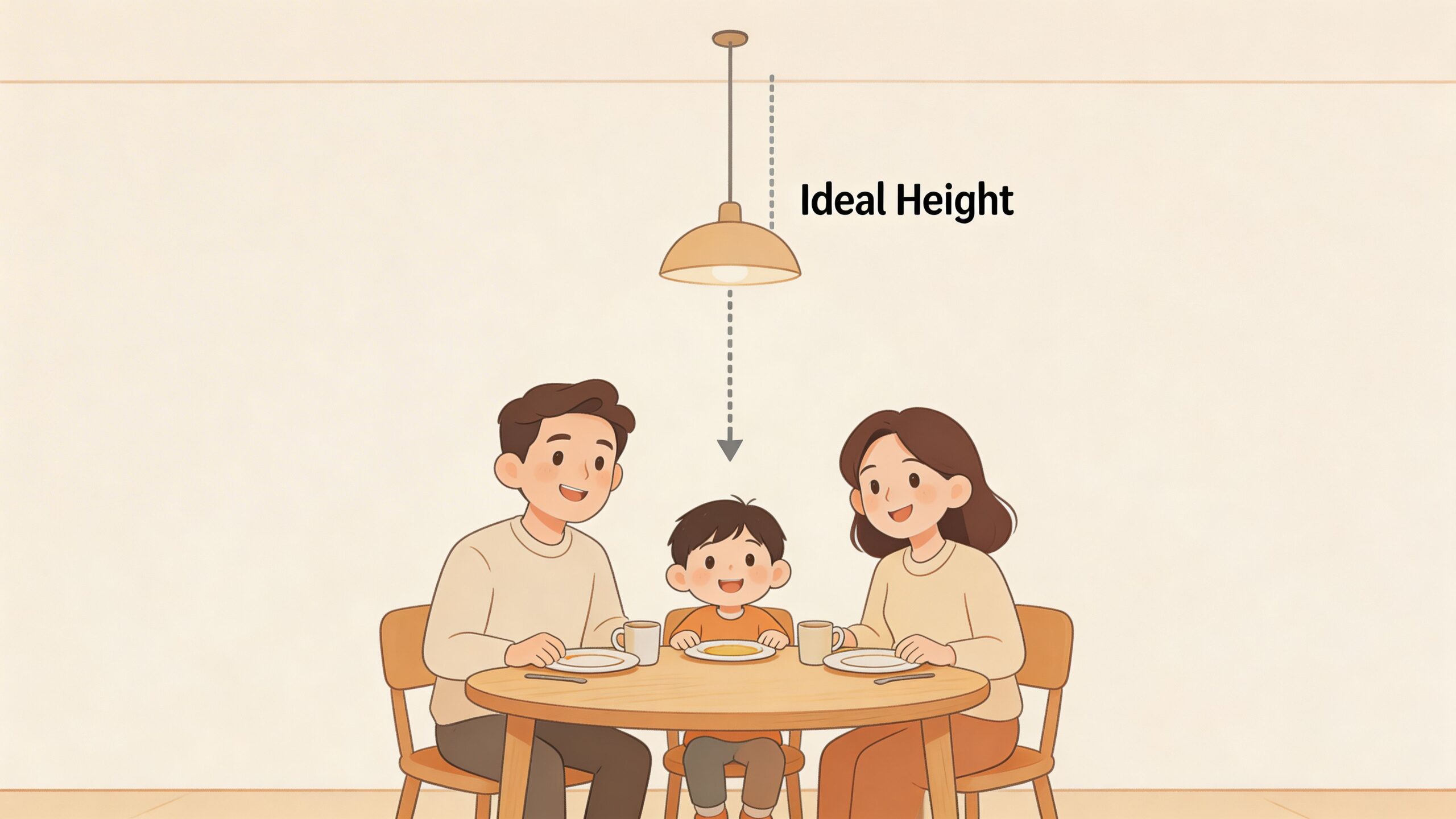
That measurement isn’t arbitrary. The 30 to 36 inch range became the North American industry baseline by the early 2020s because it balances two practical needs: it gives the table proper illumination, and it preserves sightlines across the table for seated guests, as noted in this dining light height guide.
Why this range works
When a fixture hangs too low, the room starts to feel cramped. People notice the fixture before they notice each other.
When it hangs too high, the opposite problem shows up. The light loses its connection to the table, and the dining area can feel visually scattered.
Practical rule: The fixture should feel tied to the table, not the ceiling.
That’s the core reason the height of light over dining table matters so much. You’re not just placing a fixture. You’re shaping how the table is experienced.
A simple way to judge it in the room
Use the standard as your first placement test, then sit down.
Ask yourself:
- Can you see the person across from you clearly? If not, the fixture is likely too low.
- Does the light seem to belong to the table? If it feels detached, it’s likely too high.
- Is the pool of light centered where people dine? The table surface should feel intentionally lit, not incidentally bright.
If you want a broader look at how lighting supports furniture placement and atmosphere, this room lighting article is a useful companion.
Scaling Your Light to Your Architecture
Ceiling height changes the answer. A fixture that feels perfectly grounded in one room can look adrift in another because the architecture is taller.
For ceilings above 8 feet, designers use a straightforward adjustment. Add 3 inches of hanging height for every additional foot of ceiling height. A 10-foot ceiling, for example, calls for a fixture hung 36 to 42 inches above the table, based on the formula discussed in this ceiling-height lighting guide.
How to apply the formula
The formula is often written as H = 30 + 3(C-8)*, where C is the ceiling height in feet.
You don’t need to treat that as engineering. Think of it as a proportion check.
| Ceiling height | Starting hanging range |
|---|---|
| 8 feet | 30 to 36 inches above table |
| 9 feet | 33 to 39 inches above table |
| 10 feet | 36 to 42 inches above table |
What goes wrong in taller rooms
The most common mistake in a room with height is keeping the fixture at the same placement you’d use in a standard dining room. The light may technically work, but visually it can feel compressed against the table while the rest of the room rises around it.
The opposite mistake is raising it too far because the ceiling feels lofty. Then the fixture starts acting like ambient room lighting instead of dining lighting.
In taller spaces, the fixture still needs a relationship with the tabletop. Height in the room doesn’t change that.
A mock-up helps. Even a temporary hanging test can tell you more than a sketch. In professional space planning, this is often where the room starts to make sense, especially when ceiling height, wall openings, and table size all compete for attention. That’s also why thoughtful interior design and space planning matters before anything gets permanently installed.
Finding Perfect Proportions for Your Table
A fixture can be hung at the right height and still look wrong if the scale is off. Proportion is what makes the light feel intentional rather than incidental.
The simplest rule is this: the fixture should be large enough to visually anchor the table, but not so large that it overwhelms the diners. For round tables, the fixture diameter should be 50 to 75% of the table’s diameter. For rectangular tables, the fixture should occupy roughly two-thirds of the table’s visual footprint, according to this sizing guide for dining fixtures.
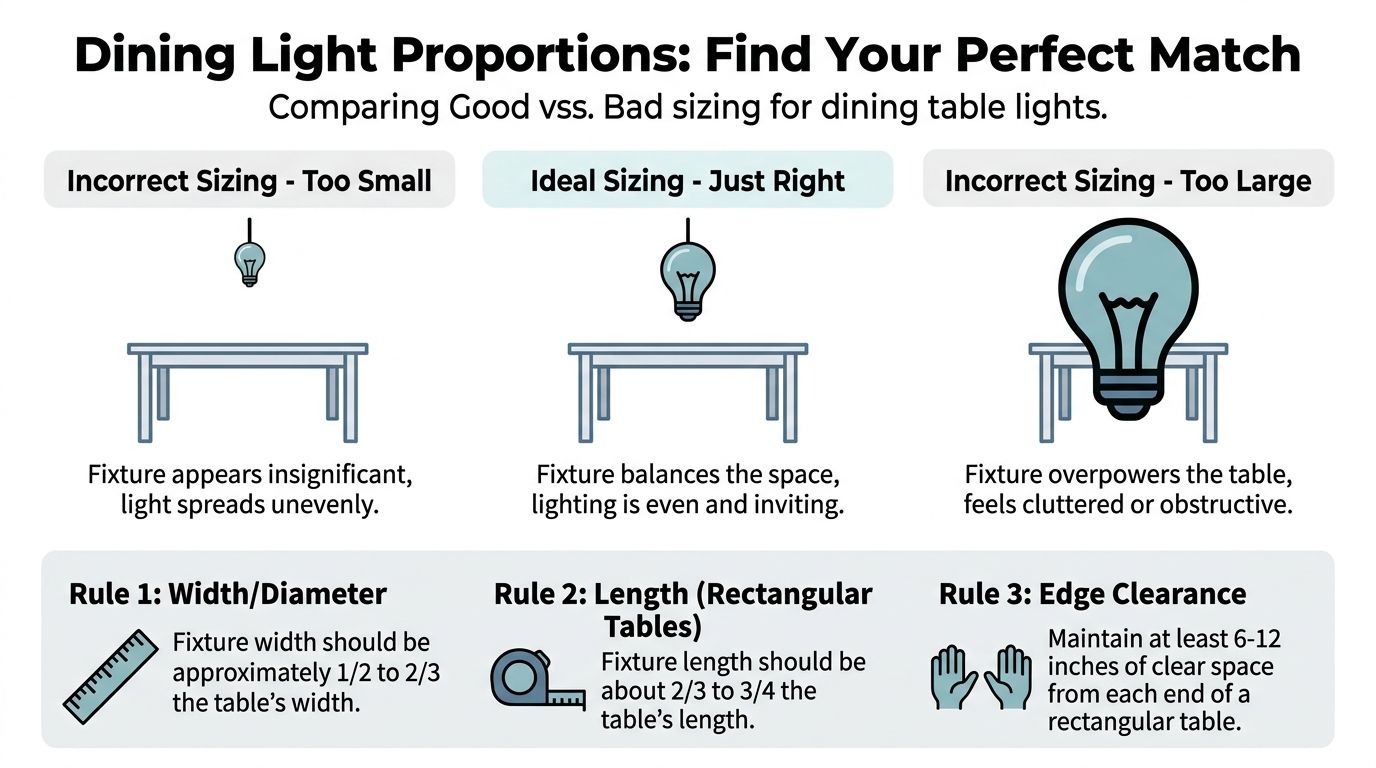
Round tables and square tables
These shapes are the easiest to read visually. A single centered pendant or chandelier usually feels natural.
What matters is diameter. Too small, and the fixture disappears. Too large, and it starts crowding the table edge.
Rectangular tables
Long tables need more visual breadth. That can come from one wider fixture or from a linear form that follows the shape of the tabletop.
Here’s the trade-off:
- Single compact fixture: can leave the table ends underemphasized
- Wide chandelier or linear piece: usually feels more balanced over a longer top
- Multiple pendants: can work well, but only when spacing is disciplined
A quick proportion check
Use this table as a visual decision tool.
| Table shape | What usually works | What usually fails |
|—|—|
| Round | One centered fixture with enough diameter to hold the space | Tiny pendants that look lost |
| Square | One statement fixture with clean symmetry | Overly long fixtures that fight the table shape |
| Rectangular | Linear chandeliers or grouped pendants that match the table’s length | Narrow fixtures that light only the center |
A dining light should echo the table beneath it. When the shapes cooperate, the room feels calmer.
This matters even more with custom dining sets, where the tabletop dimensions, extension leaves, wood tone, and chair profile all influence how substantial the lighting should feel. If you’re comparing proportions for a new table, this dining table height guide helps connect furniture dimensions with lighting decisions in a practical way.
For homeowners shopping at a Furniture store Columbus Ohio residents trust for long-term pieces, this is one of the biggest advantages of choosing Custom dining sets instead of settling for standard sizes. Better table proportions lead to better lighting proportions. That’s especially true with Solid wood furniture Ohio families expect to keep for decades.
Fine-Tuning for Ambiance and Comfort
Once height and scale are handled, the room still needs to feel good. That’s where comfort enters the conversation.
A fixture can be technically correct and still be annoying to live with. The problem is usually glare. Homeowners often discover it only after installation, when someone sits down and realizes they’re staring directly at a bulb.
A 2025 Houzz survey found that 62% of homeowners report post-installation glare issues with their dining lights, often because one-size-fits-all placement ignores different seated eye heights within a household, as described in this glare and dining light discussion.

Why seated eye level changes the answer
A household isn’t one person repeated five times. Some diners are taller. Some are shorter. Some chairs have thicker seats and change where the eye lands in relation to the fixture.
That means the best height of light over dining table often lives inside the standard range, not at one fixed number.
Watch for these signals during a test sit:
- Visible bulb glare: seated guests can see the light source directly
- Harsh shadows on faces: the fixture shape is blocking useful spread
- Visual interruption across the table: conversation feels split by the fixture
The details that improve the room immediately
A few choices make a noticeable difference, even without changing the fixture itself.
- Use a dimmer switch. Dining rooms serve more than one mood, and fixed-output lighting rarely feels right all day.
- Choose warm light. Warm bulbs are usually more flattering to wood finishes, food, and skin tones than cooler light.
- Look at the fixture from a chair, not only while standing. Dining rooms are experienced seated.
Good dining lighting doesn’t call attention to itself. It supports the people at the table.
For heirloom spaces, that human side matters as much as any formula. A hand-finished table, upholstered host chairs, and a carefully chosen fixture deserve a placement that feels generous rather than merely correct.
Lighting for Modern Multifunctional Dining Spaces
Dining rooms don’t live one life anymore. The same table hosts dinner, laptop work, homework, puzzles, and weekend gatherings. Lighting has to support that shift.
As of 2025, an estimated 35% of homeowners use their dining tables for work, and linear suspensions over rectangular tables can provide 15% more evenness in light distribution than single fixtures, according to this discussion of modern dining table lighting needs.
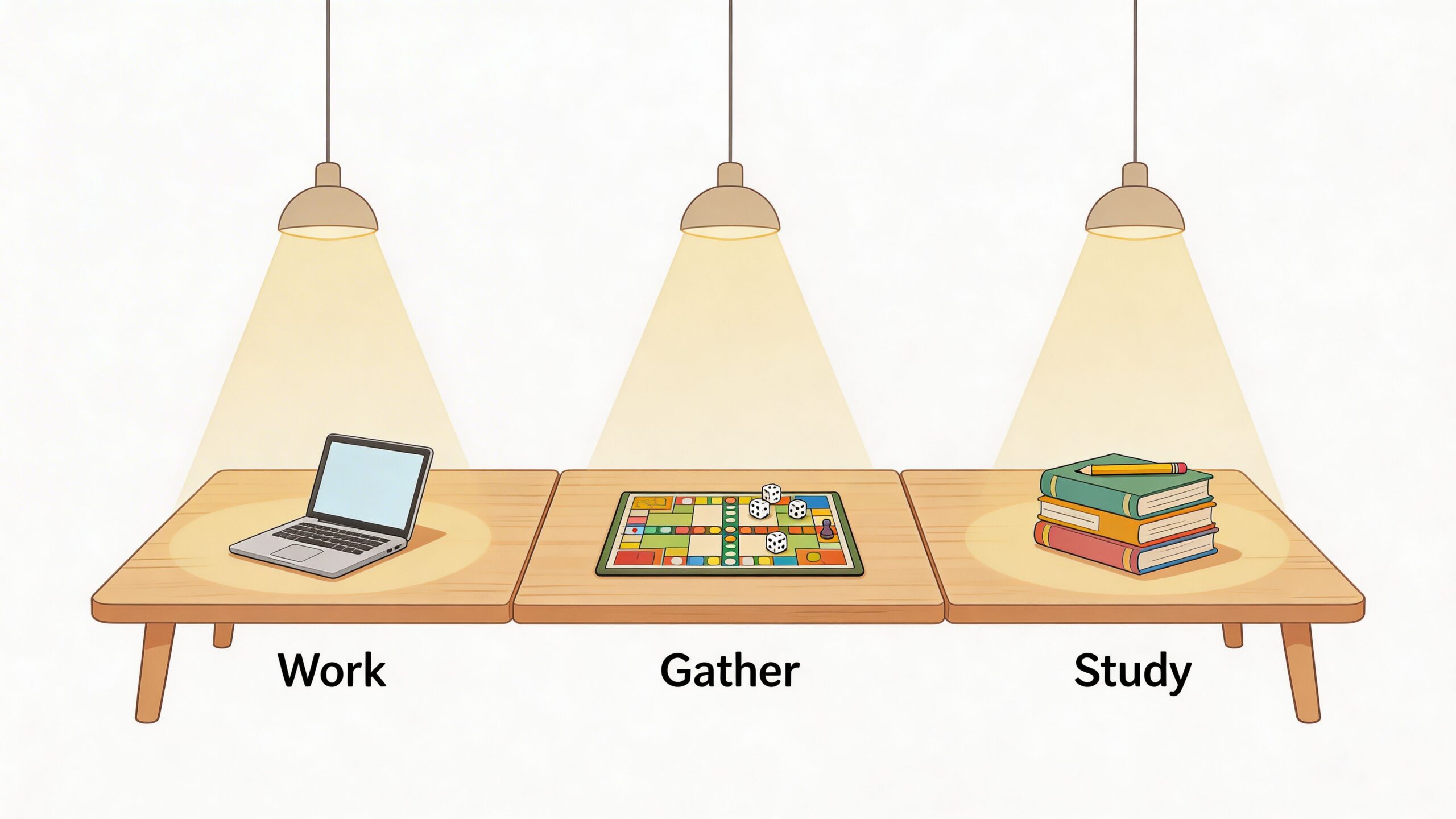
Single fixture or linear fixture
This is less about trend and more about table behavior.
A single chandelier often works beautifully over a round table or a smaller rectangular table that’s used mainly for meals. It creates focus and intimacy.
A linear suspension or a carefully spaced multi-pendant layout tends to work better when the table is long and regularly used for multiple tasks. The light reaches farther, and the ends of the table don’t feel secondary.
What this means for large dining tables
Large Amish-made furniture and other substantial solid wood furniture Ohio homeowners favor often need lighting with similar presence. A narrow fixture over a broad farmhouse or trestle table usually feels under-scaled.
Look for alignment between use and fixture type:
- Daily dining only: a centered statement piece can be enough
- Dining plus work or study: a longer fixture usually serves the tabletop better
- Frequent gatherings: even light across the full surface becomes more important
If your table is the true hub of the home, this perspective on dining tables as multifunctional furniture is worth reading. It reflects how many Columbus households use these rooms now, not how design books used to describe them.
Your Personalized Design Experience at Vinson
Rules help. Real rooms still need interpretation.
That’s especially true when you’re pairing lighting with heirloom-quality furniture. The right fixture height depends on ceiling height, table dimensions, chair scale, bulb visibility, room openness, and how your family uses the space. Two dining rooms can follow the same rule and still need different answers.
That’s where a design studio earns its place. Instead of guessing from a photo or hanging a fixture twice, you can evaluate the room as a complete composition.
What personalized guidance changes
At Vinson Fine Furniture, the showroom experience at Easton Town Center is built around that kind of practical decision-making. This isn’t only about choosing a table. It’s about getting the room to work as a whole.
The In-Store Design Studio and Complimentary Design Consultations help clients sort through details that often get missed when furniture and lighting are considered separately. That includes:
- Table and fixture proportion for round, square, and rectangular layouts
- Finish coordination so the lighting complements, rather than competes with, the wood tone
- Seating and sightline comfort for households with mixed ages and heights
- Room function when the dining area doubles as a work or homework zone
If you want expert help with those choices, you can schedule a complimentary interior design consultation.
Why the Vinson process fits investment homeowners
The Custom Order Program is a major advantage for dining spaces because it lets you personalize the pieces that determine the lighting answer in the first place. With custom options, you can select dimensions, finishes, fabrics, and configurations, then review them through 3D visualizers before committing.
That matters with Custom dining sets, especially when you’re building around brands such as Canadel or choosing among Amish-made furniture and other solid-wood collections. The room becomes more coherent when the table, chairs, and lighting are considered together.
The value side is strong as well:
- Low Price Guarantee: if you find a lower price at a local authorized dealer within 30 days, Vinson will refund 110% of the difference
- Clearance Gallery: offers savings of up to 70% on select floor samples, overstocks, and closeouts
- Flexible Financing: available through Synchrony HOME
- White-Glove In-Home Delivery: careful placement, assembly, and packaging removal
For many shoppers, that combination is what makes Vinson a standout Furniture store Columbus Ohio homeowners return to. You’re getting design help, customization, value protection, and a delivery experience that respects the investment.
The same showroom also serves clients shopping beyond the dining room, including premium sleep solutions for those researching the Best mattresses Easton Town Center has to offer. That wider perspective helps when you’re furnishing an entire home instead of solving one isolated purchase.
A dining room should feel composed the day it’s installed and still feel right years from now. That’s the benefit of treating lighting height as part of the lived experience, not just a measurement.
If you’re ready to build a dining room that feels thoughtfully designed from the ceiling down, visit Vinson Fine Furniture at Easton Town Center. The team can help you pair heirloom-quality tables, custom seating, and the right lighting plan through complimentary design guidance, 3D customization tools, flexible financing, white-glove delivery, the Low Price Guarantee, and a Clearance Gallery with savings up to 70%.