Home Office Furniture Modular Systems for 2026

Somewhere in your home, there's probably a surface doing too many jobs.
It might be the dining table that turns into a desk by morning and back into family space by dinner. It might be a spare bedroom corner with one small desk, one overworked lamp, and a tangle of charging cords on the floor. Or it might be an old office setup that made sense years ago, but no longer fits how you work.
That's why more homeowners are rethinking the home office as a permanent part of the house, not a temporary patch. The appeal of home office furniture modular design is simple. It lets a room change with your routine, your technology, and your family, without asking you to start over every few years.
Reimagining the Modern Home Workspace
A lot of people begin the same way. They borrow a chair from the breakfast nook, slide a laptop onto a table meant for meals, and promise themselves it's only for a season. Then work patterns settle in, meetings multiply, papers spread, and the makeshift setup starts to feel less charming and more exhausting.
That shift isn't just anecdotal. The global home office furniture market was valued at USD 25.3 billion in 2024 and is projected to reach USD 45.3 billion by 2034, with wood-based furniture holding 38.5% market share because buyers value durability and appearance in adaptable workspaces, according to Market.us home office furniture market data.

When a temporary setup becomes a daily frustration
The most common complaints are rarely dramatic. They're small, repeated irritations.
- The desk is too shallow for a monitor, keyboard, notebook, and coffee.
- Storage is missing, so work materials drift into other rooms.
- The room feels crowded, even when the furniture itself isn't very large.
- Nothing matches the home, so the office looks borrowed rather than designed.
Those issues are exactly where modular planning helps. Instead of buying one fixed desk and hoping it solves everything, you build around how the room functions. A return can add surface area. A credenza can hide paperwork. Vertical storage can free the floor. A compact footprint can still feel generous if each element has a purpose.
A well-planned home office should feel like part of your home, not like a corner you surrendered to work.
Why modular design feels more grown-up
People sometimes hear “modular” and think temporary, utilitarian, or office-park bland. In a well-designed home, it means something else. It means the desk, storage, and layout work together as a system.
That's especially useful in homes where one room has to support more than one life stage. A guest room might also be a work room. A loft might serve one person now and two later. A study might need to hide business equipment by evening.
If you're refining that vision, this guide to creating an inspiring home office is a helpful starting point for thinking beyond a single desk purchase and toward a room that feels settled.
Understanding Modular Furniture Systems
Modular furniture is easiest to understand as high-end architectural building blocks. Each piece is designed to connect with the others in a consistent way, so the whole arrangement feels intentional rather than improvised.
That doesn't mean every modular office looks the same. It means the underlying structure is standardized enough that you can rearrange, expand, or simplify without replacing the entire room.
What modular actually means
A modular office usually includes several components that can work independently or together:
| Module | What it does | When it helps most |
|---|---|---|
| Desk shell or writing surface | Creates the primary work area | Daily computer work, writing, planning |
| Return or bridge | Extends usable surface | Dual-monitor setups, paperwork, printers |
| Credenza | Adds enclosed or open storage | Shared rooms, visible office spaces |
| File cabinet | Organizes active records | Home businesses, tax and legal storage |
| Hutch or wall unit | Uses vertical space | Small rooms, book storage, display |
The advantage is flexibility with structure. You're not improvising with unrelated pieces. You're choosing elements that are meant to align.
Why quality engineering matters
Many homeowners get confused. They assume all modular furniture is lightweight because some mass-market versions are. High-end systems are different.
According to technical specifications summarized by Cubicles.com, precision-engineered modular systems use standardized connection points that often allow tool-free reconfiguration. Some systems can support up to 150kg per shelf, with die-cast components manufactured to tolerances under 0.1mm, which helps panels align cleanly and stay stable over time.
Practical rule: If a modular system feels flimsy when stationary, it won't improve with reconfiguration.
That precision is what separates a lasting system from a disposable one. When connection points are exact and surfaces meet properly, the office feels composed. Drawers sit square. Shelves stay level. The visual rhythm of the room remains calm, even when the layout changes.
Smart design, not compromise
The strongest modular rooms don't announce themselves as modular. They feel precisely fitted.
Some homeowners want a writing desk with a modest profile. Others need an L-shape with concealed storage. Others want a wall of cabinetry that can absorb printers, files, books, and devices. The system approach allows those outcomes without forcing every decision into a one-piece solution.
For a deeper look at layouts that do more than one job, this guide to multifunctional home office furniture shows how different modules can serve real household needs without making a room feel overfurnished.
The Long-Term Benefits of Adaptable Design
The strongest argument for modular office furniture isn't that it moves around. It's that it stays useful.
A fixed desk solves the room you have today. A modular system can keep solving the room after a renovation, a move, a new job, or a change in who uses the space. That's why adaptable design tends to age better inside a home. It responds to life instead of resisting it.
One room, several futures
Think about how often a home office changes over the years.
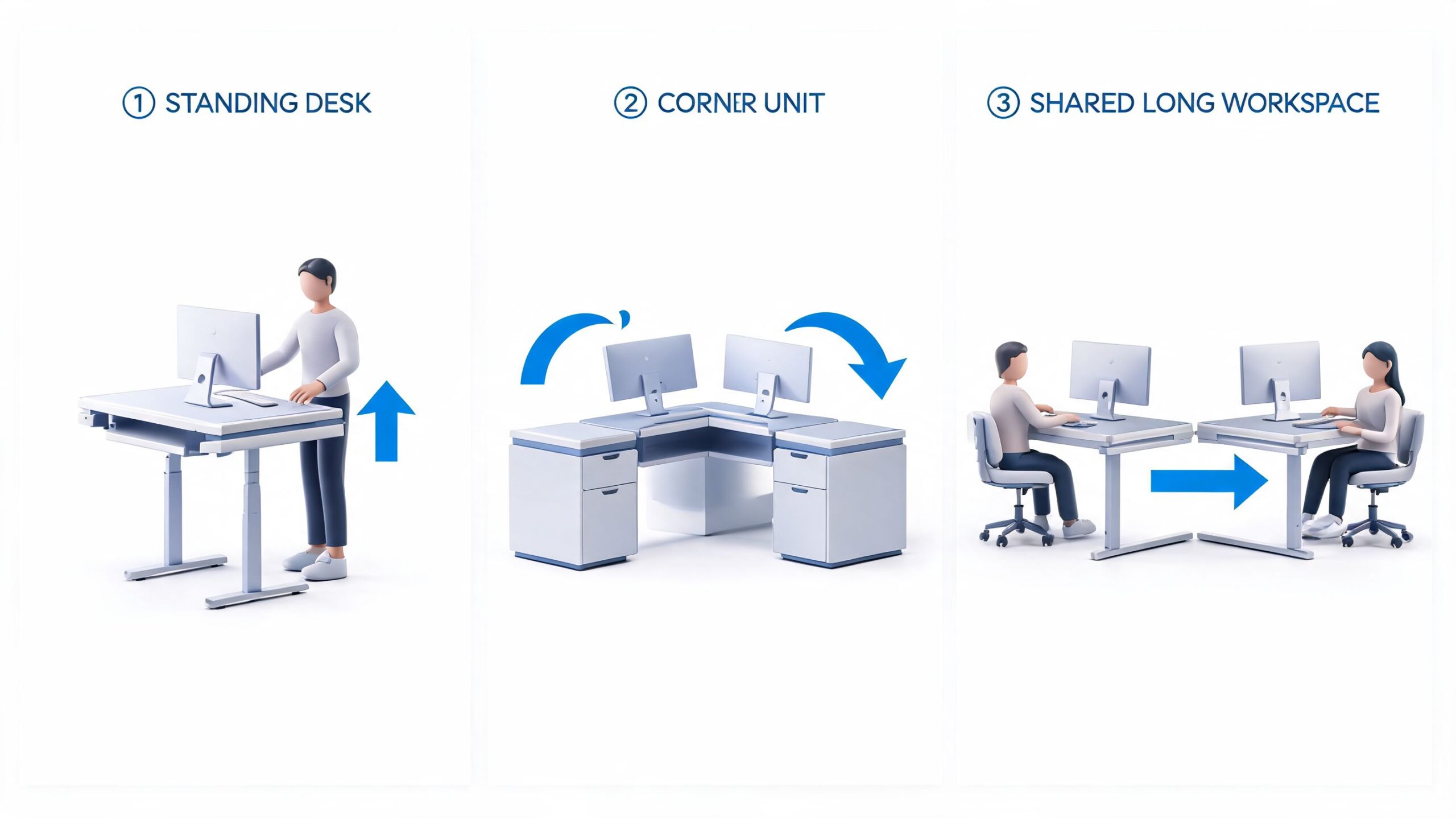
A single workstation can become a shared room for spouses with different schedules. A compact desk can grow into a full planning station for a business owner. Closed storage can matter more once children are older and household traffic increases. In a smaller home, the office may need to look orderly even when work is still in progress.
That's where modular design earns its place. Instead of replacing one large furniture piece with another, you adjust the composition.
- Add surface area when your work becomes more paper-heavy.
- Shift to a corner layout when you want the center of the room open.
- Increase vertical storage when floor space is limited.
- Simplify the room if the office later becomes a guest space again.
Why adaptability supports value
Furniture lasts longer when it keeps fitting the home. That sounds obvious, but it's often missed. People don't always replace furniture because it has failed. They replace it because it no longer works for the room, the technology, or the routine.
A modular office reduces that problem. You can preserve the parts that still serve you and change only what no longer does. That creates a more deliberate kind of ownership. It also tends to produce better-looking rooms, because each update builds on what's already there rather than starting from zero.
Good office planning isn't about buying more furniture. It's about keeping useful furniture in service longer.
Homeowners who care about longevity often benefit from reading beyond style trends and looking at lifespan. This discussion of how long furniture should last helps frame office furniture as part of the home's long-term infrastructure, not as a disposable accessory.
A better fit for awkward rooms
Adaptable systems also shine in imperfect spaces. Not every home office is a perfect square with one blank wall waiting for a desk. Many are tucked into lofts, alcoves, converted bedrooms, or narrow studies with windows and doors in inconvenient places.
A modular composition can handle those realities more gracefully than one oversized desk. You can anchor the room with a primary work surface, then add low storage under a window, place a return where wall length allows, or use a taller unit only where ceiling height feels balanced. The result is often quieter and more custom than a single large office suite.
How to Plan Your Ideal Modular Office Layout
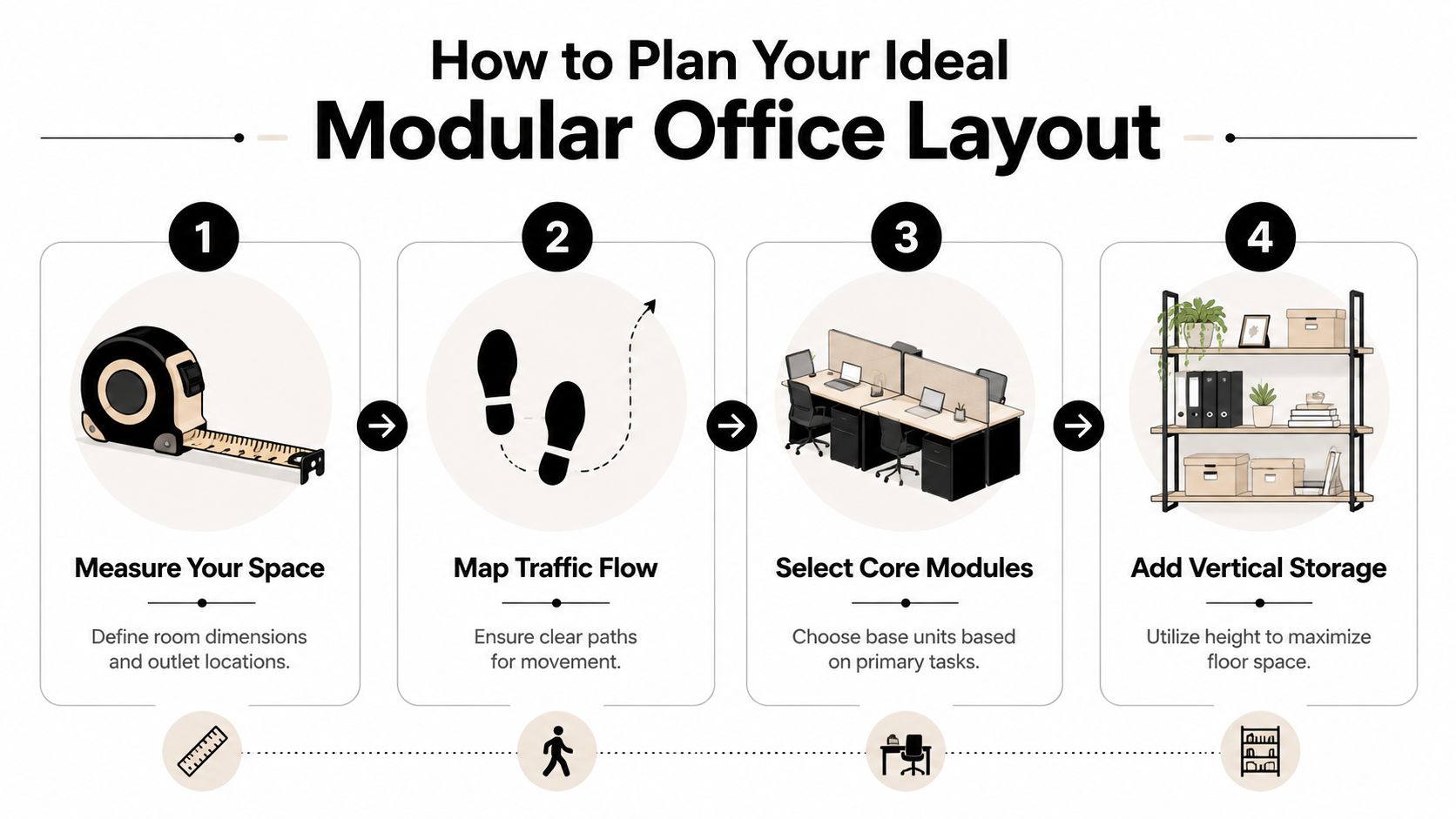
A successful office doesn't begin with finishes or hardware. It begins with movement. How you enter the room, where you sit, where cords land, where papers pile up, and what needs to be within arm's reach. Those details shape the layout far more than style boards do.
Start with the room, not the desk
Before you choose a single piece, take basic measurements and note fixed conditions.
Write down wall lengths. Mark windows, door swings, vents, and outlets. Notice whether the room needs to support video calls, concentrated reading, paperwork, or all three. A room that looks large on paper can feel tight once a chair is pulled back and drawers are open.
This first pass should answer a few practical questions:
- Where can the main work surface sit without blocking circulation?
- Which wall can support storage without making the room feel top-heavy?
- Do you need the office to face into the room, toward a wall, or near natural light?
- Which devices need regular power access?
Plan around your daily workflow
A beautiful office can still be irritating if the layout fights your habits. That's why I usually tell homeowners to track a normal workday before they shop.
If you spread out contracts, notebooks, or sketches, you'll want broader uninterrupted surface area. If you mostly work digitally, a cleaner desk with better concealed storage may serve you better. If you switch between laptop and monitor throughout the day, cable management matters more than people expect.
Here's a simple planning table to use:
| Work habit | Layout response |
|---|---|
| You use two screens daily | Prioritize a wider main desk and clean wire routing |
| You handle paper files often | Add reachable file storage beside the desk |
| You take video calls | Choose a background wall that looks composed |
| You share the room | Separate task zones rather than crowding one surface |
If you have to stand up every time you need a charger, file, or notebook, the layout isn't finished yet.
Choose modules in the right order
Homeowners often buy storage first because it looks impressive. Start with the core work zone instead.
- Primary desk module should come first. This is your anchor.
- Return or side surface comes next if your work spreads laterally.
- Storage pieces should support the desk, not overpower it.
- Upper units or shelving should only be added where they improve function.
That order keeps the room from feeling furniture-heavy. It also helps you avoid one of the most common mistakes in home office furniture modular planning, which is buying a large ensemble that leaves too little breathing room for the person using it.
Don't ignore power and cable management
Modern modular systems have become significantly more refined. According to Steelcase desk system information, powered modular systems can reduce cable clutter by up to 70%, and integrated access to power can reduce ergonomic risks such as trips or awkward reaching by an estimated 25%.
That matters more in a home than many people realize. Loose cords make a room feel unsettled. They also complicate cleaning, distract the eye, and create friction in daily use. When power is built into the plan, the office looks calmer because it is calmer.
Use professional planning when the room needs to do more
Some rooms are straightforward. Others need more thoughtful balancing because they double as guest rooms, library spaces, or family study zones. If your room has multiple demands, professional space-planning support can help you test layouts before committing to a full configuration.
That's especially useful when you're trying to decide between an L-shape, a straight desk with separate storage, or a wall-based composition with vertical elements. The right answer usually depends less on square footage than on how you move through the room and what you need the office to hide when the workday ends.
Customizing for Heirloom Quality and Style
This is the point where modular furniture either becomes forgettable or becomes part of the home.
Many modular pieces on the market are designed for short-term utility. They solve a problem quickly, but they rarely age with much grace. Edges wear. finishes flatten. Hardware looks dated. The room works, but it never feels rooted. For an investment-minded homeowner, that's not enough.

Why material choice changes everything
If you want modular furniture to feel lasting rather than temporary, start with material honesty. Solid wood brings warmth, visual depth, and repairability that many synthetic surfaces cannot match over time.
That matters because durability isn't a niche concern. A Cubicle by Design summary on modular office furniture notes that a 2025 Houzz report found 68% of homeowners prioritize furniture that lasts over 20 years. The same source states that high-end solid-wood modular systems can retain 70 to 80% of resale value after 10 years.
For a homeowner, that changes the entire conversation. The office stops being a short-term setup and becomes part of the home's long horizon.
Customization is what makes modular feel personal
The phrase “modular system” can sound standardized. In practice, customization is what gives it character.
A thoughtful custom process lets you shape:
- Wood species and finish, from lighter contemporary tones to deeper hand-finished stains
- Hardware style, which can pull the room traditional, transitional, or more architectural
- Configuration, so the office fits the room instead of forcing the room to fit the furniture
- Storage mix, with more open display, more concealment, or a balanced combination
This is also where showroom experience matters. Looking at small swatches online rarely tells you enough about undertone, grain movement, or how a finish shifts under natural versus evening light.
The right finish shouldn't just match the floor. It should belong to the room at every hour of the day.
A modular office can still feel handcrafted
There's no contradiction between modular planning and heirloom quality. One addresses flexibility. The other addresses longevity.
In a design setting, a custom order approach can combine those goals. At Vinson Fine Furniture, homeowners can work through a Custom Order Program with configurable office pieces, finish options, and design visualization tools that help them preview how a layout and material palette will read before the piece is built. That's a practical way to avoid the common mismatch between what looked acceptable on a screen and what feels right in the room.
For many Columbus homeowners, especially those already shopping for solid wood furniture Ohio families can live with for decades, that's the primary appeal of home office furniture modular planning. You're not settling for a temporary office system. You're designing a room with the adaptability of modern furniture and the staying power of a well-made cabinet.
Your Design Journey at Vinson Fine Furniture
A home office is easier to judge in person than almost any other room. You can read dimensions online, but you can't feel drawer movement, surface depth, chair scale, or finish character from a screen alone. That's why the showroom step matters, especially for homeowners who want the office to look refined and stay useful.
The need is only becoming more established. As work patterns continue to settle, 41% of employees opt for a hybrid schedule, and a June 2020 survey found nearly half of U.S. employees favored that arrangement, according to Loctek's roundup of home office ergonomics statistics. In practical terms, that means more homeowners need an office that supports regular use without taking over the house.
What the in-store process looks like
At Easton Town Center, the experience is usually less about browsing random desks and more about narrowing the right direction.
A homeowner might arrive with room measurements, a few photos, and a list of frustrations. The next steps tend to fall into place:
- Complimentary design consultations help translate needs into a working plan.
- The In-Store Design Studio gives you a place to compare finishes, layouts, and scale.
- The Custom Order Program allows choices in configuration, finishes, and other details through digital visualizers.
- White-Glove In-Home Delivery handles placement and setup once the piece arrives.
The value side of the decision
Investment furniture should still be bought carefully. That's why value protections matter.
Vinson's Low Price Guarantee offers a 110% refund of the difference if a lower price is found at a local authorized dealer within the stated window. The Clearance Gallery also offers savings of up to 70% on selected floor samples, overstocks, and closeouts. For homeowners balancing quality with budget, those options make it easier to buy for the long term rather than defaulting to a short-term compromise.
Flexible financing through Synchrony HOME can also help spread out a larger office project, especially if you're furnishing a whole room at once with desk, storage, and seating.
Why Easton is worth the trip
For Central Ohio shoppers searching terms like Furniture store Columbus Ohio, Amish-made furniture, Custom dining sets, or even Best mattresses Easton Town Center, the larger point is the same. Good furniture is easier to choose when you can test it, compare it, and speak with someone who understands room planning.
If you're ready to move from ideas to actual layouts, custom made office furniture options are a useful place to continue the process before visiting the showroom.
If you're ready to create a home office that feels tailored, lasting, and easy to live with, visit Vinson Fine Furniture at Easton Town Center. Bring your room measurements, a few photos, and a sense of how you work. The team can help you explore layout options, custom finishes, delivery support, and practical ways to build a workspace that belongs in your home for years.