Custom Sectional Sofa: The Complete Buyer’s Guide


A stock sectional can look perfect on a product page and fail the moment it enters a real home. The chaise may block the hallway, the return may cover a floor vent, or the seat depth may leave no useful clearance around the coffee table. In Columbus homes, especially open-plan rooms and compact urban layouts, those failures are usually sizing problems, not decorating problems.
A custom sectional sofa earns its place when the room has constraints that standard dimensions can't solve. The buyer chooses the footprint, configuration, upholstery, seat geometry, and motion features around the way the household lives. At Vinson Fine Furniture, the decision also includes a solid hardwood standard, regional craftsmanship, an in-store sit-test, and design support for homeowners who expect furniture to serve for years.
Why a Custom Sectional Sofa Solves Real Room Problems
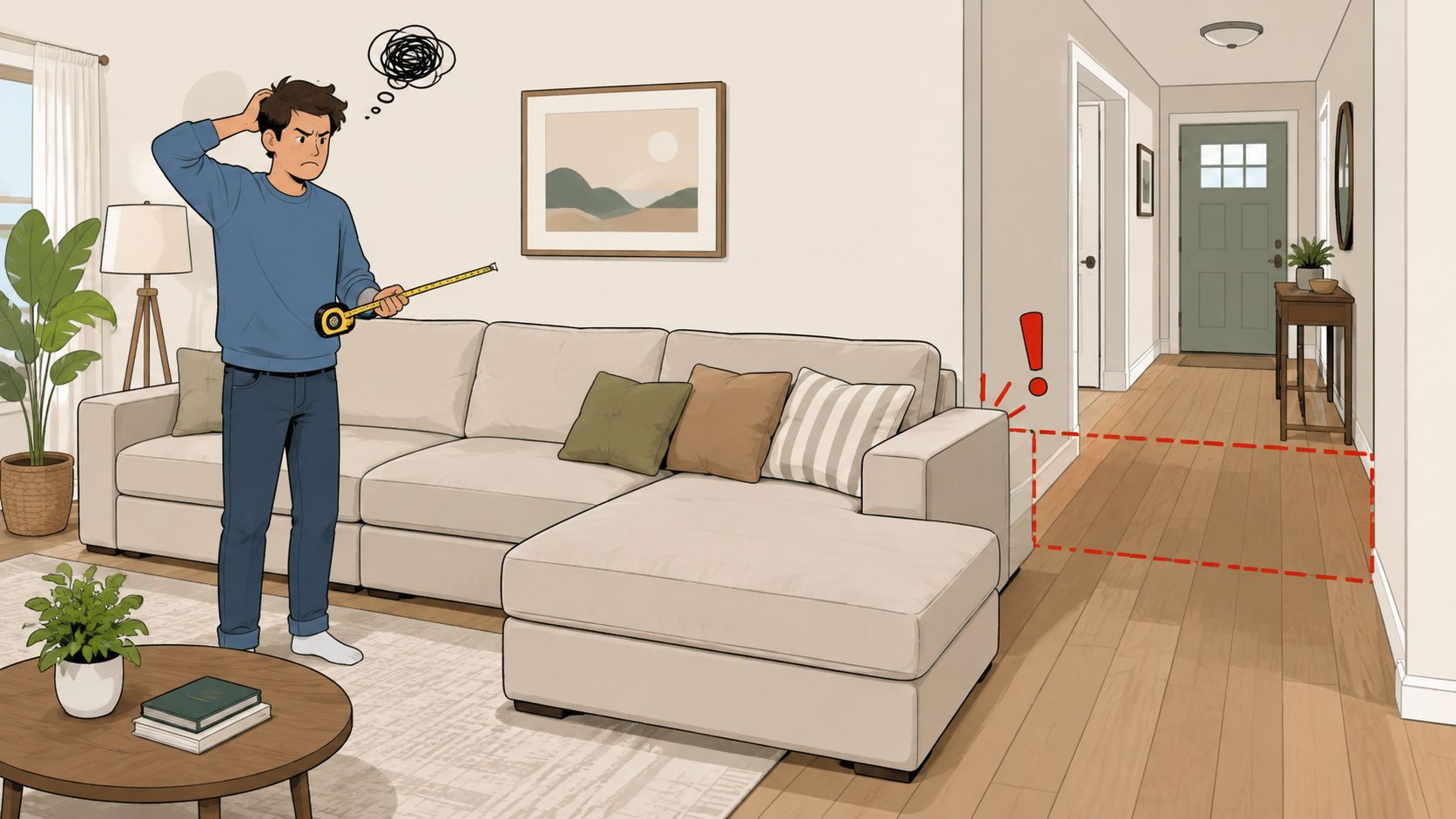
A homeowner measures the living room, orders a stock sectional, and waits for delivery. When the boxes arrive, the chaise reaches into the hallway, the back crowds a window sill, and the coffee table sits so close that moving through the room becomes awkward. Returning the piece is frustrating. Keeping it means adapting the entire room to furniture that was never designed for it.
That's the practical reason custom sectionals exist. Customization isn't merely a decorative upgrade. It allocates the room's available space intentionally, accounting for an irregular wall, a fireplace hearth, a bay window, an open-concept sightline, or a doorway that needs to remain clear. The sectional can be specified with the return on the correct side, a more suitable chaise depth, narrower arms, or a seat height that works with the household's posture and existing furniture.
Custom starts with the room
A typical contract-grade modular suite may be configured around 3200 × 1850 × 780 mm, with a seat height near 430 mm, according to modular sectional specifications. Those dimensions aren't interchangeable. They affect walking space, seated posture, sightlines, and the possibility of rearranging the room later.
A custom order lets the buyer decide which dimensions matter most:
- Footprint: The overall length and return should respect walls, openings, and circulation.
- Seat geometry: Depth, height, cushion construction, and back angle determine whether the sofa supports upright conversation or relaxed lounging.
- Chaise orientation: Left-facing and right-facing layouts should be judged from the position of the person facing the sectional, not guessed from a product thumbnail.
- Arm and back proportions: Slimmer arms can preserve seating capacity, while a lower back may protect a window view.
Practical rule: A sectional should fit the household's movement patterns first, then satisfy the room's visual proportions.
The format has a long design history. Historical accounts trace early multi-unit seating to around 1820, while Victorian households grouped seating that could be pushed together. Designer Harvey Probber helped establish modular furniture as a mainstream concept in the 1940s, a development described in this history of sectional sofas. Custom sectionals are therefore the current expression of a long-standing idea, flexible seating shaped around real rooms.
For homeowners researching furniture for small spaces, the question isn't whether a sectional is fashionable. It's whether a carefully planned configuration solves the room more effectively than a fixed stock model. The rest of the purchase should follow that answer.
Choosing the Right Configuration for Your Space
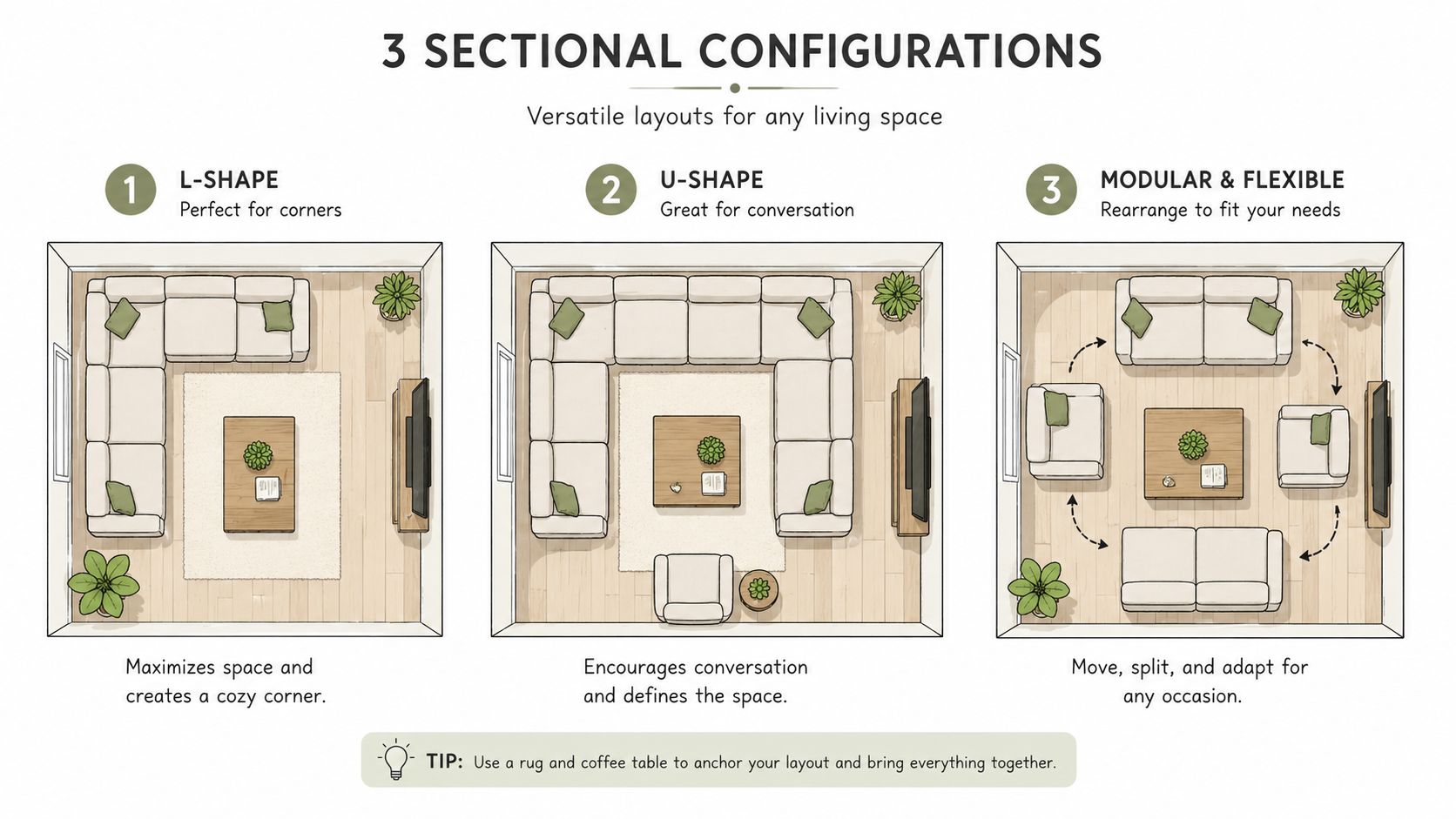
The right configuration depends on how the room needs to function, not on which silhouette looks most dramatic in a catalog. An L-shape, U-shape, and modular arrangement each solve a different planning problem.
Match the layout to the room
L-shape sectionals are the most reliable choice for a rectangular living room. One run anchors a wall, while the return defines a corner without closing off the entire floor. This arrangement works particularly well when one wall contains windows, a fireplace, or a television because the sectional can face the focal point while leaving a clear route around the room.
U-shape sectionals create a defined conversation zone. They suit a larger, more square room where several people regularly gather and where the seating itself can establish the boundary of the living area. Their advantage is generous face-to-face seating. Their weakness is equally clear, they consume substantial floor area and can make a smaller room feel crowded.
Modular sectionals provide the greatest long-term flexibility. Armless chairs, corner units, ottomans, and chaises can be arranged according to the current room and reconfigured after a move or renovation. Modular construction is especially sensible for buyers whose household, floor plan, or entertaining habits may change.
Use a showroom decision framework
Before visiting a showroom, answer three questions:
- How many people usually sit together? Design for the household's normal use, not an occasional holiday gathering.
- What is the focal point? A fireplace, television, window view, or conversation center should determine orientation.
- Does the sectional sit against a wall or divide an open plan? A freestanding sectional needs finished backs, balanced proportions, and circulation on more than one side.
Sectionals represent a major upholstery category. A 2025 industry report estimated the global market at $22.4 billion, with a projection of $36.8 billion by 2034 at a 5.2% compound annual growth rate. The same sectional sofa market report identified L-shaped sectionals as 42.3% of market share and North America as 38.5% of revenue. Those figures reflect broad demand, but they don't determine the best configuration for one living room.
Use the custom sectional design service to test the layout against the room's actual constraints. For Columbus homeowners, an in-person sit-test at the Easton Town Center showroom remains more useful than judging scale from a screen.
What Makes a Sectional Frame Built to Last
A sectional's longevity comes from three interacting layers: the frame, the suspension, and the cushion core. A beautiful upholstery pattern can't compensate for a frame that twists or a seat system that loses support.
Frame and joinery
Vinson's standard is straightforward. The company sells solid hardwood furniture, with wood discussions centered on solid cherry, oak, maple, and walnut. Kiln-dried hardwood is valuable because controlled drying stabilizes moisture content and helps the frame resist seasonal movement. Furniture guidance links solid hardwood frames, durable suspension, and high-resiliency foam with service of 15 years or more, while lower-grade construction may sag within 3 to 5 years. Those figures appear in this sectional quality guide.
Construction details deserve direct questions. Corner blocks reinforce stress points. Dowels align joined components. Mortise-and-tenon joinery creates a deep mechanical connection rather than relying on surface contact. A guide to furniture joints can help buyers recognize why joinery matters.
Suspension and cushions
Eight-way hand-tied coils are often treated as a durability benchmark because the system distributes support across the seat. Sinuous springs can provide effective support with a different feel and construction approach, while elastic webbing depends heavily on its specification and installation. The right question isn't which term sounds premium. Buyers should ask how the system is attached, how the seat is supported, and what happens when cushions are rotated or replaced.
Cushion cores also shape long-term comfort. High-resiliency foam retains structure differently from softer synthetic fills, while down-wrap combinations provide a softer hand but require regular fluffing. Density is commonly expressed in pounds per cubic foot, so the specification should appear in writing rather than being summarized as “premium.”
| Component | Material option | Expected lifespan | Durability rating |
|---|---|---|---|
| Frame | Kiln-dried solid maple, oak, cherry, or walnut | Long-term service with proper care | Very high |
| Joinery | Mortise-and-tenon, reinforced corner blocks, or dowels | Supports repeated daily loading | High |
| Suspension | Eight-way hand-tied coils | Strong support retention when well built | Very high |
| Suspension | Sinuous springs or elastic webbing | Depends on gauge, spacing, and attachment | Moderate to high |
| Cushion core | High-resiliency foam | Strong shape retention when correctly specified | High |
| Cushion fill | Down-wrap or synthetic blend | Soft comfort with greater maintenance variation | Moderate to high |
Ask for the frame species, kiln-drying method, joinery, suspension type, cushion composition, and warranty terms before approving the order. Those details predict value more reliably than a showroom label.
Selecting Upholstery That Performs in Daily Life
Upholstery should be selected according to use, not just color. A household with pets, children, direct sunlight, or frequent entertaining needs a different material strategy than a formal sitting room used occasionally.
Compare the hand-feel with the workload
Top-grain leather offers a substantial feel and develops a patina over time. It can show scratches, though, and buyers should accept that visible aging is part of the material's character. Performance leather and performance fabrics offer more targeted resistance for active rooms, while natural textiles can provide breathable texture with greater sensitivity to stains, wrinkles, and wear.
Abrasion testing gives buyers a useful baseline. Residential upholstery is commonly cited around 10,000 to 25,000 rubs, with approximately 15,000 cycles considered suitable for everyday home use and 30,000 or more cycles indicating very high abrasion resistance, according to this fabric rub test guide. A rub count isn't a complete quality assessment, but it helps compare fabrics intended for repeated sit-to-stand loading.
| Material type | Double-rub rating | Stain resistance | Pet and kid friendly | Maintenance level | Best for |
|---|---|---|---|---|---|
| Top-grain leather | Not stated consistently across leather grades | Moderate, depending on finish | Good for many households, scratches remain visible | Moderate | Buyers who want patina and a substantial feel |
| Performance leather | Confirm with the maker | High relative to untreated leather | Strong option for active rooms | Moderate | Frequent use with a leather preference |
| Performance fabric | Often specified by the manufacturer | High when treated | Strong option for pets and children | Low to moderate | Family rooms and daily lounging |
| Natural linen or cotton blend | Varies by weave and finish | Low to moderate | Better for lighter-use rooms | Moderate to high | Breathable texture and relaxed interiors |
The table avoids assigning unsupported rub counts to materials that require brand-specific testing. Buyers should request the exact test result for the selected upholstery, not a general statement about the fabric family.
Test before committing
Request swatches for every serious option. Place them near windows, existing solid oak or maple furniture, and the room's lighting at different times of day. A small sample also reveals weave texture, color shifts, pet-hair visibility, and whether the finish feels too slick or too delicate.
Vinson's performance fabric sectional options give shoppers a starting point for reviewing upholstery choices. The Custom Order Program also supports fabrics, finishes, and 3D visualizers for Smith Brothers of Berne, Mavin, and Canadel. Smith Brothers is made in Indiana, Mavin is Amish-made in Ohio, and Canadel is handcrafted in Quebec, Canada. For a Columbus buyer, that North American sourcing range makes it possible to compare American-made and Canadian craftsmanship without treating upholstery as an afterthought.
Measuring Your Room and Planning Traffic Flow
A sectional should be measured twice, once for the room and once for delivery. The most attractive configuration is useless if it can't pass through the front door, turn at the stairwell, or clear an interior doorway.
Follow a complete measuring sequence
- Record wall lengths. Measure each wall, including the distance from corners to windows, doors, and fireplace surrounds.
- Map vertical limits. Note ceiling height, window sill height, railings, and any architectural feature that affects the back or arm.
- Measure the route. Record entry doors, hallway widths, stairwell turns, elevator openings, and the tightest point along the delivery path.
- Mark fixed obstacles. Include outlets, floor vents, radiators, HVAC registers, and door swing radii.
- Confirm motion clearance. Reclining and power sections need space behind and in front of the mechanism, not merely the footprint shown when closed.
Draw the living pattern, not just the sofa
Use painter's tape to outline the proposed sectional on the floor. Keep the taped footprint in place for 48 hours. That simple test exposes problems that a plan can conceal, such as a blocked path to the kitchen, an awkward television angle, or a chaise that dominates the room.
For planning, preserve 18 inches between the sofa edge and coffee table, allow 30 to 36 inches for primary walkways, and maintain 14 inches of legroom depth, based on the specified room-planning requirements. These clearances should be treated as working targets, then adjusted for household mobility and the room's circulation pattern.
The most common errors are predictable:
- Chaise depth: Buyers measure the wall but forget how far the chaise projects into the room.
- Door operation: A door swing can eliminate the clearance that looked available on paper.
- Motion furniture: Reclining and motorized sections need additional operating space.
- Delivery access: A sectional that fits the room may still fail at a stair turn.
The furniture measuring guide can help organize those measurements before the showroom appointment.
Understanding Pricing Timelines and Customization Tradeoffs
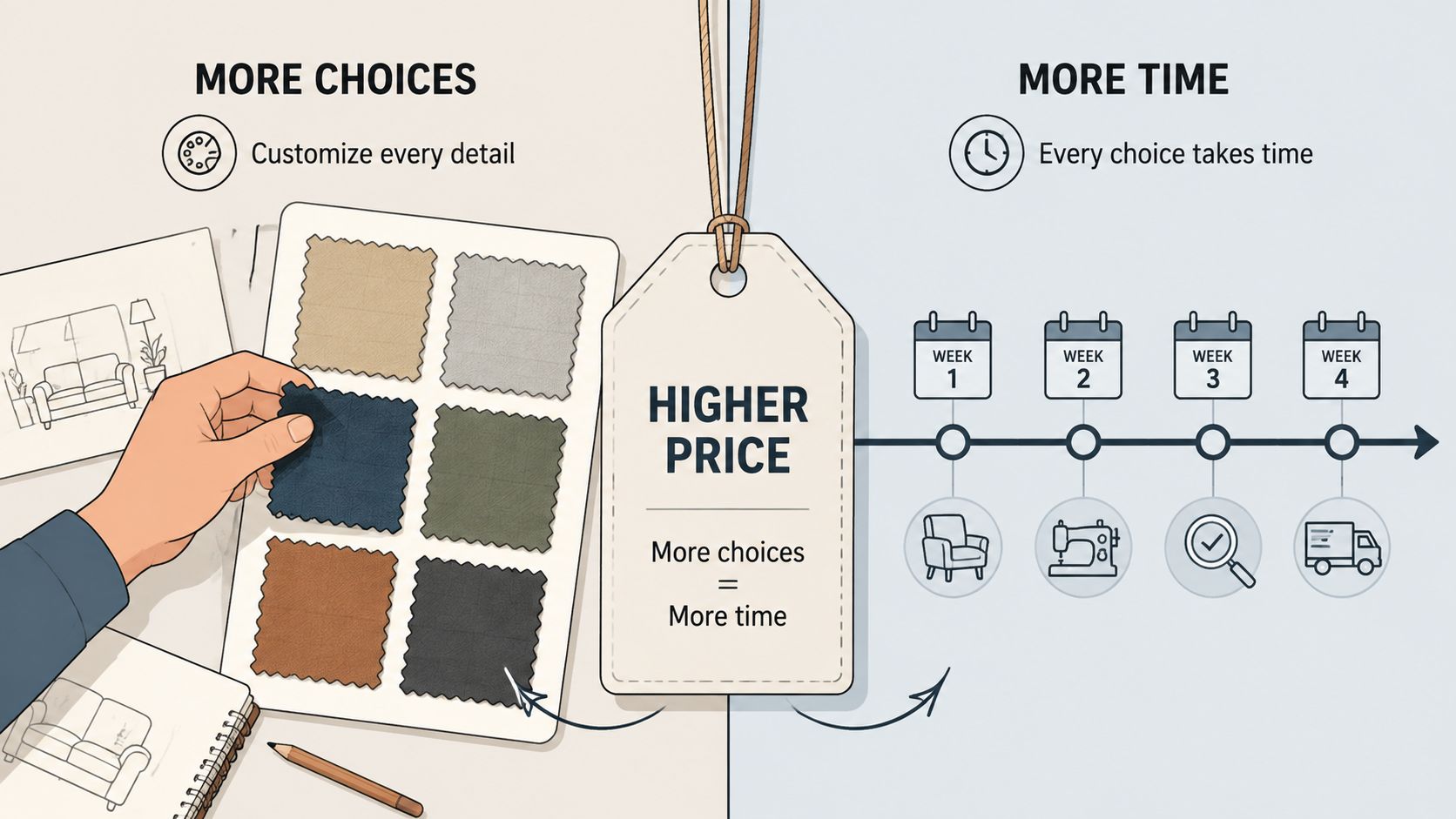
A custom sectional's price reflects more than its visible upholstery. Frame material, configuration size, cushion specification, labor, leather or fabric tier, and motion hardware all influence the final amount. Buyers should reject any decision framework that treats the lowest quote as the best value.
Prioritize the structure
The most valuable upgrades usually sit beneath the surface:
- First priority: Solid hardwood frame construction and reliable joinery.
- Second priority: Cushion core and suspension suited to daily use.
- Third priority: Upholstery selected for the household's workload.
- Later priority: Decorative details that can be changed less easily or add visual complexity without improving comfort.
A fixed budget still requires clear choices. A simpler configuration in solid hardwood with durable upholstery is usually a better investment than an oversized arrangement loaded with decorative options but compromised in structure. That principle applies whether the buyer chooses a stationary sectional, a power reclining layout, a swivel component, or a rocker and glider combination.
Accept the production reality
Custom furniture takes planning because the piece is made around a selected specification. Special-order fabrics, complex modular arrangements, and artisan-built hardwood frames can extend production schedules. The exact timeline must be confirmed with the retailer and maker before the order is signed.
Vinson's Custom Order Program supports fabric, finish, and configuration decisions for Smith Brothers, Canadel, and Mavin, with digital visualizers that help buyers review the result before production. Buyers should ask which selections are reversible, which changes trigger a new order, and when the final specification becomes fixed.
For immediate value, the Clearance Gallery offers savings of up to 70% on eligible floor samples, overstocks, and seasonal closeouts. For a custom order, the Low Price Guarantee provides a 110% refund of the difference when the stated local authorized-dealer conditions are met. Those programs address price differently, one through available inventory and the other through purchase assurance.
Working with an In-Store Design Studio
Online shopping can show upholstery colors and product dimensions, but it can't reproduce the sit-test, the texture of a top-grain leather hide, or the way a sectional relates to a room's actual sightlines. A professional design consultation turns those decisions into a coordinated plan.
Bring useful information
A productive appointment starts before the buyer arrives. The household should bring:
- Room measurements: Wall lengths, ceiling height, window placement, and delivery dimensions.
- Visual references: Photos of the room, existing hardwood pieces, flooring, and lighting.
- Material cues: Paint swatches, rug samples, curtain fabrics, or finish samples.
- Lifestyle notes: Pets, children, reclining habits, entertaining frequency, and preferred seat firmness.
The designer can then narrow the options instead of presenting an unmanageable wall of fabrics and configurations. A consultation should also test conflicts that buyers often miss, including a chaise crossing a walkway, a power mechanism approaching a wall, or a low back competing with a window.
Ask for specifications
A serious showroom conversation should include direct questions:
- What is the upholstery's abrasion rating?
- Which solid hardwood species is used in the frame?
- How are the corners and major joints reinforced?
- What suspension system supports the seats?
- What cushion composition and firmness options are available?
- Can the layout be reconfigured later?
- What are the delivery dimensions for each module?
Vinson Fine Furniture's In-Store Design Studio provides complimentary design consultations for space planning, fabric coordination, and finish selection. Its Custom Order Program includes 3D visualizers and material selection for brands such as Smith Brothers of Berne, Mavin, and Canadel. That combination is useful for buyers comparing a custom leather sectional in Columbus with a modular fabric arrangement, particularly when the room needs more than a standard sofa footprint.
A visit to the Easton showroom should be treated as a working appointment, not a sales performance. The buyer should sit in multiple depths, inspect motion features, handle samples, and leave with a documented specification.
Financing Terms and Delivery Planning
Judge financing by the total cost, not the monthly payment. Before approving a custom sectional, ask for the promotional APR terms, installment requirements, eligibility rules, fees, and total amount due if the promotional balance is not cleared on schedule. A lower monthly figure does not justify the wrong configuration or a poorly built frame.
Complete the pre-purchase checklist
Before signing the order, bring the room information and verify each item below:
- Schedule a complimentary design consultation.
- Bring room photos, measurements, paint samples, and a delivery-path sketch.
- Test seat depth, cushion firmness, reclining, swiveling, rocking, and gliding mechanisms in person.
- Review fabric or leather swatches in natural and artificial light.
- Confirm the frame species, joinery, suspension, cushion construction, and final configuration in writing.
- Measure every doorway, hallway, stairwell, and turning point.
- Review the order-change policy, estimated production schedule, warranty, and delivery terms.
Custom production schedules vary by maker and specification. Get the expected completion window in writing when the order is approved. Confirm that the delivery plan covers every module, not just the assembled sectional.
White-glove delivery is a defined premium service that typically includes in-home placement, assembly, and removal of packaging, as described in this white-glove furniture delivery guide. Clear the route before the crew arrives, remove fragile objects, and identify narrow turns or stair sections in advance.
For a custom sectional, the final approval should document the structure, configuration, production window, and delivery path. If any of those details remain verbal, pause the order until the retailer records them.
Bring the measurements, test the seating, and refuse to approve a custom sectional until its structure, financing terms, and delivery path are documented in writing.
Visit Vinson Fine Furniture at Easton Town Center for a sit-test, complimentary design consultation, and guidance through custom fabrics, finishes, solid hardwood construction, and power motion options. The showroom also offers its Custom Order Program, a 110% Low Price Guarantee, Clearance Gallery savings up to 70%, and White-Glove Delivery for a carefully planned sectional purchase.