How Much Is a Solid Wood Dining Table? a 2026 Price Guide


What does a solid wood dining table cost? Market benchmarks from Harman Furnishings' custom furniture cost guide put a straightforward oak or maple table around $500 to $1,500, walnut or cherry around $1,500 to $6,500, and artisan or bespoke work at $10,000 or more, with entry-level pine or rubberwood near $200 to $400.
The sticker price answers only part of that. What the higher price buys, and whether it lowers the cost of owning the table over time, matters more.
For a Columbus homeowner, the useful answer goes beyond the tag. A table has to fit the room, seat the household comfortably, take daily use, and stay serviceable once the finish wears. Compare quotes on like-for-like specifications, then divide price by years of service: a $1,500 table in use for 25 years runs about $60 a year, which changes how that sticker reads.
Solid Wood Dining Table Prices by Tier
The practical solid-hardwood shopping range starts with straightforward oak or maple and extends into individually commissioned work. The figures below are observed market benchmarks describing tables alone, not complete dining sets, and they give you a starting grid before you compare any two quotes.
Solid wood dining table price ranges
| Tier | Typical species | Typical price | Typical construction |
|---|---|---|---|
| Standard | Oak or maple | $500–$1,500 | Solid top and legs in standard sizes |
| Premium | Walnut or cherry | $1,500–$6,500 | Custom sizes or more detailed joinery |
| Artisan | Live-edge or bespoke hardwood | $10,000+ | One-of-a-kind, hand-finished |
A standard rectangular oak table with a straightforward apron and legs sits in the first tier. A cherry extension table built to a custom width illustrates the premium category. A sculptural walnut slab on a commissioned base belongs closer to artisan work, although live-edge styling alone doesn't establish a price tier.
The entry-level band from the opening is wider-market context. Vinson's dining room selection covers tables, chairs, buffets, and complete sets in a range of styles and finishes, with custom dining available through Canadel and Mavin.
Price gaps inside a single tier often come from board selection, stock thickness, base construction, and finishing rather than a visible change in silhouette. Inspect a lower-priced table before ruling it out, and ask a higher-priced table's maker to explain its construction. A table that stays serviceable through decades of daily use spreads its cost differently than one replaced early, which is why tier alone shouldn't drive the decision.
Practical rule: Confirm the species, solid-top construction, and usable seating capacity before treating two prices as comparable.
For homeowners replacing an existing dining set, DIYAuctions' guide can help find what your assets are worth. Keep that resale estimate separate from the replacement budget; an asking price isn't necessarily a completed-sale value.
What Pushes a Table Into a Higher Price Band
Wood species is the first meaningful decision. Oak and maple generally provide the accessible starting point among these hardwoods, while walnut and cherry carry a premium for their color and grain. Pay more for walnut when its grain and color are the reason you are buying it. Durability comes from construction, so a higher species price buys appearance rather than strength.
The walnut versus maple comparison helps separate appearance preferences from practical requirements.
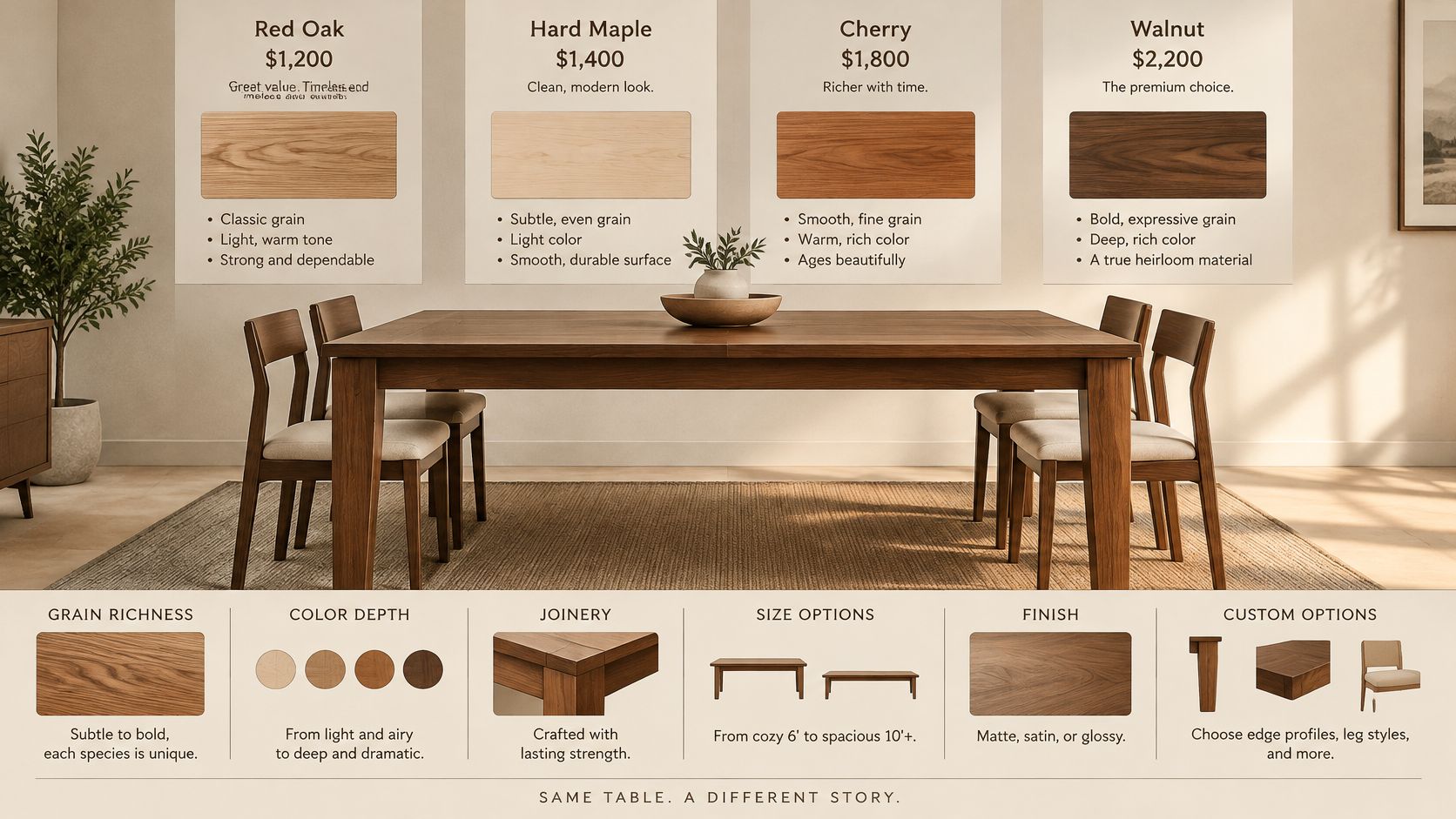
Other details deserve equal scrutiny:
- Top construction: Finished thickness, board selection, edge shaping, and the amount of usable lumber affect the work involved. A substantial-looking edge can conceal a thinner field, so confirm the actual thickness across the entire top.
- Joinery: Well-fitted mortise-and-tenon joints can provide a strong apron-to-leg connection. Proper dowel joinery can also perform well; the joint's execution matters more than its name.
- Finish: An oil finish and a film-forming finish have different maintenance and repair procedures. Ask how each one handles water rings, scratches, and spot repairs before you choose.
- Size and extensions: Longer tops, additional leaves, and extension hardware require more than extra surface area. The maker must also address support, alignment, and storage.
- Customization: An unusual width or carefully matched finish can solve a real room problem. Decorative changes that don't improve daily use are easier places to control spending.
Moisture preparation matters, too. A U.S. Forest Service finishing guide describes wood in most U.S. locations commonly equilibrating around 12% moisture content and warns that coatings generally can't be applied successfully when surface moisture exceeds approximately 20%. Those figures come from the guide's finishing context, and they give you a sensible reference point when a maker explains how a top was dried and sealed.
Harvested wood still moves with humidity. A sound table accommodates that movement through its construction, while rigid attachments are where cracks and splits begin.
When two quotes land in different bands, normalize the specifications before comparing sticker prices: same species, same confirmed top thickness, same extension hardware, same finish type. A table built to those specs costs more upfront, and divided across years of daily meals it often delivers the lower cost per year of use.
Where the Money Goes in a Custom Build
A custom table's price reflects both the lumber purchased and the hours required to turn it into finished furniture. Raw boards still need selection, milling, joining, shaping, sanding, and finishing. Offcuts, defects, and grain matching mean purchased material doesn't all become visible tabletop.
For a worked lumber example, take a table using roughly 30–50 board feet. At an assumed $8 per board foot, red oak for that build runs about $240–$400. Figured walnut or spalted maple, at an assumed $25 or more per board foot, puts the same quantity around $750–$1,250 or more before milling and waste. Use these as material math for comparing quotes; the price of a finished table adds labor, finishing, overhead, and margin on top.
Labor usually outweighs lumber in a custom quote. As an illustrative assumption, a standard build at 25–45 hours with shop rates around $55–$85 per hour produces approximately $1,375–$3,825 in labor before finishing, delivery, overhead, and margin. More labor-intensive builds can require 40–80 hours.
Material and labor cost components
| Cost component | Typical figure | What it means |
|---|---|---|
| Red oak lumber, 30–50 board feet | About $240–$400 | Raw wood at an assumed $8 per board foot, before milling |
| Figured walnut or spalted maple, 30–50 board feet | About $750–$1,250 or more | Raw wood at an assumed $25 or more per board foot |
| Standard custom build labor | 25–45 hours at $55–$85 per hour | Roughly $1,375–$3,825 before finishing, delivery, and margin |
| Complex build labor | 40–80 hours | Detailed joinery or finishing that adds hours |
| Species swap, maple to walnut, about 40 board feet | Roughly $240–$560 more | Material cost only, before overhead |
| 6-foot versus 5-foot table | About 30% more material and 20% more labor | Size drives both lumber and hours |
Those swaps and size differences explain why a modest dimensional change can create a meaningful quote adjustment. Treat them as planning ranges, since every maker prices shop time and waste differently.
Compare the same specification
Normalize the quotation before judging the total. Match length, width, finished thickness, species, moisture conditioning, edge treatment, finish system, and extension hardware. A wider walnut top with stored leaves isn't directly comparable to a fixed oak top, even when both seat the same household.
The long view pays off here, too. A table built to a matched specification and used daily for decades spreads its price across far more meals than a cheaper piece replaced after a few years, so cost per year of use often favors the better build. The guide to how much custom furniture costs provides additional context for evaluating made-to-order work.
The most useful pricing question is which materials, operations, and services the quoted total includes.
Matching Your Budget to Your Household
A household's routine should determine the table before a finish sample does. Daily seating, occasional guests, chair dimensions, and the path through the room all matter. An impressive tabletop becomes poor value if diners have to move furniture to get past it.
The following choices apply the market tiers to different households without assuming that a spending level guarantees a particular seating capacity.
- First-time buyers with a constrained budget: Start with a compact solid-oak or solid-maple table in the standard tier, including available clearance pieces. The likely compromise is a smaller top or fewer extension options. The deciding question is whether leaves are included or would require a separate purchase.
- Couples and smaller households: A standard fixed-top table often provides a more direct value proposition than an elaborate extension design. The trade-off is limited flexibility for larger gatherings. Confirm comfortable seating with the actual chairs, especially when arms or wide upholstered seats take up room.
- Families who host regularly: A premium-tier cherry, walnut, or custom-size maple table can justify its cost through a better room fit and useful extension capacity. Custom work may involve a longer wait. Finish-renewal instructions should be available before purchase, not discovered after damage occurs.
- Frequent hosts and heirloom buyers: Bespoke work suits a room that needs a particular scale, base arrangement, or distinctive board selection. The compromise is a more involved planning process. Delivery access, assembly, and leaf storage need to be settled alongside the design.
The guide to table shapes and seating arrangements helps connect those choices to the room rather than an isolated product photograph.
Chairs belong in the budget conversation. A table-only price doesn't furnish the entire dining space, and existing chairs may not clear a new apron or pedestal comfortably. Bring room measurements, chair dimensions, and the household's regular dinner count to the Easton showroom.
Why the Lowest Price Is Not Always the Lowest Cost
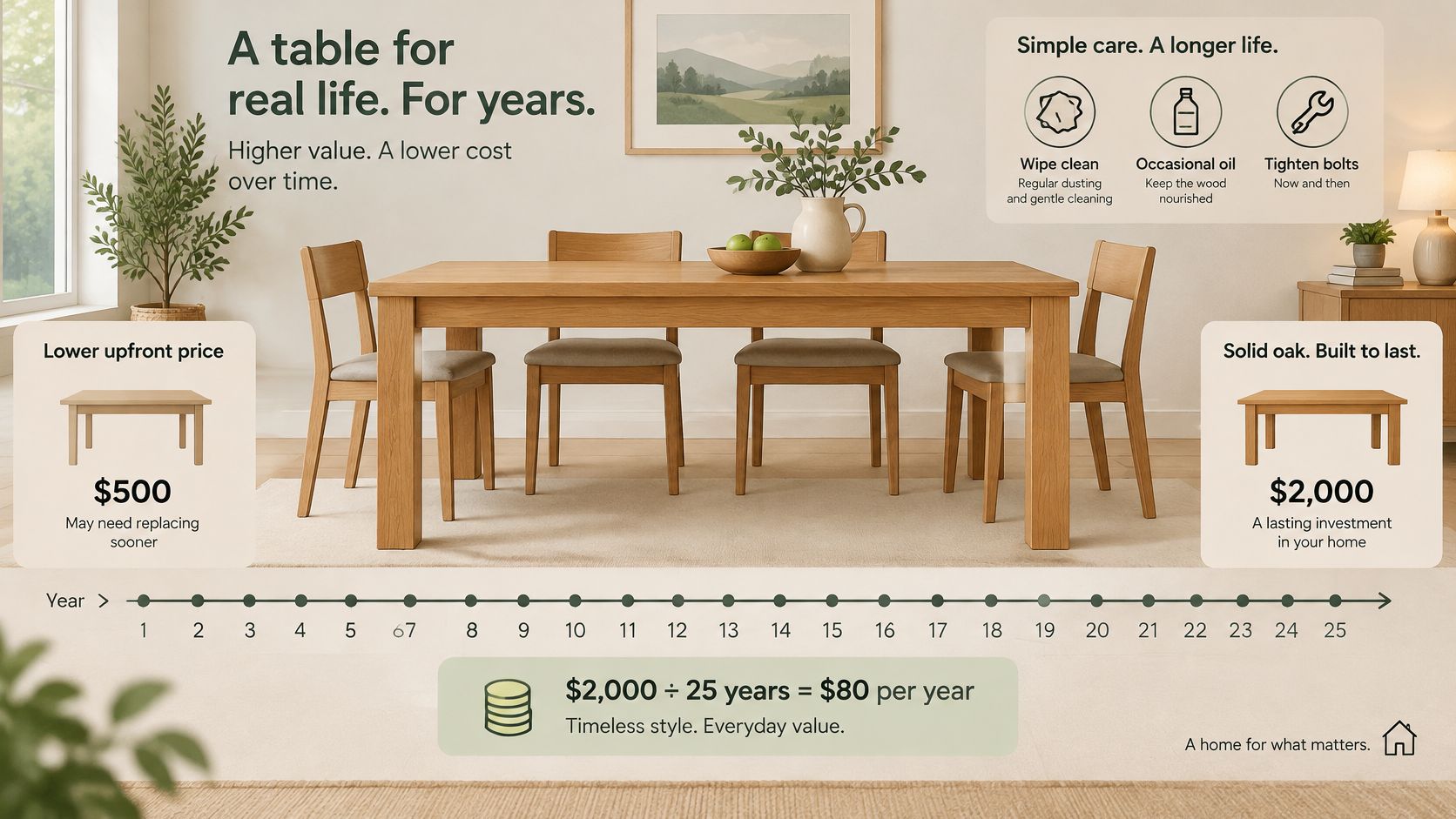
A $2,000 table used for 25 years costs about $80 per year before maintenance, the ownership example presented in Meltflex's furniture pricing guide. That calculation doesn't promise a lifespan; it shows how purchase price changes meaning when spread across useful service.
For a hypothetical comparison, replacing a $500 solid-oak table every five years requires five purchases totaling $2,500 over 25 years, or about $100 per year. The replacement schedule is an assumption for the calculation, not a forecast for all lower-priced oak tables.
Cost per year of ownership over 25 years
| Option | Purchase price | Years of use | Cost per year |
|---|---|---|---|
| One solid oak table, kept for life in this example | $2,000 | 25 years | About $80 per year |
| Solid oak table replaced every five years | $500 each, five purchases | 25 years | About $100 per year |
A higher purchase price doesn't guarantee lower ownership cost. A well-built standard table that remains useful can outperform a more expensive piece that doesn't fit the household's changing needs.
A fuller calculation adds delivery, set-up, maintenance, finish repairs, and eventual refinishing to the purchase price before dividing by expected years of use. Leaf storage also deserves consideration if it requires space the home doesn't have.
Solid hardwood can often be sanded and refinished, but the available thickness, existing damage, and finish determine the appropriate repair. Construction matters as well; the overview of wood joints used in furniture helps identify what supports long-term service.
Durability deserves attention independent of environmental marketing. An imm cologne article on durable design cites a representative German YouGov survey of 2,101 adults, in which 95.5% considered durability important or very important, compared with 65.3% for sustainability.
Ownership test: Write down expected service, likely repairs, and repairability before deciding which table offers better value.
Getting Real Value Through Clearance and Custom Orders
A clearance tag only lowers the cost per year if the table still fits the room, seats the household, and holds up under daily use. A floor sample in the right size can outperform a newly ordered table loaded with modifications nobody needed. A discounted table that blocks circulation or lacks the extension the family uses at holidays stays expensive no matter what the tag says.
- Clearance when the existing specification works: Vinson Fine Furniture's Clearance Gallery carries floor samples, overstocks, and seasonal closeouts at up to 70% off. The furniture floor-sample guide frames the inspection: surface condition, hardware operation, and exactly what accompanies the piece.
- Price protection on an equivalent item: The Low Price Guarantee refunds 110% of the difference when a shopper finds a lower price at a local authorized dealer within 30 days. Ask a consultant to confirm the qualifying item and terms before placing the order.
- Custom work when fit requires it: The Custom Order Program covers fabrics, finishes, and digital visualizers across partner lines. Mavin and Canadel handle custom dining, while Smith Brothers serves upholstered seating needs.
- Finish selection with a maintenance plan: Match the finish to the household's tolerance for upkeep. Get the renewal procedure during the consultation rather than choosing from a small stain sample alone.
- Design assistance before committing: Complimentary consultations in the In-Store Design Studio resolve scale, finish coordination, and layout questions before money changes hands.
The regional production base behind custom orders runs deep. U.S. Forest Service research on Ohio's Amish furniture industry identified nearly 500 establishments, including manufacturers, finishers, and distributors.
For homeowners weighing where a table is built, use origin as background, and let the in-person inspection decide the purchase. The Easton Town Center showroom makes that inspection possible before committing. My recommendation stands either way: price the custom build first, then compare it against clearance pieces on the same dimensions, leaf count, and finish. That side-by-side comparison shows the cost per year more clearly than either sticker price.
Confirm the Quote Before You Buy
The final buying decision should rest on a written specification. A showroom impression tells you how a table looks today; the paperwork tells you what you are paying for. Vinson Fine Furniture is family-owned, formerly Kitchen Tables & More, and serves Columbus and Central Ohio from its Easton Town Center showroom.
The written quote checklist
- Species and preparation: Record the species and grade, solid-hardwood top and edge construction, and how the lumber was kiln-dried and acclimated.
- Finished dimensions: Include the closed and extended dimensions, supplied leaves, and the seating arrangement the household needs.
- Construction and service: Identify the joinery, finish system, care requirements, and repair policy.
- Delivery and set-up: Confirm White-Glove Delivery arrangements, access requirements, assembly, placement, and packaging removal.
- Final price: Check the complete total against clearance pricing and the guarantee terms before signing.
Two quotes only compare cleanly when the specifications match. Normalize each bid to the same species, top thickness, leaf count, and finish system before weighing sticker prices, then divide each total by the years you expect the table to serve. That math turns a price tag into a cost per year, which is the figure worth comparing.
Households furnishing more than the dining room can coordinate adjoining pieces during the same visit through the Custom Order Program, including custom dining by Canadel and custom bedroom and dining lines by Mavin. Financing is available for qualified buyers, so bring the written quote into that conversation as well and settle payment terms before committing.
Call (614) 476-5858 ext.3 to plan the visit. Bring room measurements, a realistic seating requirement, and any competing quotes you want compared line by line. The best table is the one whose construction, fit, and complete cost still hold up on paper after inspection.
Vinson Fine Furniture carries dining tables, chairs, buffets, and complete dining sets in a range of styles and finishes, backed by custom-order guidance and complimentary design assistance. Visit Vinson Fine Furniture for the Design Quiz and current clearance information, then bring your room measurements to the showroom to finalize a written quote.